The 'War on Terror': Afghanistan & Iraq (AQA A Level History: Component 2: Depth study): Revision Note
Exam code: 7042

Summary
The 11 September 2001 attacks transformed Blair's foreign policy, drawing Britain into the US-led 'war on terror' against al-Qaeda
British forces joined the invasion of Afghanistan in October 2001
The Taliban government was removed, but the conflict continued, with British troops taking on a major role in Helmand from 2006
In March 2003, Britain joined the US-led invasion of Iraq
Blair justified intervention largely through claims about weapons of mass destruction (WMD), but no stockpiles were found
The invasion went ahead without a second UN resolution
Iraq became more politically damaging than Afghanistan
It triggered mass protest, ministerial resignations and growing criticism of how the government had made its case for war
The 'war on terror' also changed politics at home
New anti-terror laws and the 7/7 bombings in 2005 intensified debate over how far security measures should restrict civil liberties
The key question asks whether the 'war on terror' came to define Britain's world role after 2001, or whether it remained one part of a wider foreign policy that still included Europe, North Atlantic Treaty Organization (NATO), the UN and other global priorities
9/11 and the "war on terror"
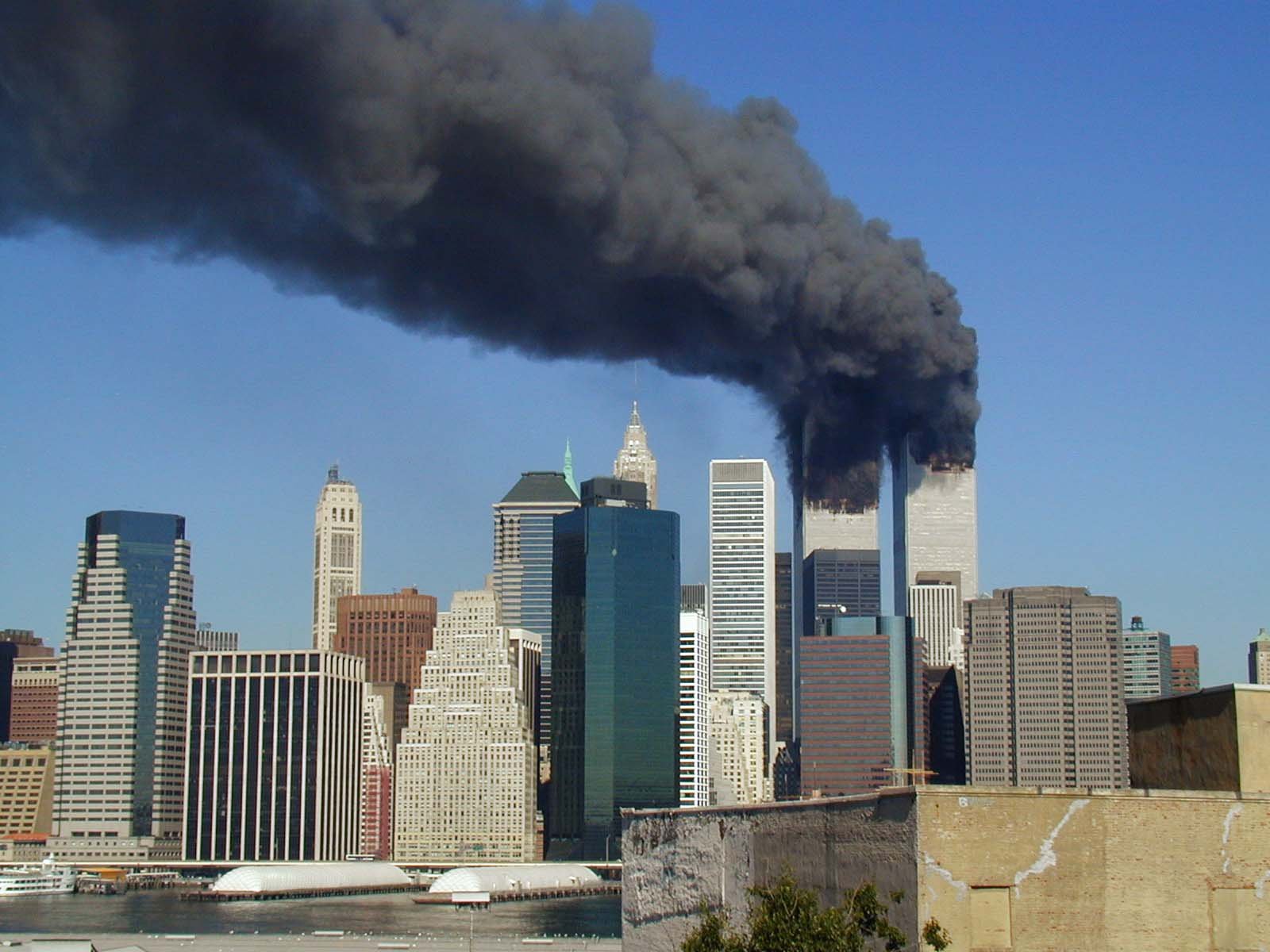
The attacks of 11 September 2001
On 11 September 2001, al-Qaeda terrorists hijacked four passenger planes in the USA
Two were flown into the World Trade Center in New York City
One hit the Pentagon in Washington, D.C.
The fourth crashed in Pennsylvania
Almost 3,000 people were killed, including 67 British citizens
Al-Qaeda was led by Osama bin Laden and was based in Afghanistan
The Taliban government allowed the organisation to train and operate there
Britain's response
Blair immediately backed the United States
On the day of the attacks, he said Britain would stand "shoulder to shoulder" with the USA
Parliament was recalled on 14 September 2001
Conservative leader Iain Duncan Smith gave the government his full support
NATO invoked Article 5 for the first time in its history
An attack on one member was treated as an attack on all members of the alliance
What did the 'war on terror' mean?
President George W. Bush declared a 'war on terror' against terrorist organisations and the states that supported them
It was not a war against one single country
It had no clear end point or goal
Britain committed itself to the campaign from the beginning
Blair also linked terrorism to WMD
He warned that terrorist organisations might try to obtain chemical, biological or nuclear weapons
This argument later became part of the case for war in Iraq
“Because the World Trade Centre was the home of many big financial firms, and because many of their employees are British, whoever committed these acts of terrorism will have murdered at least a hundred British citizens, maybe many more. Murder of British people in New York is no different in nature from their murder here in the heart of Britain itself. In the most direct sense, therefore, we have not merely an interest, but an obligation to bring those responsible to account. ... Our objective will be to bring to account those who have organised, aided, abetted and incited this act of infamy; and those who harbour or help them have a choice: either to cease their protection of our enemies or be treated as an enemy themselves”
Tony Blair, Prime Minister, statement to the House of Commons, recalled after the 9/11 attacks, 14 September 2001
Approach: The source is useful because it shows how he explained Britain’s response at the time:
the attacks had killed British citizens as well as Americans
Britain had a duty to help bring those responsible to justice
It is a public statement made during a national crisis, so it is useful for showing Blair’s stated aims and tone, rather than proving what later policy would achieve
Examiner Tips and Tricks
Do not treat 9/11 as the start of Blair’s use of military force abroad. Britain had already intervened in Kosovo and Sierra Leone
The key change after 9/11 was that British foreign policy became tied much more closely to the US-led ‘war on terror’
The war in Afghanistan, 2001
Why did Britain go to war?
The Taliban refused US demands to hand over Osama bin Laden
On 7 October 2001, US and British forces began air and missile strikes on Afghanistan
Targets included al-Qaeda training camps and Taliban military sites
British submarines fired Tomahawk cruise missiles
The intervention had broad international backing
NATO, Russia and Pakistan supported the action
No frontbench MP spoke against it in the Commons debate on the 8th October 2001
The fall of the Taliban
Afghan opposition forces, supported by US and British air power, captured Kabul in November 2001
The Taliban government lost power within weeks
Bin Laden and senior Taliban leaders escaped
A new government under Hamid Karzai was established in December 2001
The UN created the International Security Assistance Force (ISAF) to help keep order in Kabul
Britain led the first ISAF force from December 2001
NATO took command of ISAF in August 2003
A longer war
Progress towards a stable Afghan government remained slow
From 2002, attention in Britain and the USA increasingly shifted towards Iraq
Critics argued that this gave the Taliban time to recover
In 2006, British forces were deployed to Helmand province in southern Afghanistan
They faced heavy fighting against a revived Taliban
By 2007, British troops were fighting in both Afghanistan and Iraq
“Our argument is not with the Afghan people. They are victims of the Taliban regime. They live in poverty, repressed viciously, women denied even the most basic human rights, and subject to a crude form of theocratic dictatorship that is as cruel as it is arbitrary. ... I repeat: we will not walk away from them once the conflict ends, as has happened in the past. We will stand by them and help them to a better, more stable future under a broad-based Government involving all the different ethnic groupings”
Tony Blair, Prime Minister, statement to the House of Commons the day after air strikes on Afghanistan began, 8 October 2001
Approach: The source is useful because it sets out the government’s stated aims:
the Taliban, rather than the Afghan people, was presented as the enemy
Britain promised to support Afghanistan after the fighting ended
Because the statement was made at the beginning of the war, it shows what the government intended, not what the intervention eventually achieved
Examiner Tips and Tricks
Keep the short war of 2001 separate from the longer conflict that followed
The Taliban government fell quickly, but fighting continued, and British forces later faced a much harder campaign in Helmand from 2006. This distinction is useful when judging how successful the intervention was
The Iraq War, 2003
Background
Saddam Hussein remained in power after the Gulf War of 1990-91
UN weapons inspectors continued searching Iraq for WMD
Iraq was accused of obstructing inspections
The inspectors left in December 1998
Britain and the USA then bombed Iraqi weapons sites in Operation Desert Fox
After 9/11, the Bush administration made regime change in Iraq a major aim
Blair agreed that Saddam remained a threat
He also pushed for action to go through the UN Security Council (UNSC)
The case for war
In September 2002, the British government published a dossier on Iraq's weapons
It claimed that some chemical and biological weapons could be prepared for use within 45 minutes of an order
Blair presented the September 2002 dossier, with his own foreword, to a recalled House of Commons on 24 September 2002
In November 2002, UN Resolution 1441 gave Iraq a final opportunity to disarm
UN weapons inspectors returned under Hans Blix
By early 2003, Britain and the USA argued that Iraq was still not cooperating fully
A second dossier published in February 2003 was later found to contain material copied from older sources
It became known as the "dodgy dossier"
In March 2003, the Attorney General advised that the war could be legal under existing UN resolutions
Britain then tried to secure a second UN resolution authorising force
France said it would veto a resolution containing an ultimatum
The attempt for a resolution was abandoned in March 2003
Opposition at home
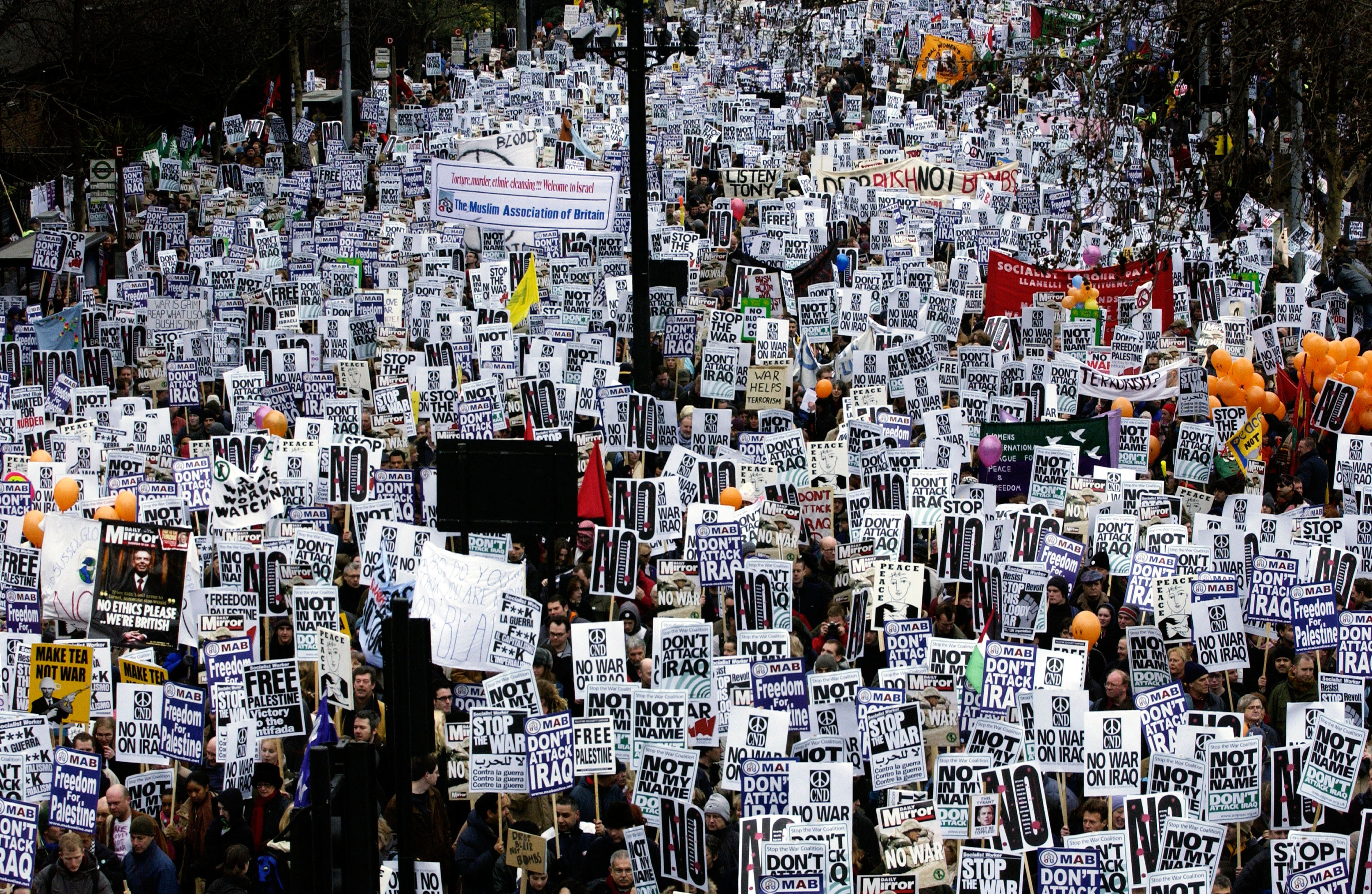
Opposition to the war was widespread
On 15 February 2003, the Stop the War Coalition organised a huge march in London
Estimates ranged from about 750,000 to 2 million
Robin Cook resigned from the Cabinet on 17 March 2003
He had been Foreign Secretary and was then Leader of the House of Commons
On the 18 March 2003, the Commons backed military action by 412 votes to 149
139 Labour MPs backed a rebel amendment opposing military action, and 84 voted against the main motion
Clare Short resigned in May 2003
Invasion and occupation
The US-led invasion began on 20 March 2003
British forces operated mainly in southern Iraq around Basra
Baghdad fell on 9 April
Saddam's government collapsed soon afterwards
The military campaign was short, but the occupation became much more difficult
An insurgency developed against coalition forces
Violence also grew between Sunni and Shia groups
Photographs of prisoner abuse at Abu Ghraib in 2004 damaged the coalition's reputation
No WMD stockpiles were found
Questions about the case for war
After the invasion, the government faced growing criticism over how it had presented the intelligence on Iraqi WMD
In May 2003, BBC journalist Andrew Gilligan claimed that the September 2002 dossier had made the threat from Iraq sound more certain and alarming than the intelligence justified, calling it 'sexed up'
Downing Street's Director of Communications, Alastair Campbell, denied the claim and attacked the BBC in evidence to the Commons Foreign Affairs Committee in June 2003
Gilligan's source was later identified as a government weapons expert Dr David Kelly
Kelly died in July 2003 after becoming caught up in the public dispute
The Hutton Inquiry investigated the circumstances surrounding Kelly's death and reported in January 2004
It cleared the government of deliberately inserting false information into the dossier
It strongly criticised the BBC
The Butler Review, published in July 2004, looked more widely at the intelligence used before the war
It found that intelligence on Iraq's WMD had been unreliable
It also found that the evidence had been presented with greater certainty than it could support
The failure to find WMD in Iraq kept the government's original case for war under scrutiny
Britain in Iraq by 2007
British forces remained in southern Iraq throughout the period
In October 2007, Gordon Brown announced that troop numbers would be reduced to 2,500
Basra was handed over to Iraqi control in December 2007
“I have chosen to address the House first on why I cannot support a war without international agreement or domestic support. ... The reality is that Britain is being asked to embark on a war without agreement in any of the international bodies of which we are a leading partner, not NATO, not the European Union and, now, not the Security Council
To end up in such diplomatic weakness is a serious reverse”
Robin Cook, Labour MP and former Foreign Secretary, personal statement to the House of Commons after resigning as Leader of the House, 17 March 2003
Approach: The source is useful because he explained his opposition in terms of international legitimacy:
there was no second UN resolution
Britain risked going to war without agreement from key international bodies
Cook had served as Foreign Secretary, so he had direct knowledge of the diplomacy. His resignation also meant he was defending a personal decision, so the source should be read as a strong critique of government policy rather than a neutral summary
“Those two threats have, of course, different motives and different origins, but they share one basic common view: they detest the freedom, democracy and tolerance that are the hallmarks of our way of life. At the moment, I accept fully that the association between the two is loose, but it is hardening. The possibility of the two coming together, of terrorist groups in possession of weapons of mass destruction or even of a so-called dirty radiological bomb, is now, in my judgment, a real and present danger to Britain and its national security”
Tony Blair, Prime Minister, speech opening the Commons debate on military action against Iraq, 18 March 2003
Approach: The source is useful because it shows how he linked the threats from terrorism and WMD
Blair acknowledged that the connection between the two was “loose”, but argued that the possibility of terrorists gaining WMD created a danger to Britain. The source therefore shows the government’s case for war at the point when Blair was trying to win parliamentary support
Examiner Tips and Tricks
AQA does not require you to compare sources, so judge the value of each in turn. Cook and Blair spoke a day apart on the same issue, so setting one against the other can still help you test what each emphasises and what each leaves out
The domestic impact of the 'war on terror'
New security laws
The Anti-terrorism, Crime and Security Act (2001) allowed foreign terror suspects to be detained without trial
Many were held at Belmarsh prison in London
A group of detainees challenged the law, leading to the 2004 Law Lords ruling that the system was incompatible with human rights law
The Prevention of Terrorism Act (2005) replaced detention with control orders
Suspects could face restrictions such as curfews, electronic tagging and limits on who they could contact
These restrictions could be imposed without a criminal conviction
The 7/7 bombings, 2005
On 7 July 2005, four suicide bombers attacked three Underground trains (tubes) and a bus in London
52 people were killed
Three of the four bombers had been born in Britain
In a video released in September 2005, bomber Mohammad Sidique Khan blamed the actions of Western governments, including Britain
On the 21 July, another group attempted similar attacks in London
The bombs failed to explode
The following day, police shot dead Jean Charles de Menezes, a Brazilian man who had been wrongly identified as a suspect
The Terrorism Act (2006)
After 7/7, the government asked Parliament to allow terror suspects to be held for up to 90 days without charge
On the 9 November 2005, the Commons rejected the proposal by 322 votes to 291
It was Blair's first Commons defeat as Prime Minister
Parliament agreed to a maximum of 28 days instead
The Terrorism Act (2006) also created offences connected with encouraging or glorifying terrorism
The Identity Cards Act (2006) introduced national ID cards
The government argued that they would help improve security and tackle terrorism
Political debate and civil liberties
The new laws led to arguments over how far the government should go in the name of national security
Ministers argued that the scale of the terrorist threat required stronger powers
Civil-liberties groups argued that some measures went too far
Parliament and the courts both placed limits on government policy
The Belmarsh ruling challenged detention without trial
The Commons rejected the proposed 90-day detention period
The political cost
The Iraq War had already damaged trust in Blair's government
The failure to find WMD led critics to accuse ministers of exaggerating the threat
The domestic war on terror added an argument over the balance between security and individual rights
By the mid-2000s, foreign policy and domestic security had become closely linked in public debate
“There is a compelling case for extending the current 14-day period. The police and the prosecution service have come clearly and unequivocally to the view that in their professional judgment 90 days is the appropriate time. ... I am making the point simply and straightforwardly that we should take the professional judgment of the police, who actually deal with situations such as the one at Russell Square tube station, and the advice of the prosecutors extremely seriously”
Charles Clarke, Home Secretary, speech in the Commons debate on the Terrorism Bill, before the vote on 90-day detention, 9 November 2005
Approach: The source is useful because it sets out the government’s case that the police needed more time to investigate complex terrorism cases
As Home Secretary, Clarke was defending his own policy and relied heavily on police advice, so the source is strongest for showing the government’s argument for stronger powers, not whether 90 days was necessary
Examiner Tips and Tricks
Link the domestic impact back to foreign policy. The government argued that the terrorist threat at home justified stronger security measures, while critics argued that British actions abroad had increased the danger
Use the Belmarsh ruling and the 90-day detention defeat to show that the government did not have a free hand. Both the courts and Parliament placed limits on how far anti-terror powers could go
How far did the 'war on terror' define Britain's world role?
The question asks whether the 'war on terror' became the main feature of Britain's international role after 2001, or whether it remained one part of a wider foreign policy
Some evidence for each side is outlined below
Evidence that the 'war on terror' defined Britain's world role
Britain became deeply involved in two major conflicts after 2001
British forces fought in both Afghanistan and Iraq
The relationship with the USA became even more central to foreign policy
Blair strongly supported the US-led response to terrorism
Iraq showed how closely Britain was prepared to act alongside Washington
Britain joined the invasion without a second UN Security Council resolution
The consequences of the wars shaped politics well beyond the battlefield
The failure to find WMD damaged trust in the government
The 7/7 bombings brought the terrorist threat directly into Britain
Security policy at home also changed
New anti-terror laws, control orders and longer detention powers became major political issues
Evidence that the 'war on terror' was only one part of Britain's role
Britain still tried to work through international organisations
Blair pushed for UN Resolution 1441 before the Iraq War
Afghanistan involved both the UN and NATO
Britain did not automatically support every US policy
Blair later criticised Guantanamo Bay
By 2007, the British government had stopped using the phrase 'war on terror'
Britain's military commitment in Iraq was already being reduced by 2007
Other foreign-policy priorities continued alongside the wars
Britain remained active in Europe
Blair promoted aid to Africa and action on climate change
Parliament and the courts also limited government power at home
The Belmarsh ruling challenged detention without trial
MPs rejected the proposed 90-day period
Examiner Tips and Tricks
A strong answer should separate military importance from overall foreign policy
The ‘war on terror’ clearly dominated Britain’s military commitments after 2001, but that does not automatically mean it defined Britain’s whole world role. Test it against what continued alongside it, such as:
Britain’s role in Europe
its place in NATO and the UN
the G8 focus on aid to Africa and climate change
The best judgement is likely to distinguish between what dominated Britain’s attention and what fundamentally changed Britain’s international position

Unlock more, it's free!
Join the 100,000+ Students that ❤️ Save My Exams
the (exam) results speak for themselves:

Was this revision note helpful?
