Anti-Semitism & the Persecution of the Jews, 1933–1938 (AQA A Level History: Component 2: Depth study): Revision Note
Exam code: 7042

Summary
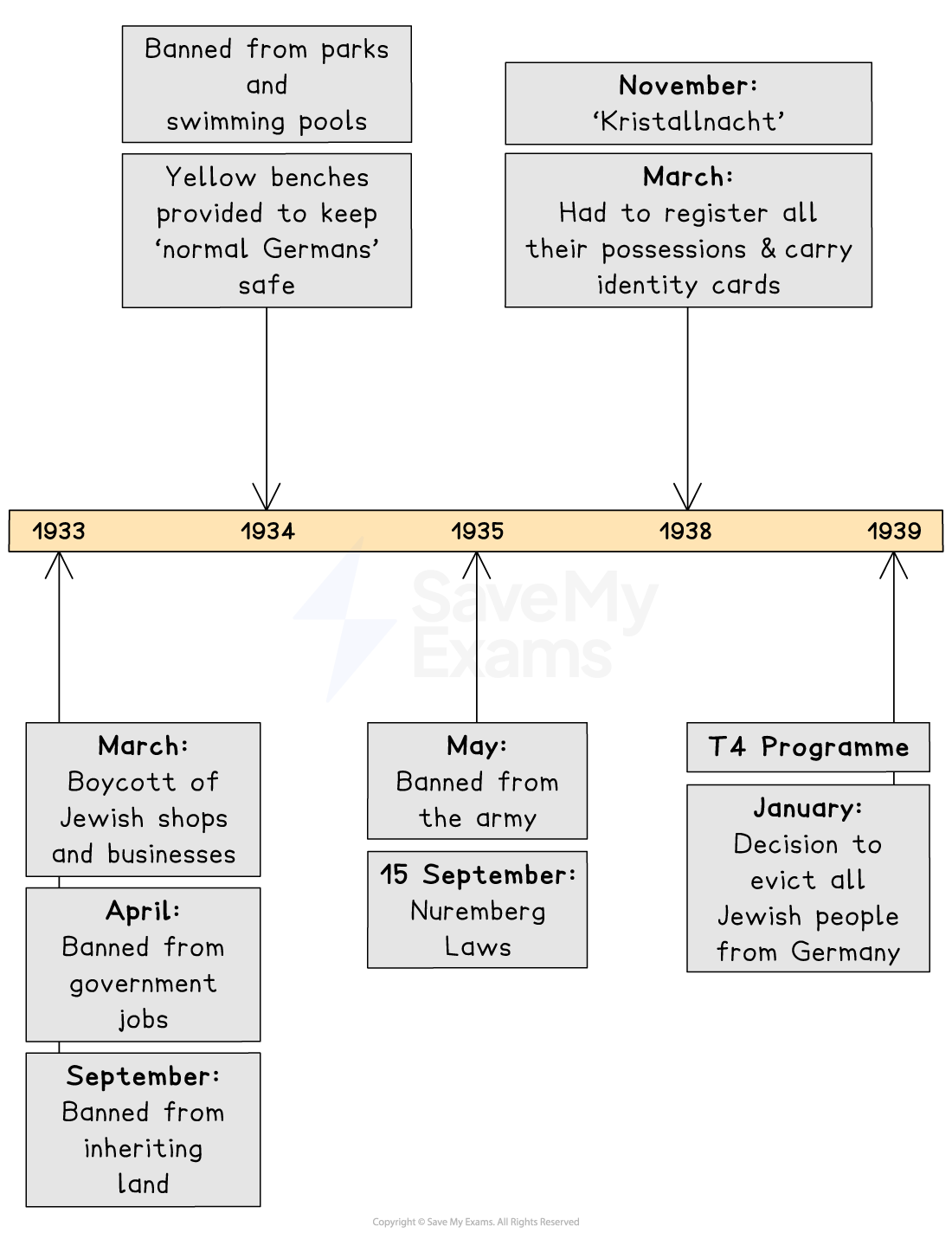
Jewish people faced increased discrimination and persecution throughout the 1930s in Germany
Beginning with the boycotts of 1933, the Nazis soon stripped away the German citizenship of thousands of Jewish people through the Nuremberg Laws of 1935
Following 'Kristallnacht' in 1938, Jewish communities were no longer safe in Germany
After Germany invaded Poland in 1939, millions more Jewish people came under Nazi control
The Nazis explored the possibility of forcing millions of European Jewish people to move to the African island of Madagascar
The failure of Germany to defeat Britain meant the Nazis did not have control of the seas to make this a realistic plan
The boycott of Jewish shops, 1933
A boycott of Jewish shops throughout Germany took place in April 1933 and was enforced by the SA
SA members stood outside Jewish businesses and intimidated people into not entering
The boycott only lasted one day and, despite a coordinated propaganda campaign, it was not viewed as successful
Many people defied or ignored the SA and used the Jewish shops anyway
The SA struggled to identify which businesses were Jewish-owned
"We do not subscribe to the view that Herr Hitler and his friends, now finally in possession of the power they have desired for so long, will enact the proposals circulating in the Angriff or the Völkischer Beobachter newspapers[1] (opens in a new tab); they will not suddenly divest German Jews of their constitutional rights, lock them away in race ghettos, or subject them to the avaricious and murderous impulses of the mob. They not only cannot do this because many other crucial factors hold their powers in check, ranging from the Reich president to some of the political parties affiliated with them, but they also clearly do not want to go this route, for when one acts as a European world power, the whole atmosphere is more conducive to ethical reflection upon one’s better self than to revisiting one’s earlier oppositional role: operating as a European world power means that one seeks an enduring place in the harmonious exchange of peoples of culture."
An extract from Der Israelit, a newspaper written by and for German Jewish people. This article was published on 2nd February 1933, shortly after Hitler had been appointed Chancellor.
The Nuremberg Laws, 1935
In April 1933, the Nazis passed the Law for the Restoration of the Professional Civil Service
This required all Jewish people to be dismissed from the Civil Service
Hindenburg insisted that German Jewish people who had served in the First World War or whose fathers had died in the war were exempted
This exemption was ended after Hindenburg died in 1934
The Nazis passed other anti-Semitic laws in 1933, including the Law Against the Overcrowding of German Schools and Universities
This restricted the number of Jewish students who could attend state schools and universities
The Reich Press Law also gave the Nazis the right to remove Jewish journalists from their jobs
One of the effects of the boycott and these laws was to encourage around 37,000 Jewish Germans to emigrate by the end of 1933
1. Civil servants of non-Aryan descent are to be retired; honorary officials are to be removed from official status.
2. Section 1 does not apply to civil servants who were already employed on August 1, 1914, or who fought during the World War at the front for the German Reich or who fought for its allies or whose fathers or sons were killed in the World War. With the agreement of the appropriate special minister or the highest authorities of the federal states, the Reich Minister of the Interior can permit further exceptions in the case of officials who are abroad.3.
Civil servants whose former political activity affords no guarantee that they will act in the interest of the national state at all times and without reservation can be dismissed from service. They are to be accorded their former salary for a period of 3 months after their dismissal. Thereafter, they will receive ¾ of their pension and corresponding survivor’s benefits.An extract from Law for the Restoration of the Professional Civil Service, 7th April 1933.
However, the German Jewish people that remained were to face even worse legal discrimination when the Nuremberg Laws were introduced in September 1935
These included:
The Reich Citizenship Law
This removed German citizenship from all those who could not prove they had 'pure' German blood
Jewish people and those who were unable to prove their ancestry became subjects rather than citizens
Subjects had fewer legal rights than citizens but still had to pay taxes
The First Supplementary Decree on the Reich Citizenship Law was introduced in November 1935
This legally classified people as being 'full-Jews' if they had three Jewish grandparents or, if they were married to a Jewish person, two Jewish grandparents
People with some Jewish ancestry were classified as 'half-Jews' or 'Mischlinge' and suffered prejudice but had more legal rights than people classified as 'full-Jews'
The Law for the Protection of German Blood and Honour
This made marriage and sexual relations between Aryans and non-Aryans illegal and punishable by imprisonment
In addition to serving time in prison, many Jewish people were sent to concentration camps once their sentences were complete
The effect of the Anschluss, 1938
The Anschluss is the name given to the unification of Germany and Austria, which took place in March 1938
Although the Nazi occupation of Austria was not violent, the treatment of Austria's Jewish population marked a new level of persecution
It brought approximately 180,000 Austrian Jews under Nazi control
Adolf Eichmann set up the Central Office for Jewish Emigration in Vienna, later expanded into the Reich Central Office
The process of identifying and stripping Austrian Jewish people of their rights and property emboldened the Nazis into even more severe treatment of Jewish people throughout Germany
Under the Decree of Registration of Jewish Property, Jewish people had to register all property they owned
The state was then legally able to confiscate all Jewish-owned property with a value over 5000 marks
From October 1938, all Jewish people had to have their passports marked with the letter 'J'
From November 1938, all Jewish people lost their entitlement to all state benefits, such as pensions
From January 1939, all Jewish people who had first names that were deemed to be non-Jewish were forced to change them
All Jewish males had to take the name Israel, and females had to take the name Sarah
Kristallnacht, 1938 (Night of Broken Glass)
Kristallnacht, which took place on the night of the 9th and 10 November 1938, marked the change from the legal discrimination against Germany's Jewish population to state-organised violence
The murderous attack was triggered by the killing of Ernst vom Rath, a German diplomat, by Herschel Grynszpan, a Polish-Jewish teenager whose family had been deported from Germany
In response, Joseph Goebbels coordinated a wave of violence throughout Germany that the Nazis presented as spontaneous
Reinhard Heydrich issued the orders to the SA, SS and police
Police and fire brigades were ordered not to intervene unless the property of non-Jewish people came under threat
According to official records over the course of the night:
91 Jewish people were murdered and thousands more injured
191 synagogues were destroyed
814 Jewish-owned shops were destroyed
These are likely to be underestimates, modern estimates suggest around 267 synagogues were destroyed and 7,500 businesses attacked
In the days that followed, more than 30,000 Jewish people were arrested
Many were sent to concentration camps where large numbers died
Insurance companies were prevented from paying compensation to their Jewish customers who had paid for cover
The Decree for Restoration of the Street Scene was issued on 12 November 1938 and ordered that the Jewish community had to pay a fine of 1 billion Reichsmarks to cover the cost of repairs
Jewish emigration and the Madagascar Plan
Between March 1933 and November 1938, the anti-Semitic laws and policies of the Nazis led to 150,000 Jewish people leaving Germany
After the violence and murder of Kristallnacht, German Jewish people became even more keen to leave
However, few foreign countries were keen to accept large numbers of Jewish refugees, so emigration was difficult
In desperation to secure the safety of their children, some Jewish parents sent them abroad alone
In 1938 and 1939, around 9,000 Jewish children were allowed to enter Britain as part of the Kindertransport scheme
The Madagascar Plan
The prejudice, discrimination, and violence that the Nazis inflicted on Germany's Jewish population meant that the Nazis had almost achieved their aim of removing all Jewish people from Germany by 1939
However, the invasion of Poland in September 1939 meant that the number of Jewish people living under Nazi control suddenly increased massively
After France was defeated by Germany in June 1940, France and its Empire came under the control of the Nazis
Madagascar, a large island of Africa's east coast, was part of the French Empire
The Nazis began to explore the possibility of the forced migration of over 4 million European Jewish people to Madagascar
The failure to defeat Britain meant that the Royal Navy would have remained a threat and would have been able to intercept the large numbers of ships needed to transport such enormous numbers of people
This led to the Madagascar Plan being quickly abandoned
How did anti-semitic policy develop, 1933–1938?
The legal discrimination against Germany's Jewish population began almost immediately upon Hitler coming to power
This discrimination then escalated with each passing year
The Nuremberg Laws of 1935 stripped Germany's Jewish people of many rights
The Anschluss of March 1938 marked an intensification of the legal persecution of Germany's Jewish people
Kristallnacht in November 1938 marked the start of state-organised violence, bloodshed and murder against Germany's Jewish population
Examiner Tips and Tricks
The strongest answers about Kristallnacht show Goebbels and Heydrich orchestrated it, and cite evidence that ordinary Germans were bewildered and disturbed by it, whereas weaker answers describe Kristallnacht as a spontaneous outburst of popular anger.
Examiners want 1938 explicitly identified as a turning point rather than 1933-41 treated as one uniform block of persecution.

Unlock more, it's free!
Join the 100,000+ Students that ❤️ Save My Exams
the (exam) results speak for themselves:

Was this revision note helpful?
