The Affluent Economy, 1951-1964 (AQA A Level History: Component 2: Depth study): Revision Note
Exam code: 7042

Summary
Britain enjoyed a post-war boom, with full employment, rising wages and a surge in spending on cars, homes and household goods
Growth rested on the post-war consensus and worldwide recovery, but it was slower than in West Germany, Japan and much of Europe
The economy kept hitting balance of payments problems, as imports and wage rises outran exports and productivity
Governments responded with stop-go policies, boosting demand and then slowing it with higher taxes, bank rate rises and credit squeezes
Sterling crises kept returning, from the 1956 run on the pound to the 1961 crisis that led to the pay pause, and the stop-go cycle was never broken
The key question is whether the British economy in 1951–1964 was fundamentally healthy or held back by weakness relative to its competitors
The post-war economic boom
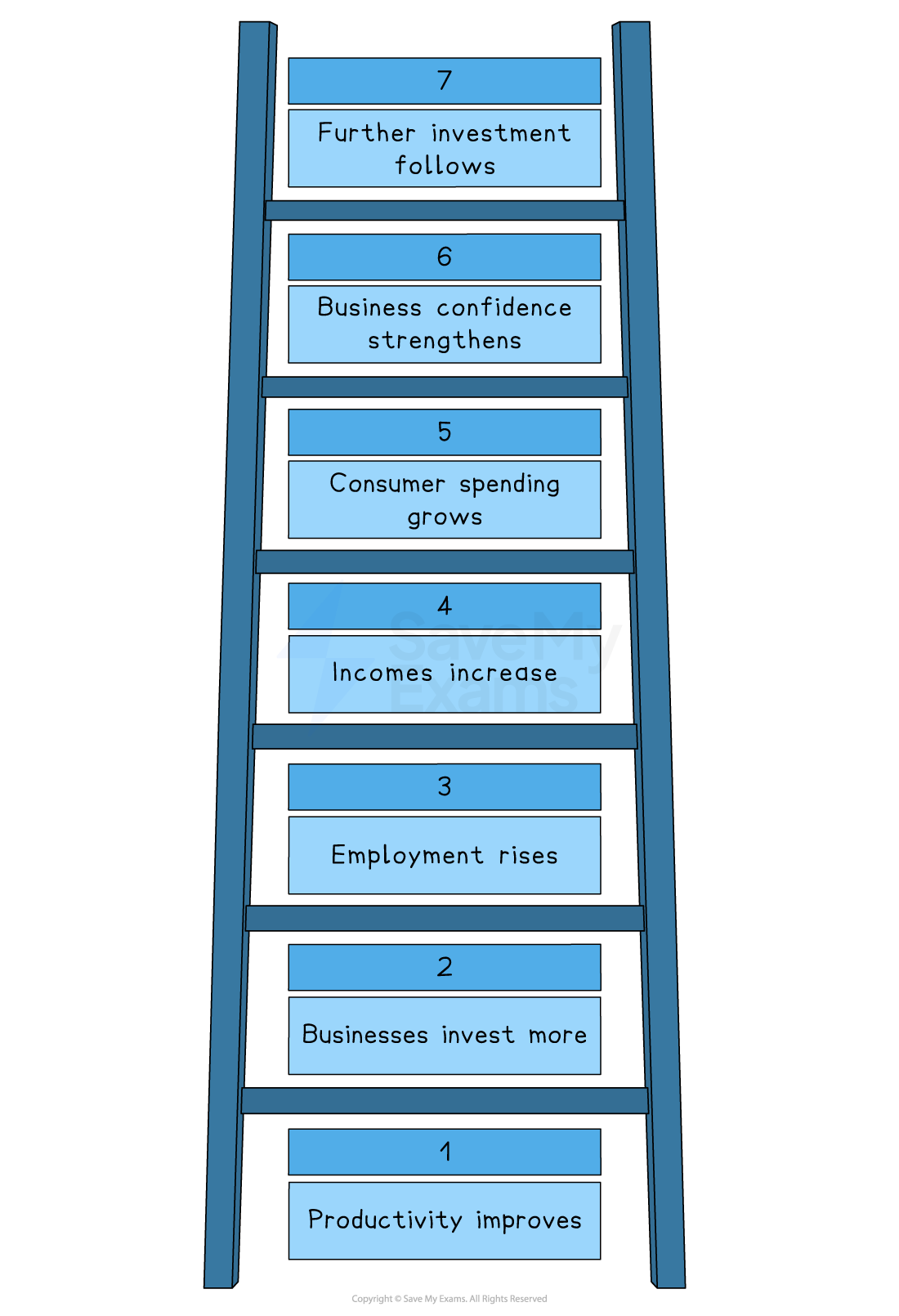
The roots of the boom
The 1950s brought a long economic boom across the Western world
Britain shared in worldwide recovery and growing trade after 1945
Both main parties backed the post-war consensus of full employment, the welfare state and a mixed economy
A rising population fed demand
The post-war baby boom meant more households, more spending and a wider variety of jobs
Full employment gave many families a steady income for the first time in a decade
Rising wages and consumer spending
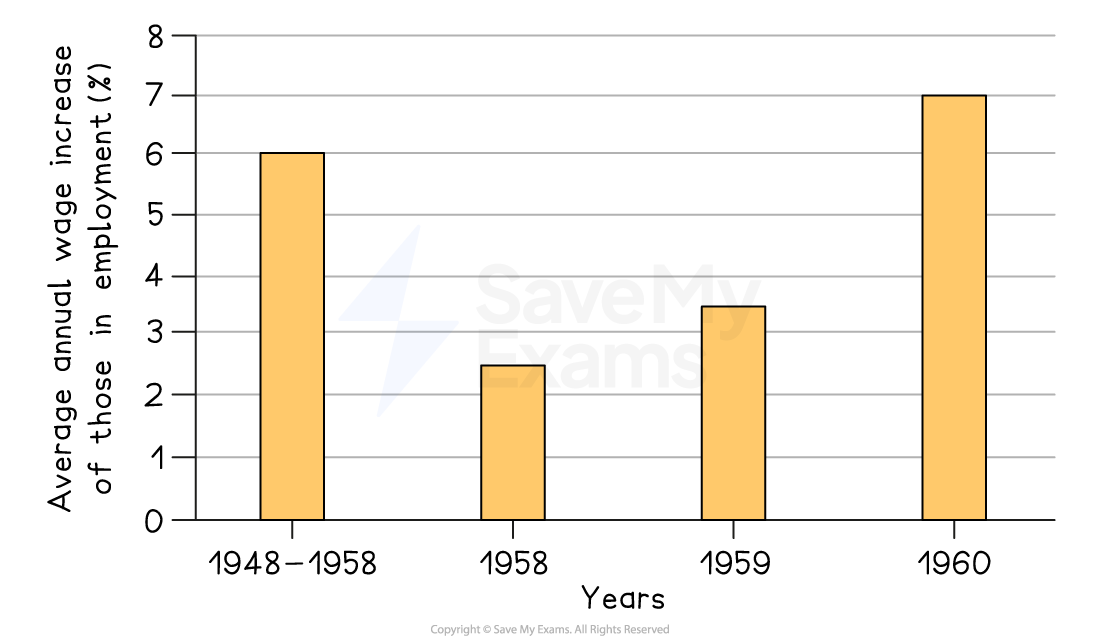
Real wages rose through the decade
Average weekly money wages roughly doubled, from about £8 in 1951 to about £15 by 1961, well ahead of prices
For many, this was the first real rise in living standards since the 1930s
Consumer goods spread into ordinary homes
Cars, televisions, fridges and washing machines became affordable
Car ownership rose by around 25% between 1957 and 1959
New motorways, beginning with the Preston bypass in 1958 and the M1 in 1959, encouraged further car use
Hire purchase and the end of rationing fuelled spending
Buying on instalments allowed families to own goods before they could fully afford them
Rationing ended in 1954, lifting the last wartime limits on consumption
Not everyone credited the government
Labour insider Douglas Jay later argued the Conservatives had "coasted along into the economically easy years of the 1950s", built on the tough post-war policies of the Attlee governments
"Let us be frank about it, most of our people have never had it so good. Go around the country, go to industrial towns, go to the farms, and you will see a state of prosperity such as we have never had in my lifetime – nor indeed ever in the history of the country. What is beginning to worry some of us, 'Is it too good to be true?', or perhaps I should say, 'Is it too good to last?' For amidst all this prosperity there is one problem that had troubled us ever since the war. It is the problem of rising prices. Our concern today is, "Can prices be steadied while at the same time we maintain full employment in an expanding economy?'"
Harold Macmillan, speaking to a crowd of Conservative supporters at Bedford football ground in July 1957
Approach: Macmillan gave this speech to Conservative supporters at Bedford on 20th July 1957. He was promoting his government’s economic record and presenting rising living standards as proof of Conservative success
The source is useful for showing how the government wanted prosperity to be understood. However, Macmillan also admits that rising prices were a serious problem. This makes the speech useful for showing both confidence in the economy and concern about inflation
Examiner Tips and Tricks
A leader's speech like the one above is strong evidence for how the government wanted the boom to be seen, not proof that everyone shared in it. In source questions, say what it reveals (a confident government selling prosperity), and then test it against stronger evidence such as wage and trade figures.
Notice that Macmillan raises the issue of rising prices himself. The same source works for both strength and strain in the economy, so make sure your answer in a source question shows this.
Balance of payments issues
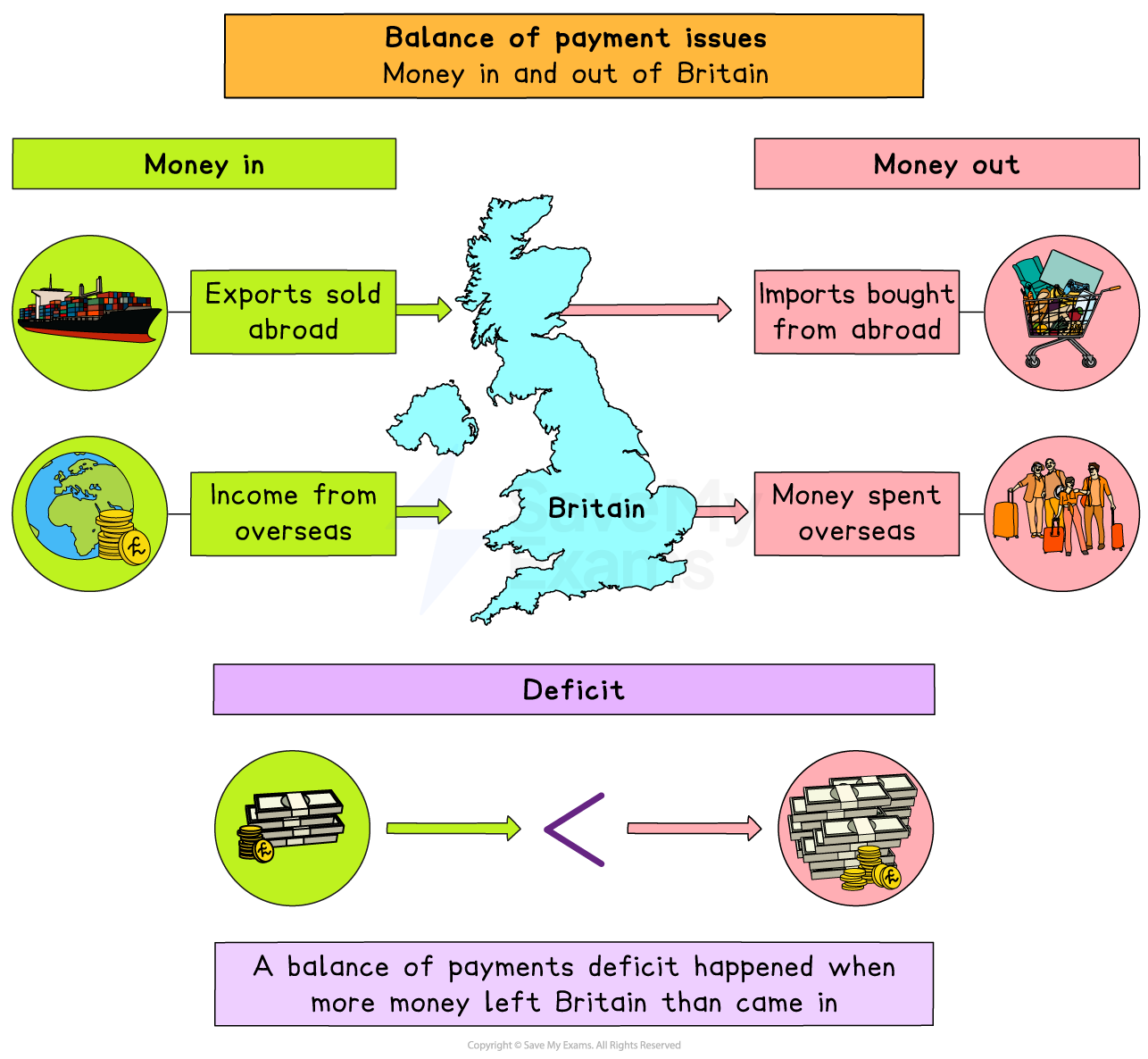
What was the balance of payments?
The balance of payments recorded the money entering and leaving Britain
Money entered when Britain sold exports or received income from abroad
Money left when Britain bought imports or spent money overseas
Britain had a balance of payments deficit when more money left the country than came in
Why was a deficit a problem?
Britain needed foreign buyers and investors to have confidence in the pound
A continuing deficit made people worry that the pound was worth less than its official exchange rate
This could lead investors to sell pounds and exchange them for other currencies
The government then had to protect the value of the pound by:
raising interest rates
cutting government spending
borrowing money from abroad
These measures could slow economic growth and reduce living standards
Why did Britain keep struggling?
Wages often rose faster than productivity
Workers were paid more, but businesses were not producing enough goods to meet demand
This increased costs and contributed to inflation
British goods became more expensive and harder to sell abroad
Britain also faced stronger competition
West Germany and Japan invested in newer factories and increased their exports
Britain remained more dependent on older industries and traditional Commonwealth markets
British exports, therefore, grew more slowly than those of some competitors
Industrial production growth, 1952–59, with each country’s 1950 output set at 100
Country | 1952 | 1955 | 1957 | 1959 |
|---|---|---|---|---|
West Germany | 126 | 179 | 204 | 225 |
France | 110 | 131 | 156 | 170 |
Italy | 117 | 153 | 177 | 202 |
Netherlands | 103 | 134 | 143 | 158 |
USA | 111 | 124 | 127 | 133 |
UK | 101 | 121 | 123 | 129 |
Recurring sterling crises
Britain experienced repeated crises when confidence in the pound fell
During the 1956 Suez Crisis, investors sold pounds because they feared for Britain's economy
In 1961, another crisis forced the government to:
introduce a pay pause
borrow more money from overseas
By 1962, the underlying problem remained: Britain's economy and exports were growing more slowly than those of its major competitors
"Britain economically came bottom of the class in the annual report published here tonight by the Secretariat of the United Nations Economic Commission for Europe. Britain has the 'sorry distinction of being the only Western country whose volume of national output was practically unchanged from the previous year' and is 'the one country where the employment situation has seriously deteriorated.'"
The Guardian, April 1962
Approach: This report appeared in The Guardian in April 1962. It covered a critical United Nations Economic Commission for Europe report, which placed Britain at the bottom of the table for economic performance
The source is useful for showing concern about Britain’s relative economic decline. However, The Guardian was a left-leaning newspaper, so its framing may place extra emphasis on the weaknesses of Conservative economic policy. The figures in the original report should therefore be checked alongside the newspaper account
Examiner Tips and Tricks
When you analyse a report, such as the one above, ensure you weigh its provenance. An international survey carries authority, but a newspaper chooses which findings to headline. Cross-reference it with the evidence of rising wages and consumer spending to show both sides of the economy at once.
'Stop-Go' economic policies
The stop-go cycle
What was the stop-go cycle?
Governments repeatedly switched between encouraging economic growth and trying to slow the economy down
During a 'go' phase, the government:
cut taxes
lowered interest rates
encouraged people and businesses to spend more
This increased demand and helped the economy grow
However, it could also cause:
rising prices and inflation
higher imports, as people bought more goods from abroad
pressure on Britain's balance of payments
Why did the government apply the brakes?
When inflation and imports rose too quickly, the government introduced a 'stop' phase
It tried to reduce spending by:
raising interest rates
increasing taxes
restricting access to loans through a credit squeeze
These measures reduced demand and slowed economic growth
Once the immediate pressure had eased, the government often returned to policies that encouraged growth
This created a repeated cycle of short periods of expansion followed by slowdown
Why was this a problem?
Stop-go policies produced short bursts of growth rather than steady, long-term expansion
Businesses found it difficult to plan investment because government policy kept changing
The cycle controlled demand temporarily but did not solve deeper problems such as:
low productivity
weak investment
growing competition from West Germany and Japan
This approach reflected Keynesian ideas, as governments adjusted taxes, spending and interest rates to maintain demand and employment
The policy in action
Disagreements over economic policy divided the Conservative government
In January 1958, Chancellor Peter Thorneycroft resigned after Macmillan rejected his demand for larger cuts in government spending
Macmillan dismissed the disagreement as a "little local difficulty"
Later chancellors continued to alternate between restraint and expansion
Selwyn Lloyd introduced a pay pause in 1961 to curb inflation and ease pressure on the pound during a balance-of-payments crisis
Chancellors used 'give-away' budgets before elections (Butler 1955, Heathcoat-Amory 1959, Maudling 1963), so the 'go' phases often followed the electoral cycle
In 1962, the government introduced the National Economic Development Council, known as Neddy, to encourage long-term economic growth
Reginald Maudling then introduced expansionary policies in 1963–64, including a cut in the bank rate to encourage borrowing and spending
The economy grew by almost 6% in 1964
However, imports increased much faster than exports
This worsened the balance of payments and showed that the underlying economic weaknesses had not been solved
"We have slithered from one crisis to another. Sometimes it has been the balance of payments crisis and sometimes it has been the exchange crisis. It is a picture of a nation in full retreat from its responsibilities. It is the road to ruin. I do not believe that the problem is technical at all. I do not believe in an answer to the question whether we should use bank rate or physical controls. To tell the truth, neither of them works very well. The simple truth is that we have been spending more money than we should"
A speech from Peter Thorneycroft to Parliament in January 1958 after resigning as Chancellor of the Exchequer
Approach: Thorneycroft gave this speech in the House of Commons in January 1958, shortly after resigning as Chancellor of the Exchequer. He argued that excessive government spending was behind Britain’s repeated economic crises
The source is useful for showing the disagreement inside the Conservative government over spending and inflation. However, Thorneycroft had just resigned over this issue, so he had a clear reason to defend his own position and criticise the policy followed by the Cabinet
Examiner Tips and Tricks
With a source like Thorneycroft’s, consider both its content and provenance. His language shows genuine concern about repeated sterling and balance of payments crises, but he had just resigned over government spending, so the speech also justifies his own policies and criticises Macmillan. It is especially useful as evidence of divisions within the Conservative government, rather than as an objective account of the causes of Britain’s economic problems.
How healthy was the British economy, 1951–1964?
This question weighs real signs of prosperity against evidence of underlying weakness
Some examples for each side are outlined below
The economy was healthy
Full employment lasted throughout the period
Wages and living standards rose faster than ever before
Consumer spending on cars, homes and appliances boomed
Growth was steady enough to keep unemployment low
Sterling recovered after each crisis rather than collapsing
The economy was troubled
Growth was slower than in West Germany, Japan and much of Europe
Balance of payments and sterling crises kept returning
Wages outran productivity, feeding inflation
Stop-go policies blocked steady long-term growth
Britain relied too heavily on older Empire and Commonwealth trade
Examiner Tips and Tricks
Stop-go and the balance of payments are central to any essay on the health of the economy. Make sure you can define each and give short, specific examples

Unlock more, it's free!
Join the 100,000+ Students that ❤️ Save My Exams
the (exam) results speak for themselves:

Was this revision note helpful?
