Analysing Advertisements (DP IB English A: Language and Literature: HL): Revision Note

Analysing Advertisements
Paper 1 asks you to analyse unseen non-literary texts. A non-literary text broadly means a text that is not a novel, poetry, drama or literary non-fiction (such as a memoir). While you cannot predict what type of text will come up in the exam, it is a good idea to practise analysing common text types so that you are familiar with typical features and conventions of a variety of texts.
One type of text you may be asked to analyse is advertisements.
Here we will cover these aspects of analysing advertisements:
Overview of advertisements
Advertisements: genre norms
How to analyse advertisements
Advertisements: Paper 1 model answer
Overview of advertisements
Print and video ads are visual texts that aim to attract customers’ attention to a brand or product.
In order to convincingly analyse an ad, you need to be able to make detailed, specific claims about what it is trying to do and why (see more in Approaching Unseen Non-Literary Texts: Purpose, Audience, Context).
Purpose
The purpose of an ad is the reason it was made. To effectively identify the purpose of the ad, ask yourself:
What is the writer trying to achieve?
What is the writer trying to make the audience feel/think/do?
While it seems logical to conclude that ads are trying to sell a product, this is not always the case. Other possible purposes to consider include:
Raising brand awareness
Aligning a brand with a topic or trend
Associating a brand with a value in the audience’s mind
Creating controversy to gain publicity
Persuading the audience to buy, support, feel, or think something
Audience
The intended audience of an advertisement is who the ad is targeted at and who it was made for. To effectively identify the intended audience of the ad, ask yourself:
Who is the ad aimed at?
What type of person would notice/pay attention to/be interested in/be impacted by the ad?
Consider age, gender, demographics, interests, lifestyle, values, concerns
Examiner Tips and Tricks
Remember, you might not be the demographic of the intended audience. Just because the ad does not appeal to you or you do not find the authorial choices effective or impactful does not mean that the intended audience does not.
For example, an advertisement for cigarettes in the 1960s that has young, working men as its target audience will likely use textual features that would not appeal to a non-smoking, health-conscious 17-year-old girl in 2026. That does not mean the ad is not successful, as the latter is not its intended audience.
Context
The context is the facts of time and place that influence how and why an advertisement was made. To effectively identify the context of the ad, ask yourself:
When was the text made?
Where was the text made?
What economic/political/cultural/social factors influence how the text was made and how it might be received (i.e., the context of production and the context of reception)?
Examiner Tips and Tricks
Honing the skill of identifying specific purposes, audiences and contexts can help you score well on multiple criteria: Criterion D: Language, because you are using effective, accurate and precise vocabulary for textual analysis; Criterion A, because you are showing understanding of the text; and Criterion B, because you can make convincing analytical claims by evaluating how a specific textual feature allows the writer to achieve their specific purpose on a specific audience in a specific context.
Advertisements: genre norms
Criterion B in Paper 1 assesses your ability to analyse how a text achieves a purpose or has an impact on the audience. While many textual features can be found across text types, some are specific to certain text types.
Here, we will examine some genre norms and techniques that are frequently found in advertisements.
Examiner Tips and Tricks
Criterion D assesses your use of effective and appropriate language. One good way to do well in this is to use subject-specific vocabulary when naming textual features. However, overly using technical language without fully understanding its meaning is not effective. Use the list below to critically examine ads and understand how they are constructed. Ensure you understand the terms and build a dictionary with definitions that make sense to you.
Advertisements are multi-modal texts, that is, they make use of both visual and textual elements. You need to be able to interpret how these elements work and how they work together.
Ads often use one of these broad techniques that may influence the specific stylistic choices:
Humour
Bandwagon effect (doing/thinking something because it seems popular)
Controversy
Testimonial (a celebrity or trusted expert endorses the product/brand)
Problem-benefit (the ad identifies a problem and offers its product as the solution to the problem)
Not all of these stylistic features are found in all ads, but it is a good idea to look out for them as you begin to annotate and analyse any advertisement.
Icons and symbols |
|
Anchoring |
|
Figures |
|
Gaze |
|
Colour |
|
Visual path |
|
Typography |
|
Copy |
|
Logo and slogan |
|
How to analyse advertisements
Before you write an answer to any Paper 1 question, it is important that you select the best evidence from your source text. A great way to do this is to identify the focus of the guiding question, and then annotate your text with this focus in mind.
Here is an example of how you might annotate an advertisement in the exam:
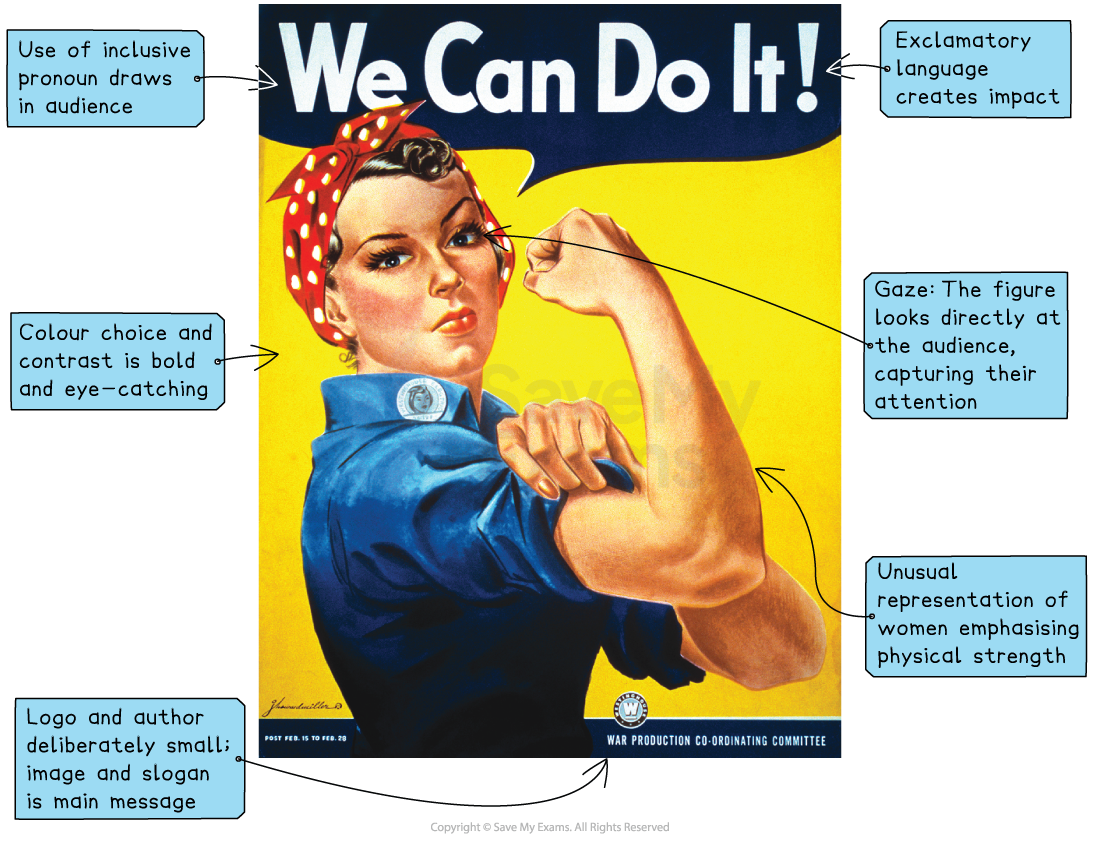
Advertisements: Paper 1 model answer
Below is a top-mark answer to the following Paper 1 question on an advertisement. We’ve included where the answer has hit the assessment criteria to show you exactly why it would achieve full marks.
Source: Colin Kaepernick Nike advertisement, 2018 Question: How are text and image used in this advertisement to align the brand with a wider social cause? |
The 2018 Nike ad features NFL player Colin Kaepernick and aims to align the sports apparel brand with the Black Lives Matter movement and wider calls for racial equality and protests against police brutality. Kaepernick famously took the knee, or refused to stand, during the US national anthem as a protest against police brutality. He was subsequently dropped from his team, and his football career declined. Nike’s ad is an example of brand activism as it cleverly and effectively aligns the brand with pressing social issues and encourages the audience to stand up for what is right.
Visually, the ad puts Kaepernick and what he stands for at the centre. The connotation of the black and white colour scheme effectively sets the tone and mood as serious but dignified. The black, white and grey colours give the ad a pared-back feel, with little to distract from Kaepernick’s face and message. The graphic weighting of the lights in his eyes draws us to him and emphasises his emotion and humanity. This is enhanced by the fact that the close-up of his face and his direct gaze at the viewer demand that we focus on him and meet his gaze. His facial expression conveys the seriousness of the topic, but also his determination to protest.
The textual elements build on these visuals to urge the audience to stand up for what they believe in. The centred, white copy “Believe in something. Even if it means sacrificing everything” combines allusion to Kaepernick’s protest with a wider call for protest and values in the juxtaposed generic terms “something” and “everything”. The connotations of “believe” and “sacrificing” add an almost spiritual level to the message, and the didactic tone gives a sense of urgency and ethical responsibility. The vector through Kaepernick’s face means that we follow down from this copy to the Nike slogan and logo. “Just do it” becomes more than Nike’s call to be authentic and brave in the sports field; it becomes a call to action in the face of injustice.
Thus, Nike combines visual and textual elements to align its brand with pressing social issues. Embracing a controversial moment and figure, it sparks debate and raises brand awareness. The stylistic choices result in an ethos-filled inspirational text that will surely appeal to its audience of conscientious sports fans and players.
Sources
Nike (2018), Dream Crazy — Just Do It 30th anniversary campaign featuring Colin Kaepernick [Advertisement], Wieden+Kennedy.
Miller, J. H. (1943), We Can Do It! [Poster], Westinghouse Electric / War Production Co-Ordinating Committee. Available at: https://commons.wikimedia.org/wiki/File:We_Can_Do_It!.jpg (opens in a new tab) (Public domain).

Unlock more, it's free!
Join the 100,000+ Students that ❤️ Save My Exams
the (exam) results speak for themselves:

Was this revision note helpful?