Analysing Speeches (DP IB English A: Language and Literature: HL): Revision Note

Analysing Speeches
Paper 1 asks you to analyse unseen non-literary texts. A non-literary text broadly means a text that is not a novel, poetry, drama or literary non-fiction (such as a memoir). While you cannot predict what type of text will come up in the exam, it is a good idea to practise analysing common text types so that you are familiar with typical features and conventions of a variety of texts.
One type of text you may be asked to analyse is speeches.
Here we will cover these aspects of analysing speeches:
Overview of speeches
Speeches: genre norms
How to analyse speeches
Speeches: Paper 1 model answer
Overview of speeches
Speeches are oral texts that aim to persuade an audience.
In order to convincingly analyse a speech, you need to be able to make detailed, specific claims about what it is trying to do and why (see more in Approaching Unseen Non-Literary Texts: Purpose, Audience, Context).
Purpose
The purpose of a speech is the reason it was written and delivered. To effectively identify the purpose of the speech, ask yourself:
What is the speaker trying to achieve?
What is the speaker trying to make the audience feel/think/do?
While it seems logical to conclude that speeches are trying to persuade an audience, other possible purposes to consider include:
Raising awareness of an issue
Prompting a reaction or emotion from the audience
Informing
Calling to action
Audience
The intended audience of a speech is who the speech is targeted at and who it was made for. To effectively identify the intended audience of the speech, ask yourself:
Who is the speech aimed at?
What type of person would notice/pay attention to/be interested in/be impacted by the speech?
Consider age, gender, demographics, interests, lifestyle, values, concerns
Where is it delivered?
Who is directly addressed?
Context
The context is the facts of time and place that influence how and why a speech was written/delivered. To effectively identify the context of a speech, ask yourself:
When was the speech delivered?
Where was the speech delivered?
What economic/political/cultural/social factors influence why the speech was written and how it might be received (i.e., the context of production and the context of reception)?
Who was the audience of the speech?
Examiner Tips and Tricks
Honing the skill of identifying specific purposes, audiences and contexts can help you score well on multiple criteria: Criterion D: Language, because you are using effective, accurate and precise vocabulary for textual analysis; Criterion A, because you are showing understanding of the text; and Criterion B, because you can make convincing analytical claims by evaluating how a specific textual feature allows the writer to achieve their specific purpose on a specific audience in a specific context.
Speeches: genre norms
Criterion B in Paper 1 assesses your ability to analyse how a text achieves a purpose or has an impact on the audience. While many textual features can be found across text types, some are specific to certain text types.
Here, we will examine some genre norms and techniques that are frequently found in speeches.
Examiner Tips and Tricks
Criterion D assesses your use of effective and appropriate language. One good way to do well in this is to use subject-specific vocabulary when naming textual features. However, overly using technical language without fully understanding its meaning is not effective. Use the list below to examine speeches and understand how they are constructed. Ensure you understand the terms and build a dictionary with definitions that make sense to you.
Speeches are an example of rhetoric. You need to be able to interpret how language is used to persuade.
Not all of these stylistic features are found in all speeches, but it is a good idea to look out for them as you begin to annotate and analyse speeches.
| |
| |
| |
Cadence and tone |
|
Anaphora and parallelism |
|
Inclusion |
|
Pinpointing the enemy |
|
Emotive language |
|
|
How to analyse speeches
Before you write an answer to any Paper 1 question, it is important that you select the best evidence from your source text. A great way to do this is to identify the focus of the guiding question, and then annotate your text with this focus in mind.
Here is an example of how you might annotate a speech in the exam:
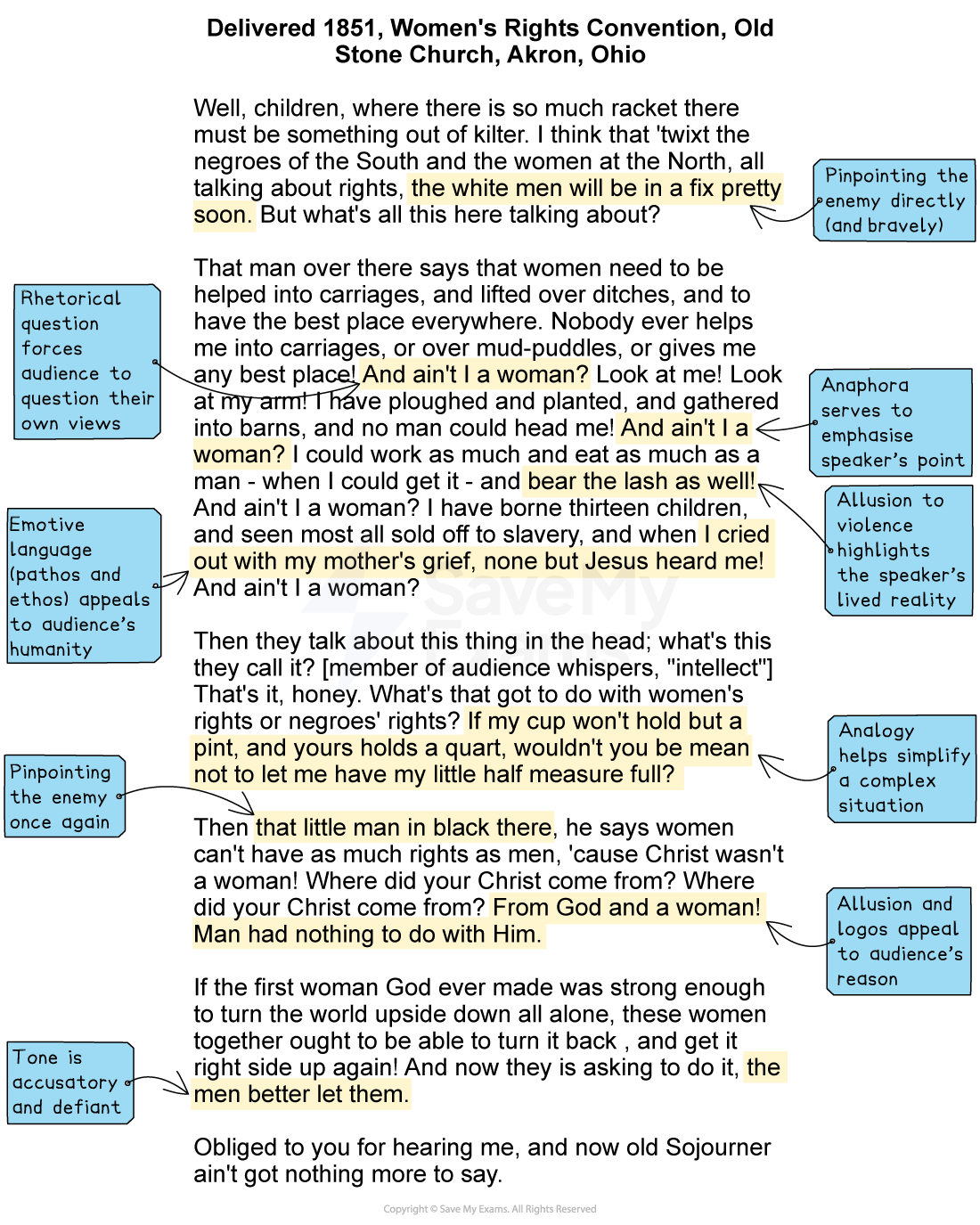
Speeches: Paper 1 model answer
Below is a top-mark answer to the following Paper 1 question on a speech. We’ve included where the answer has hit the assessment criteria to show you exactly why it would achieve full marks.
Source: Sojourner Truth speech, 1851 Question: How and to what effect does the speaker use persuasive techniques to challenge her audience? |
Sojourner Truth’s 1851 speech makes an impassioned call for racial and gender equality that resonates still. Delivered at an assembly for women’s rights that was interrupted by ministers arguing women should concentrate on traditional activities, Truth called out the hypocrisy and ignorance behind those who would deny all women equality. A former slave who became an orator, Truth draws on her lived experience and appeals to her audience’s religious and moral sense of right to demand equality.
Truth bravely pinpoints the enemy both in the assembly and in wider society. The “white men” and “that little man in black” are warned that they will soon “be in a fix” and that they “better let” the women have their rights. Calling out those in power like this she inspires the women in the audience to do the same. She undermines their power by using colloquial terms and a warning tone to refuse to be intimidated by their superiority.
She implicitly juxtaposes the false strength of these men, only achieved through social norms, with her real physical strength. Alluding to the challenges of women of colour in the context, Truth reminds the audience of the strength of women, mothers and slaves who have survived immense hardships. She details her ability to eat as much as any man and “bear the lash” with a kind of black humour before alluding to the horrific crimes of slavery that saw her children sold. Her emotive language and allusion to slavery and Christianity in “I cried out with my mother’s grief, none but Jesus heard me!” is a powerful example of pathos and ethos. It calls out the hypocrisy of religious leaders who could condone such horrors.
Truth’s speech is an example of highlighting intersectionality, more than a century before such a term was coined. She supports the women’s fight for rights, but reminds the audience that women of colour must be included in that fight. The anaphora of the rhetorical question, “Ain’t I a woman?” demands honest reflection and a recognition of her, and all women’s, humanity. It is a demand that echoes through the years.
Sources
Truth, S. (1851), ‘Ain’t I a Woman?’ [Speech]. Delivered at the Women’s Rights Convention, Old Stone Church, Akron, Ohio. Available at: https://www.ushistory.org/documents/truth.html (opens in a new tab).

Unlock more, it's free!
Join the 100,000+ Students that ❤️ Save My Exams
the (exam) results speak for themselves:

Was this revision note helpful?