Period of Simple Pendulum (AQA A Level Physics): Revision Note
Exam code: 7408

Period of simple pendulum
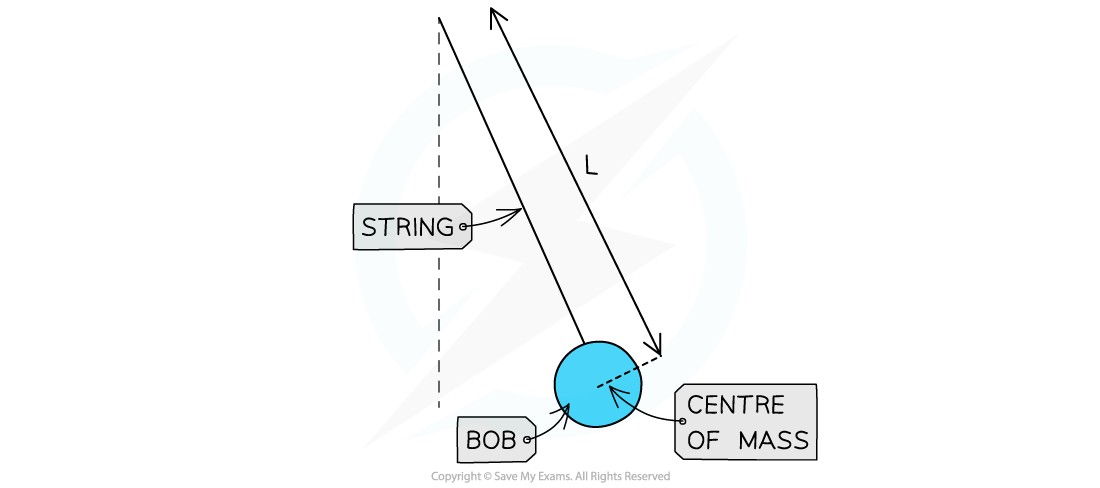
A simple pendulum consists of a string and a bob at the end
The bob is a weight, generally spherical and considered a point mass
The bob moves from side to side
The string is light and inextensible remaining in tension throughout the oscillations
The string is attached to a fixed point above the equilibrium position
The time period of a simple pendulum for small angles of oscillation is given by:
Where:
= time period (s)
= length of string (from the pivot to the centre of mass of the bob) (m)
= gravitational field strength (N kg-1)
The time period of a pendulum does depend on the gravitational field strength, meaning its period would be different on the Earth and the Moon
Small angle approximation
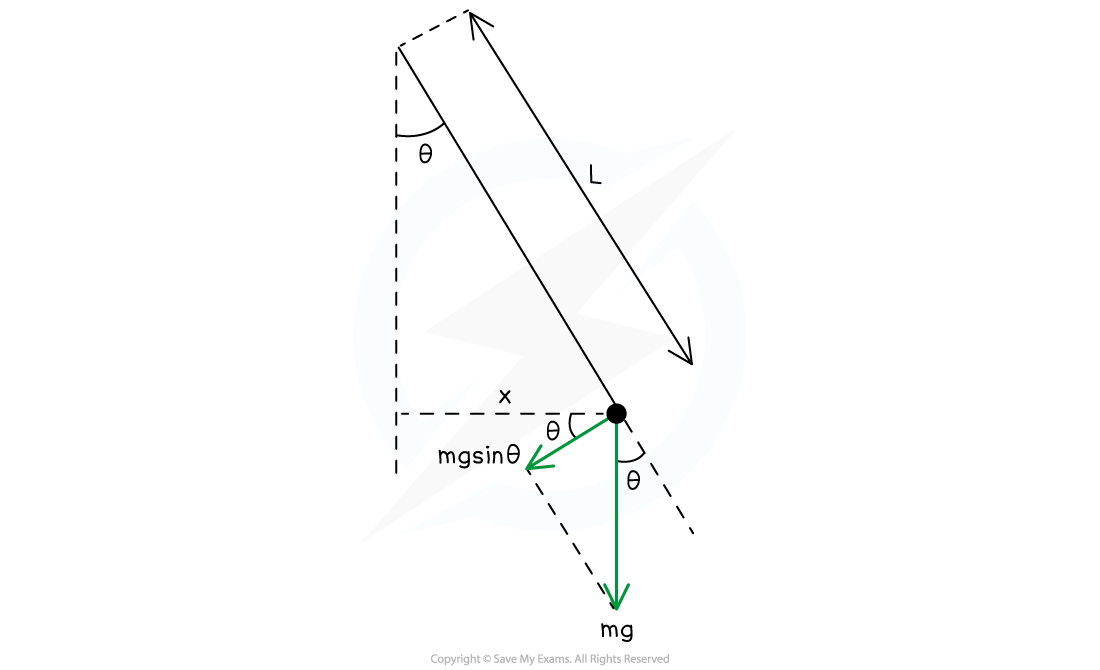
This formula is limited to small angles () and therefore small amplitudes of oscillation from the equilibrium point
The restoring force of the pendulum is the weight component acting along the arc of the circle towards the equilibrium position
It is resolved to act at an angle to the horizontal
When considering SHM because of small angle approximation it is assumed the restoring force acts along the horizontal
So
Worked Example
Calculate the time period of a simple pendulum on the Moon, if on Earth it has a time period of 7 s. on the moon is 1/6 of that on Earth.
[2]
Answer:
Step 1: List the known quantities
Gravitational field stength on Earth,
Gravitational field stength on moon,
Time period,
Length of pendulum will be the same for both
Step 2: Write down the time period equation for Earth and moon
[1 mark]
Step 3: Calculate the time period
[1 mark]

Unlock more, it's free!
Join the 100,000+ Students that ❤️ Save My Exams
the (exam) results speak for themselves:

Was this revision note helpful?
Build on this topic