Moments (AQA A Level Physics): Revision Note

Exam code: 7408

Katie M

Written by: Katie M

Reviewed by: Tim

Updated on

Guided study available on this topic

Understand this topic with deeper explanations and understanding checks.

What is a moment?

  • A moment is the turning effect of a force

  • Moments occur when forces cause objects to rotate about some pivot

  • The moment of a force is given by

Moment (N m) = Force (N) × perpendicular distance from the pivot (m)

  • The SI unit for the moment is Newton metres (N m)

    • This may also be Newton centimetres (N cm) depending on the units given for the distance

Two diagrams show a perpendicular force and a non-perpendicular force acting about a pivot. For the former, moment equals F times d. For the latter, the perpendicular distance is d cos theta: moment equals F times d cos theta. Textbox says "although d is the distance from the pivot to the force F, it is not the perpendicular distance. therefore we must take the component of the distance which is perpendicular to F."
The force might not always be perpendicular to the distance
  • An example of moments in everyday life is opening a door

  • The door handle is placed on the other side of the door to the hinge (the pivot) to maximise the distance for a given force and therefore provide a greater moment (turning force)

    • This makes it easier to push or pull it

Worked Example

A uniform metre rule is pivoted at the 50 cm mark.

A 0.5 kg weight is suspended at the 80 cm mark, causing the rule to rotate about the pivot.

Assuming the weight of the rule is negligible, what is the turning moment about the pivot?

Metre rule pivoted at the 50 cm mark, with a mass hanging at the 80 cm mark.

Answer:

Worked-example solution: weight equals 0.5 × 9.81 = 4.905 N, rounded to 5 N; perpendicular distance is 80 cm − 50 cm = 30 cm. Moment equals 5 N × 30 cm = 150 N cm.

Examiner Tips and Tricks

If not already given, drawing all the forces on an object in the diagram will help you see which ones are perpendicular to the distance from the pivot. Not all the forces will provide a turning effect and it is not unusual for a question to provide more forces than required to throw you off.

The principle of moments

  • The principle of moments states:

    For a system to be in equilibrium, the sum of clockwise moments about a point must be equal to the sum of the anticlockwise moments (about the same point)
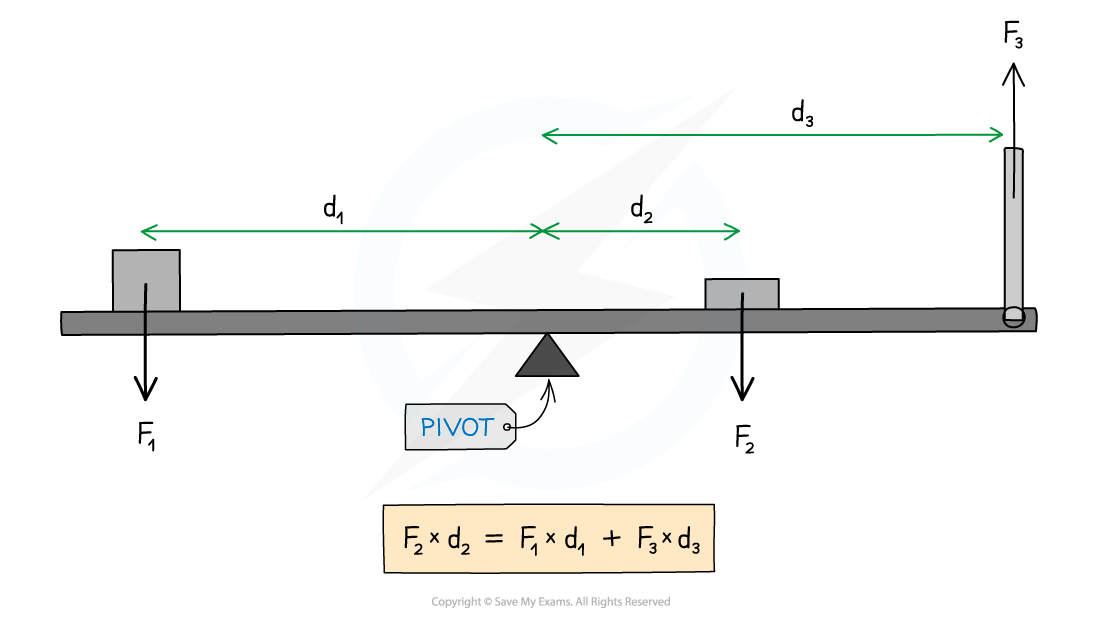
Beam balanced on a pivot, with force F2 giving a clockwise moment and forces F1 and F3 giving anticlockwise moments at distances d1, d2 and d3. Equation says F2 times d2 equals F1 times d1 plus F3 times d3.
When a beam is balanced, the clockwise moments equal the anticlockwise moments
  • In the above diagram:

    • Force F2 is supplying a clockwise moment;

    • Forces F1 and F3 are supplying anticlockwise moments

  • Hence: F2 × d2 = (F1 × d1) + (F3 × d3)

Worked Example

A uniform beam of weight 40 N is 5 m long and is supported by a pivot situated 2 m from one end. When a load of weight W is hung from that end, the beam is in equilibrium as shown in the diagram.

A 5 m uniform beam on a pivot 2 m from one end and a load W hanging from the end nearest the pivot.

What is the value of W?

A     10 N               B     50 N               C     25 N               D     30 N

[1]

Answer:

Worked solution marked “ANSWER: A”: clockwise moments equal anticlockwise moments. It shows the 40 N weight acting 0.5 m to the right from the pivot, giving a clockwise moment of 20 N m, with W acting 2 m to the left from the pivot.
Worked solution steps 3–5: anticlockwise moment equals W × 2 m; equating moments gives 20 N m = W × 2 m; rearranging gives W = 20 N m ÷ 2 m = 10 N.

Examiner Tips and Tricks

Make sure that all the distances are in the same units and you’re considering the correct forces as clockwise or anticlockwise, as seen in the diagram below
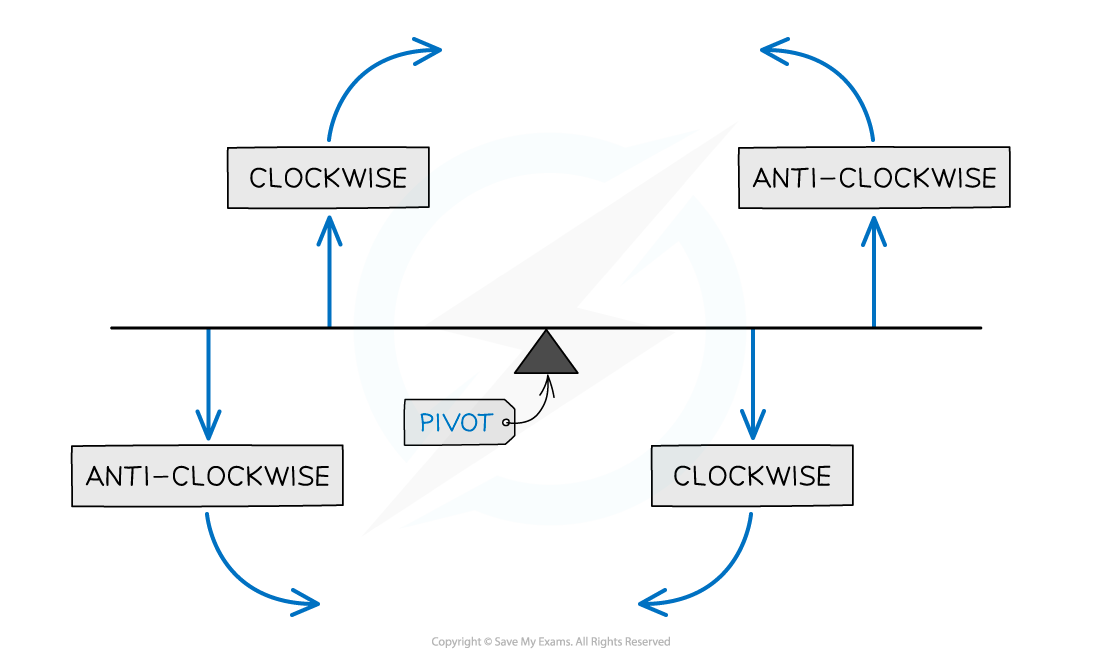
Forces on a beam labelled as giving clockwise or anticlockwise moments about the pivot.

Unlock more, it's free!

Join the 100,000+ Students that ❤️ Save My Exams

the (exam) results speak for themselves:

Build on this topic

Katie M

Author: Katie M

Expertise: Curriculum Expert

Katie has always been passionate about the sciences, and completed a degree in Astrophysics at Sheffield University. She decided that she wanted to inspire other young people, so moved to Bristol to complete a PGCE in Secondary Science. She particularly loves creating fun and absorbing materials to help students achieve their exam potential.

Tim

Reviewer: Tim

Expertise: Content Creator

Timothy graduated with a first class degree in Mathematics and Physics from the University of Warwick. After working as a postgraduate researcher, Timothy has worked as a content creator for various online revision platforms, creating physics resources for a range of levels and exam boards.