Newton's Second Law (AQA A Level Physics): Revision Note
Exam code: 7408

Newton's second law
Newton's second law describes the change in motion that arises from a resultant force acting on an object
Newton's second law states that:
The resultant force acting on an object with a constant mass is directly proportional to its acceleration
Where:
= resultant force, measured in newtons (N)
= mass of object, measured in kilograms (kg)
= acceleration, measured in metres per second squared (m s−2)
This acceleration always acts in the same direction as the resultant force
When unbalanced forces act on an object, the object experiences a resultant force
If the resultant force acts along the direction of the object's motion, the object will:
speed up (accelerate)
slow down (decelerate)
If the resultant force acts on an object at an angle to its direction of motion, it will:
change direction
Resultant force
Force is a vector quantity with both magnitude and direction
The resultant force is, therefore, the vector sum of all the forces acting on the body
If the object is in motion, then the positive direction is in the direction of motion

If the resultant force acts at an angle to the direction of motion, the magnitude and direction of the resultant force can be found by:
combining vectors
scale drawings
Both of these methods are covered in Scalars & Vectors
Acceleration
Acceleration is a vector quantity with both magnitude and direction
If the resultant force acts in the direction of an object's motion, the acceleration is positive
If the resultant force opposes the direction of the object's motion, the acceleration is negative
But the acceleration will always act in the same direction as the resultant force
Examiner Tips and Tricks
Remember that a resultant force opposing an object's motion makes it decelerate; it doesn't suddenly travel backwards. If there are no drag forces, the acceleration of a falling object doesn't depend on its mass, which astronauts showed on the Moon by dropping a hammer and a feather from the same height and watching them land together at the same time. (Because there is no air resistance on the Moon.)
Worked Example
A rocket produces an upward thrust of 15 MN and has a weight of 8 MN.
(a) When in flight, the force due to air resistance is 500 kN. Determine the resultant force on the rocket. [2]
(b) The mass of the rocket is 0.8 × 10⁵ kg. Calculate the acceleration of the rocket, and state the direction of the acceleration. [3]
Answer:
Part (a)
Step 1: Draw a force diagram of the situation
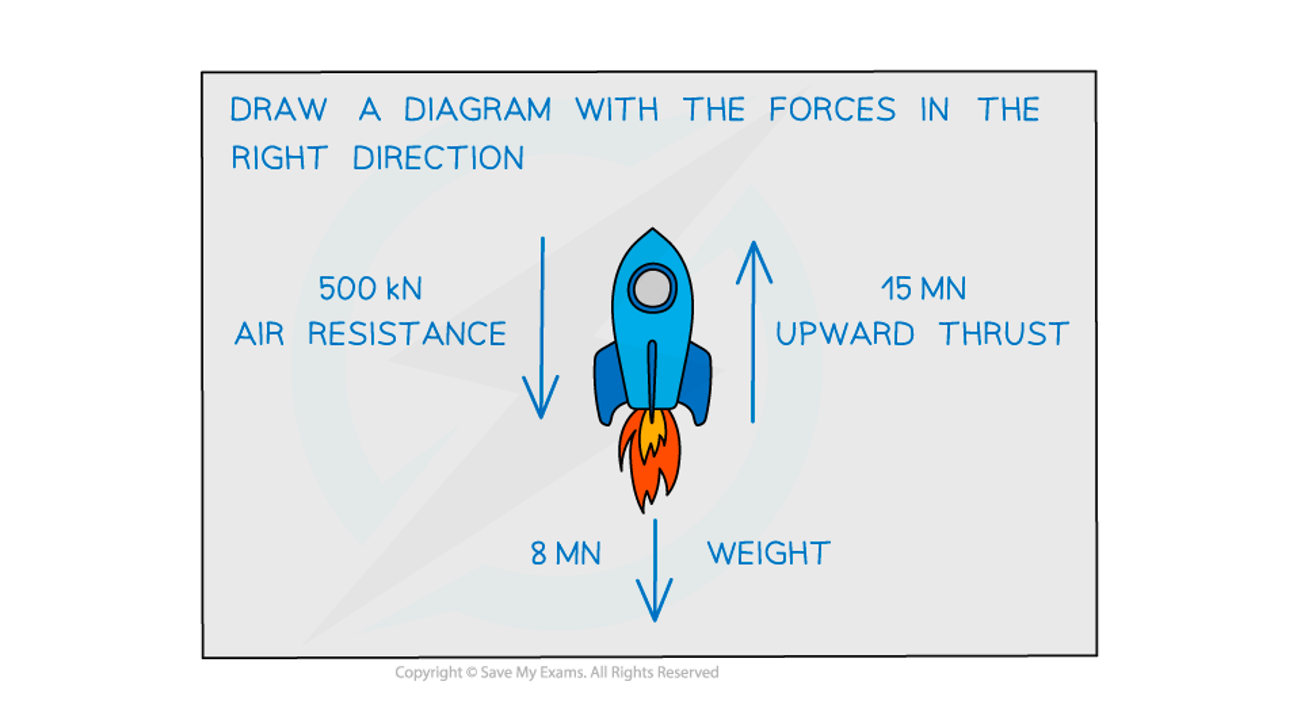
Step 2: Convert the forces into newtons and assign directions
The direction of motion is upwards, therefore upwards is the positive direction
Air resistance (downward acting) = −500 kN =
Weight (downward acting) = −8 MN =
Thrust (upward acting) = 15 MN = [1 mark]
Step 3: Calculate the resultant force
[1 mark]
The positive value indicates that the resultant force acts in the direction of motion i.e. upwards
Part (b)
Step 1: State the equation for Newton's second law and rearrange to make acceleration the subject
Step 2: Calculate the acceleration and state the direction
[1 mark]
upwards [1 mark]
Acceleration is in the same direction as the resultant force [1 mark]
Examiner Tips and Tricks
It is a general rule to consider the direction of the object's motion as positive. Therefore, all vectors in the direction of motion will be positive, and opposing vectors, such as drag forces, will be negative. For stationary objects, you can choose which direction is positive or negative as long as you are consistent throughout your calculations. However, it is generally assumed that forward, upwards, and to the right are positive and backward, downwards, and to the left are negative.
Newton's second law and momentum
Newton's second law can also be given in terms of momentum
The resultant force on an object is equal to its rate of change of momentum
This change in momentum is in the same direction as the resultant force
These two definitions are derived from the definition of momentum, as follows:
Momentum:
Rate of change of momentum:
Force:
Acceleration:
Therefore:
Worked Example
A girl is riding her skateboard down the road and increases her speed from 1 m s-1 to 4 m s-1 in 2.5 s.
The force driving her forward is 72 N.
Calculate the combined mass of the girl and the skateboard.

[2]
Answer:
Step 1: List the known quantities
Initial speed,
Final speed,
Time,
Force,
Step 2: Use Newton's second law in terms of momentum to calculate mass
[1 mark]
[1 mark]

Unlock more, it's free!
Join the 100,000+ Students that ❤️ Save My Exams
the (exam) results speak for themselves:

Was this revision note helpful?
Build on this topic