Collisions (AQA A Level Physics): Revision Note
Exam code: 7408

Elastic & inelastic collisions
In both collisions and explosions, momentum is always conserved
However, kinetic energy might not always be
A collision (or explosion) is:
elastic if the kinetic energy is conserved
inelastic if the kinetic energy is not conserved
Collisions are when objects strike against each other
Elastic collisions are commonly those where the objects colliding do not stick together and then move in opposite directions
Inelastic collisions are commonly those where the objects collide and stick together after the collision
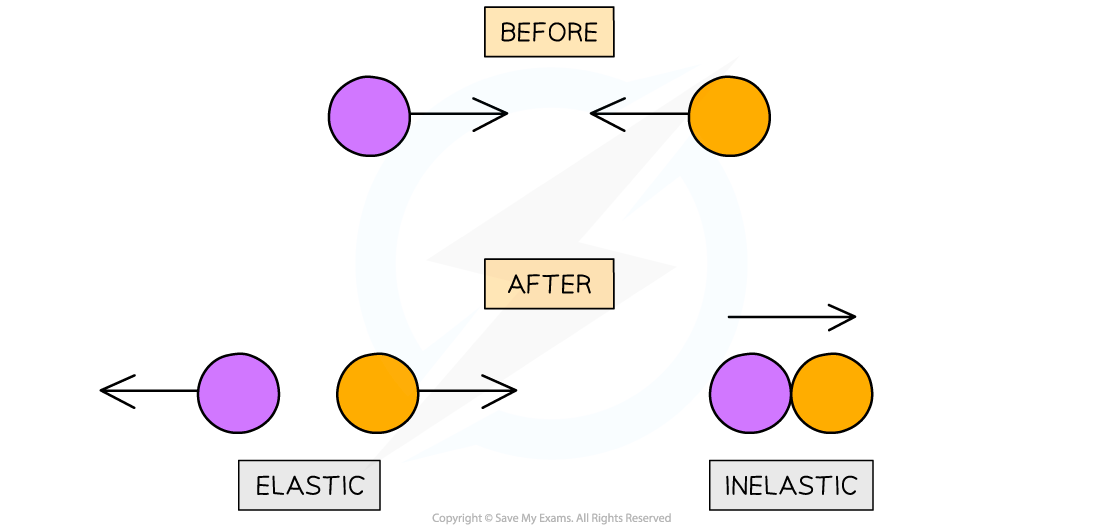
An explosion is commonly to do with recoil
For example, a gun recoiling after shooting a bullet or an unstable nucleus emitting an alpha particle and a daughter nucleus
To find out whether a collision is elastic or inelastic, compare the kinetic energy before and after the collision
The equation for kinetic energy is:
Where:
= kinetic energy (J)
= mass (kg)
= velocity (m s–1)
Worked Example
Trolley A of mass 0.80 kg collides head-on with stationary trolley B at speed 3.0 m s–1. Trolley B has twice the mass of trolley A. The trolleys stick together and travel at a velocity of 1.0 m s–1. Determine whether this is an elastic or inelastic collision.
[3]
Answer:
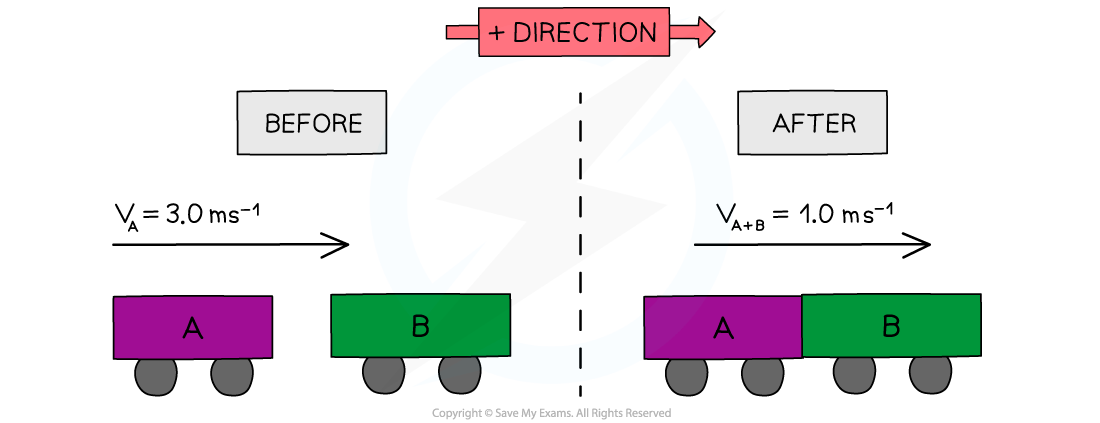
Step 1: List the known quantities
Mass of trolley A,
Initial velocity of trolley A,
Mass of trolley B,
Initial velocity of trolley B,
Combined velocity of trolleys A and B,
Step 2: Calculate the kinetic energy before the collision
[1 mark]
Step 3: Calculate the kinetic energy after the collision
[1 mark]
Step 4: Determine the type of collision
Kinetic energy is not conserved in this collision
Therefore, this is an inelastic collision [1 mark]
Examiner Tips and Tricks
If an object is stationary or at rest, its velocity equals 0, therefore, the momentum and kinetic energy are also equal to 0. When a collision occurs in which two objects are stuck together, treat the final object as a single object with a mass equal to the sum of the two individual objects.
Momentum conservation issues
The force of an impact in a vehicle collision can be decreased by increasing the contact time over which the collision occurs
The contact time is the time in which the vehicle or passenger is in contact with the object it has collided with
Vehicles have safety features such as crumple zones, seat belts and airbags to account for this
For a given force upon impact, the safety features are designed to absorb the energy from the impact
This increases the time taken for the change in momentum of the passenger to occur
The increased time reduces the force exerted on the passenger and therefore reduces the risk of injury

Designing safety features
Vehicle safety features are designed to absorb energy upon an impact by changing shape
Seat belts:
These are designed to stop a passenger from colliding with the interior of a vehicle by keeping them fixed to their seat in an abrupt stop
They are designed to stretch slightly to increase the contact time over which the passenger's momentum reaches zero and, therefore, reduce the force exerted on them during a collision
Airbags:
These are deployed from the dashboard and steering wheel (and in newer cars, from the doors) when a collision occurs
They act as a soft cushion to prevent injury on the passenger when they are thrown forward upon impact
They increase the contact time over which the passenger changes momentum, thereby reducing the force exerted on them
Crumple zones:
These are designed into the exterior of vehicles
They are at the front and back and are designed to crush or crumple in a controlled way in a collision
This is why vehicles after a collision look more heavily damaged than expected, even for relatively small collisions
Crumple zones increase the time over which the vehicle's momentum reaches zero, reducing the force on the passengers
The reduced force due to the increase in contact time can be shown on a force-time graph
For the same change in momentum, which depends on the mass and speed of a vehicle, the increase in contact time will result in a decrease in the maximum force exerted on the vehicle and passenger
This is demonstrated by a lower peak and wider base on a force-time graph


Unlock more, it's free!
Join the 100,000+ Students that ❤️ Save My Exams
the (exam) results speak for themselves:

Was this revision note helpful?
Build on this topic