Period of Mass-Spring System (AQA A Level Physics): Revision Note

Exam code: 7408

Ashika

Written by: Ashika

Reviewed by: Tim

Updated on

Guided study available on this topic

Understand this topic with deeper explanations and understanding checks.

Period of mass-spring system

  • A mass-spring system consists of a mass attached to the end of a spring

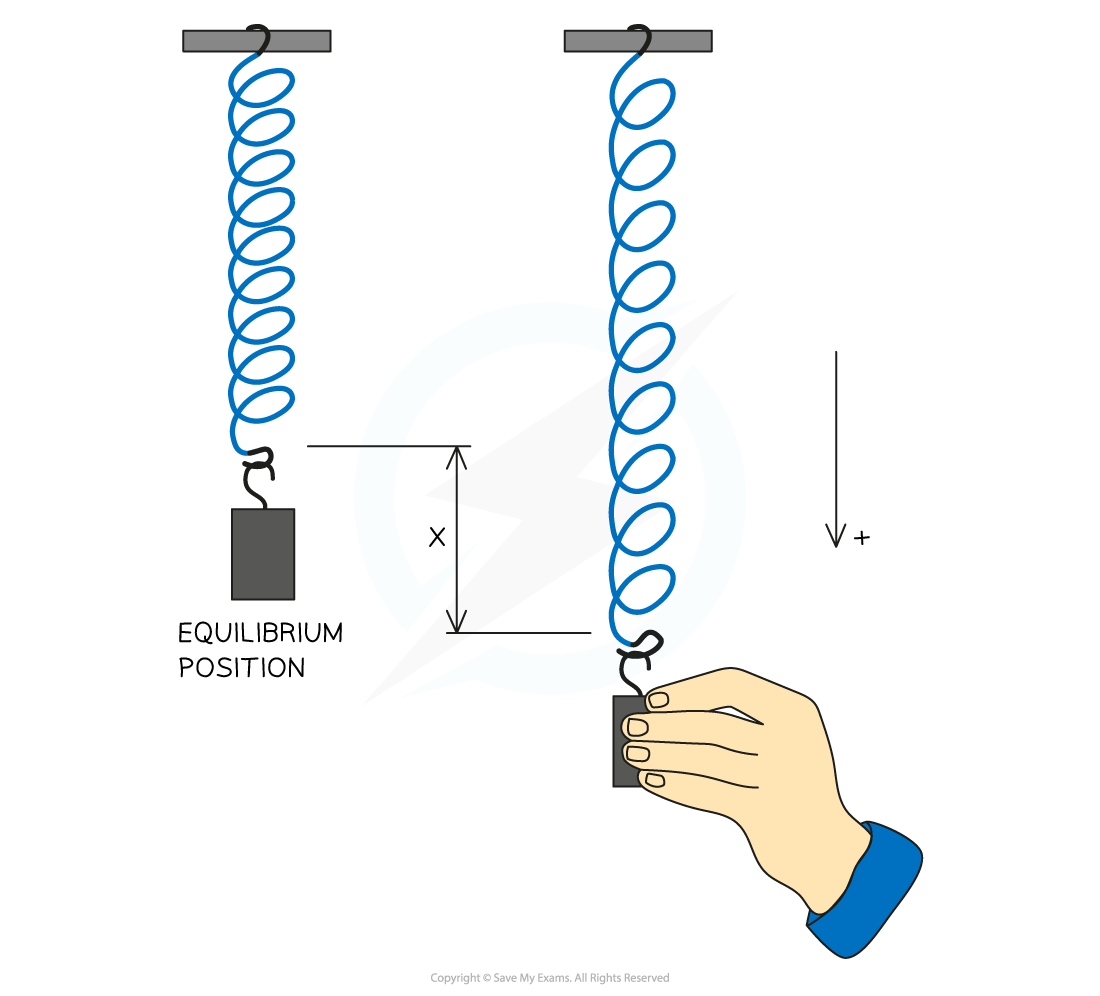
  • The equation for the restoring force (the force responsible for the SHM) is FH = −kx

A mass hangs from a vertical spring at its equilibrium position, then is displaced downwards by distance x, with a hand holding it and a downward direction marked positive.
The restoring force on a mass-spring system always acts towards the equilibrium position and is proportional to the displacement
  • The time period of a mass-spring system is given by:

T = 2πmk

  • Where:

    • T = time period (s)

    • m = mass on the end of the spring (kg)

    • k = spring constant (N m-1)

  • This equation applies to both horizontal and vertical mass-spring systems:

Diagram showing two mass-spring systems. A mass m hanging from a vertical spring with spring constant k, and a mass m attached to a horizontal spring with spring constant k.
A mass-spring system can be either vertical or horizontal. The time period equation applies to both
  • The equation shows that the time period and frequency, of a mass-spring system, does not depend on the force of gravity

    • Therefore, the oscillations would have the same time period on Earth and the Moon

  • The higher the spring constant k, the stiffer the spring and the shorter the time period of the oscillation

Worked Example

Calculate the frequency of a mass of 2.0 kg attached to a spring of spring constant 0.9 N m–1 oscillating in simple harmonic motion.

[2]

Answer:

Step 1: List the known quantities

  • Mass, m = 2.0 kg

  • Spring constant, k = 0.9 N m−1

Step 2: Calculate the time period

T = 2πmk = 2π2.00.9 = 9.3664 s [1 mark]

Step 3: Calculate the frequency

f = 1T = 19.3664 = 0.1068 Hz = 0.11 Hz (2 s.f.) [1 mark]

Examiner Tips and Tricks

Another area of physics where you may have seen the spring constant k is from Hooke's Law. Exam questions commonly merge these two topics together, so make sure you're familiar with the Hooke's Law equation too.

Unlock more, it's free!

Join the 100,000+ Students that ❤️ Save My Exams

the (exam) results speak for themselves:

Build on this topic

Ashika

Author: Ashika

Expertise: Physics Content Creator

Ashika graduated with a first-class Physics degree from Manchester University and, having worked as a software engineer, focused on Physics education, creating engaging content to help students across all levels. Now an experienced GCSE and A Level Physics and Maths tutor, Ashika helps to grow and improve our Physics resources.

Tim

Reviewer: Tim

Expertise: Content Creator

Timothy graduated with a first class degree in Mathematics and Physics from the University of Warwick. After working as a postgraduate researcher, Timothy has worked as a content creator for various online revision platforms, creating physics resources for a range of levels and exam boards.