Covalent Bonds (College Board AP® Chemistry): Study Guide

Nonpolar covalent bonds
A covalent bond is formed when two nonmetals share a pair of electrons
Atoms form covalent bonds to gain a full outer shell of electrons
A group of atoms held together by covalent bonds is a molecule (for example, Cl2 and HF)
There are three types of covalent bond:
A single covalent bond occurs when one pair of electrons is shared, and each atom contributes one valence electron
A double covalent bond occurs when two pairs of electrons are shared, and each atom contributes two valence electrons
A triple covalent bond occurs when three pairs of electrons are shared, and each atom contributes three valence electrons
Whether a covalent bond is polar depends on the difference in electronegativity between the two atoms
A very small difference gives a nonpolar bond; on the Pauling scale a difference below about 0.4 is a rough guide, not a rule
Nonpolar covalent bonds are formed when two elements with similar or equal electronegativity share pairs of electrons
Bonds between carbon and hydrogen are often considered to be nonpolar, even though carbon (2.5) is slightly more electronegative than hydrogen (2.1)
Example: Chlorine, Cl2
Chlorine is a diatomic element
This means that it exists as a molecule of Cl2 instead of an individual Cl atom
The two chlorine atoms form a single covalent bond by sharing a pair of electrons as shown in the image below

Since both atoms are the same, their difference in electronegativity is 0
Therefore, the nature of the covalent bond is nonpolar
Examiner Tips and Tricks
The seven elements that exist as diatomic molecules are H2, N2, O2, F2, Cl2, Br2 and I2.
Always write these elements as molecules in equations, for example Cl2 (g), not Cl (g).
You can remember them by using the mnemonic: Have No Fear Of Ice Cold Beer
Polar covalent bonds
A polar covalent bond is formed when the nonmetals that share pairs of electrons have a greater electronegativity difference
On the Pauling scale, differences between about 0.4 and 2.0 are typical of polar covalent bonds, but there is no sharp boundary
Electronegativity is the tendency of an atom to attract a pair of electrons when it forms a covalent bond
One of the atoms will have greater Coulombic attraction to the electrons, pulling them towards itself
The more electronegative atom develops a partial negative charge (δ−) and the other atom a partial positive charge (δ+); this separation of charge is a bond dipole
A dipole moment is created when particles of equal magnitude but opposite sign charges are separated
Example: Hydrogen fluoride, HF
Polar covalent bonds occur in a molecule of hydrogen fluoride as shown in the image below
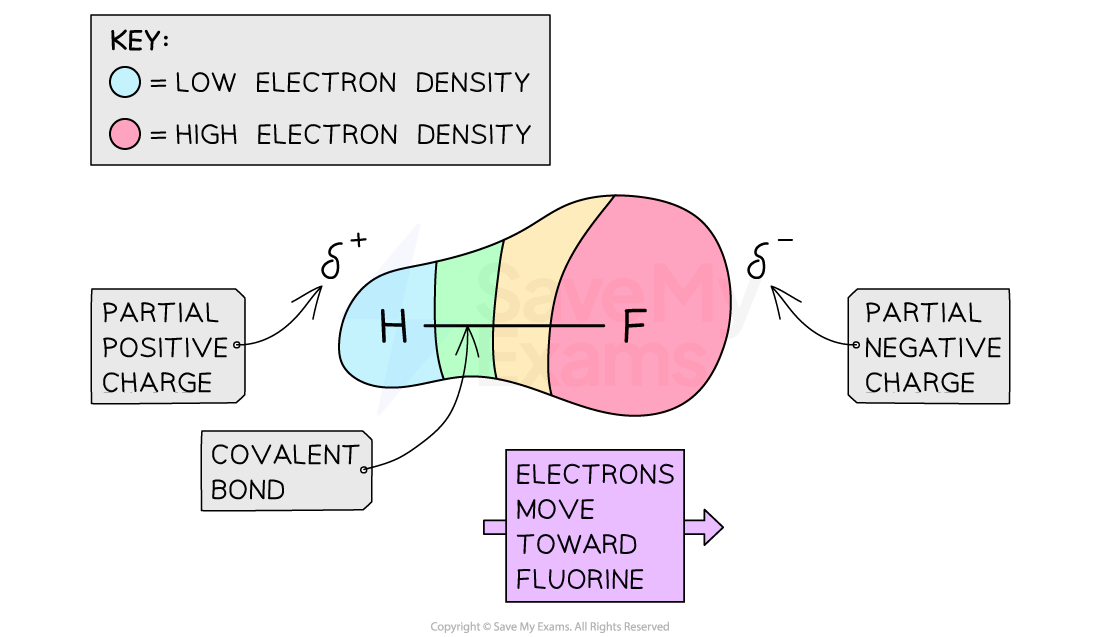
The fluorine atom and the hydrogen atom form a single covalent bond by sharing a pair of electrons
The difference in electronegativity (ΔEN) is found by subtracting the lower value from the higher one:
ΔEN = 4.0 − 2.1
ΔEN = 1.9
Since the difference is between 0.4 and 2.0, the nature of the covalent bond is polar
Fluorine has a partial negative charge, δ−
Hydrogen has a partial positive charge, δ+
In single bonds, a greater difference in electronegativity gives larger partial charges, so the bond dipole is greater
Ionic character
Ionic bonds are formed when electrons are transferred from one atom to another
In polar covalent bonds, there is a partial transfer of electrons toward the more electronegative atom
Therefore, all polar covalent bonds have some ionic character: the difference between ionic and covalent bonding is not distinct but a continuum
The ionic character of a covalent bond increases if the difference of electronegativity between the atoms is greater
Examiner Tips and Tricks
A polar bond does not make a polar molecule.
If the molecule's shape makes the bond dipoles cancel, as in CO2, the molecule is nonpolar.
Say 'polar bond' or 'polar molecule' precisely.

Unlock more, it's free!
Join the 100,000+ Students that ❤️ Save My Exams
the (exam) results speak for themselves:

Was this revision note helpful?
Build on this topic