Ionic Crystals (College Board AP® Chemistry): Study Guide

Ionic crystals
Ionic lattice
Ionic crystals are arranged in a lattice structure of positive and negative ions
This lattice structure is responsible for the crystalline nature of ionic compounds
The ions in the lattice are arranged in a three-dimensional array with a regular, repeating pattern
This systematic arrangement maximizes the Coulombic forces of attraction between positively charged ions and negatively charged ions
This arrangement also minimizes the Coulombic forces of repulsion between equally charged ions
Ionic lattices tend to be close-packed and symmetric arrangements
The overall charge of an ionic lattice is neutral
In a particulate model of an ionic solid, cations and anions alternate, and each ion is drawn to match its relative size
For example, Cl− is larger than Na+
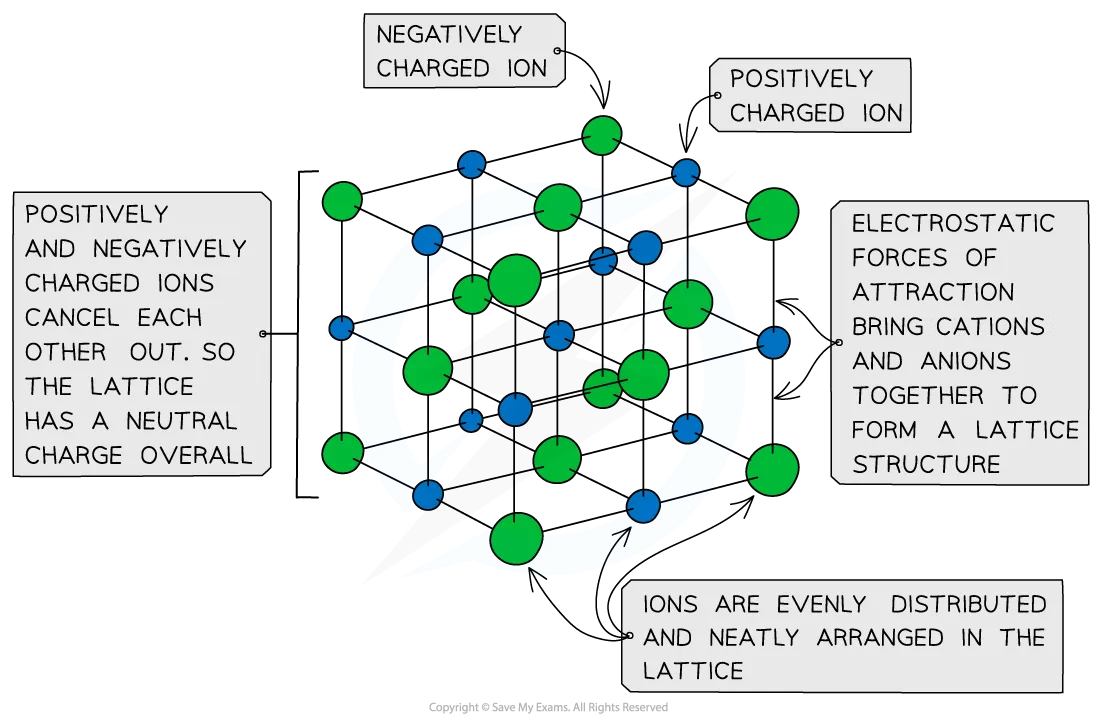
Ionic crystals are arranged in lattice structures
Properties of ionic crystals
The physical properties of ionic crystals depend on the strength of the Coulombic attraction between the positive and negative ions
The strength of the Coulombic attraction increases when:
the charge on the ions increases, because the force of attraction is proportional to the product of the charges on the two ions
For example, the Coulombic attraction is stronger in MgCl2 than in NaCl
This occurs because Mg2+ has a 2+ charge and Na+ a 1+ charge
the ionic radius decreases, because smaller ions can get closer together, so the distance between the centers (nuclei) of the cation and anion is smaller
For example, the Coulombic attraction is stronger in NaCl than in KCl
This is because Na+ is smaller than K+, so the distance between the centers of Na+ and Cl− is smaller than the distance between K+ and Cl−
Table listing the characteristics of ionic crystals
Property | Explanation |
|---|---|
Brittle | If a layer of ions is shifted, ions with the same charge are pushed next to each other and repel, so the crystal breaks |
High melting and boiling points | The Coulombic attraction between the positive and negative ions in the lattice is strong, so a lot of energy is needed to overcome it |
Many are soluble in water | The lattice is broken down and the ions can form ion-dipole interactions with the water molecules |
Conduct electricity when in solution or molten | The lattice is broken down and there is free movement of ions |
Ionic compound as a solid and when molten or in solution

When molten or in solution the ions are free to move and carry charge, so the compound conducts; in the solid the ions are held in fixed positions, so it does not conduct
Examiner Tips and Tricks
In Coulomb's law, r is the distance between the centers of the cation and the anion, not the radius of one ion. Chief readers did not credit answers that treated r as the radius of an ion
Do not just say 'the ion is smaller': say that the smaller ion lets the cation and anion get closer, so the distance between their centers is smaller and the attraction is stronger
Explain the strength of the attraction with charge and distance only: electronegativity, ionization energy or position in the periodic table on their own do not earn the point
Call the particles in an ionic solid ions, not atoms or molecules
Worked Example
Based on Coulomb’s Law and using the information in the table below, which of the following anions is most likely to have the strongest attraction towards Na+ ions in a lattice structure?
Ion | Ionic Radius (pm) |
|---|---|
S2- | 184 |
Cl- | 181 |
Te2- | 221 |
Br- | 196 |
A. S2-
B. Cl-
C. Te2-
D. Br-
Answer:
According to Coulomb's Law (F ∝ q1q2 / r2), the strength of the electrostatic attraction is maximized by having:
The largest charge magnitude (q)
The smallest distance between the ion centers (r)
Here the cation (Na+) is the same in every case, so the smallest anion gives the smallest distance
Comparing charges:
S2- and Te2- have a 2- charge
Cl- and Br- have a 1- charge
Therefore, the attraction will be strongest with either S2- or Te2-
Comparing the radii of the 2- ions:
Between S2- and Te2-, S2- has the smaller ionic radius (184 pm vs. 221 pm)
Conclusion:
S2− has the best combination of a large charge (2−) and a small radius
This results in the strongest Coulombic attraction to a Na+ ion

Unlock more, it's free!
Join the 100,000+ Students that ❤️ Save My Exams
the (exam) results speak for themselves:

Was this revision note helpful?
Build on this topic