Valence Electrons & Ionic Compounds (College Board AP® Chemistry): Study Guide

Valence electrons
Valence electrons are the electrons present in the outermost shell of an atom
Valence electrons dictate an atom's reactivity and ability to form bonds
The number of valence electrons can be obtained from the electron configuration of an atom
Valence electrons and electron configuration
The beryllium atom

Beryllium electron configuration and valence electrons
The interactions between the valence electrons and nuclei of elements determine if two elements are likely to form a chemical bond
There are two types of chemical bonds depending on the elements that take part in the bonding process: ionic bond and covalent bond
An ionic bond occurs between a metal and a nonmetal
A covalent bond occurs between two nonmetals
Ion charges & valence electrons
Valence electrons and the periodic table
Elements in the same group (columns) of the periodic table have the same number of electrons in their valence shell
The valence electrons determine the chemical behavior
Elements in the same column of the periodic table tend to form analogous compounds, with the same type of formula: for example, NaCl and KCl, MgO and CaO, and H2O and H2S
Across a period from left to right, excluding the transition metals, the number of valence electrons increases by one from each element to the next
Formation of ions
Ions are atoms that have lost or gained electrons
Main-group atoms often form ions with the same electron configuration as the nearest noble gas (Na+ and F- both match neon); transition metal ions usually do not
Noble gases have a stable electron configuration because their outer shell is full: 2 electrons in helium (1s2) and 8 (full s and p subshells) in the others
Atoms lose electrons to form cations
Since a cation has more protons than electrons, it has a positive charge
The number of protons does not change when an ion forms: Na and Na+ both have 11 protons; only the number of electrons changes
Cations are formed by metals, which have few valence electrons
Sodium atom becoming a sodium ion

A sodium atom loses one electron to form a sodium ion, Na+
Atoms gain electrons to form anions
Since an anion has fewer protons than electrons, it has a negative charge
Anions are formed by nonmetals, which need only a few electrons to fill their valence shell
The electrostatic attraction between a positive ion (cation) and a negative ion (anion) is defined as an ionic bond
Chlorine atom becoming a chloride ion
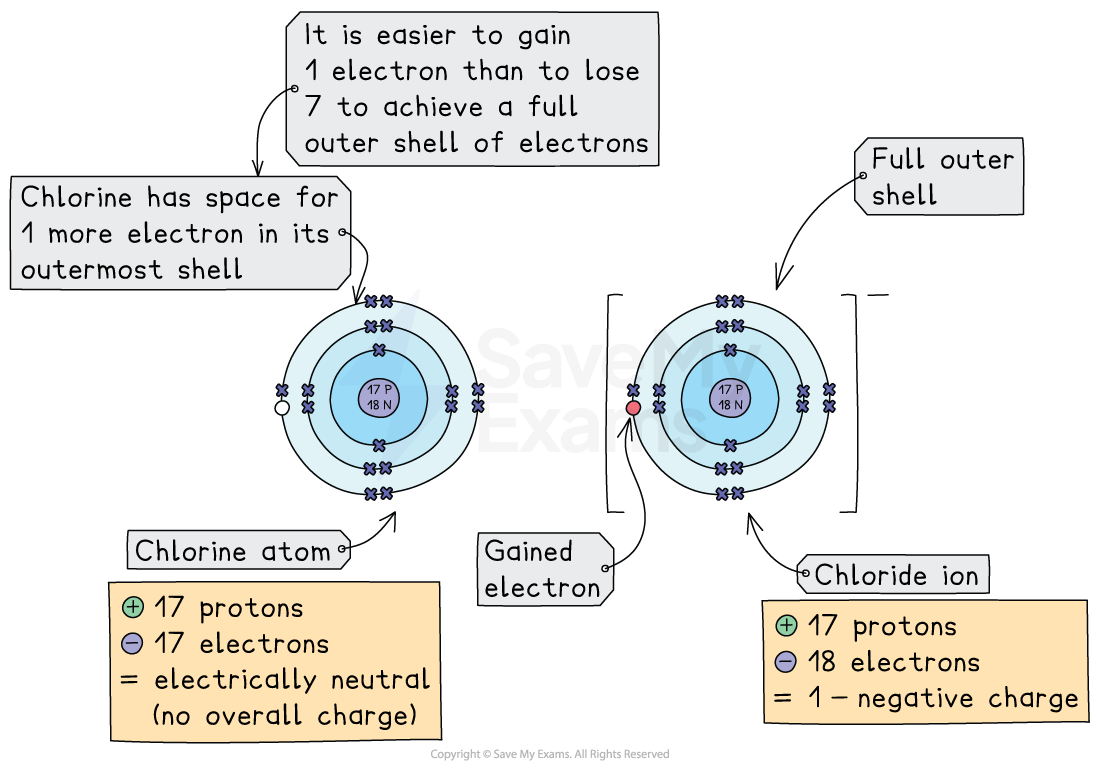
A chlorine atom gains one electron to form a chloride ion, Cl-
Common ions and the periodic table
An element's position in the periodic table predicts the typical charge of its ion, for both cations and anions
Group | Valence electrons | Tend to | Usual ion charge | Example |
|---|---|---|---|---|
1 | 1 | lose 1 electron (forms a cation) | 1+ | Na+ |
2 | 2 | lose 2 electrons (forms a cation) | 2+ | Mg2+ |
13 (metals) | 3 | lose 3 electrons (forms a cation) | 3+ | Al3+ |
15 | 5 | gain 3 electrons (forms an anion) | 3− | N3− |
16 | 6 | gain 2 electrons (forms an anion) | 2− | O2− |
17 | 7 | gain 1 electron (forms an anion) | 1− | F− |
Carbon and silicon in group 14 rarely form simple ions, but the metals lower in the group form cations such as Sn2+ and Pb2+ (for example, in PbI2)
Examiner Tips and Tricks
For groups 1 and 2, the ion charge equals the group number (1+, 2+), and for group 13 metals it is 3+.
For groups 15 to 17, the charge equals the group number minus 18 (for nitrogen, 15 − 18 = −3).
These rules apply to main-group elements, not transition metals.

Unlock more, it's free!
Join the 100,000+ Students that ❤️ Save My Exams
the (exam) results speak for themselves:

Was this revision note helpful?
Build on this topic