Ionic vs Covalent (College Board AP® Chemistry): Study Guide

Ionic vs covalent
Ionic bonding
Bonds between a metal and a nonmetal are generally ionic
The metal atom transfers electrons to the nonmetal atom
The metal becomes a positive ion (cation) because it has lost electrons
Forming a cation

Forming cations by the removal of electrons from metals
The nonmetal becomes a negative ion (anion) because it has gained electrons
Forming an anion
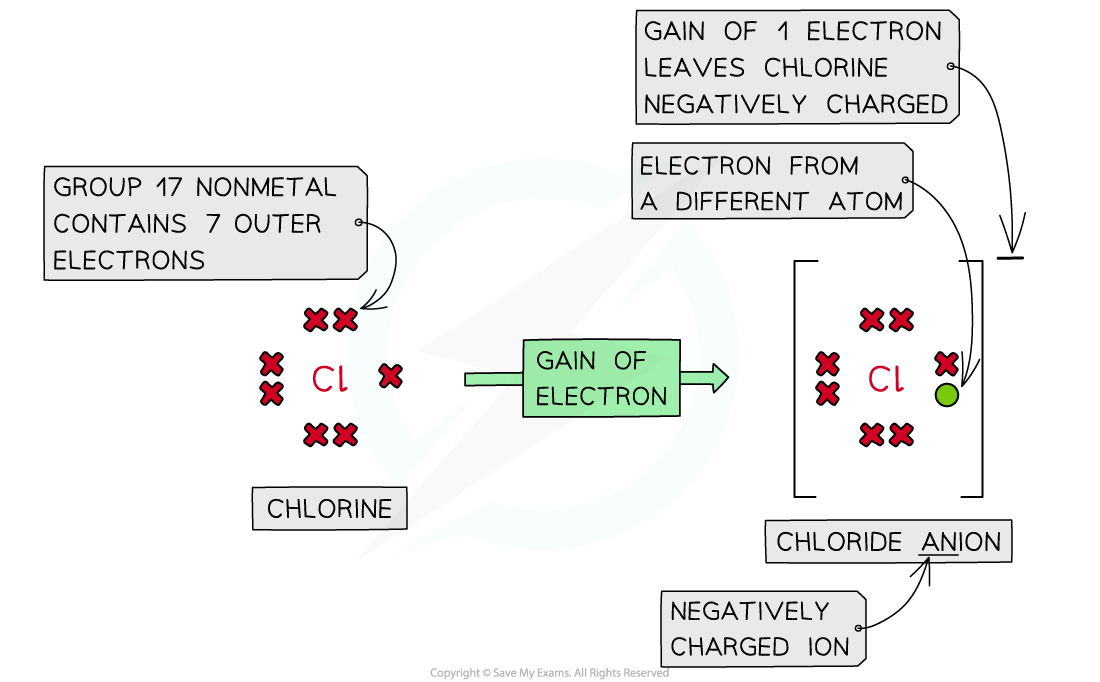
Forming anions by the addition of electrons to nonmetals
A large difference in electronegativity is typical of ionic bonding, but it is only a rough guide
For example, potassium iodide, KI, is ionic although its electronegativity difference is only 1.7 (2.5 − 0.8)
Electronegativity difference is not the only factor that decides whether a bond is ionic or covalent
A full outer shell is stable, which is why noble gases do not normally form ions
When the ionic bond is formed, their electron configurations are the same as their closest noble gas
Sodium chloride will be used as the main example below
Na has one valence electron
Na in sodium chloride (NaCl) loses one electron to form Na+
Therefore, Na+ has the electron configuration 1s2 2s2 2p6, which is the same as Ne
Cl has seven valence electrons
Cl in sodium chloride (NaCl) gains one electron to form Cl-
Therefore, Cl- has the electron configuration 1s2 2s2 2p6 3s2 3p6, which is the same as Ar
When ions are formed, a strong Coulombic force of attraction is formed between the oppositely charged ions
Forming an ionic bond
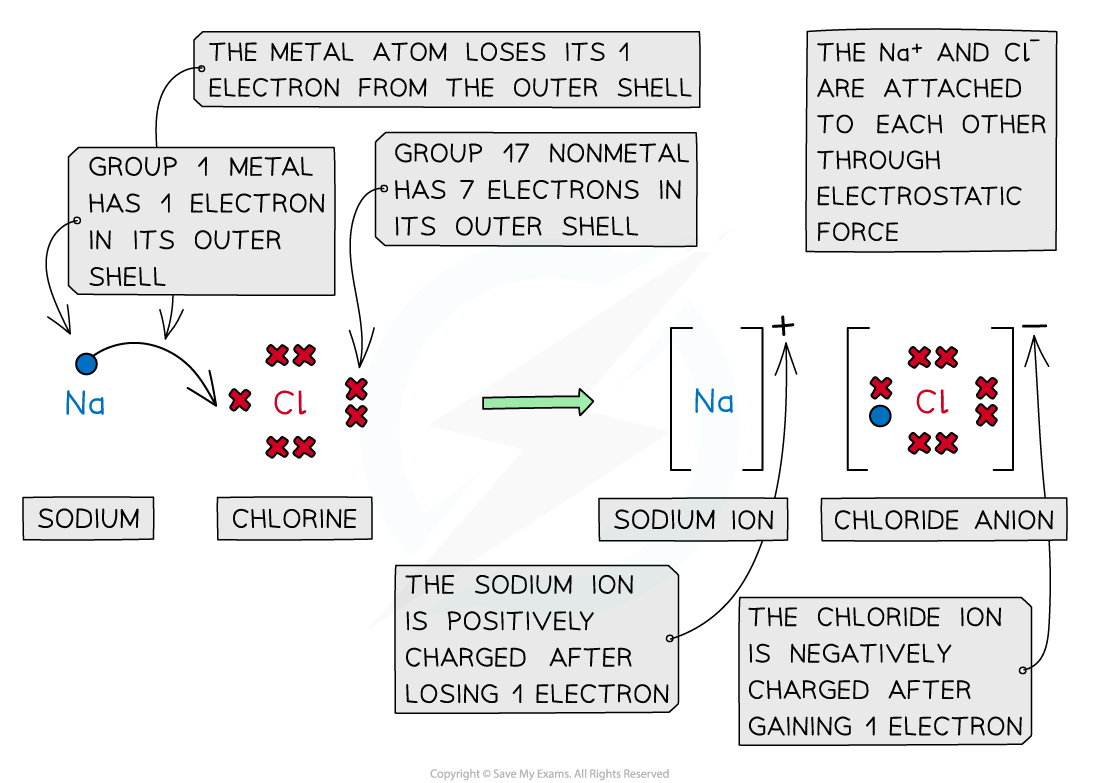
Cations and anions bond together using strong Coulombic forces of attraction, which require a lot of energy to overcome
Covalent bonding
A covalent bond is formed when two nonmetals share a pair of electrons
Atoms form covalent bonds to gain a full outer shell of electrons
There are two types of covalent bonds: polar and nonpolar
This classification depends on the difference in electronegativities between the atoms in the bond
All polar bonds have some ionic character; the difference between ionic and covalent bonding is not distinct but a continuum
Ionic vs covalent compounds
The best way to differentiate between ionic or covalent compounds is analyzing the physical and chemical properties
Properties of ionic and covalent compounds
Property | Ionic compounds | Molecular (covalent) compounds |
|---|---|---|
Melting point/Boiling point | High | Low |
Electrical conductivity | Only when molten or dissolved in water, because the ions are then free to move; the solid does not conduct | Do not conduct electricity |
Solubility | Generally soluble in water | Usually insoluble unless they are polar covalent |
Hardness | Hard, brittle | Soft |
Physical state at room temperature | Solid | Solid, liquid or gas, depending on the strength of their intermolecular forces |
Forces | Strong Coulombic force of attraction between cations and anions | Weak intermolecular forces between molecules; melting or boiling overcomes these, and the covalent bonds inside the molecules stay intact |
Elements involved | Generally a metal and a nonmetal | Generally two nonmetals |
Examples | NaCl | Polar covalent: HF |
There is no sharp electronegativity cut-off between ionic and covalent bonding
Examiner Tips and Tricks
Decide the type of bonding from evidence, not from a single rule.
Bonds between two nonmetals are covalent; bonds between a metal and a nonmetal are generally ionic.
Do not call a metal halide covalent because its melting point is low or its electronegativity difference is below 2.0.
Chief readers marked 'LiI and KI are covalently bonded since the melting points were low' as an error.
To show that a solid is ionic, give a test and its result, such as 'conducts when molten or dissolved, because its ions can move'.

Unlock more, it's free!
Join the 100,000+ Students that ❤️ Save My Exams
the (exam) results speak for themselves:

Was this revision note helpful?
Build on this topic