Sigma & Pi Bonds (College Board AP® Chemistry): Study Guide

Sigma & pi bonds
Orbital overlapping in bonds
A single covalent bond forms when two nonmetal atoms share a pair of electrons
Usually each atom provides one electron from a valence atomic orbital
The overlapping orbitals hold the shared pair of electrons between the two nuclei
The overlapping can occur between hybrid orbitals too
The type of the covalent bond depends on the type of overlapping
There are two types of interaction:
End-to-end overlap, which forms sigma bonds (σ)
Sideways or lateral overlap, which forms pi bonds (π)
End-to-end overlap is stronger than sideways overlap, so a σ bond has a greater bond energy than a π bond
Sigma bonds
A sigma bond (σ) is formed when there is an end-to-end overlap of atomic orbitals
The interaction can occur between any type of atomic orbital (unhybridized or hybridized)
The atoms are free to rotate around a sigma bond
A single covalent bond is always a sigma bond
E.g. in methane (CH4), the four sp3 hybrid orbitals overlap with the s orbital of the hydrogen atoms to form four σ covalent bonds
Sigma bonds in methane
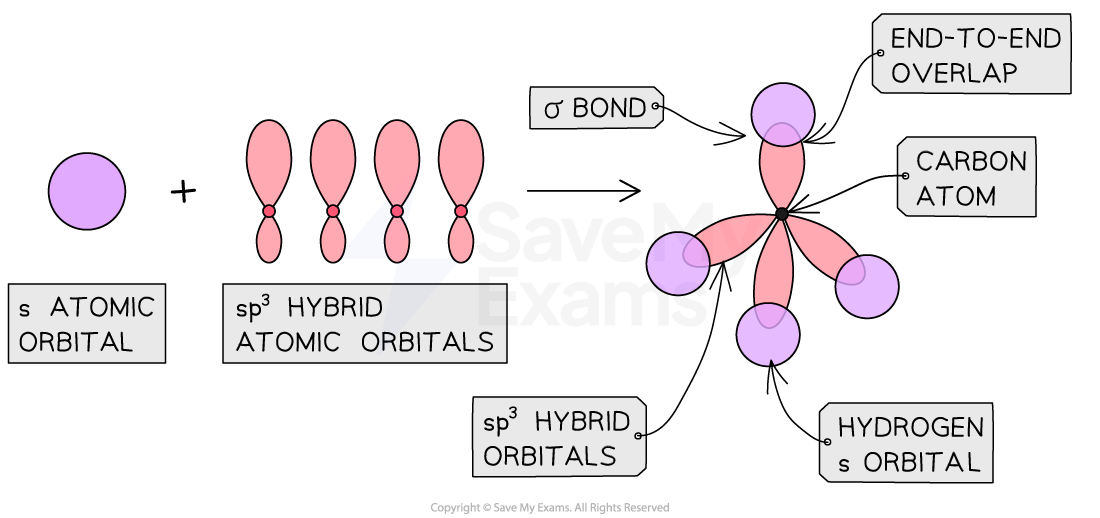
Sigma bonds in methane
Pi bonds
A pi bond (π) is formed when there is sideways (lateral) overlapping of adjacent atomic p orbitals
The pi bond occurs perpendicular to the plane in which the sigma bonds are being formed
A single π bond is drawn as two electron clouds, one above the plane and one below the plane of the sigma bond
The electron clouds above and below the plane prevent rotation around the bond
Because the groups on each carbon atom cannot rotate, molecules with a C=C double bond can exist as geometric isomers (e.g. cis and trans forms)
A double bond is one σ bond and one π bond; a triple bond is one σ bond and two π bonds
E.g. in ethene (C2H4),
Ethene has a double bond
On each carbon atom, two of the three sp2 hybrid orbitals overlap end to end with the s orbital of a hydrogen atom, forming two C–H σ bonds
One sp2 hybrid orbital on each carbon atom overlaps end to end to form the C–C σ bond
At the same time, the unhybridized p orbitals on the two carbon atoms overlap sideways to form one π bond
Bonding in ethene

Each carbon atom in ethene forms two sigma (σ) bonds with hydrogen atoms and one sigma (σ) bond with another carbon atom. The fourth electron is used to form a pi (π) bond between the two carbon atoms
E.g. in ethyne (C2H2):
Ethyne has a triple covalent bond
On each carbon atom, one sp hybrid orbital overlaps end to end with the s orbital of a hydrogen atom, forming one C–H σ bond
One sp hybrid orbital on each carbon atom overlaps end to end to form the C–C σ bond
At the same time, the two unhybridized p orbitals on each carbon atom (four in total) overlap sideways to form two π bonds
Bonding in ethyne

Ethyne has a triple bond formed from two π bonds and one σ bond between the two carbon atoms
Examiner Tips and Tricks
Between any two bonded atoms there is exactly one σ bond, and every extra bond between them is a π bond.
A double bond is 1 σ + 1 π
A triple bond is 1 σ + 2 π
If a question asks for the hybridization of an atom, give sp, sp2 or sp3, because a count of σ and π bonds earns no credit.

Unlock more, it's free!
Join the 100,000+ Students that ❤️ Save My Exams
the (exam) results speak for themselves:

Was this revision note helpful?
Build on this topic