Acid-Base Indicators (College Board AP® Chemistry): Study Guide

Acid-base indicators
Acid-base indicators change color depending on the pH of the solution they are in
They are weak acids or weak bases whose respective conjugate bases and conjugate acids have different colors
For example, the weak acid HIn ionizes as follows:
HIn (aq) + H2O (l) ⇌ H3O+ (aq) + In– (aq)
color 1 ⇌ color 2
HIn (weak acid) and In- (its conjugate base) are different colors
The relative concentrations of the two species determine the color of the solution
If the solution is basic:
The equilibrium shifts to the right
More In– are present
Color 2 will be observed
If the solution is acidic:
The equilibrium will shift to the left
More HIn are present
Color 1 will be observed
The color depends on the pH of the solution
The color will not change suddenly but gradually over a pH range
The Ka value of the indicator determines the pH at which the transition occurs
Ka =
The end point is the point at which the indicator changes color, where [HIn] = [In-]
For a well-chosen indicator, the end point is very close to the equivalence point
Ka = = [H+]
Taking the negative log of both sides:
pKa = pH
This means that the pKa of an indicator equals the pH at the midpoint of its color change (its end point)
The shift in color for the majority of indicators occurs within a pH range of pKa ± 1
Choosing a suitable indicator
The pH changes very rapidly around the equivalence point of a titration
Indicators change color over a narrow pH range, approximately centered around the pKa of the indicator
Choose an indicator whose pKa is close to the pH at the equivalence point, so that its color change falls within the rapid pH change around the equivalence point
Indicator | Color in acid | Color in base | pKa | pH range of color change |
|---|---|---|---|---|
Thymol blue | red | yellow | 1.7 | 1.2–2.8 |
Methyl orange | red | yellow | 3.7 | 3.1–4.4 |
Bromophenol blue | yellow | blue | 4.1 | 3.4–4.6 |
Methyl red | red | yellow | 5.1 | 4.4–6.2 |
Phenolphthalein | colorless | pink | 9.3 | 8.3–10.0 |
Examiner Tips and Tricks
Compare the indicator’s pKa with the pH at the equivalence point, not with the pKa of the acid being titrated
Do not assume every equivalence point is at pH 7. The equivalence point of a weak acid–strong base titration is above pH 7, because the conjugate base reacts with water
Strong acid–weak base titrations
The pH changes sharply between about 7 and 4 around the equivalence point
Methyl red is the most suitable
Methyl orange is often used because its color change is easy to see and it is widely available
Weak acid–strong base titrations
The pH changes sharply between about 7 and 10 around the equivalence point
Phenolphthalein is the only widely available indicator suitable for these titrations
Strong acid–strong base titrations
In a strong acid–strong base titration, the pH rises sharply from about 4 to 10 around the equivalence point, so a suitable indicator must change color within this range
Methyl red and phenolphthalein are both suitable
Methyl orange is less ideal but is often used because its color change is easy to see
Weak acid–weak base titrations
There is no abrupt pH change around the equivalence point, so there is no suitable indicator for these titrations, and the equivalence point is hard to find
Titration curve for a weak acid–weak base titration
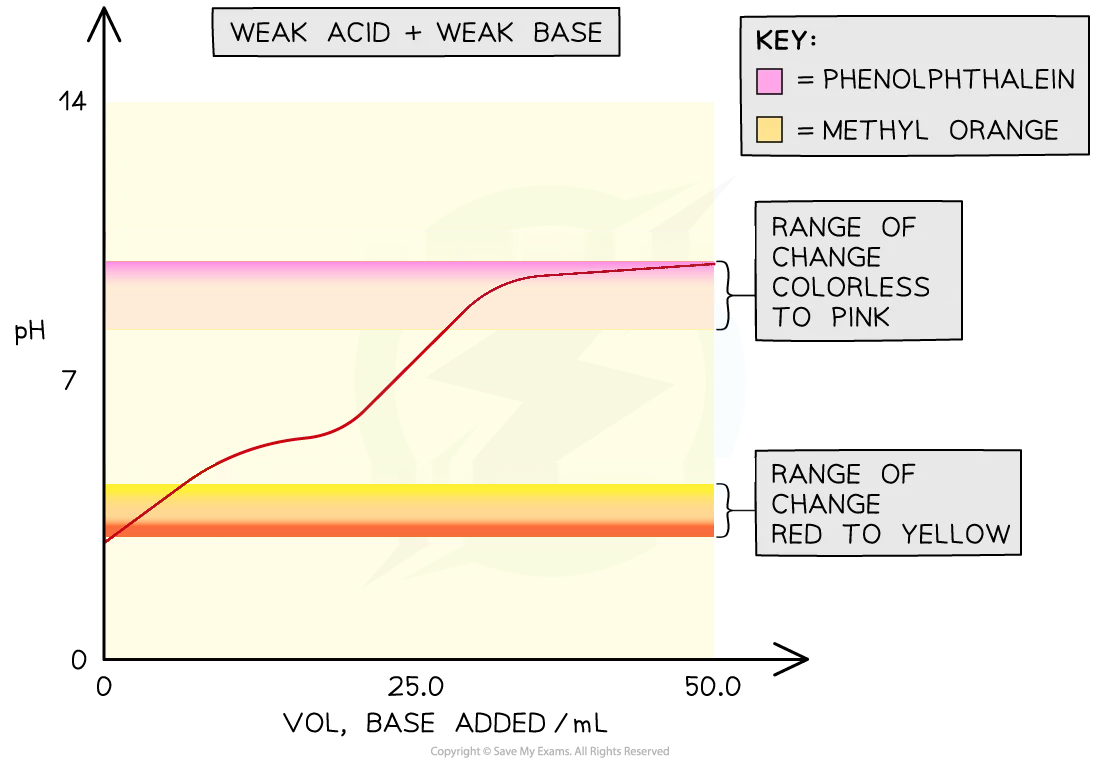
The overlay on the graph shows that both phenolphthalein and methyl orange would change color outside the point of inflection in a weak acid-weak base titration so they would not be able to show the equivalence point of the titration

Unlock more, it's free!
Join the 100,000+ Students that ❤️ Save My Exams
the (exam) results speak for themselves:

Was this revision note helpful?
Build on this topic