Thermodynamic & Kinetic Control (College Board AP® Chemistry): Study Guide

Thermodynamic & kinetic control
A common misconception is that thermodynamically favorable reactions occur quickly
Actually, some processes that are thermodynamically favored either occur at a very slow rate or do not occur to any measurable extent
These reactions are said to be under kinetic control
A reaction that does not proceed at a noticeable rate is not necessarily at equilibrium
If a process is known to be thermodynamically favored but does not occur at a measurable rate, it is reasonable to conclude that it is under kinetic control
A common reason is a high activation energy, Ea
Reactions with a high Ea occur extremely slowly, or not to any measurable extent, at room temperature
Some reactions under kinetic control can be sped up by using a catalyst which reduces the activation energy and allows the reaction to proceed at a measurable rate
Hydrogen peroxide decomposition
For example, the decomposition of hydrogen peroxide at 298 K
H2O2 (l) → H2O (l) + ½O2 (g)
This reaction has a high Ea, so at 298 K it is very slow; adding manganese dioxide, MnO2, as a catalyst makes it fast
If the reaction was left for long enough, the hydrogen peroxide would eventually decompose
However, the addition of the MnO2 allows the reaction to take place via an alternative route with a lower Ea
Reaction energy profiles can be used to show how the activation energy changes when a catalyst is used
Reaction energy profile for an exothermic reaction
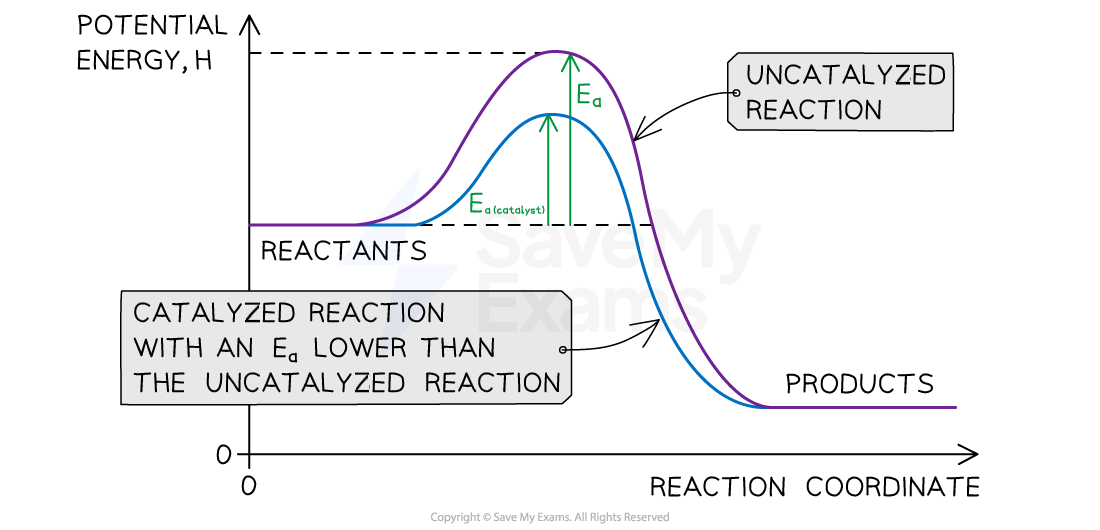
A catalyst will lower the activation energy, Ea, and help speed up some reactions that are under kinetic control
Examiner Tips and Tricks
If a question asks why a thermodynamically favored reaction does not occur at room temperature, or needs heating to proceed, answer in terms of kinetics. For example, the activation energy is high, so few collisions have enough energy to react.
Arguments from ΔH°, ΔS° or ΔG° do not answer this. Readers have previously commented on “Focusing on thermodynamics rather than kinetics” and “Invoking thermodynamics” as errors.

Unlock more, it's free!
Join the 100,000+ Students that ❤️ Save My Exams
the (exam) results speak for themselves:

Was this revision note helpful?
Build on this topic