Resonance & Lewis Structures (College Board AP® Chemistry): Study Guide

Resonance & Lewis structures
Some molecules can be represented by more than one Lewis structure
Resonance structures are equivalent Lewis structures of the same molecule or ion
The atoms stay in the same positions and only the electrons are arranged differently
The resonance hybrid is the actual structure of a molecule, and it is a mixture of all its resonance structures
Resonance occurs because electrons are often delocalized
Delocalized electrons are not fixed to a single atom or covalent bond, therefore they can be spread through the molecule
The resonance hybrid is the most stable form of a molecule because the delocalization of electrons stabilizes the structure
Resonance structures of the nitrate ion
To draw the resonance structure of the nitrate ion, the first step is to count the valence electrons that are present in the ion
There is one nitrogen atom, three oxygen atoms and a negative charge
Nitrogen in group 15 contributes 5 valence electrons
Oxygen in group 16 contributes 6 valence electrons
The negative charge means that an electron has been gained
Valence electrons = N + (3 × O) + 1e⁻
Valence electrons = 5 + (3 × 6) + 1e⁻
Valence electrons = 24e⁻
After drawing a skeletal structure (N as the central atom) and placing the bonding and nonbonding electrons, three Lewis structures are possible
Each structure has one double bond and two single bonds
Only the position of the double bond (and the lone pairs) differs
The structures are not real and do not switch between each other
The ion has one structure, the resonance hybrid, in which all three N–O bonds are identical
Resonance in the nitrate ion

Resonance structures in the nitrate ion
Once the resonance structures are identified, the resonance hybrid can be drawn using dashed lines to show the delocalized electrons
The three resonance structures have more energy than the resonance hybrid of nitrate ion
Therefore, the resonance hybrid is the most stable and the actual structure of the nitrate ion
Resonance predicts properties that a single Lewis structure cannot
All three N–O bonds in the nitrate ion have the same length and strength, between those of a single and a double bond (bond order 4/3)
The nitrate ion resonance hybrid
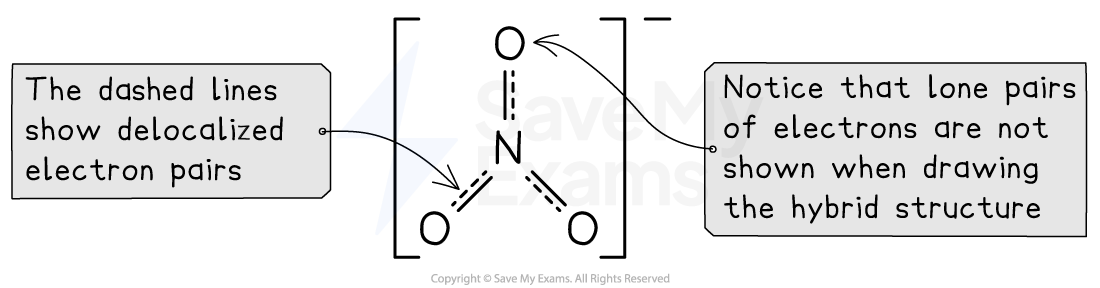
Resonance hybrid nitrate ion
Other examples of resonance
Some common examples of resonance are the carbonate ion, benzene, ozone, and the carboxylate ion which are shown below:
Carbonate ion, CO32-
Lewis diagram:

Resonance hybrid structure:

Benzene, C6H6
Lewis diagram:

Resonance hybrid structure:

Ozone, O3
Lewis diagram:

Resonance hybrid structure:

Carboxylate ion, RCOO-
Lewis diagram:

Resonance hybrid structure:

Examiner Tips and Tricks
To show resonance, draw at least two structures joined by a double-headed arrow (↔), or draw the hybrid with dashed bonds.
Resonance structures keep every atom in the same place, so drawing the same ion rotated is not a new resonance structure.
Check the charge before you draw: a resonance structure of NO2 must not be drawn as NO2+.

Unlock more, it's free!
Join the 100,000+ Students that ❤️ Save My Exams
the (exam) results speak for themselves:

Was this revision note helpful?
Build on this topic