Solubility of Ionic & Molecular Compounds (College Board AP® Chemistry): Study Guide

Solubility of ionic & molecular compounds
The solubility of two substances depends on their intermolecular interactions
Ions and molecules can attract each other through:
Ion–dipole forces
Hydrogen bonding
Dipole–dipole forces
Dipole–induced dipole forces
London dispersion forces
All molecules have London dispersion forces
Polar molecules have dipole–dipole forces in addition
Ion–dipole forces tend to be stronger than dipole–dipole forces, but there is no fixed order for the others
London dispersion forces between large, polarizable molecules can be stronger than dipole–dipole forces or hydrogen bonds between small molecules
A solution is made from two components a solvent and a solute
In a solution system, intermolecular interactions exist in three possible scenarios:
Solvent–solute, i.e. solvent particles with solute particles
Solvent–solvent, i.e. solvent particles with themselves
Solute–solute, i.e. solute particles with themselves
When does a solution form?
Substances with similar intermolecular interactions tend to be miscible or soluble in one another, because the solute–solvent attractions can replace the solute–solute and solvent–solvent attractions
Two liquids that mix completely in all proportions are miscible; a solid that dissolves in a liquid is soluble
E.g. ethanol and water molecules hydrogen bond to each other, so ethanol and water are miscible
When the solvent-solvent interaction and the solute-solute interaction are not equal, the strength of the solvent-solute interaction must be considered
The three interactions between the particles of solute and solvent

Solvent-solvent, solvent-solute and solute-solute interactions must be considered for solubility
A solution is formed when the solute–solvent attractions can replace the solute–solute and solvent–solvent attractions
For example, sodium chloride:
When sodium chloride dissolves in water, ion–dipole attractions between the ions and water molecules replace the attractions between the ions in the lattice and some of the hydrogen bonds between water molecules
Therefore, sodium chloride is soluble in water
Not every ionic compound is very soluble
If the attractions between the ions in the lattice are too strong, little of the solid dissolves
Examiner Tips and Tricks
On the AP exam you are expected to know that all sodium, potassium, ammonium and nitrate salts are soluble in water
A solution is unlikely to form when the solute–solvent attractions are much weaker than the solvent–solvent attractions they would have to replace
For example, hexane and water:
The weak attractions between hexane and water molecules cannot replace the hydrogen bonds between water molecules
Therefore, they are not miscible in one another
The rules of solution formation are summarized in the table below
Predicting whether a solution forms
Comparison of attractions | Solution likely? |
|---|---|
Solute–solvent attractions similar to, or stronger than, the solute–solute and solvent–solvent attractions they replace | Yes, they tend to be miscible or soluble |
Solute–solvent attractions much weaker than those they replace | No, e.g. hexane and water |
Examiner Tips and Tricks
Make sure to explain solubility using the attractions between solute and solvent particles. Describing only the forces in the pure solute or the pure solvent does not earn credit
When a molecular solute such as ethanol dissolves, its molecules separate: no covalent bonds break and no ions form
"Like dissolves like" is not a justification on its own. You must name and compare the attractions (e.g. the number of hydrogen-bonding sites)
Worked Example
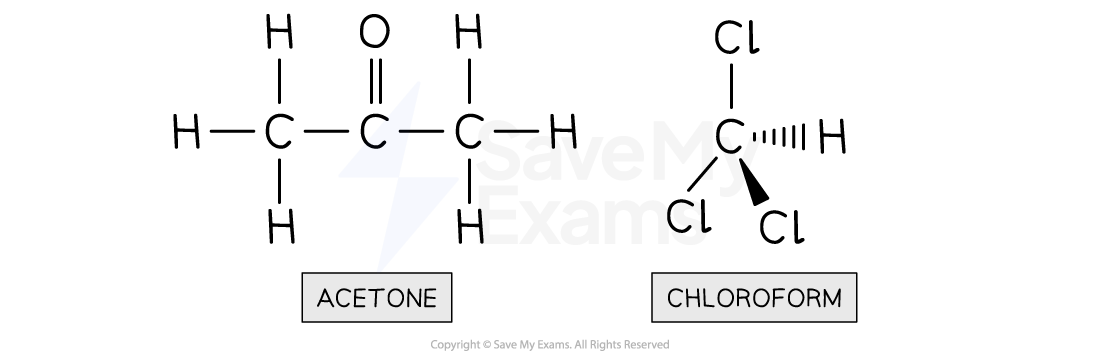
Predict if a solution will be formed when chloroform is mixed with an acetone solvent.
Answer:
Step 1 (Optional): Draw the molecular structure of the solvent molecules and the solute molecules. This step is not applicable to ions since they exist as lattice structures
Step 2: Identify the solvent-solvent intermolecular interactions
Acetone is the solvent. Since oxygen is more electronegative than carbon, a dipole moment will be formed

Therefore, acetone molecules attract each other through dipole–dipole forces in addition to London dispersion forces
Step 3: Identify the solute-solute intermolecular interactions
Chloroform is the solute. Since it is a non-symmetrical molecule and chlorine is more electronegative than carbon, dipole moments will be formed

Therefore, chloroform molecules attract each other through dipole–dipole forces in addition to London dispersion forces
Step 4: Identify the solute–solvent attractions and compare them with the solute–solute and solvent–solvent attractions they must replace
Acetone and chloroform molecules attract each other through dipole–dipole and London dispersion forces that are similar in strength to the attractions in each pure liquid, so acetone and chloroform are miscible
Worked Example
Predict if a solution will be formed when hexane is mixed with water as solvent.

Answer:
Step 1 (Optional): Draw the molecular structure of the solvent molecules and the solute molecules. This step is not applicable to ions since they exist as lattice structures
Step 2: Identify the solvent-solvent intermolecular interactions
Water is the solvent. Since hydrogen is bonded to a highly electronegative atom such as oxygen, a strong dipole moment will be formed
Therefore, water molecules attract each other through hydrogen bonding (and London dispersion forces)

Step 3: Identify the solute-solute intermolecular interactions
Hexane is the solute
Since hexane is a symmetrical molecule, all its dipole moments are canceled out

Therefore, the only attractions between hexane molecules are London dispersion forces
Step 4: Identify the solute–solvent attractions and compare them with the solute–solute and solvent–solvent attractions they must replace
The solvent-solvent interaction is not the same as solute-solute interaction
The solvent-solute interaction must be considered
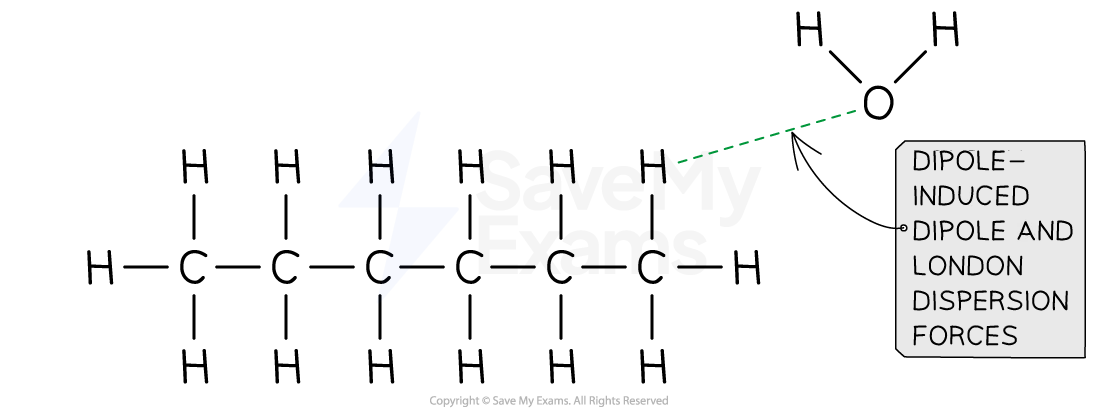
As shown in the image above, water and hexane attract each other through dipole–induced dipole forces (the water dipole induces a temporary dipole in hexane) and London dispersion forces
The attractions between hexane and water molecules are much weaker than the hydrogen bonds between water molecules that they would have to replace
So water molecules stay hydrogen-bonded to each other, hexane and water are not miscible, and they form two layers

Unlock more, it's free!
Join the 100,000+ Students that ❤️ Save My Exams
the (exam) results speak for themselves:

Was this revision note helpful?
Build on this topic