Physical & Chemical Changes (College Board AP® Chemistry): Study Guide

Evidence of physical changes
Physical changes
Matter constantly undergoes changes
A physical change occurs when a substance’s properties change but its composition does not, e.g. a change of state
In physical changes, the internal composition of matter remains the same
E.g. All the changes of state of a substance are physical changes because the particles preserve their identity
Changes of state

Interconversions between states of matter are all physical changes
Another common example of physical change is the formation or separation of a mixture
A mixture is a combination of two or more substances that are not chemically joined, so each keeps its own composition
When salt and water are mixed, the water molecules and the salt ions attract each other, but the particles themselves are unchanged
Dissolving an ionic solid can also be argued to be a chemical process, because ionic bonds break (see Physical & Chemical Processes)
The mixture can be separated into its components by a simple distillation
Water can be collected in a separate container, while the salt remains in the round-bottom flask
Separation of a mixture between water and salt
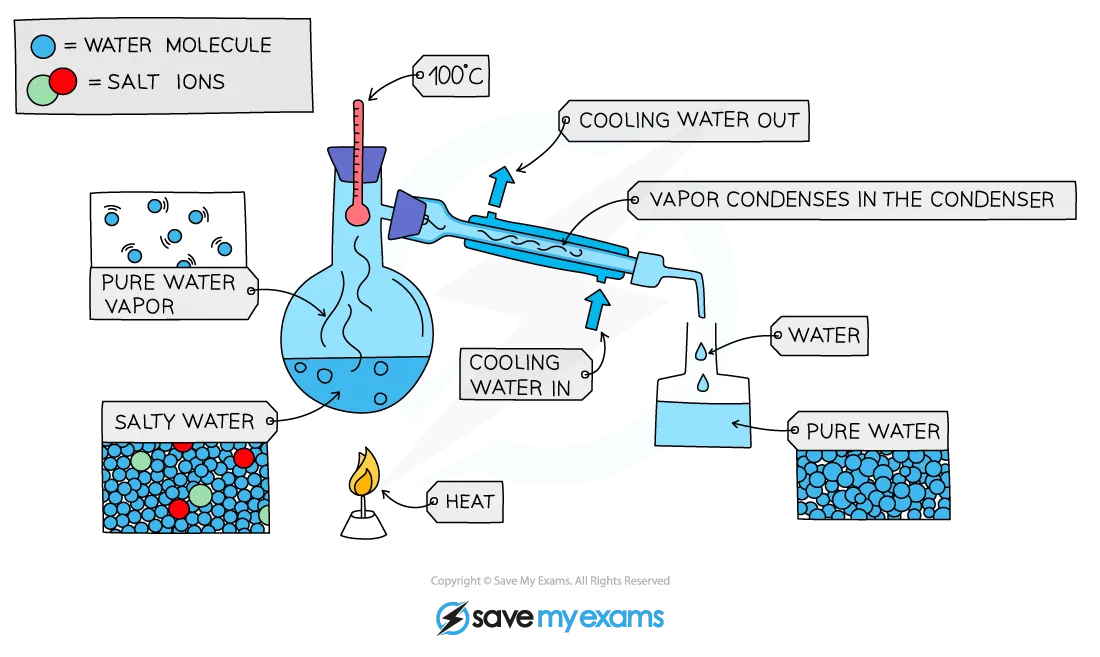
The separation of a mixture is a common physical change because the components do not lose their internal structure
Examiner Tips and Tricks
Dissolving or diluting is a physical change. If a question asks what happens when a solid dissolves:
Describe the particles separating and being attracted to water molecules
Do not write a reaction between the solute and water
Readers list a ‘chemical reaction between Ca(OH)2 and H2O’ and a ‘chemical reaction between CuSO4 and water’ among students’ common errors
Evidence of chemical changes
Chemical changes
A chemical change occurs when substances are transformed into new substances, typically with different compositions
In chemical changes, the atoms from the original substances rearrange to form new substances
The new substances are chemically different than the original ones
E.g. When hydrogen burns with air, water is produced. Water is totally different in its chemical composition compared to hydrogen gas and oxygen gas
Possible evidence that a chemical change has occurred includes the production of heat or light, the formation of a gas, the formation of a precipitate (an insoluble solid that forms in a solution) and a color change
E.g. when nitric acid reacts with a copper penny, a brown gas and a blue-green solution form
These are clues, not proof: boiling also produces a gas and dissolving can release heat, so check whether a new substance has formed
Reaction between nitric acid and a copper penny

Chemical change showing the formation of a brown gas and a blue-green solution when nitric acid reacts with a copper penny

Unlock more, it's free!
Join the 100,000+ Students that ❤️ Save My Exams
the (exam) results speak for themselves:

Was this revision note helpful?
Build on this topic
