Introduction to Rate Law (College Board AP® Chemistry): Study Guide

Rate law
Experimental data and the rate of reaction
Experiments monitor the amount of a reactant or product over time (for example by measuring the volume or pressure of a gas, or the color intensity of a solution) to find the rate
Measuring the rate at several concentrations of a reactant shows how the rate depends on that concentration
The following general reaction will be used as example
D → E + F
The rate of reaction at different concentrations of D was tabulated and plotted
[D] (M) | Rate (M s-1) |
|---|---|
3.00 | 2.000 × 10⁻³ |
2.00 | 1.334 × 10⁻³ |
1.00 | 6.670 × 10⁻⁴ |
A line is plotted and the slope of the line is calculated using the formula below
slope =
Graph to show rate against [D]
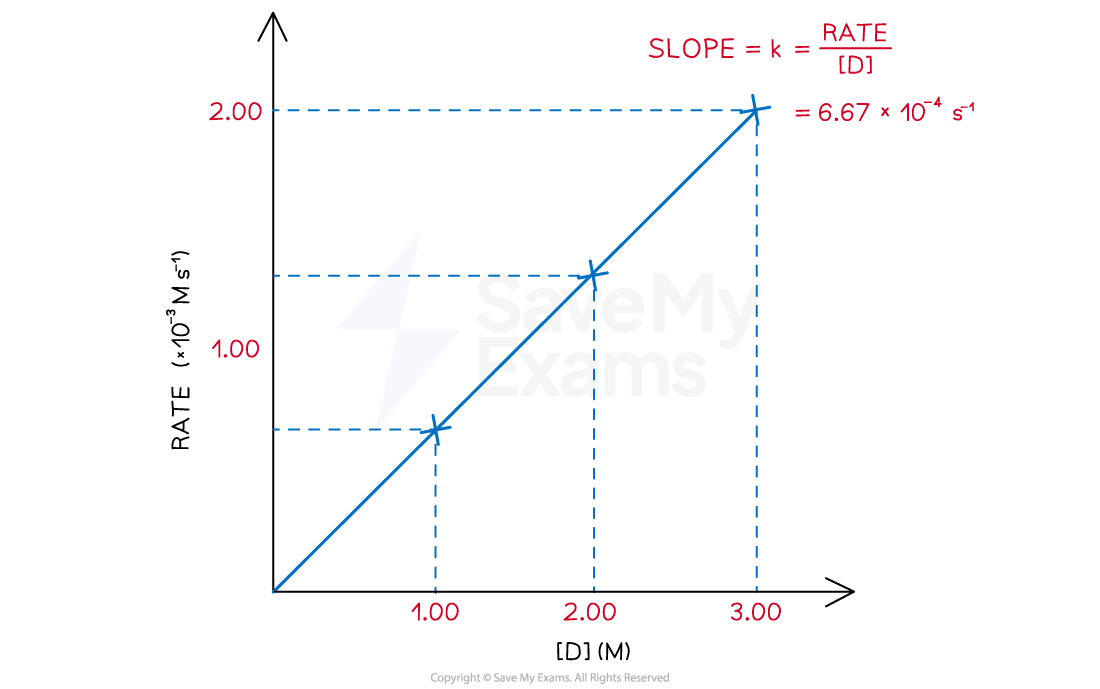
Rate of reaction over various concentrations of D
As shown in the diagram, there is a directly proportional relation between the rate of reaction and the concentration of D
This relation can be written as a mathematical equation as shown below
Rate ∝ [D]
Rate = k [D]
From the slope of the graph, k = 6.67 × 10⁻⁴ s-1
This equation means that if the concentration of D doubles, the rate will double
The constant of proportionality (k) is called the rate constant
The value of k depends on temperature: at one temperature k is fixed, and changing a concentration changes the rate, not k
The units of k reflect the overall order of the reaction
The rate equation
The following general reaction will be used to discuss the rate equation:
A + B → C + D
The general rate equation is:
Rate = k[A]m[B]n
Where:
[A] and [B] are the concentrations of the reactants
m and n are the orders with respect to each reactant
The rate law (the orders m and n) can only be found from experimental data
It cannot be read from the coefficients in the balanced equation
In the worked example below, N2O5 has a coefficient of 2 but is first order
Reaction intermediates do not appear in the rate law
The order of reactants
The order with respect to a reactant shows how the rate depends on that reactant’s concentration
It is represented as the power to which the concentration is raised in the rate equation
The most common orders are listed below:
Zero order occurs when the order with respect to a reactant is 0
This means that changing the concentration has no effect on the rate
Therefore, it is not included in the rate equation
First order occurs when the order with respect to a reactant is 1
This means that the concentration is directly proportional to the rate
E.g. Doubling the concentration will double the rate
Second order occurs when the order with respect to a reactant is 2
This means that the rate is directly proportional to the square of the concentration
E.g. Doubling the concentration increases the rate by a factor of 4, since 22 = 4
Overall order is just the sum of the powers of the reactants that appear in the rate equation
Worked Example
The chemical equation for the thermal decomposition of dinitrogen pentoxide is:
2N2O5 (g) → 4NO2 (g) + O2 (g)
The rate equation for this reaction is:
Rate = k [N2O5 (g)]
State the order of reaction with respect to dinitrogen pentoxide
State the overall order of reaction
Deduce the effect on the rate of reaction if the concentration of dinitrogen pentoxide is doubled
Determine the units of the rate constant
Answer:
Answer 1:
Dinitrogen pentoxide features in the rate equation, therefore, it cannot be order zero
The dinitrogen pentoxide is not raised to a power, which means that it cannot be order 2
Therefore, the order with respect to dinitrogen pentoxide must be order 1
Answer 2:
Dinitrogen pentoxide is the only reactant and is raised to the power 1
So, the overall order is first order
Answer 3:
Since the overall order is first order, the concentration of dinitrogen pentoxide is directly proportional to the rate
This means that if the concentration of dinitrogen pentoxide is doubled, the rate of reaction will double
Answer 4:
Rearranging the equation:
units of rate constant =
units of rate constant =
Examiner Tips and Tricks
The units of k depend on the overall order. With time in seconds:
Rate constant units of a zero order reaction are M s-1
Rate constant units of a first order reaction are s-1
Rate constant units of a second order reaction are M-1 s-1
Use the time unit of the data: if time is in hours, a first-order k is in hr-1
Make sure to write the rate constant as lowercase k. K is the equilibrium constant, so ‘rate = Kc[NO2]2’ is wrong
Careful: The rate, k and the half-life are different quantities. At one temperature k stays the same while the rate changes with concentration
Initial rates & orders of reaction
The order of the reactants can be determined with experimental data from the initial rates of reaction
This information is usually displayed in a table
The following steps must be followed to determine the order for each reactant:
Identify two experiments where the concentration of this reactant changes, but the concentration of the other reactants is the same
Identify what has happened with the concentration
Determine the effect of the concentration in the rate of reaction
Deduce the order of reaction
Repeat this procedure with all the reactants, one at a time
Once all the orders are determined the rate equation can be built
Zero order reactants are not included
First order reactants are included with no power written (the power is 1)
Second order reactants are raised to the power of 2
Examiner Tips and Tricks
When you justify an order:
Name the two experiments you compare
Say that the other reactant’s concentration is held constant
Say what happens to the rate
E.g. ‘In experiments 1 and 2, [OH-] is constant; doubling [(CH3)3CBr] doubles the rate, so the reaction is first order in (CH3)3CBr’.
Make sure to always name the substance and refer to the data
Worked Example
(CH3)3CBr + OH- → (CH3)3COH + Br-
The table shows experimental data for the reaction above
Experiment | Initial [(CH3)3CBr] / M | Initial [OH-] / M | Initial rate of reaction / M s-1 |
|---|---|---|---|
1 | 1.0 × 10⁻³ | 2.0 × 10⁻³ | 3.0 × 10⁻³ |
2 | 2.0 × 10⁻³ | 2.0 × 10⁻³ | 6.0 × 10⁻³ |
3 | 1.0 × 10⁻³ | 4.0 × 10⁻³ | 3.0 × 10⁻³ |
4 | 1.5 × 10⁻³ | 4.0 × 10⁻³ | 4.5 × 10⁻³ |
Determine the rate equation for this reaction
Answer:
Order with respect to (CH3)3CBr
In experiments 1 and 2, the concentration of (CH3)3CBr changes while the concentration of OH- remains constant
The [(CH3)3CBr] has doubled
The rate of the reaction has also doubled
Therefore, the order with respect to [(CH3)3CBr] is 1 (first order)
[change in concentration]order = change in rate
[2]order = 2
[2]1 = 2
order = 1
Order with respect to OH-
In experiments 1 and 3, the concentration of OH- changes while the concentration of (CH3)3CBr remains constant
The [OH-] has doubled
The rate of the reaction has not changed
Therefore, the order with respect to [OH-] is 0 (zero order)
[change in concentration]order = change in rate
[2]order = 1
[2]0 = 1
order = 0
Building the rate equation:
Rate = k[(CH3)3CBr]m[OH-]n
Replacing the orders:
Rate = k[(CH3)3CBr]
The rate constant:
k = rate ÷ [(CH3)3CBr]
k = 3.0 × 10⁻³ M s-1 ÷ 1.0 × 10⁻³ M
k = 3.0 s-1
Experiments 2 and 4 give the same value, which confirms the rate law

Unlock more, it's free!
Join the 100,000+ Students that ❤️ Save My Exams
the (exam) results speak for themselves:

Was this revision note helpful?
Build on this topic