Electrochemical Cells (College Board AP® Chemistry): Study Guide

Electrochemical cells
Redox reactions involve simultaneous oxidation and reduction
Electrons flow from the species that is oxidized to the species that is reduced
Which way electrons flow depends on the reactivity of the species involved
Redox chemistry has very important applications in electrochemical cells, which come in two types:
Voltaic or galvanic cells
Electrolytic cells
Reduction and oxidation in cells
Regardless of the type of cell:
Oxidation takes place at the anode
Reduction takes place at the cathode
But depending on the type of cell, the polarity changes
In voltaic cells, the anode is negative
In electrolytic cells, the anode is positive
Identify the anode and cathode by where oxidation and reduction happen, not by the sign of the electrode
Comparing galvanic and electrolytic cells
| Negative | Positive |
|---|---|---|
Voltaic cell | anode | cathode |
oxidation | reduction | |
Electrolytic cell | cathode | anode |
reduction | oxidation |
Examiner Tips and Tricks
Students often confuse the redox processes that take place in voltaic cells and electrolytic cells
An easy way to remember is the phrase RED CAT and AN OX
REDuction takes place at the CAThode
OXidation takes place at the ANode
Galvanic (voltaic) & electrolytic cells
Voltaic cells
A galvanic (voltaic) cell generates a potential difference called the cell potential, given the symbol E
The potential of a single electrode cannot be measured on its own
A voltmeter measures the difference between two electrodes, which is the cell potential
Galvanic (voltaic) cells generate electricity from a thermodynamically favored redox reaction, for example:
Zn (s) + CuSO4 (aq) → Cu (s) + ZnSO4 (aq)
Instead of electrons being transferred directly from the zinc to the copper ions, a cell is built which separates the two redox processes
Each part of the cell is called a half-cell
If a rod of metal is dipped into a solution of its own ions, an equilibrium is set up
For example
Zn (s) ⇌ Zn2+ (aq) + 2e–
Zinc metal in a solution of zinc sulfate

When a metal is dipped into a solution containing its ions, an equilibrium is established between the metal and its ions
This is a half-cell and the strip of metal is an electrode
The position of the equilibrium determines the potential difference between the metal strip and the solution of metal
The Zn atoms on the rod can deposit two electrons on the rod and move into solution as Zn2+ ions:
Zn (s) ⇌ Zn2+ (aq) + 2e–
This process would result in an accumulation of negative charge on the zinc rod
Alternatively, the Zn2+ ions in solution could accept two electrons from the rod and move onto the rod to become Zn atoms:
Zn2+ (aq) + 2e– ⇌ Zn (s)
This process would result in an accumulation of positive charge on the zinc rod
In both cases, a potential difference is set up between the rod and the solution
This is known as an electrode potential
A similar electrode potential is set up if a copper rod is immersed in a solution containing copper ions (e.g. CuSO4), due to the following processes:
Cu2+ (aq) + 2e– ⇌ Cu (s) – reduction (rod becomes positive)
Cu (s) ⇌ Cu2+ (aq) + 2e– – oxidation (rod becomes negative)
No net reaction takes place in a single half-cell
The equilibrium sets up a potential difference between the rod and the solution
Creating a cell potential
If two different electrodes are connected, the potential difference between the two electrodes will cause a current to flow between them
Thus a cell potential is established and the system can generate electrical energy
A typical electrochemical cell can be made by combining a zinc electrode in a solution of zinc sulfate with a copper electrode in a solution of copper sulfate
Electrochemical cell

The zinc-copper voltaic cell (also known as the Daniell Cell)
A salt bridge containing a strong electrolyte such as KNO3 (aq) joins the two half-cells
Its ions migrate to keep each half-cell electrically neutral
Cations (K+) move toward the cathode half-cell
Anions (NO3−) move toward the anode half-cell
Electrons never travel through the salt bridge
They travel only through the external wire, from the anode to the cathode
The cell potential can be measured using a voltmeter
Voltmeters have a high resistance so that they do not divert much current from the main circuit
The two half cells are said to be in series as the same current is flowing through both cells
The combination of two electrodes in this way is known as a voltaic cell and can be used to generate electricity
As the zinc-copper cell runs:
The zinc anode loses mass because Zn atoms become Zn2+ ions in the zinc sulfate solution
The copper cathode gains mass because Cu2+ ions from the copper(II) sulfate solution become Cu atoms
Electrons have almost no mass, so they do not carry mass from one electrode to the other
Conventional representation of cells
Chemists use a type of shorthand convention to represent electrochemical cells
In this convention:
A solid vertical (or slanted) line shows a phase boundary, which is an interface between a solid and a solution
A double vertical line (sometimes shown as dashed vertical lines) represents a salt bridge
A salt bridge has mobile ions that complete the circuit
Potassium chloride and potassium nitrate are commonly used to make the salt bridge as chlorides and nitrates are usually soluble
This should ensure that no precipitates form which can affect the equilibrium position of the half-cells
The substance with the highest oxidation state in each half-cell is drawn next to the salt bridge
The cell potential difference is shown with the polarity of the right-hand electrode
The cell convention for the zinc and copper cell would be
Zn (s) ∣ Zn2+ (aq) ∥ Cu2+ (aq) ∣ Cu (s) E cell = +1.10 V
This tells us the copper half-cell is more positive than the zinc half-cell so that electrons would flow from the zinc to the copper half-cell
The same cell can be written as:
Cu (s) ∣ Cu2+ (aq) ∥ Zn2+ (aq) ∣ Zn (s) E cell = -1.10 V
The polarity of the right-hand half-cell is negative, so we can still tell that electrons flow from the zinc to the copper half-cell
Examiner Tips and Tricks
Cell notation is useful shorthand, but it is not part of the AP Chemistry course and is unlikely to appear in the exam.
Identify the anode and cathode by where oxidation and reduction happen, not by where they sit in a cell diagram.
Electrolytic cells
An electrolytic cell uses an external power source to drive a thermodynamically unfavored reaction
The reaction continues only while the power source keeps supplying energy
The cell can be a beaker (for a solution) or a crucible (for a molten ionic compound)
Electrolysis of a molten ionic compound
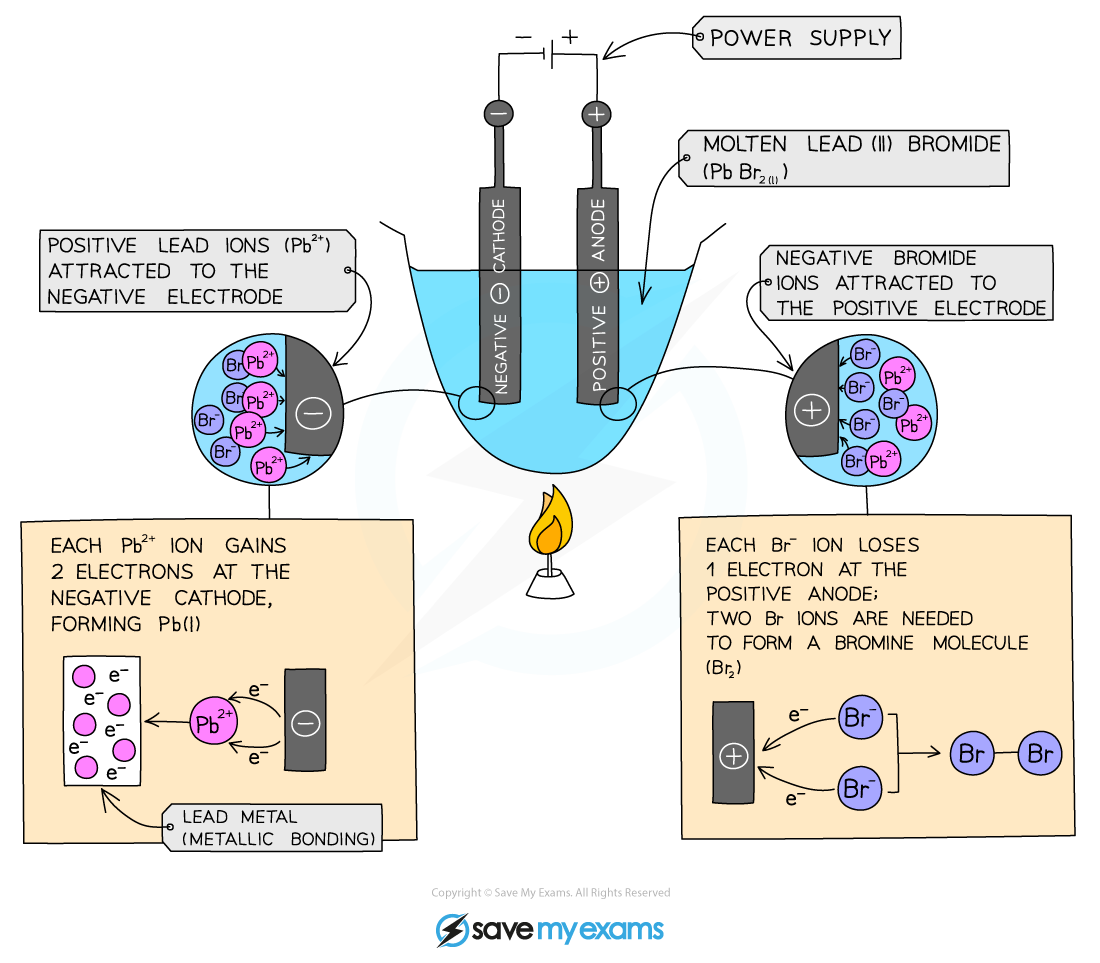
Positive ions move to the negative electrode and negative ions move to the positive electrode
In electrolytic cells, the substance that the current passes through and splits up is called the electrolyte
The electrolyte contains positive and negative ions
What happens to these ions during electrolysis?
Negative ions move to the anode and lose electrons, which is oxidation
Positive ions move to the cathode and gain electrons, which is reduction
Electrically neutral atoms or molecules are released
Electrolysis of molten lead bromide
The reactions which take place at the electrodes can be shown by half equations
When the positive lead ions move to the cathode, they gain electrons in a reduction reaction:
Pb2+ + 2e− → Pb (l)
Similarly, when the bromide ions move to the anode they lose electrons in an oxidation reaction:
2Br− → Br2 (g) + 2e−
In a molten binary ionic compound the metal forms the cation and the nonmetal forms the anion
So, the metal forms at the cathode and the nonmetal at the anode

Unlock more, it's free!
Join the 100,000+ Students that ❤️ Save My Exams
the (exam) results speak for themselves:

Was this revision note helpful?
Build on this topic