Electronegativity Values (College Board AP® Chemistry): Study Guide

Electronegativity values
Electronegativity is the tendency of an atom to attract a pair of electrons when it forms a covalent bond, mainly involving valence electrons
Trends in electronegativity
For the representative elements, electronegativity increases from left to right across a period
The number of protons increases while the number of inner shells stays the same, so the effective nuclear charge increases
This makes the Coulombic attraction between the nucleus and the electrons from the covalent bond stronger
Therefore, the electronegativity value will increase
Change in electronegativity across a period
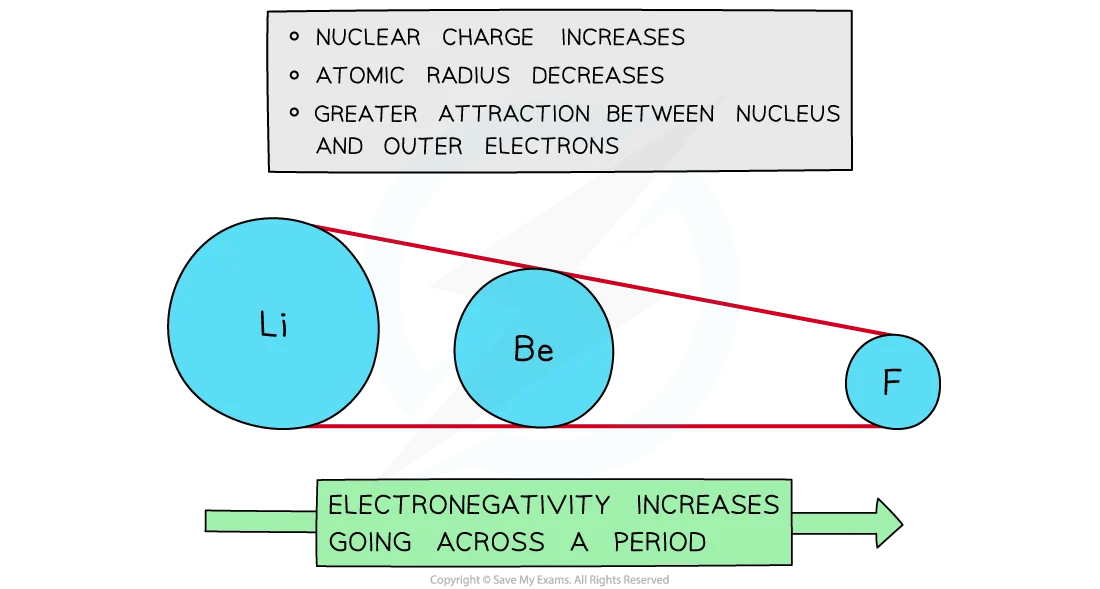
Electronegativity increases going across the periods of the periodic table
Down a group, electronegativity decreases
The bonding electrons are in a higher occupied shell, so they are farther from the nucleus
The extra inner shells cancel the extra protons, so the core charge felt by the bonding pair stays about the same
The Coulombic attraction between the nucleus and the bonding pair is therefore weaker, so electronegativity decreases
Change in electronegativity down a group
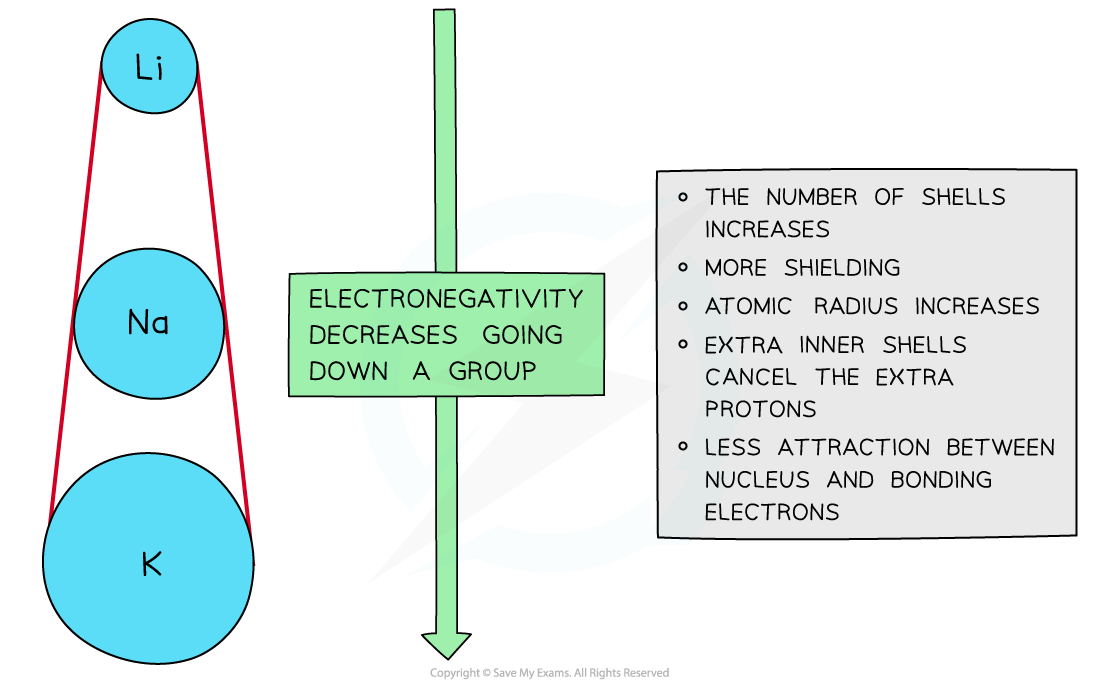
Electronegativity decreases going down a group of the periodic table
The Pauling scale
The Pauling scale has the values of electronegativity for each atom
Electronegativity values are not usually given for helium, neon and argon because they do not form stable compounds
Heavier noble gases, such as xenon, do form covalent compounds (for example, XeF4)
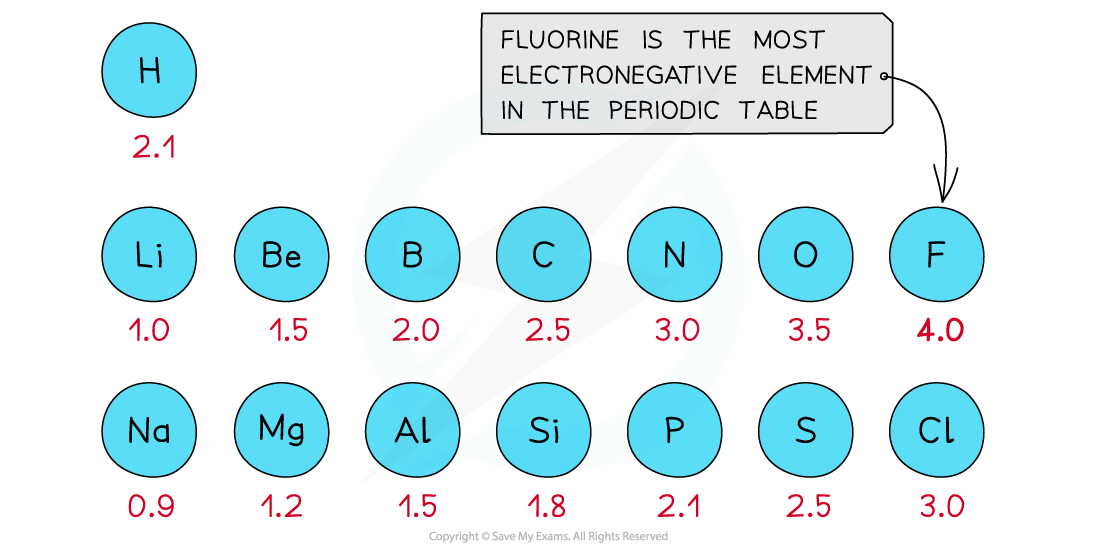
First three rows of the periodic table showing electronegativity values
Fluorine (F) is the most electronegative atom in the periodic table
It attracts the bonding pair in a covalent bond more strongly than any other atom
Molecule of CH3F
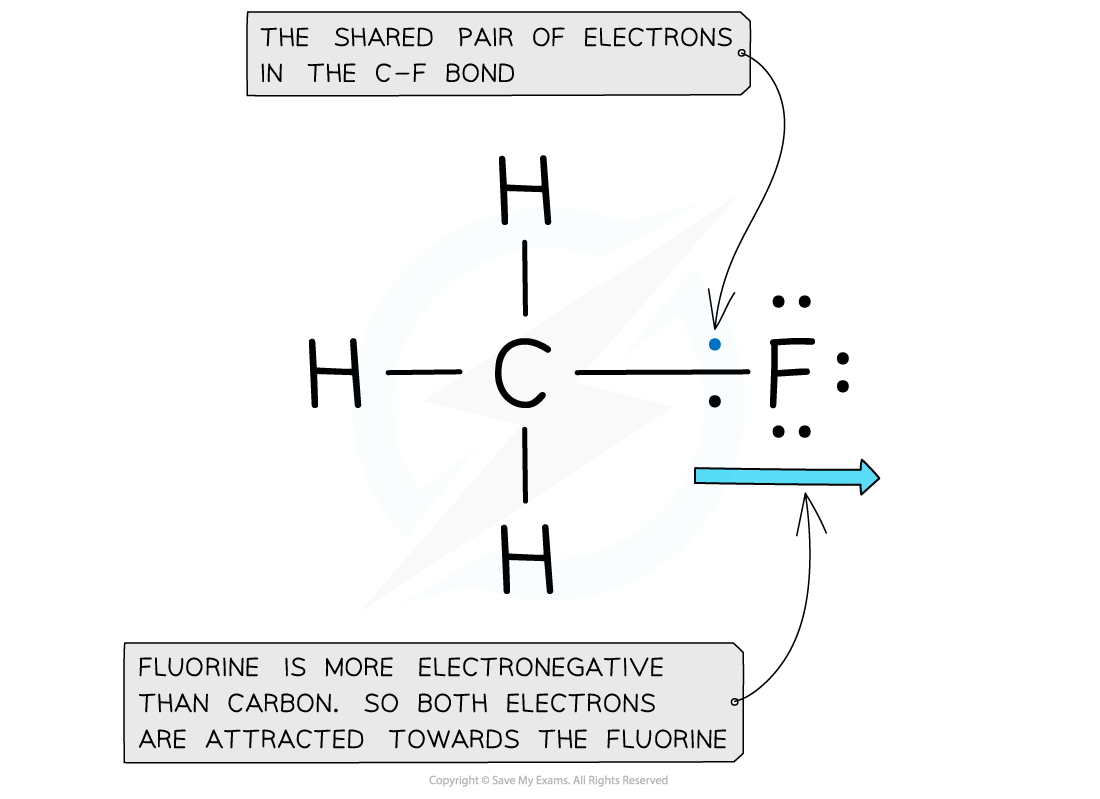
Electron distribution in the C-F bond of fluoromethane
Examiner Tips and Tricks
Electronegativity tells you how unequally a bonding pair is shared, so it predicts bond polarity.
It does not explain the strength of the attraction between ions in an ionic solid: compare the ion charges and the distance between the ion centers using Coulomb's law instead.
When you explain why electronegativity decreases down a group, say that the bonding electrons are in a higher shell, farther from the nucleus.
Answers that only say 'more shielding' or 'lower effective nuclear charge' do not earn the point.

Unlock more, it's free!
Join the 100,000+ Students that ❤️ Save My Exams
the (exam) results speak for themselves:

Was this revision note helpful?
Build on this topic