Relative Strength of Acids & Bases (College Board AP® Chemistry): Study Guide

Relative strength of acids & bases
Why are some acids stronger than others?
Acid strength is determined by the stability of the conjugate base of the acid
The more stable the conjugate base the stronger the acid
Or, the stronger the acid, the weaker the conjugate base
An acid will donate a proton to form a conjugate base
HA (aq) | + H2O (l) | H3O+ (aq) | + A– (aq) | |
acid | base |
| conjugate acid | conjugate base |
Table of acids and conjugate bases
Acid | Conjugate base |
|---|---|
HNO3 | NO3– |
H2SO4 | HSO4– |
HClO4 | ClO4– |
HCl | Cl– |
HBr | Br– |
HI | I– |
These six are the strong acids: they ionize completely in water, and their conjugate bases are very weak
They are stabilized by electronegativity, inductive effects, resonance or a combination of these
Factors that affect acid strength
Bond polarity
In general, as the polarity of the H–A bond increases, the strength of the acid will increase
For example, oxyacids (X–O–H) react with water via the following reaction
AOH + H2O AO– + H3O+
Oxyacids (X–O–H), polarity and pKa values
Acid | Name | Polarity of O–H | *pKa |
|---|---|---|---|
Cl–O–H | hypochlorous acid | Most polar | 7.5 |
Br–O–H | hypobromous acid | - | 8.7 |
I–O–H | hypoiodous acid | Least polar | 10.7 |
*The lower the pKa value, the stronger the acid
The electronegativity of the halogen atom increases up the group, so the polarity of the O–H bond will increase up the group as well
This is because of the electron-withdrawing inductive effect of the halogen atom
The more electronegative the element (X), the more polar the O–H bond, as more electron density is withdrawn from the O–H bond
The inductive effect in an oxy acid

The more electronegative X element withdraws electron density from the O–H bond
Therefore the acid is more likely to donate a proton
Bond strength
The weaker the H–A bond, the more easily HA loses a proton
In general, the weaker the bond, the stronger the acid
For example, the H–X bond in the hydrogen halides becomes weaker moving down group 17, so acid strength increases from HF to HI
This is due to the increase in bond length of the H–X bond and, therefore, the increased ability for the acid to donate a proton
For the hydrogen halides, bond strength matters more than bond polarity
H–F is the most polar bond but also the strongest, so HF is the weakest of the four acids
Table to show the relative bond enthalpies and strengths of the Group 17 binary acids
Acid | Bond enthalpy (kJ mol–1) | pKa value |
|---|---|---|
H–F | 567 | 3.2 |
H–Cl | 431 | −7.0 |
H–Br | 366 | −8.0 |
H–I | 299 | −10.0 |
Stability of the conjugate base
Carboxylic acids (–COOH) are one common class of weak acid
In a carboxylate ion (–COO–) the negative charge is shared over both oxygen atoms by resonance, which stabilizes the conjugate base
This is because it is more likely that HA will donate a proton
The pKa values of acetic acid and its chlorine-substituted derivatives show this
pKa values of acetic acid and chlorine-substituted derivatives table
Acid | pKa value |
|---|---|
Acetic acid | 4.74 |
Chloroacetic acid | 2.9 |
Dichloroacetic acid | 1.3 |
Trichloroacetic acid | 0.6 |
The pKa values of acetic acid and chloro-substituted derivatives show that the more electron-withdrawing groups there are on the carbon attached to the -COOH group, the stronger the acid
Acid strength in chlorine substituted carboxylic acids
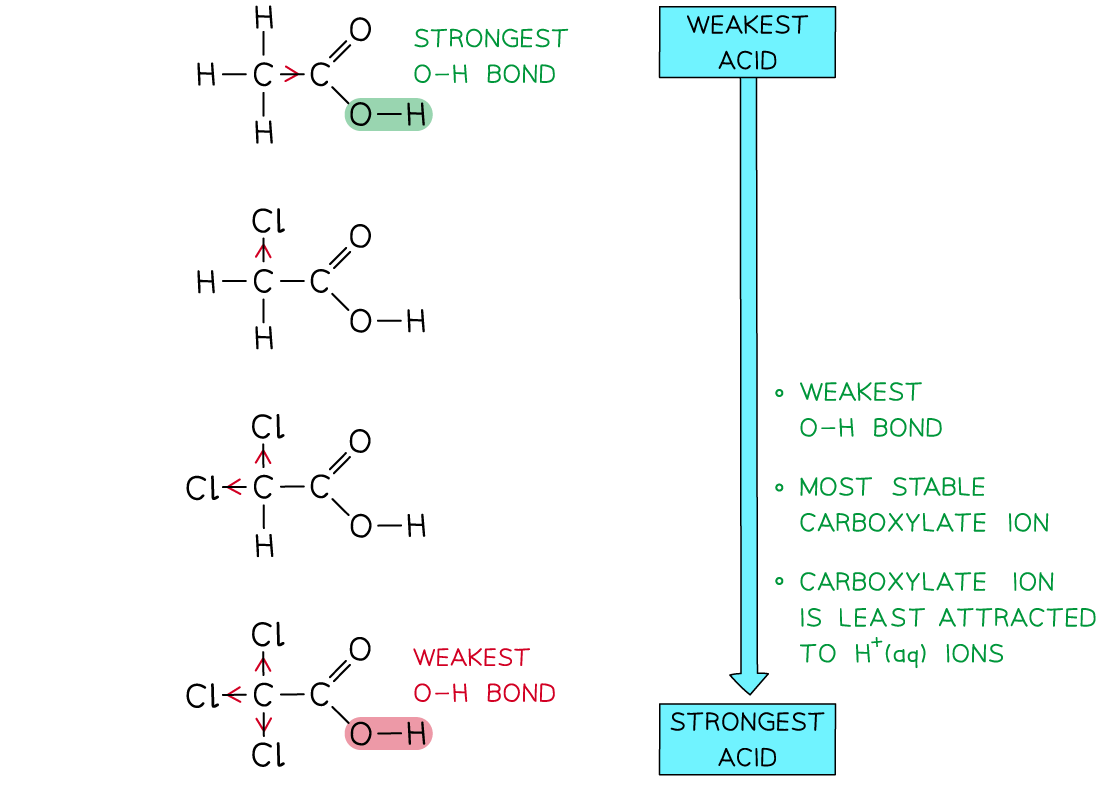
The more chlorine atoms there are in the carboxylic acids, the stronger the acid is
Trichloroacetic acid is the strongest acid as:
The O–H bond in CCl3COOH is the weakest since there are three very strong electronegative Cl atoms withdrawing electron density from the -COOH group
When the O–H is broken to form the carboxylate (-COO-) ion, the charge density is further spread out by the three electron-withdrawing Cl atoms
The carboxylate ion is so stabilized that it is less attracted to H+ ions
Examiner Tips and Tricks
When you are asked which hydrogen atom is acidic, choose the H of the –COOH group (the O–H of the carboxyl group). The H of an alcohol –OH group and H atoms bonded to carbon are not acidic in water.
Compare acid strength using Ka or pKa, not the number of H atoms or the molar mass.
Relative acidity of trichloroacetic acid
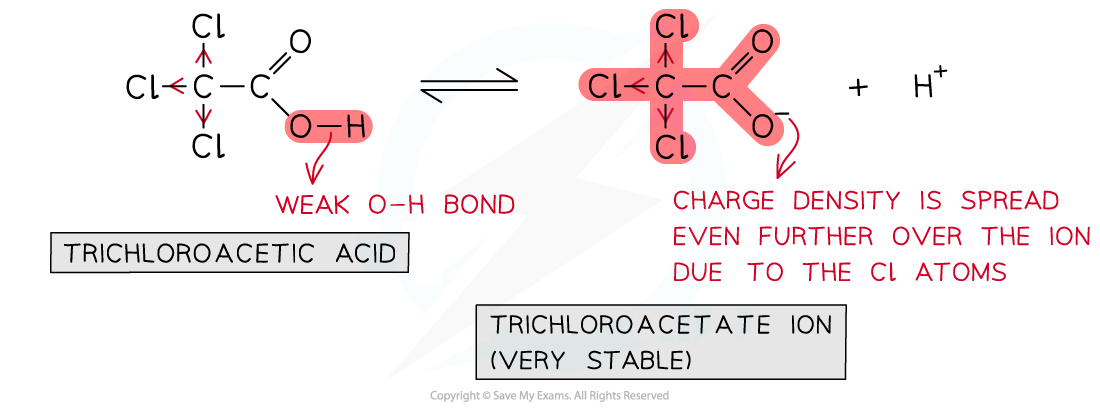
The trichloroacetate ion is very stable due to the distribution of charge density
Acetic acid is the weakest acid as:
It contains an electron-donating methyl group which strengthens the O-H bond
The methyl group donates negative charge towards the -COO- group which becomes more likely to accept an H+ ion
Relative acidity of acetic acid
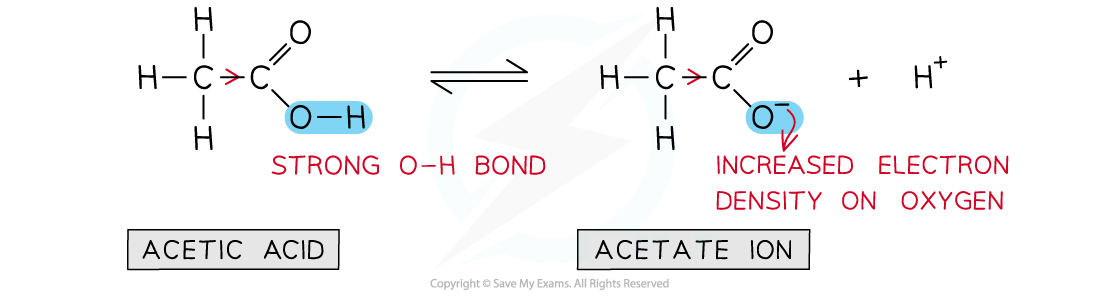
The acetate ion has increased electron density on the oxygen
Strong bases
The same concept will apply to bases
Strong bases include the group I and group II hydroxides, such as NaOH, KOH, Ba(OH)2
These strong bases have very weak conjugate acids
E.g.
NaOH (aq) | + HCOOH (aq) | H2O (l) | + HCOO–Na+ (aq) | |
base | acid |
| conj. acid | conj. base |
pKb = 0.2 |
|
| pKa = 14.00 |
|
OH– from a strong base is fully released in water, so its conjugate acid, H2O, is very weak
Weak bases, such as ammonia (a nitrogenous base) and carboxylate ions, have conjugate acids that are relatively stronger
Although NH4+ and carboxylic acids are still weak acids
NH3 (aq) | + H2O (l) | NH4+ (aq) | + OH– (aq) | |
base | acid |
| conj. acid | conj. base |
pKb = 4.74 |
|
| pKa = 9.26 |
|

Unlock more, it's free!
Join the 100,000+ Students that ❤️ Save My Exams
the (exam) results speak for themselves:

Was this revision note helpful?
Build on this topic