Hybridization (College Board AP® Chemistry): Study Guide

Hybridization of valence orbitals
The terms hybridization and hybrid atomic orbital describe the arrangement of electron domains around an atom in a molecule or polyatomic ion
Work out the hybridization by counting the electron domains around the atom in its Lewis diagram
Each lone pair, single bond, double bond or triple bond counts as one domain
2 domains = sp (180°)
3 domains = sp2 (120°)
4 domains = sp3 (109.5°)
sp3 hybridization
An atom with four electron domains is sp3 hybridized, and its ideal bond angle is 109.5°
E.g. the carbon atom in methane (CH4) has four bonding domains, so it is sp3 hybridized
Lone pairs count as domains too: nitrogen in NH3 (three bonding domains and one lone pair) and oxygen in H2O (two and two) are also sp3 hybridized
sp2 hybridization
An atom with three electron domains is sp2 hybridized, and its ideal bond angle is 120°
E.g. each carbon atom in ethene (H2C=CH2) has three electron domains (two single bonds and one double bond), so it is sp2 hybridized
A double bond counts as ONE domain
The carbon in H2CO is sp2, not sp3
For how the σ and π bonds form, see Sigma & Pi Bonds
sp hybridization
An atom with two electron domains is sp hybridized, and its ideal bond angle is 180°
E.g. each carbon atom in ethyne (H–C≡C–H) has two electron domains (one single bond and one triple bond), so it is sp hybridized
The carbon atom in CO2 (O=C=O) also has two electron domains and is sp hybridized
For how the σ and π bonds form, see Sigma & Pi Bonds
Summary of hybridization
Electron domains | Hybridization | Ideal bond angle | Examples |
|---|---|---|---|
2 | sp | 180° | CO2, C2H2 |
3 | sp2 | 120° | BF3, C2H4, H2CO |
4 | sp3 | 109.5° | CH4, NH3, H2O |
Picturing hybrid orbitals
You do not need to explain how hybrid orbitals form, but the diagrams below show how they are usually pictured
Formation of sp3 hybrid orbitals
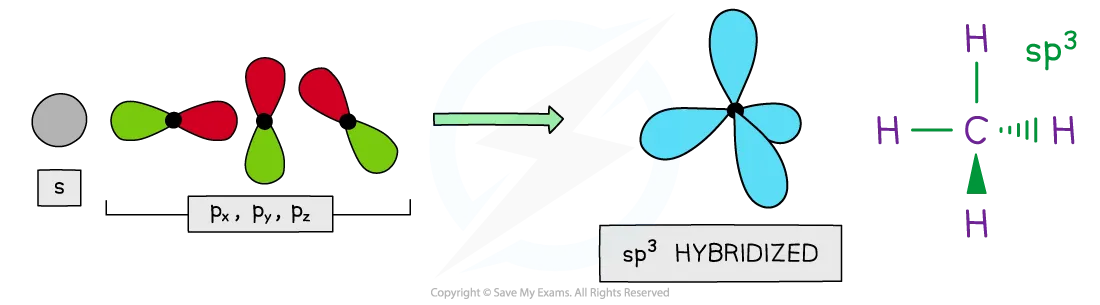
4 × sp³ hybrid orbitals are formed from one s orbital and three p orbitals
Formation of sp2 hybrid orbitals
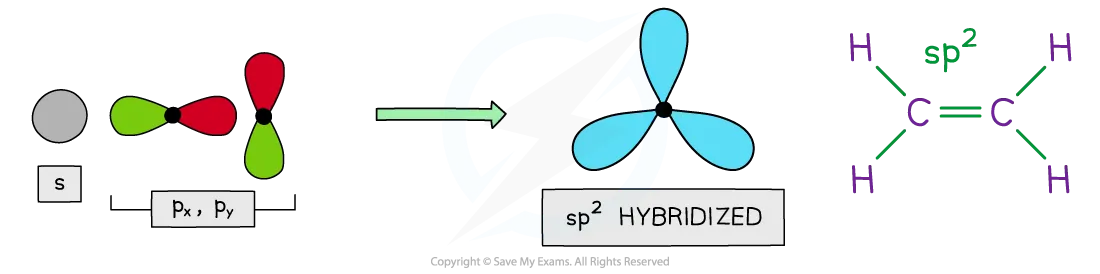
3 × sp2 hybrid orbitals are formed from one s orbital and two p orbitals
Formation of sp hybrid orbitals

2 × sp hybrid orbitals are formed from one s orbital and one p orbital
Worked Example
Compound X has the following Lewis diagram:

Lewis diagram of compound X
What is the hybridization of the atoms I, II, III, and IV?
Answer:
Atom I
The carbon atom has three electron domains (two single bonds and one double bond), so it is sp2 hybridized
Atom II
The carbon atom has three electron domains (two single bonds and one double bond), so it is sp2 hybridized
Atom III
The carbon atom has four electron domains (four single bonds), so it is sp3 hybridized
Atom IV
The oxygen atom has four electron domains (two single bonds and two lone pairs), so it is sp3 hybridized, even though it forms only two bonds
Examiner Tips and Tricks
If a question asks for the hybridization of an atom, answer sp, sp2 or sp3.
Chief readers reported that many responses gave an electron configuration, an orbital diagram, a molecular geometry or a count of σ and π bonds instead, and these earn no credit.
Count the electron domains around the atom: a double or triple bond is one domain, and lone pairs count.
If a question asks for a geometry or a VSEPR argument, do not answer with hybridization.
Only sp, sp2 and sp3 are used in AP Chemistry, so for atoms with more than four electron domains you only need the shape.

Unlock more, it's free!
Join the 100,000+ Students that ❤️ Save My Exams
the (exam) results speak for themselves:

Was this revision note helpful?
Build on this topic