Photoelectron Spectroscopy (College Board AP® Chemistry): Study Guide

Photoelectron spectroscopy
Photoelectron spectroscopy (PES) is an experimental technique that is used to measure the relative energies of electrons ejected by a source of radiation
Binding energy is the energy required to remove an electron by overcoming the Coulombic attraction to the nucleus
A PES spectrum is a graph that shows the relationship between:
The binding energy (x-axis)
The relative number of electrons removed (y-axis)
A PES spectrum is directly related to the ground-state electron configuration of the atom or ion
Each peak in the PES spectrum corresponds to one subshell; its position shows the energy needed to remove an electron from that subshell
Electrons in different subshells experience different effective nuclear charge, affecting the energy
The relative height of each peak is (ideally) proportional to the number of electrons in that subshell
Interpreting a PES spectrum
PES shows which shells and subshells are occupied by electrons in an atom or ion
Higher binding energy indicates electrons in subshells closer to the nucleus, which require more energy to remove
Lower binding energy indicates electrons in subshells further from the nucleus, which require less energy to remove
Comparing two elements: the same subshell has a higher binding energy in the element with more protons
For example, the 1s peak of oxygen is at a higher binding energy than the 1s peak of carbon, because the greater nuclear charge attracts the 1s electrons more strongly
Peaks with a greater number of electrons in a subshell will be taller
Examiner Tips and Tricks
Peak height shows the relative number of electrons in a subshell; it is not one electron per gridline, so compare each height with the 1s peak, which is 2 electrons in every element after hydrogen.
A partly filled subshell gives a shorter peak: the 3p peak of silicon represents 2 electrons, not 6.
For elements after argon, include the 4s peak, and do not add a 3d peak unless the atom has 3d electrons (calcium has none).
Worked Example
A PES analysis of an unknown element (X) was performed and the spectrum below was obtained. The sample does not contain any impurities. What is the identity of X?
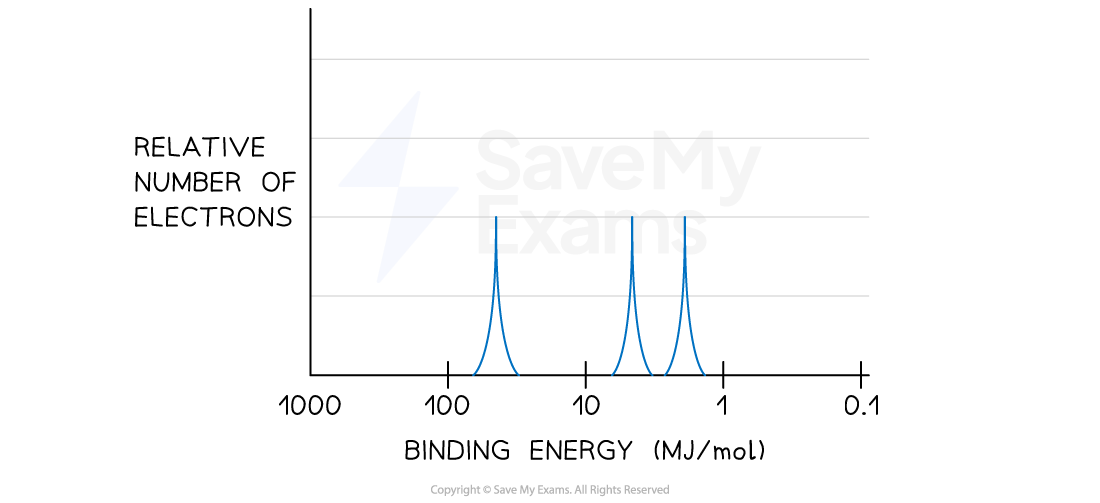
Three peaks of equal height mean three occupied subshells with the same number of electrons
Answer:
Step 1: Analyze the number of peaks
Since there are three peaks, this will correspond to the three first subshells of an atom: 1s, 2s and 2p
Step 2: Analyze the position of the peaks
The peak with the highest binding energy will correspond to the 1s subshell since it is the closest to the nucleus, and the Coulombic attractions are stronger
The peak with the lowest binding energy will correspond to the 2p subshell since it is the farthest from the nucleus, and the Coulombic attractions are weaker
Therefore, the peak in the middle will correspond to the 2s subshell
Step 3: Analyze the height of the peaks
The three peaks are the same height
Therefore, the same number of electrons have been removed in the 1s, 2s and 2p
The 1s and 2s subshells each hold 2 electrons, and the 2p peak is the same height, so the 2p subshell also holds 2 electrons
Step 4: Predict the electron configuration of the atom
1s2 2s2 2p2
We can connect the electron configuration with the PES Spectrum labeled below
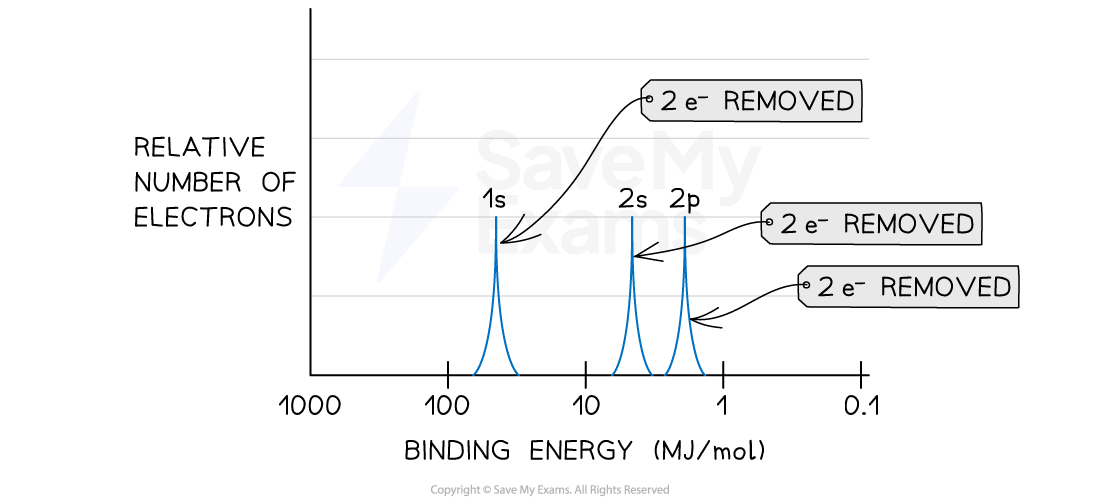
Each peak is one subshell: 1s, 2s and 2p each hold 2 electrons, so X is 1s2 2s2 2p2
Step 5: Identify the element using the periodic table
There are two ways to identify the unknown element:
Count the electrons and deduce the number of protons
6 electrons and, since it was a neutral sample, there are 6 protons
OR
Count the valence electrons to find the group, and use the shell they occupy to find the period
There are 4 valence electrons, therefore the element should be in Group 14 of your AP Chemistry Periodic Table
Since the valence electrons are in the second shell, the element should be in the second period of the periodic table
Therefore, element X is carbon (C)

Unlock more, it's free!
Join the 100,000+ Students that ❤️ Save My Exams
the (exam) results speak for themselves:

Was this revision note helpful?
Build on this topic