Economic Development Under Witte and Stolypin, 1892–1914 (AQA A Level History: Component 1: Breadth study): Revision Note
Exam code: 7042

Summary
Sergei Witte, Finance Minister from 1892 to 1903, drove a state-led surge in heavy industry known as the 'Great Spurt'
Witte used high tariffs, foreign loans and the 1897 gold standard to pull Western capital into railways, coal, iron and steel
The Trans-Siberian Railway, begun in 1891, showed state-led growth in action but stretched government finances
Pyotr Stolypin's reforms from 1906 let peasants leave the mir and consolidate scattered strips into enclosed farms
Witte’s industrial policies had a lasting impact
By 1914, Russia ranked among the great industrial powers by total output, but remained overwhelmingly rural and poor per person
Historians debate how strong the Russian economy really was by 1914
Falkus argues that Russia had built a substantial industrial power
Service argues this apparent advance was deceptive and fragile
Sergei Witte: Russia’s great moderniser
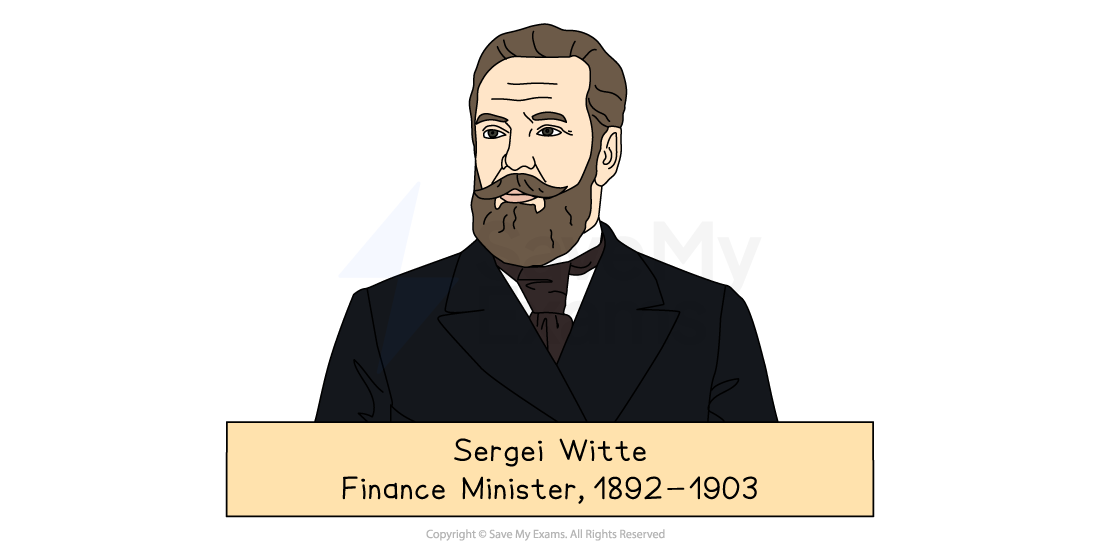
Sergei Witte set out to transform Russia's economy, convinced it had to industrialise fast or be left behind by the West
Witte's aims and approach
Witte saw industrial strength as the foundation of Russia's military and Great Power status
He built on the high-tax, grain-export policies Vyshnegradsky began in the 1880s
He wanted the state, not private enterprise, to direct and finance growth
Witte deliberately put the state in charge of industrial growth
The government placed orders, set tariffs and controlled the key railways
He recruited foreign advisers, managers and skilled workers to Russia
His strategy concentrated resources on heavy industry
Coal, iron, steel and oil took priority over consumer goods
This made growth fast but lop-sided, with light industry left behind
How Witte funded industrialisation
Year | Foreign Investment (Millions of Roubles) |
|---|---|
1895 | 280 |
1900 | 911 |
Witte needed huge amounts of capital that Russia could not raise at home
He kept tariffs high to protect new industries and raise revenue
He taxed everyday goods heavily, shifting the burden onto the peasantry
Putting the rouble on the gold standard in 1897 was central to his plan
A stable currency backed by gold reassured foreign investors
France, Britain, Germany and Belgium supplied most of the foreign capital
France alone provided around 1/3 of all foreign investment
Foreign loans and investment funded the railways and heavy industry
Relying on Western money left Russia exposed when economies abroad slumped
Examiner Tips and Tricks
Don’t treat Witte’s record as a straightforward success story. The strongest answers weigh the speed of industrial growth against its costs: the heavy tax burden on the peasantry, the reliance on foreign loans, and the neglect of agriculture and consumer goods.
Holding both sides of this together is what separates an analytical answer from a descriptive one.
Witte and the ‘Great Spurt’: foreign investment & heavy industry
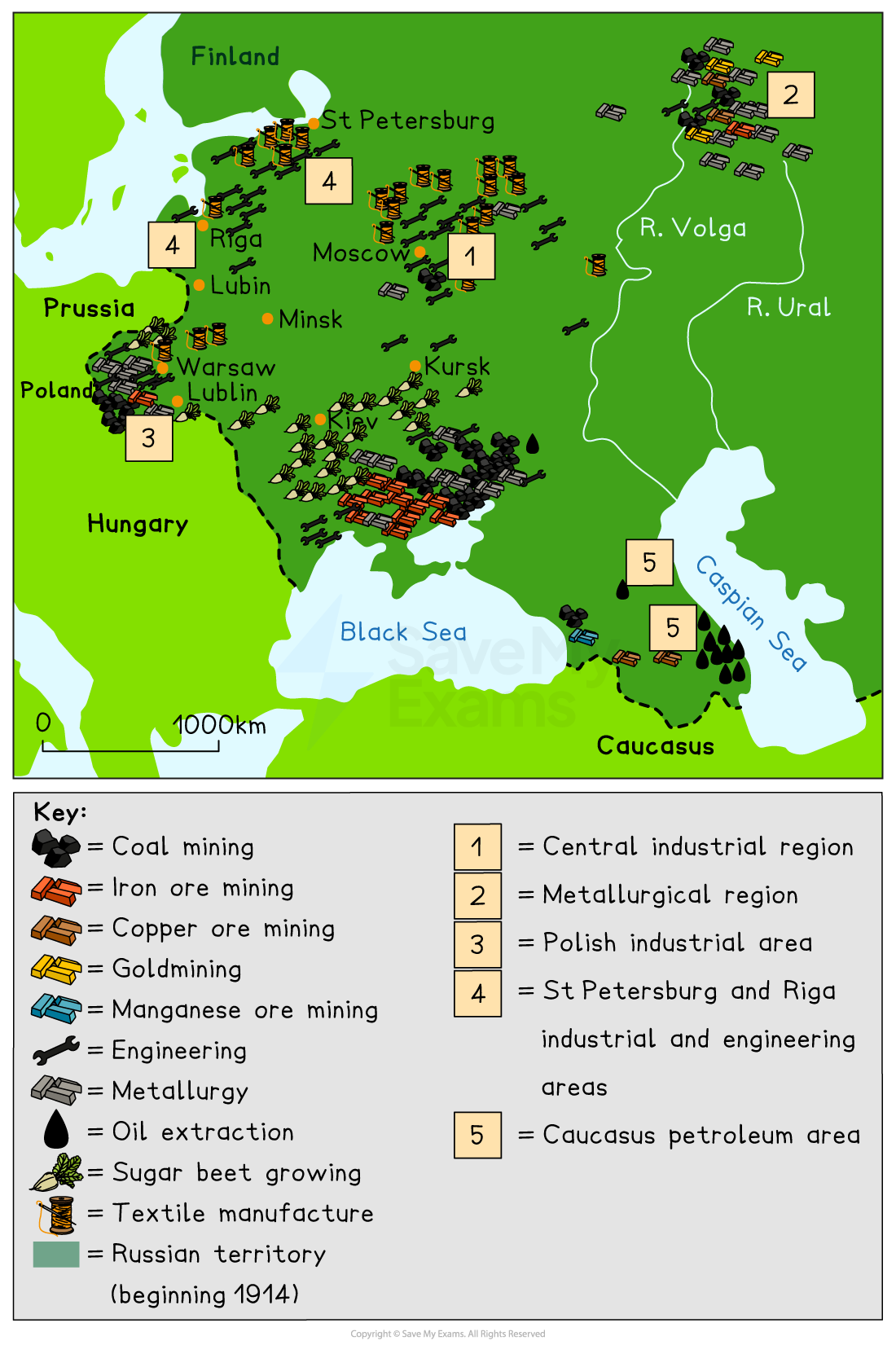
The 1890s saw the fastest burst of industrial growth in Russian history up to that point
It is often called the "Great Spurt"
The railway boom and the Trans-Siberian Railway
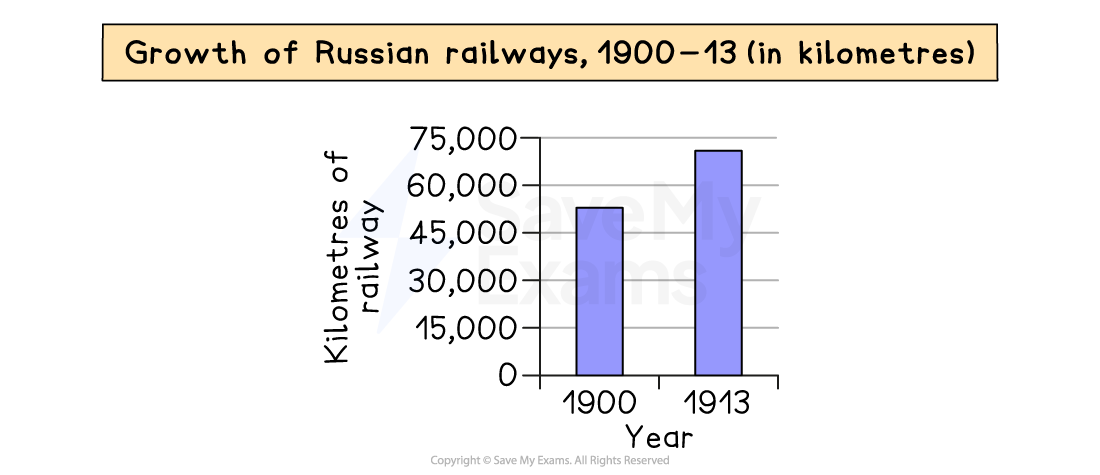
Railway building was the engine of the "Great Spurt"
Railway track roughly doubled during Witte's time as Finance Minister
Railways opened up Russia's raw materials and linked grain regions to export ports
The Trans-Siberian Railway was the flagship project
Construction began in 1891 and the main line was largely complete by 1902
It ran around 9,000 km (7,000 miles) from European Russia towards Vladivostok
The line mattered for military and political reasons too, especially for transferring military and weapons much more quickly
Heavy industry
Industrial production (millions of metric tons)
Material | 1890 | 1900 | 1910 |
|---|---|---|---|
Coal | 5.9 | 16.1 | 25.4 |
Pig Iron | 0.89 | 2.66 | 3.0 |
Crude Oil | 3.9 | 10.2 | 12.1 |
Output of coal, iron and oil rose sharply in the 1890s
Large, modern factories, such as the Putilov Iron Works, expanded rapidly
Factories and factory workers, 1887 – 1908
Year | Number of Factories | Number of Factory Workers |
|---|---|---|
1887 | 30,888 | 1.3 million |
1908 | 39,856 | 2.6 million |
Overall, between 1908 and 1913, Russia witnessed a huge industrial growth of 8.5% per year
Witte's main tools of industrialisation
Tool | How it Worked |
|---|---|
Gold Standard (1897) |
|
Protective tariffs |
|
Foreign loans and investment |
|
Heavy taxation |
|
State-directed railways |
|
The limits and costs of the Great Spurt
Growth was real but came at a price
Heavy taxes and grain exports squeezed the peasantry
Agriculture and consumer industries were left behind
The boom depended on foreign investment
The boom in the economy was fragile and could be impacted when crises hit
Examiner Tips and Tricks
Do not describe the Great Spurt as simple economic success. Strong answers explain both sides: Witte helped drive rapid growth in railways, coal, iron and oil, but this was concentrated in heavy industry and depended heavily on foreign investment, high taxation and pressure on the peasantry.
For evaluation, ask whether Russia was becoming truly modernised or whether it was developing an unbalanced industrial economy built on weak agricultural foundations.
Stolypin’s agrarian reforms: breaking up the mir
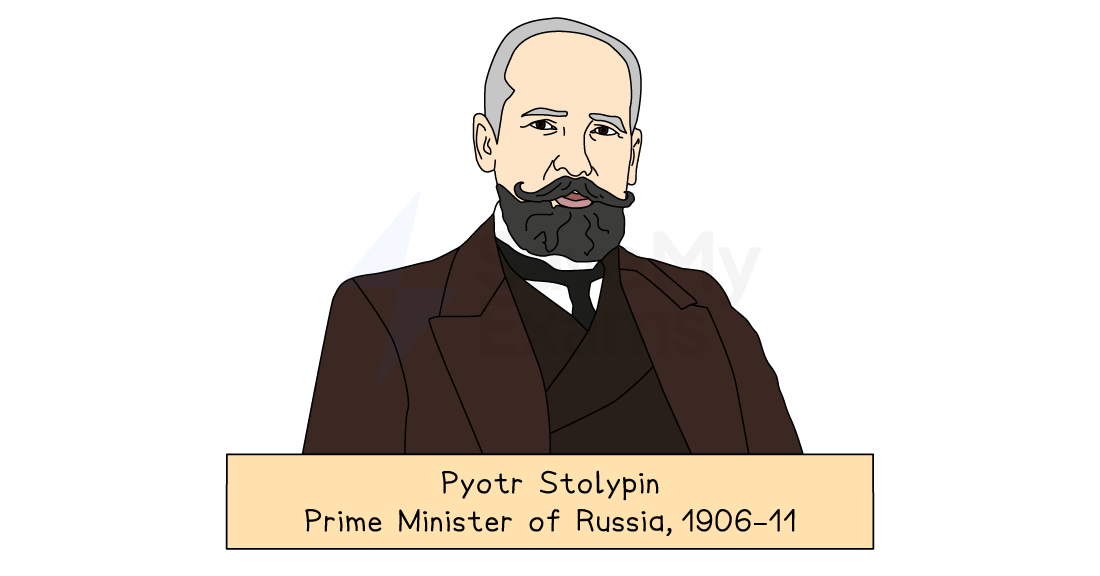
While Witte transformed industry, agriculture was left behind, becoming Russia's great weakness
Pyotr Stolypin set out to address this
Why Stolypin targeted the commune (mir)
Stolypin believed the commune held Russian farming back
Before 1906, most farming was small-scale and in the hands of former serfs and state peasants and tied to the local mir by redemption payments
Although the population increased, the agricultural land available did not
The average holding fell from 35 acres in 1877 to 28 acres by 1905
He wanted to create a class of prosperous, independent farmers
He hoped loyal landowning peasants would act as a barrier against revolution, as they would have something to lose
This is sometimes referred to as a "wager on the strong and sober"
The land reforms
From 1906, Stolypin passed laws allowing peasants to leave the commune
Households could claim their strips as private property and consolidate them
A consolidated block within the village was known as an 'otrub'; a separate farmstead was known as a 'khutor'
The reforms aimed to turn communal land into private property
A series of decrees and laws from 1906 onwards encouraged land transfers
The Peasants' Land Bank gave loans to help peasants buy and consolidate land
Legislation for land reform under Stolypin
Date | What it Did |
|---|---|
September 1906 |
|
October 1906 |
|
November 1906 |
|
January 1907 |
|
June 1910 |
|
The reforms outlined above became fully operative in 1910, once approved by the Third Duma
Land organisation commissions, with elected peasant members, supervised the process on the ground
Examiner Tips and Tricks
Make sure you are being specific when referring to 'Stolypin's reforms'. Giving individual legislation will help with the strength of your argument.
The impact of Stolypin’s reforms: did they improve the lives of the peasants?
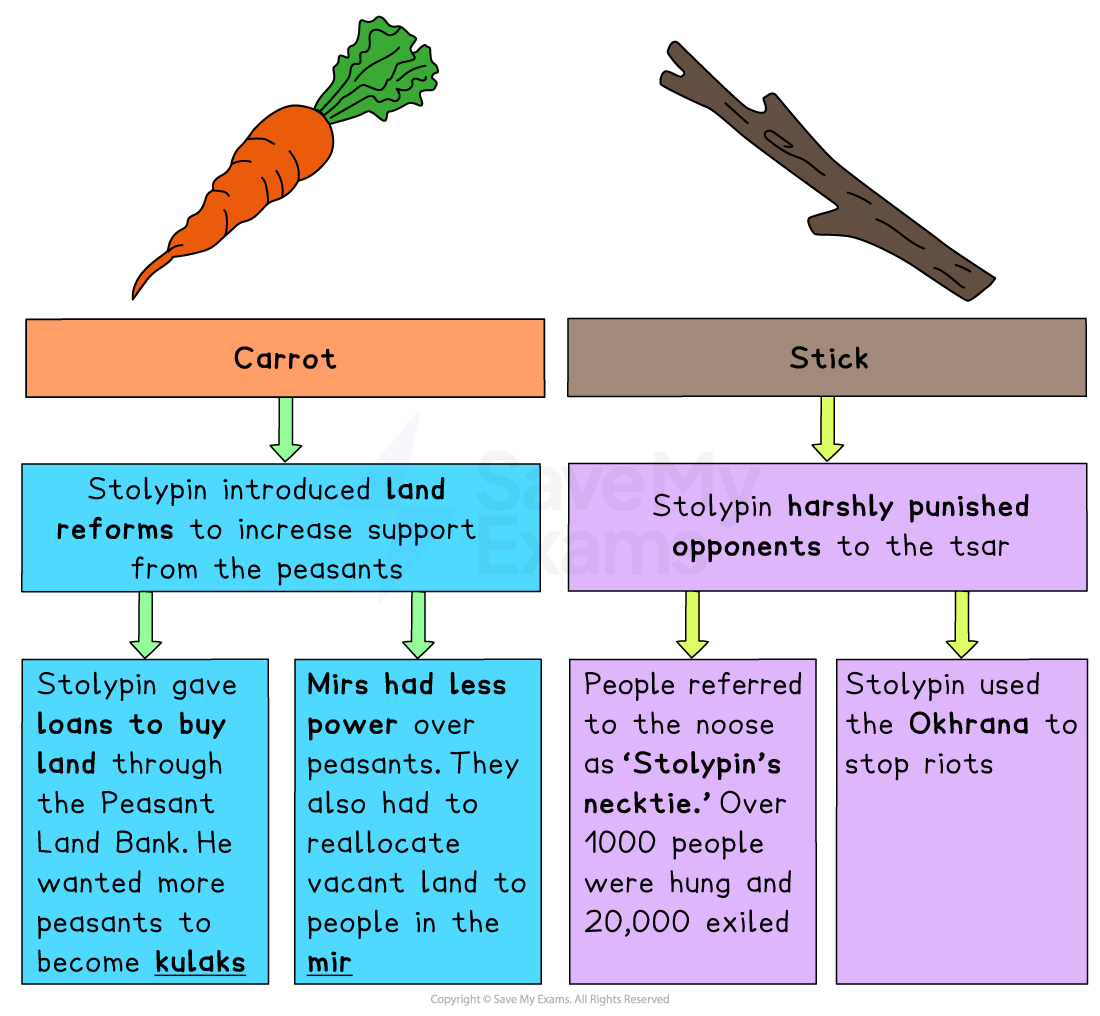
Stolypin's reforms changed the countryside, but how far they improved peasant lives is open to debate
Evidence the reforms improved lives of the peasants
A minority of peasants clearly did better under the reforms
Ambitious peasants consolidated their land and raised output
The kulak class grew, buying up land with bank loans from the Peasants' Land Bank
Land transfers and output both rose
More land was moved from communal to private ownership
Grain production rose annually from 56 million tons to 90 million by 1915
Larger, consolidated farms could be worked more efficiently
By 1909, Russia was the world's leading cereal exporter
Evidence that the reforms fell short
Most peasants saw little real change
By 1914, only around 10% of land had passed from communal to private ownership
The poorest peasants often sold up and were left worse off
The reforms ran out of time
Stolypin himself claimed that the reforms needed 20 years of peace to take effect
His assassination in 1911 and the outbreak of war in 1914 cut these reforms short
Strip farming and widespread rural poverty remained common
By 1914, 90% of peasant holdings were still in traditional strips
Due to legal battles and landowners being reluctant to give up land, around 20–25% of the land remained in the hands of the nobility
Resettlement in Siberia barely eased land hunger
State schemes encouraged peasants to move to new farmland in the east
Only around 3.5 million of nearly 97 million peasants took up the offer
Examiner Tips and Tricks
Stolypin’s reforms are often described but not evaluated. Push your answer towards judgement: did the reforms actually improve peasant lives, and did they strengthen or weaken the regime?
Focus on how much had really changed by the time the reforms were cut short, rather than assuming they would have worked given more time.
How strong was the Russian economy by 1914?
By 1914, the Russian economy had changed significantly, but historians disagree about how strong it really was
By 1914, Russia had built a substantial modern industrial economy
Russia had become one of the world's major industrial producers
By 1914, Russia was the world's fifth industrial power
Coal, iron and oil production had all risen sharply
The railway network had expanded dramatically
Russia had the second-largest railway network in the world by 1914
Industrial recovery was strong after 1908
Industry grew at around 8.5 per cent a year between 1908 and 1913
Key historian
"Russia, on the eve of the First World War, could scarcely be regarded as an industrial country. Farming was still the occupation of the overwhelming majority of the population, and while large towns existed, they were few in number and the urban population was only 18% of the total. It is true that Russian industry had made advances. By 1914, Russia's industries had grown considerably from their 1890s level and Russia possessed a substantial industrial sector."
M.E. Falkus The Industrialisation of Russia 1700–1914 (1972)
Falkus's study is a standard account of Russian industrialisation
His argument is balanced: he accepts Russia was still overwhelmingly rural, but concludes that by 1914 it had built a substantial industrial sector
This supports the view that real and lasting industrial growth had taken place
The apparent strength of the economy by 1914 was deceptive
Russia remained overwhelmingly agricultural
Farming still occupied the great majority of the population
The urban population was only around 18% of the total
For its size, Russia was still poor and backward by European standards
Output per person lagged far behind Britain, Germany and the USA
Growth was concentrated in a few regions and a few industries
The economy stayed dependent and fragile
Heavy reliance on foreign capital left Russia exposed to crises abroad
A fast-growing population swallowed up much of the growth
Key historian
"State ownership and state contracts contributed vitally to capitalise economic development in Russia in the 1890s and the decision, in 1897, to put the rouble on the gold standard also attracted investment from abroad. But there were dangers of relying so heavily upon injections of capital from Western Europe and the Russian imperial economy remained vulnerable to periodic recessions. The imperial population increased steeply and the benefit of agricultural expansion was less than it would have been. The appearance of advance in the years up to 1914 is deceptive."
R. Service The Russian Revolution 1900–1927 (2009)
Service is a leading historian of modern Russia and the revolution
His argument is that state-led growth and foreign capital created only a fragile, surface-level advance
This supports the view that the economy remained weak and vulnerable beneath its apparent success
Examiner Tips and Tricks
The best answers separate two things: Russia ranked among the great industrial powers in total output, but remained poor per person, mostly rural and financially fragile. Hold these two measures side by side rather than picking one, and your judgement will be properly balanced.

Unlock more, it's free!
Join the 100,000+ Students that ❤️ Save My Exams
the (exam) results speak for themselves:

Was this revision note helpful?
