Social Developments and Class Structure in Tsarist Russia to 1894 (AQA A Level History: Component 1: Breadth study): Revision Note
Exam code: 7042

Summary
Emancipation in 1861 weakened the nobility by ending their coercive power over serfs
The Noble Land Bank of 1885 slowed its financial decline, but could not reverse it
Russia’s middle class remained much smaller and less influential than in Western Europe
The professional class that emerged after 1861 was largely excluded from the central government
Workers had no legal rights or unions, lived in poverty and launched early strikes over low wages and harsh conditions
In the 1870s and 1880s, these protests were usually treated as disorder and brutally suppressed by the authorities
Over 80% of Russians were peasants
Although legally free after 1861, they remained tied to village life through redemption payments, communal taxes and the internal passport system
Peasant society was organised around the patriarchal household and the mir
The mir controlled land allocation, tax collection and local justice
No single social group posed a decisive threat to the regime
The intelligentsia had ideas but little mass support
The peasantry had numbers but lacked political organisation
The working class was still too small and underdeveloped to act as a united force
The landed elite: nobles & landowners in tsarist Russia
The position of the nobility before 1861
Nobles dominated Russian society before Emancipation
They owned the majority of serf-tied land
They staffed the bureaucracy and officer corps almost exclusively
Local administration, taxation and justice all passed through noble hands
The noble class was deeply stratified
Great magnates held estates of tens of thousands of serfs and dominated court life
Minor service nobles had little land and often their standard of living was barely above that of the peasants they supervised
Serf-owners extracted labour (barshchina) or money dues (obrok) as their economic foundation
The impact of Emancipation, 1861
Emancipation stripped nobles of direct coercive control over serfs
They could no longer compel serf labour or extract dues by force
State compensation bonds were often worth less than the land they had surrendered
Many former serf-owners found their estates unmanageable without forced labour
Most noble estates fell into debt through the 1860s – 1880s
Agricultural prices were falling across Europe, cutting estate incomes
Mortgaged estates became increasingly common across all regions
Many nobles could not compete with more efficient grain producers in Western Europe
Alexander III's attempts to restore noble privilege
The Noble Land Bank (1885) offered state loans to slow noble land loss
It helped some estates survive in the short term
It could not reverse the structural decline of the landed class
The Land Captains Act (1889) restored noble authority at the district level
Nobles could override the volost court and zemstvo decisions
This partially restored political privilege without restoring economic strength
By 1894, the nobility retained prestige and political dominance
They still dominated the military officer class and the senior bureaucracy
As landowners, however, they were a class in structural decline
Examiner Tips and Tricks
Do not treat noble political influence and noble landholding as the same thing. A noble could sit in the Senate and still be mortgaged to the hilt.
The middle classes & urban working classes in Tsarist Russia
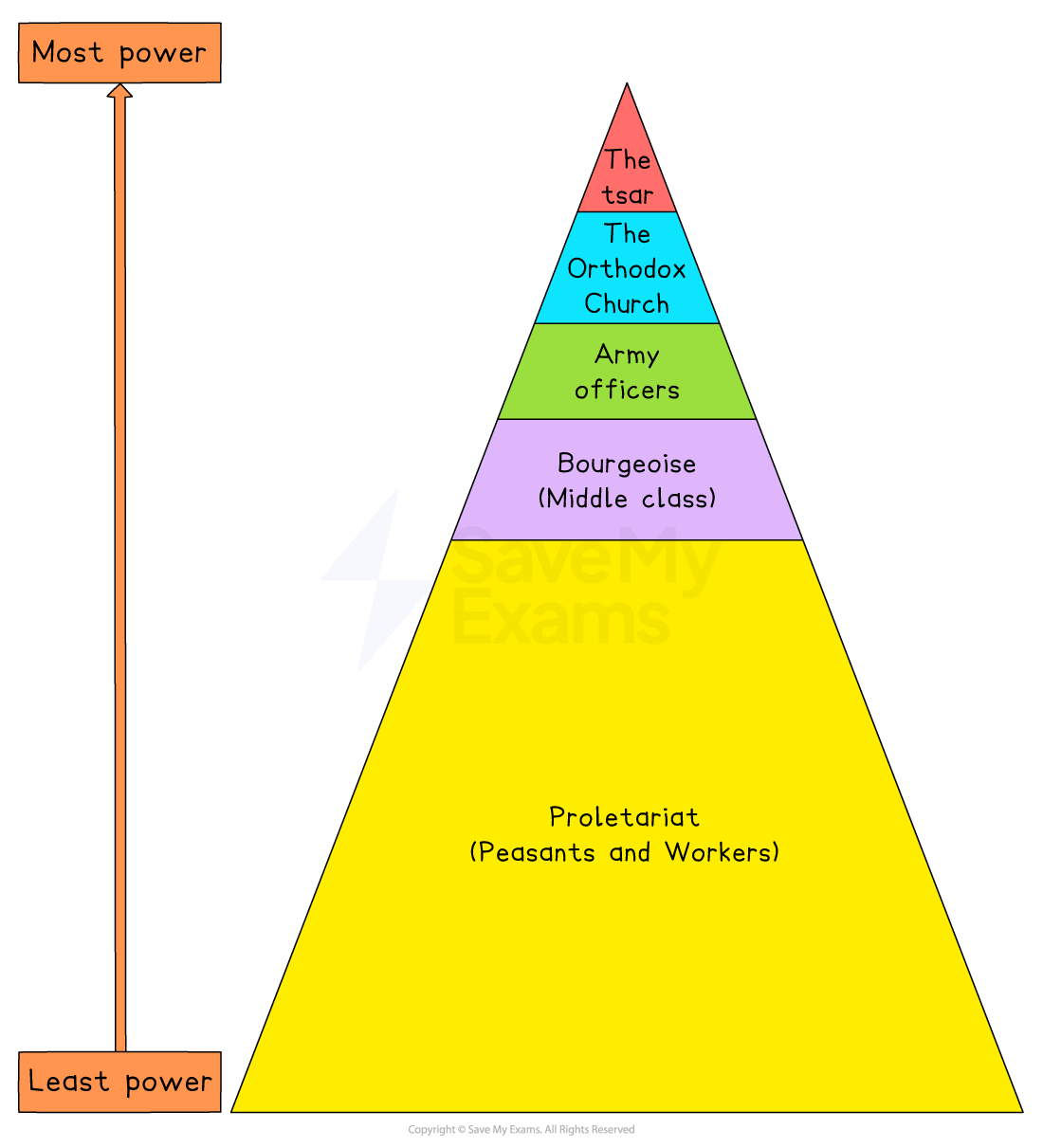
The absence of a bourgeoisie
Russia lacked the commercial middle class that shaped politics across Western Europe
Serfdom suppressed middle-class formation by keeping labour tied to the land
Without a free labour market, no significant merchant or manufacturing class could develop
The simple pyramid structure of Russian society left no space for a prosperous middle class
A small professional stratum emerged after 1861
Lawyers, doctors, teachers, engineers and journalists grew in number
Many were linked to the zemstvo system of local government, established in 1864
They sought administrative influence rather than political power
They remained politically excluded and numerically tiny compared to Western equivalents
Urban growth and the factory working class
Russia's urban population was small but growing
Around 10% of Russians lived in cities in 1855
St Petersburg and Moscow grew significantly through the 1860s-1880s
The factory working class was almost entirely drawn from the peasantry
The urban working class was under 2% of the population by 1881
Workers typically migrated seasonally, maintaining ties to their home villages
Working days of 12-15 hours were standard
Workers had no legal right to strike, no unions and no welfare protection
Most lived in factory barracks or overcrowded urban tenements
Early labour unrest showed the potential for conflict
St Petersburg textile workers struck in 1870
Moscow textile strikes followed in the 1880s
Both were brutally suppressed, but the state took note of the new social force
Examiner Tips and Tricks
Do not confuse the intelligentsia with the middle class. They often came from similar social backgrounds but had very different aims. The middle-class professional sought a place within the existing system; the intelligentsia wanted to transform it.
Examiners reward answers that keep these groups distinct. A lawyer working for the zemstvo and a nihilist writing revolutionary pamphlets were not the same kind of threat to tsarism.
The position of the peasantry in Russian society: status, the mir & social relations
Peasant legal status after 1861
Over 51 million serfs were legally free after emancipation, but they still belonged to a separate legal estate
They were subject to customary law and the volost court, not the reformed civil courts
Other social classes used the new judicial system created in 1864; peasants did not
This kept the peasantry legally inferior and separately governed
Redemption payments were the financial condition of freedom
Peasants paid the state for their land allocation over 49 years
The commune was collectively responsible for each member's payment
Individual peasants could not leave until the commune agreed to release them
The internal passport system limited movement
Peasants needed permission from the commune to seek work elsewhere
This kept labour tied to the village long after legal emancipation
Peasants bore a disproportionate share of the empire's tax burden
Land taxes, poll taxes and indirect taxes fell overwhelmingly on rural communities
This left little surplus income for investment or escape from subsistence farming
The mir as an institution
The village commune (mir) was the central institution of peasant life
It allocated strips of land to each household and decided crop rotation
It managed communal assets and resolved local disputes
The village elder (starosta) carried out assembly decisions
The skhod (assembly of household heads) made all key decisions
Only male heads of household could vote
Decisions required a majority agreement
Collective tax liability (krugovaya poruka) was the commune's most binding mechanism
If one peasant could not pay, the commune covered the shortfall
This made the community actively enforce individual compliance
It was the single most effective mechanism for keeping peasants in the village
Social relations within the village
The patriarchal household was the basic unit of rural life
The bolshak (male household head) held legal authority over all family members
Sons could not legally separate from the household while their father lived
Women had no property rights and no voice in the skhod
Widows heading households were the exception, not the norm
Social differentiation was growing within the peasantry
The most industrious households accumulated small surpluses over time
Landless labourers and widows had no stake in communal decision-making
This internal stratification prefigured the kulak question but was limited before 1894
Relations between former serfs and former noble masters changed after 1861
Former serfs still worked on noble land as hired labourers or tenant farmers
The social deference nobles expected was no longer legally enforceable
This created friction and resentment across many rural communities
Examiner Tips and Tricks
The mir was more than oppressive; it was more than protective. It was a safety net for the weakest peasants, absorbing tax shortfalls and redistributing land, but it was also limiting for the most entrepreneurial, as it prevented exit for the individual. Good answers will acknowledge both sides of this.
Which social class posed the biggest threat to the tsars?
Historians disagree about who posed the bigger threat to tsarist stability by 1894: the peasantry, with their sheer numbers, or educated and urban groups, with their organisational capacity
The peasantry posed the greatest threat
The peasantry made up over 80% of Russia's population
Any large-scale peasant uprising would have overwhelmed the state's coercive capacity
Chronic poverty and land hunger made unrest a permanent, structural risk
Emancipation produced immediate and widespread unrest
Around 500 major peasant disturbances were recorded in 1861 alone
Many peasants believed the terms were a betrayal: redemption payments were heavy and noble landholding remained largely intact
Land hunger intensified through the 1860s-1880s
Population growth subdivided communal strips into ever-smaller holdings
Periodic famine, including the devastating 1891-92 famine, brought the peasantry to the edge of survival
The regime's own officials feared the peasantry above all other groups
The land question dominated every serious discussion of Russia's political future
Alexander II himself said emancipation was 'better… from above than to wait until it begins to abolish itself from below' (Moscow nobility, 1856)"
The intelligentsia and urban radicals posed the greater organised threat
The commune contained, rather than radicalised, the peasantry
Collective tax liability and passport restrictions kept peasants economically dependent on the village
Without land, political programme or organisation, peasant revolts remained local and uncoordinated
The intelligentsia achieved what the peasantry never could: they assassinated a Tsar
People's Will killed Alexander II in 1881 with a bomb thrown in St Petersburg
No peasant organisation came close to this level of coordinated political violence
The tsarist repressive apparatus was overwhelmingly directed at educated dissidents
The Okhrana, censorship and networks of agents focused on universities, political circles and underground presses
This itself reveals where the tsars perceived the greater threat
Urban workers, though few in number, were concentrated in politically visible locations
A strike in a St Petersburg factory was far harder to ignore than unrest in a distant village
Urban proximity to government made working-class unrest disproportionately threatening
Examiner Tips and Tricks
Avoid treating "the peasantry" as a single entity. A mir-tied subsistence farmer in Tambov and a landless seasonal labourer in a Moscow factory were not the same person and did not pose the same threat. The strongest answers break the peasantry down by type.

Unlock more, it's free!
Join the 100,000+ Students that ❤️ Save My Exams
the (exam) results speak for themselves:

Was this revision note helpful?
