The February/March Revolution, 1917: The Fall of the Tsar (AQA A Level History: Component 1: Breadth study): Revision Note
Exam code: 7042

Summary
By early 1917, total war had pushed Petrograd into crisis, with bread shortages, soaring prices and mass strikes
The revolution began with strikes and the International Women's Day march on 23 February
Within days, this grew into a citywide rising
The decisive turning point came on 27 February
The Petrograd garrison mutinied
Soldiers joined the crowds rather than firing on them
Nicholas II abdicated on 2 March for himself and his son Alexei
His brother Grand Duke Mikhail refused the throne
The rule of the Romanovs ended after 304 years
Power passed to two rival bodies:
The Provisional Government
The Petrograd Soviet
This arrangement became known as 'dual power'
Historians debate whether tsarism collapsed because of long-term weakness or because the First World War made survival impossible
D. Christian emphasises the destructive pressures of long-term modernisation
D. Volkogonov emphasises wartime failure and the autocracy's self-destruction
Causes of the February/March Revolution, 1917
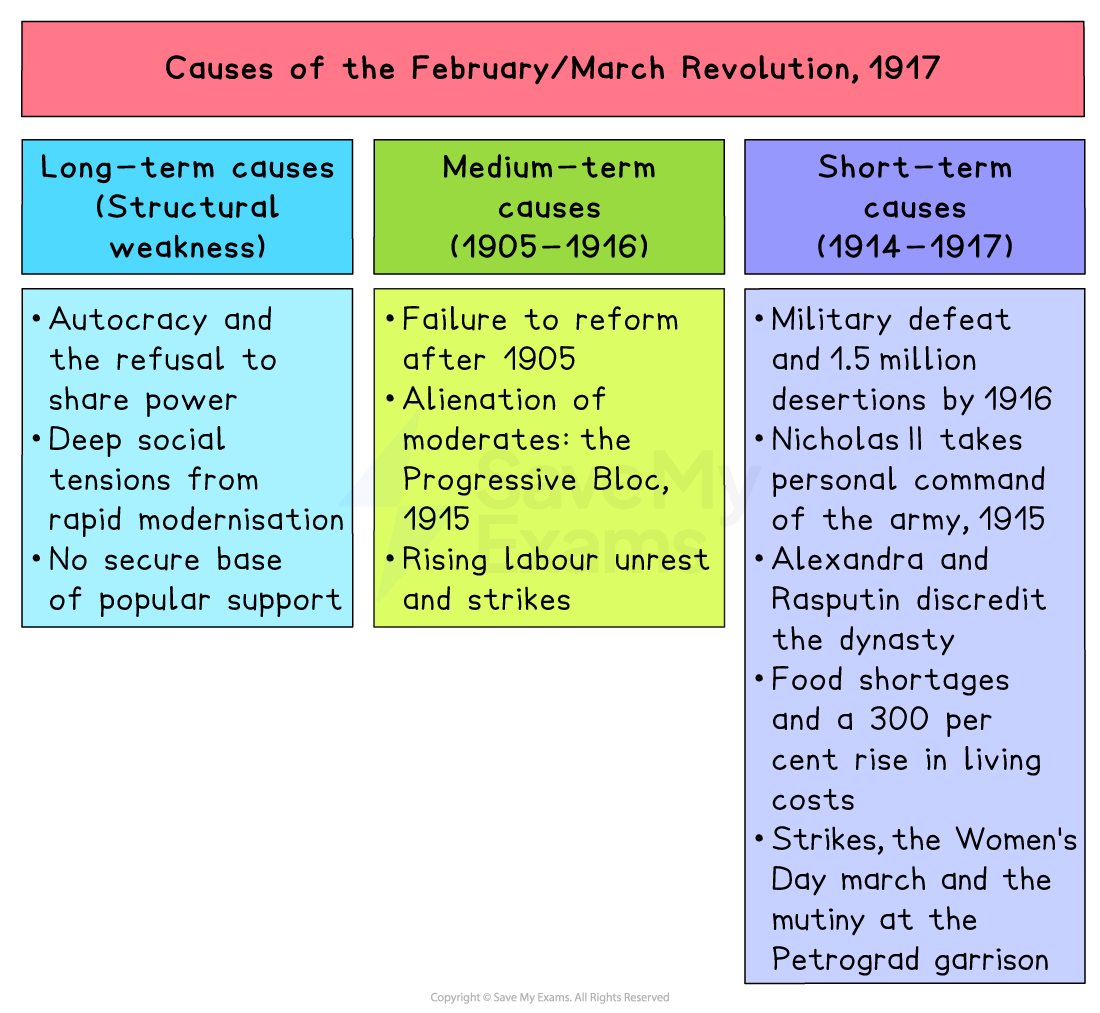
The collapse of tsarism had deep roots reaching back decades, but the First World War triggered that long-standing weakness into a fatal crisis
Long-term causes: the deep weaknesses of tsarism
Autocracy:
Nicholas II treated any sharing of power as a betrayal of his sacred duty
He granted an elected Duma only under pressure in 1905, then limited its powers
No popular base:
The regime had failed to win the loyalty of any major social group
Workers, peasants and liberals all carried grievances the regime left unanswered
This meant that when crisis came, almost no one rallied to defend the Tsar
Social strain:
Rapid modernisation created tensions the regime could not control
Fast industrial growth produced a large, discontented working class in cities like Petrograd
Medium-term causes: missed chances, 1905 to 1916
The wasted lessons of 1905:
The regime survived revolution but failed to reform in any lasting way
The October Manifesto calmed the unrest of 1905 but satisfied few in the long run
The alienation of moderates:
Even loyal elites turned against the Tsar during the war
In 1915, Duma parties formed the Progressive Bloc, asking for a government the public could trust
Nicholas II refused, leaving moderate opinion shut out and resentful
Short-term and trigger causes: the First World War and February 1917
Military defeat:
Repeated losses shattered the army's morale and discipline
The failures at the Battle of Tannenberg and the Masurian Lakes were particularly prominent
By the end of 1916 the army had suffered around 1.5 million desertions
Nicholas becomes commander-in-chief:
The Tsar tied his own name to every defeat at the front
This left the unpopular Tsarina and Rasputin shaping government in the capital
Economic breakdown:
The war damaged the economy that fed the cities
Railway collapse left grain rotting in the countryside while Petrograd went hungry
The cost of living had risen by around 300% by January 1917
February triggers:
Bread shortages and strikes brought huge crowds onto the streets
In January 1917, around 145,000 workers were already on strike in the capital
The garrison mutiny:
The decisive trigger was the soldiers refusing to fire on the crowds
Once the army joined the people, a major pillar of tsarism collapsed, and the regime had nothing left to defend it
Examiner Tips and Tricks
Bear in mind that Russia used the Old Style (Julian) calendar in 1917, running 13 days behind the West, which is why the same revolution is called both “February” (Old Style) and “March” (New Style). Pick one system, state it once and stay consistent.
Events of the February/March Revolution
The revolution unfolded in Petrograd over a single week in late February
Timeline of key events
Date | What happened |
|---|---|
January 1917 |
|
Tuesday 14 February |
|
Wednesday 22 February |
|
Thursday 23 February International Women's Day |
|
Friday 24 February |
|
Saturday 25 February |
|
Sunday 26 February |
|
Monday 27 February |
|
Tuesday 28 February |
|
Primary source: Rodzianko’s telegram to the Tsar, 26 February 1917 (Old Style)
“The situation is serious. The capital is in a state of anarchy. The government is paralysed; the transport service has broken down; the food and fuel supplies are completely disorganised. Discontent is general and on the increase. There is wild shooting in the streets. Troops are firing at each other. It is urgent that someone enjoying the confidence of the country be entrusted with the formation of a new government. There must be no delay. Hesitation is fatal.”
Rodzianko’s telegram to the Tsar, 26 February 1917
The abdication of Nicholas II, March 1917
With Petrograd lost, the Tsar's own generals concluded he could no longer hold the throne
Nicholas II tried to return to Petrograd but never reached it
Striking railway workers diverted his train, forcing it to stop at the town of Pskov
His senior commanders, led by General Alekseev, urged him to abdicate
They believed only his removal could save the war effort and restore order
Nicholas abdicated on 2 March
He stepped down for himself and for his son Alexei, whose haemophilia made a regency unworkable
He named his brother, Grand Duke Mikhail, as the new Tsar, although Mikhail had not been consulted
Mikhail refused the throne the next day
With no one willing to rule, 304 years of Romanov rule came to an end
Examiner Tips and Tricks
Be precise about how the monarchy ended. Nicholas abdicated for himself and for Alexei because his son’s haemophilia made a regency unworkable and then named his brother Mikhail, who refused the throne. A common error is to write that “the Bolsheviks overthrew the Tsar.” They were a minor force in February and would not take power for another eight months.
The creation of dual power: Provisional Government & Petrograd Soviet
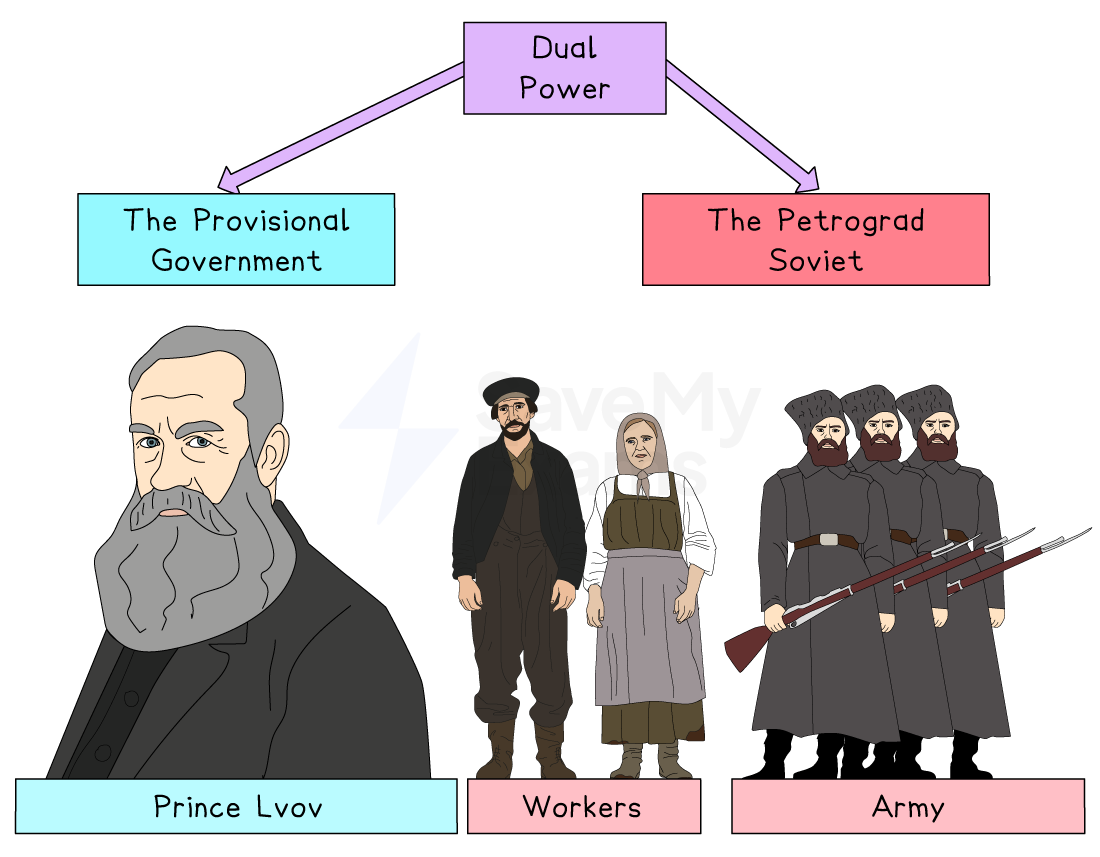
The revolution produced not one but two rival authorities sharing power uneasily
Provisional Government
The Provisional Government grew out of the Duma's committee and claimed to govern Russia
It was led by Prince Lvov
It based itself in the Tauride Palace in Petrograd
Its ministers were drawn mainly from liberal and moderate elites
They included:
Pavel Milyukov as Foreign Minister
Alexander Guchkov as War Minister
Alexander Kerensky as the Minister of Justice (the only socialist and its key link to the Petrograd Soviet)
Its authority depended on the old institutions agreeing to accept it
Grand Duke Mikhail's blessing led the civil service, army officers and police to recognise it
It saw itself as a temporary, caretaker government (hence, provisional)
It promised free elections to a Constituent Assembly to write a new constitution
Until those elections, it claimed no permanent right to rule
Petrograd Soviet
The Petrograd Soviet was a council of workers' and soldiers' deputies
It met in another wing of the same building as the Government, the Tauride Palace
It had grown to 3,000 members by 10 March
It was dominated by moderate socialists, not by the Bolsheviks
Mensheviks and Socialist Revolutionaries led it, with only a small number of Bolsheviks
Most deputies were socialist intellectuals
Only 7 of the first 42 committee members were workers
Ordinary people trusted the Soviet far more than the Provisional Government
They saw the government as a self-appointed committee of the wealthy, tainted by links to Tsardom
Through Order No. 1, the Soviet held the loyalty of the capital
Soldiers agreed to obey the Provisional Government only when the Soviet approved
The Soviet also controlled the railways, communications and food supply
Dual-power system: an unstable partnership
The two bodies agreed to work together in an arrangement known as dual power
The Soviet backed the government in return for a programme of reforms
These included an amnesty for political prisoners, civil liberties and the right to strike
Real power was split between the two bodies
The Provisional Government could pass laws, but the Soviet controlled the people who carried them out
Kerensky was the only man who sat in both bodies at once
He became the human link holding the fragile partnership together
The arrangement was unstable from the very start
Neither body could govern without the other, storing up conflict for the months ahead
Examiner Tips and Tricks
Do not blur the two bodies. The Provisional Government held formal authority, but the Petrograd Soviet, through Order No. 1, held the real power over the soldiers and the railways. Explaining that imbalance is the key to dual power.
What caused the collapse of tsarist Russia by 1917?
This is one of the most common essay questions on this topic, with many different wordings
The evidence below summarises the long-term/short-term debates, but refer to the specific information in the sections above for further detail
The collapse was long in the making
On this view, tsarism was fatally weakened well before 1914
The regime had nearly fallen once already, during the 1905 Revolution
It had failed to win lasting support from workers, peasants or liberals
The war is seen as the occasion of collapse, not its underlying cause
It exposed and accelerated weaknesses that would probably have proved fatal in time
Key historian
“Between 1850 and 1914, Russian society saw both the creative and the destructive sides of modernisation. Slowly, Russia’s social structures were assuming the familiar features of capitalism and the traditional social and economic structures of Russian society lost vitality. By 1900 many peasants and many nobles had abandoned their traditional way of life. It is no coincidence that in 1905, the tsarist government came close to collapse.”
D. Christian, Imperial and Soviet Russia (1986)
Christian argues that decades of social change had already destabilised tsarism, and he points to 1905 as evidence that the regime was vulnerable long before the war
The war was the decisive trigger
On this view, tsarism was not doomed and might have survived without the war
It had recovered after 1905, and the economy was still growing before 1914
The specific pressures of total war brought the regime down
Defeat, food shortages and the discrediting of the dynasty all flowed from the war
The collapse came suddenly in 1917, rather than as the end of a long, steady decline
Volkogonov even suggests a surviving February settlement could have made Russia a lasting democracy
Key historian
“The tsarist government’s failings in the war and its weakness at home led to the self-destruction of the autocracy on a wave of discontent. Had the democratic February Revolution managed to hold, most likely, Russia today would be a great democratic state, rather than one that has disintegrated. Soon after returning from exile to Petrograd in April 1917, Lenin embarked on a course of violent seizure of power. His slogans, primitive and rabble-rousing, worked without fail.”
D.Volkogonov, The Rise and Fall of the Soviet Union (1999)
Volkogonov links the collapse directly to the war, and his belief that a lasting democracy was possible suggests the outcome was not fixed in advance
Examiner Tips and Tricks
As this is one of the most popular essay questions that can be asked, it is often worded slightly differently. There are different styles of approach to the same question, whether that's the long/medium/short term covered here, for and against, or analysis of factors (political, social, or economic).
The best thing is to practise this type of question and see which style works best for you.

Unlock more, it's free!
Join the 100,000+ Students that ❤️ Save My Exams
the (exam) results speak for themselves:

Was this revision note helpful?
