Cultural Changes in Russia by 1914: Women, Education and the Arts (AQA A Level History: Component 1: Breadth study): Revision Note
Exam code: 7042

Summary
After 1900, Russian culture broadened to reach far beyond the educated elite
Primary education expanded quickly, but secondary and higher education remained elitist
Women gained new openings in education and professional employment, yet remained legally subordinate
The post-1905 Silver Age gave Russian arts genuine international significance
The 1913 Romanov Tercentenary projected an image of traditional autocratic and Orthodox strength
Historians debate whether Russian culture by 1914 had changed fundamentally or remained anchored in tradition
Christian argues that modernisation reshaped Russian society between 1850 and 1914
The continuity case stresses patriarchal family structures, mass illiteracy and Orthodox tradition
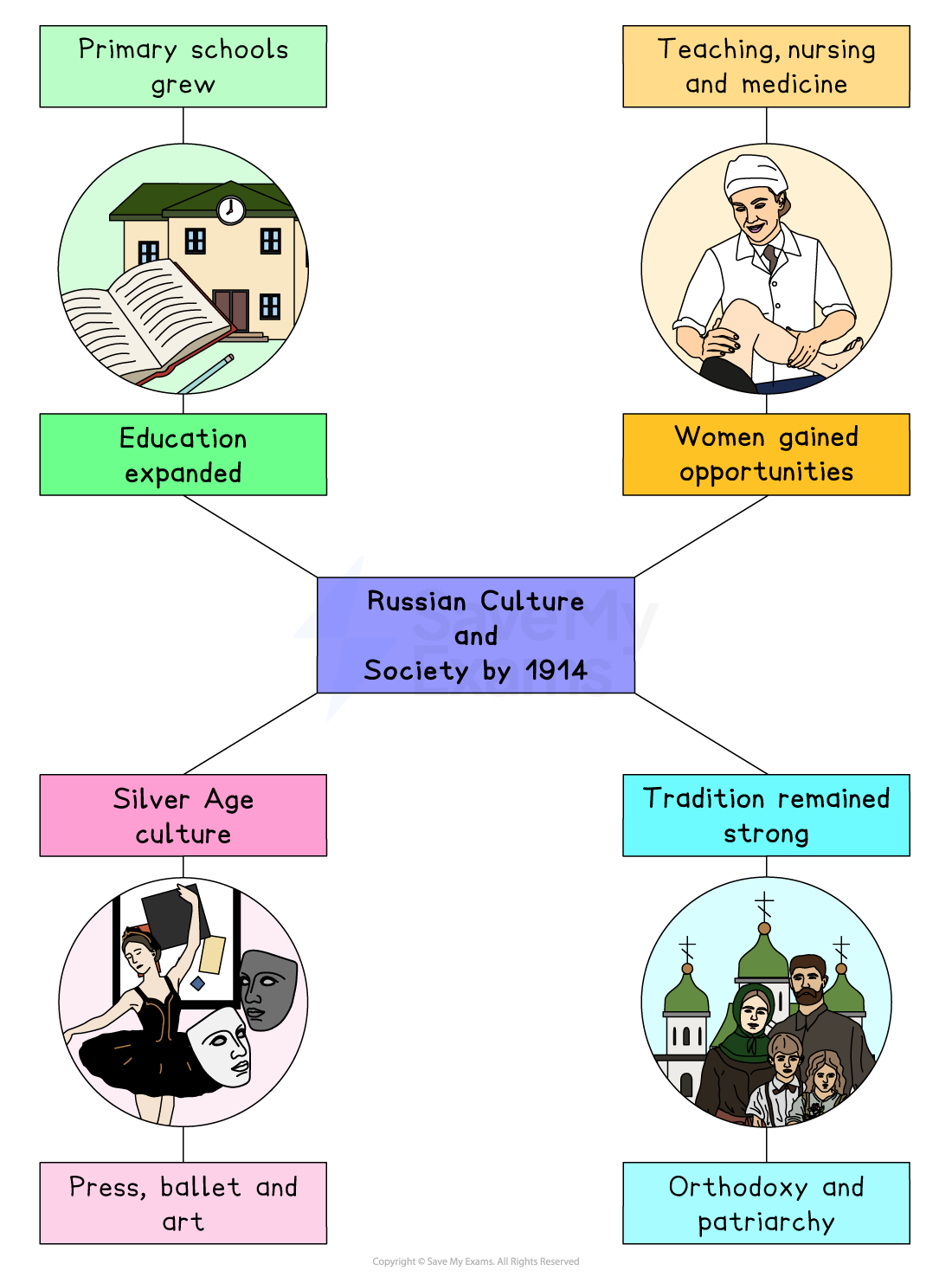
The lives of women in Russia by 1914
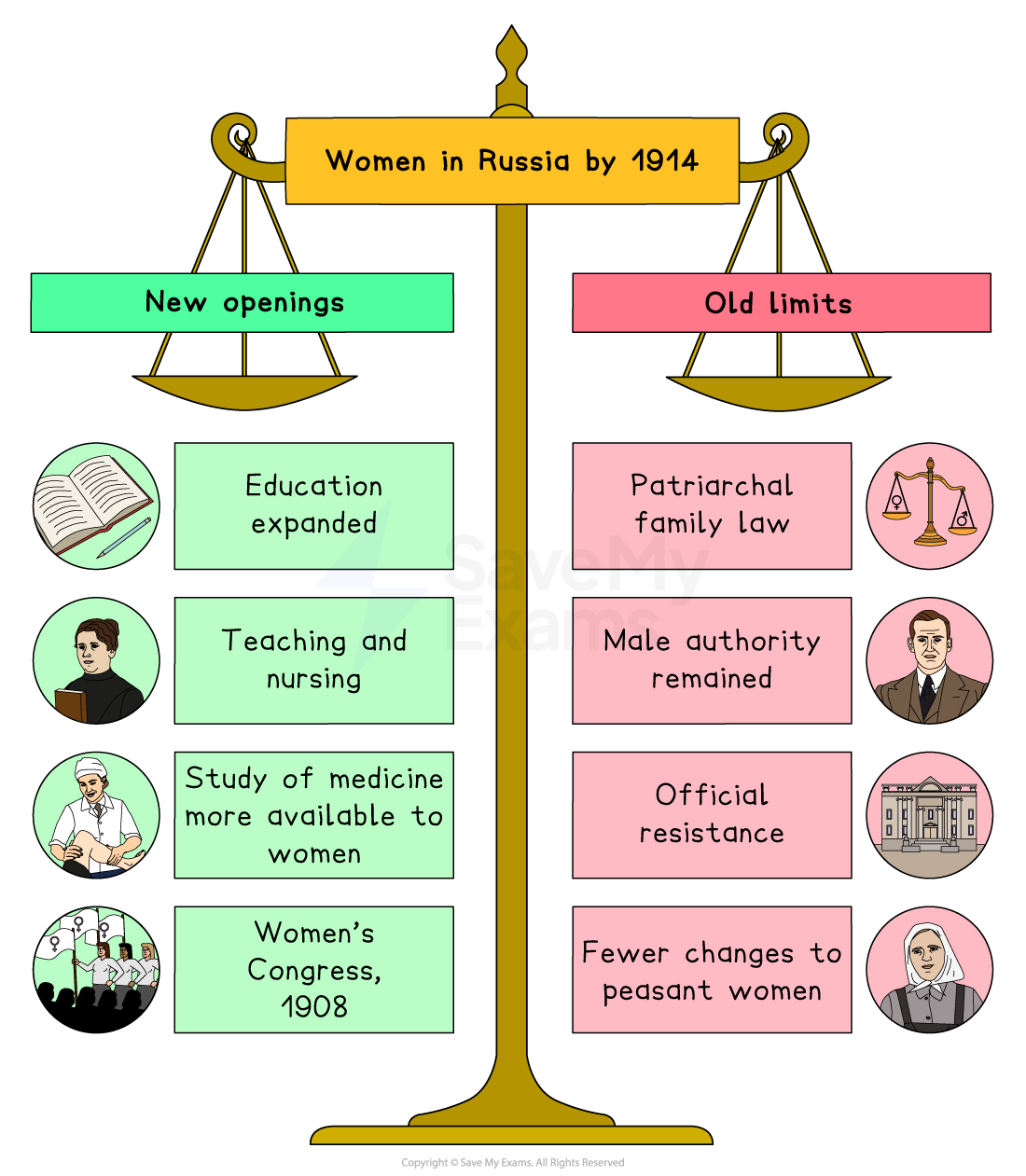
New opportunities for women
Educational and professional openings for women grew after 1900
Zemstvo work created posts for women as teachers and nurses
The Women's Medical Courses had trained women since 1872
Higher education increasingly admitted women by 1914
By 1914, Russia had around 69,000 university students, showing the growth of higher education
Women’s access to higher education had expanded sharply, with women making up around 45% of students in some forms of higher education
However, women’s options remained restricted, as they were often channelled into separate women’s courses rather than admitted on equal terms to all university courses
Organised campaigning for women's rights began to take shape
The First All-Russian Congress of Women met in December 1908
Its 1,035 delegates called for the women's right to vote
The limits of change for women
The patriarchal family structure kept women legally subordinate
The male household head held almost unlimited authority over the family
Both Alexander III and Nicholas II tried to restrict women's education
Gains for women came despite official resistance, not because of it
These changes touched urban women far more than peasants
Most peasant women's lives stayed bound to the household and the field
Examiner Tips and Tricks
Be careful not to overstate women's gains. New posts in teaching, nursing and medicine were real, but the patriarchal legal framework around marriage and property was untouched.
Education in Russia by 1914
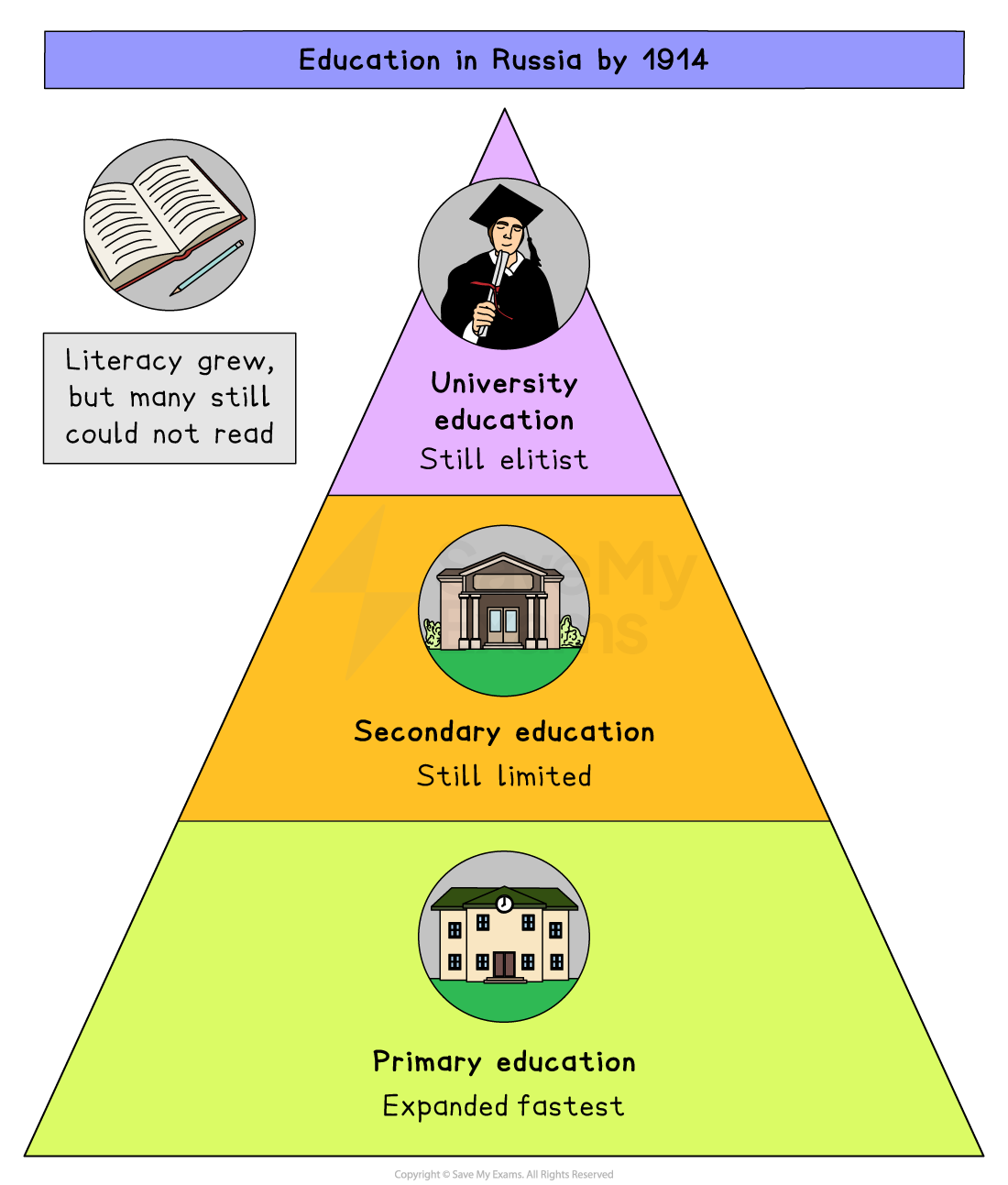
The expansion of primary education
The state invested heavily in primary schooling after the 1890s
Spending rose from 5 million roubles in 1896 to over 82 million by 1914
Primary enrolment reached a large minority of children by 1911
6.5 million children aged 8 to 11 attended, 44% of that age group
Only 1/3 of these pupils were girls
Literacy and the popular press
Rising literacy created a mass reading public for the first time
The popular press boomed once censorship eased after 1905
By 1914, around 1,757 newspapers appeared at least weekly
Widespread illiteracy still left much of the population outside print culture
Around 60% of Russians remained illiterate in 1914
The limits at the secondary and higher levels
Secondary and higher education stayed narrow and elitist
University students grew from 5,000 in 1860 to 69,000 by 1914
These totals stayed tiny against a population of around 170 million
Examiner Tips and Tricks
Use precise figures rather than vague claims that literacy ‘improved’.
Russian arts & culture by 1914: literature, music, ballet & art
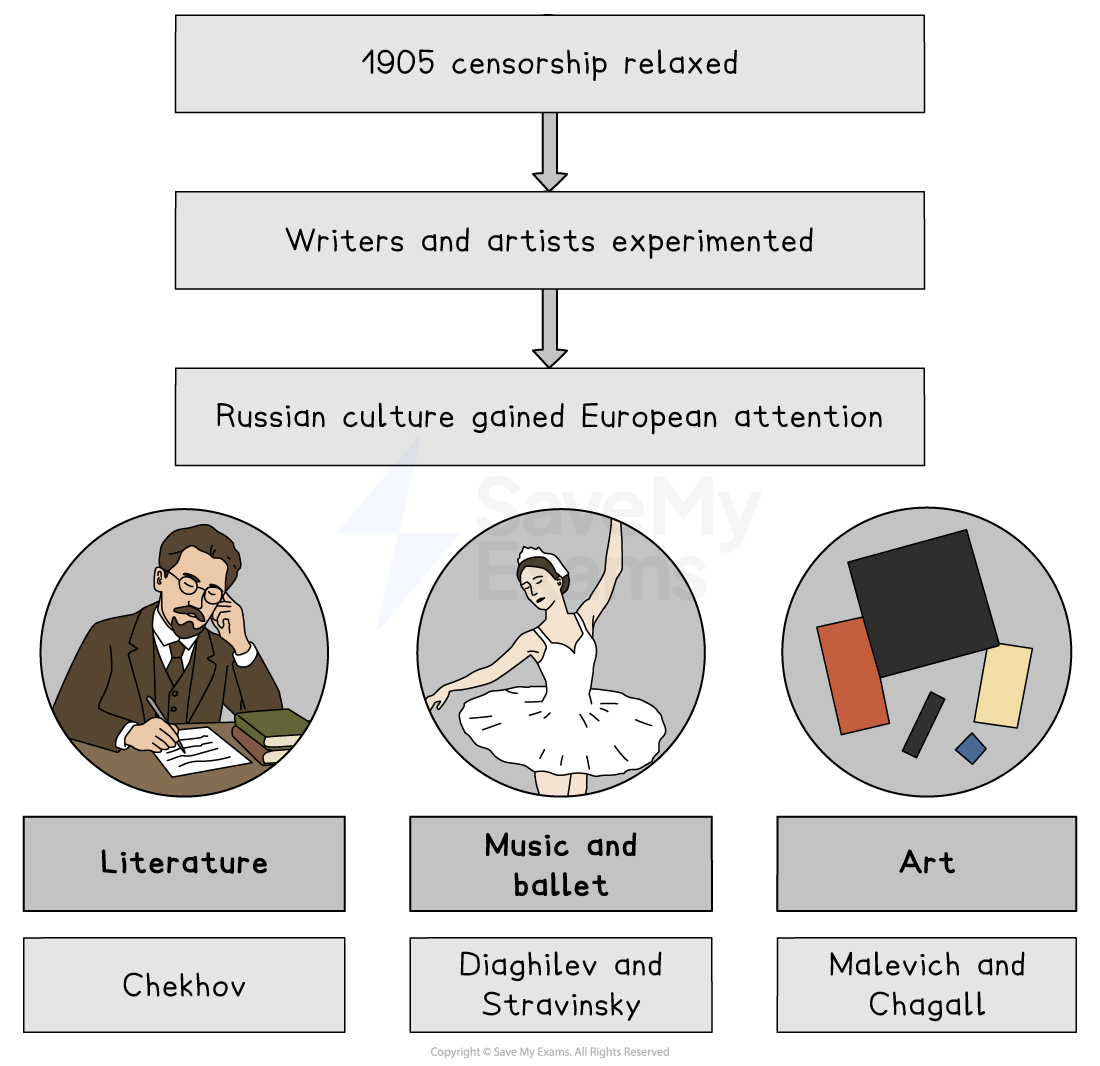
The Silver Age
The relaxation of censorship in 1905 opened what is called a cultural 'Silver Age'
Artists and writers expressed their creativity to address and comment on problems in Russian society
Realist writing continued the tradition of Tolstoy and Dostoevsky
Anton Chekhov produced stories and plays from the 1880s until 1904, continuing their style
Modernism and international recognition
Modernist artists challenged conventions and gained global recognition
Diaghilev's Ballets Russes carried Russian dance to Europe
Stravinsky's music and Malevich's and Chagall's art shocked audiences
The 19th-century Russian literary classics were produced cheaply for the newly literate
Examiner Tips and Tricks
Link the Silver Age back to the 1905 relaxation of censorship. This shows how a political change directly enabled a cultural one, which is exactly the kind of connection examiners reward.
The Romanov Tercentenary, 1913: celebration or illusion?
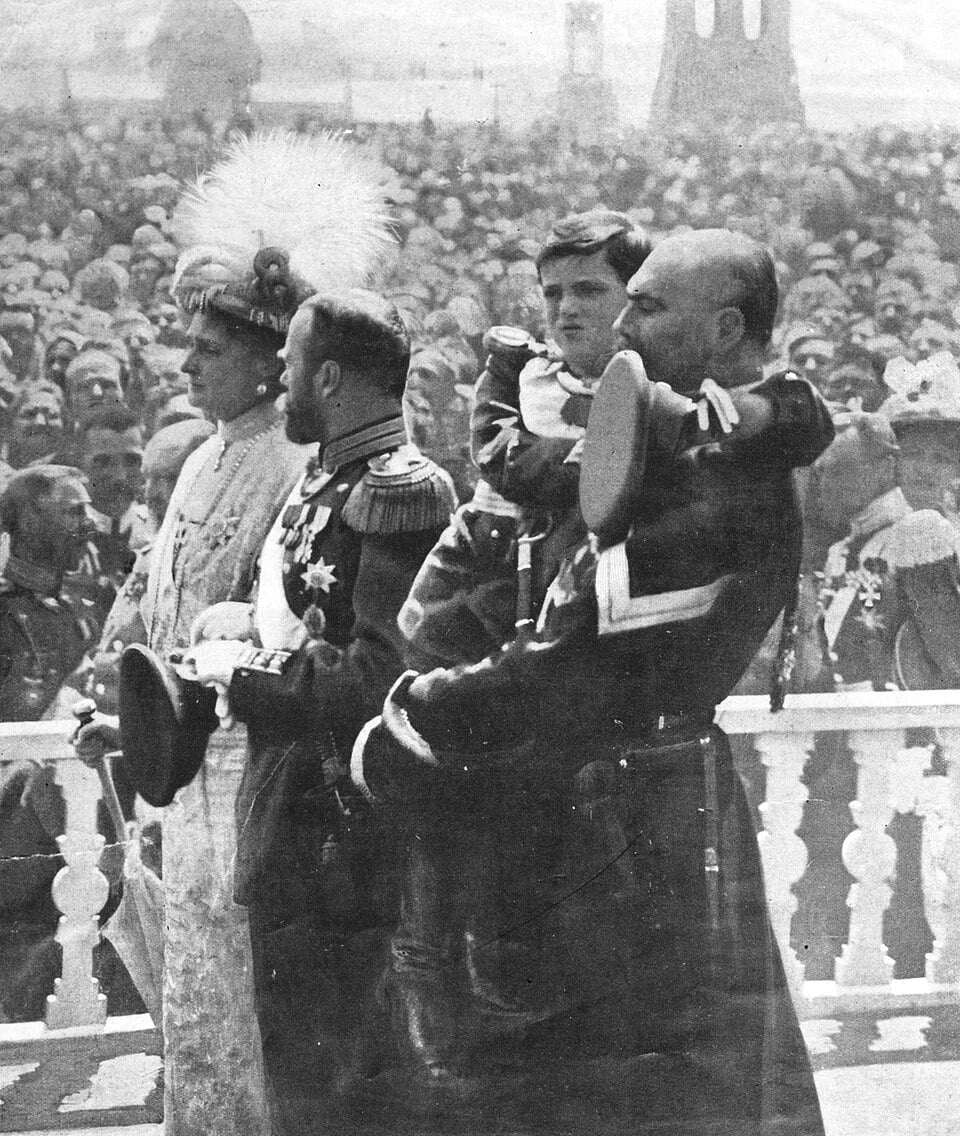
The celebration of autocracy
The 1913 jubilee marked 300 years of Romanov rule
Nicholas and Alexandra revived the Muscovite costume and the Orthodox ritual
The dynasty toured the empire to large, cheering crowds
A three-month tour of 'old Muscovy' ended with a triumphal entry into Moscow
Nicholas led the way into the city on a white horse
Surface loyalty or genuine strength?
The crowds left Nicholas convinced of his people's devotion
However, the display masked deep political and social strains
Within four years, revolution would sweep the dynasty away
Examiner Tips and Tricks
The Tercentenary is strong evidence of the contrast between how secure the regime looked on the surface and the tensions building beneath it. Treat the celebration as a question, not a fact.
How much had Russian culture changed by 1914?
By 1914, Russia could look both strikingly modern and stubbornly traditional
Historians disagree over how far its culture had really changed
Russian culture had changed significantly
Culture reached a far wider public than ever before
The popular press, cheap classics and reading rooms spread literacy
Russian arts achieved genuine international standing
The Silver Age and the Ballets Russes drew European attention
Education and the professions opened new paths, including for women
Key historian
“Between 1850 and 1914, Russian society saw both the creative and the destructive sides of modernisation. Slowly, Russia’s social structures were assuming the familiar features of capitalism and the traditional social and economic structures of Russian society lost vitality. By 1900 many peasants and many nobles had abandoned their traditional way of life. It is no coincidence that in 1905, the tsarist government came close to collapse.”
D. Christian, Imperial and Soviet Russia (1986)
Christian sees deep, accelerating modernisation across the whole period, with social and cultural change feeding directly into the instability of 1905
This supports the view that change by 1914 was real and far-reaching
Russian culture had changed little
The patriarchal family structure remained essentially untouched
Male authority still governed the household and its property
Mass illiteracy kept print culture out of most lives
Around 60% of Russians still could not read by 1914
Tradition and Orthodoxy still framed everyday culture
The 1913 Tercentenary revived Muscovite and religious culture
Examiner Tips and Tricks
Distinguish the genuine change among educated, urban Russians from the largely unchanged lives of the peasant majority. Weaker answers treat ‘Russian society’ as a single entity.

Unlock more, it's free!
Join the 100,000+ Students that ❤️ Save My Exams
the (exam) results speak for themselves:

Was this revision note helpful?
