Working and Living Conditions in Russia by 1914 (AQA A Level History: Component 1: Breadth study): Revision Note
Exam code: 7042

Summary
Rapid industrialisation pulled millions of peasants into Russia's fast-growing towns and cities
Factory laws improved conditions on paper, but life for most workers remained harsh
Urban housing was overcrowded and unsanitary, while disease spread quickly through the towns
Real wages failed to keep up with inflation, fuelling growing worker discontent
The countryside changed slowly: strip farming and the commune (mir) still shaped peasant life
Historians debate whether industrial workers were better off than peasants by 1914
Read emphasises the new urban opportunities that town life created: schools, libraries and political activity
Figes stresses that terrible factory conditions and rising unrest left workers no better off
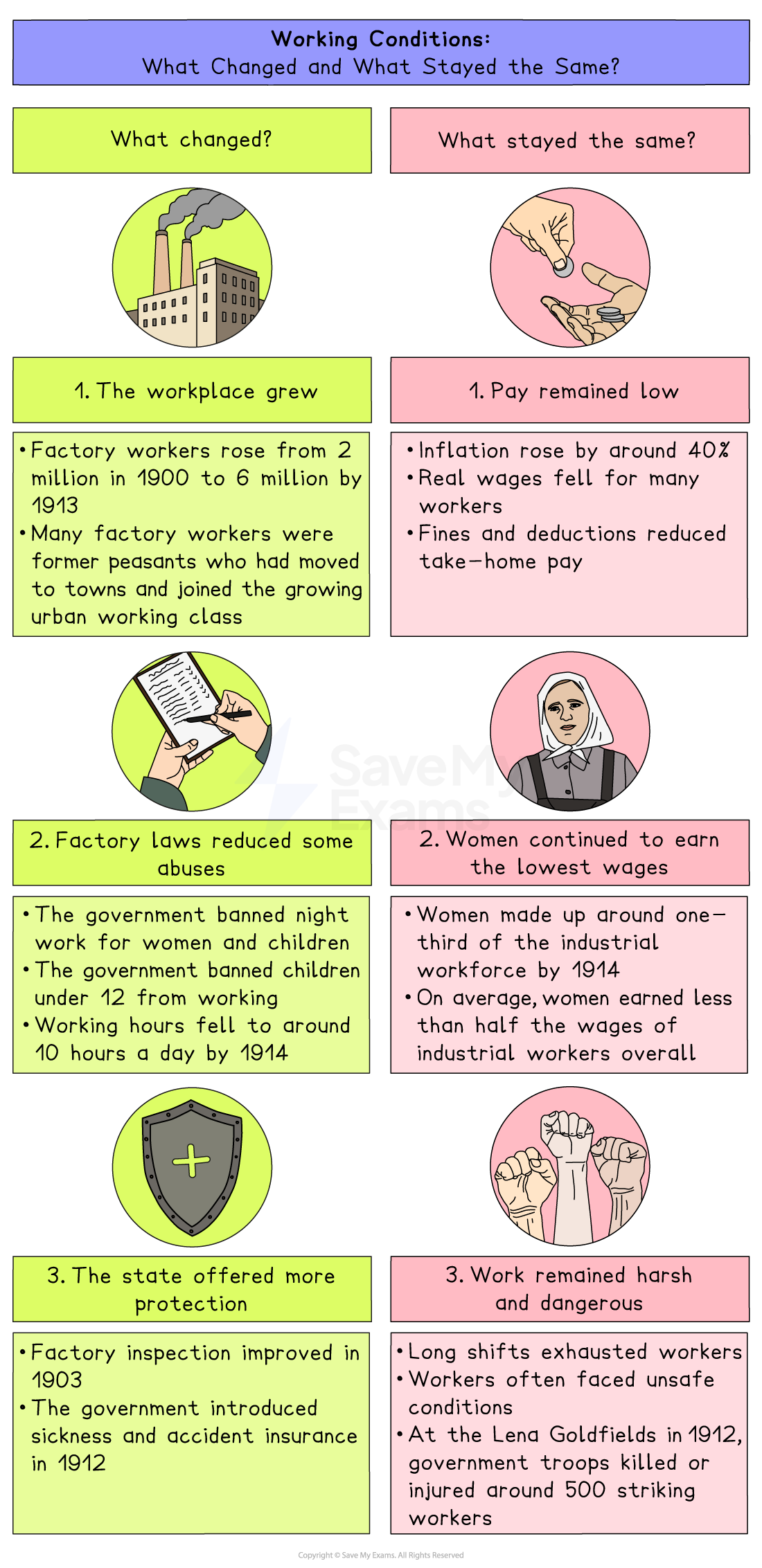
Working conditions: what had changed & what had stayed the same?
Industrialisation transformed the size of the workforce
Industry boomed after the 1890s, swelling Russia's urban working class
Factory workers rose from 2 million in 1900 to 6 million by 1913
Most were peasants who came to the towns to find work, forming a new proletariat
Many of these migrant workers kept one foot in the village
Known as otkhodniki, they often returned home for the harvest
Others stayed in the towns for years before moving on again
Over time, their children grew up thinking of themselves as urban workers
What had changed: the law slowly limited the worst abuses
A series of factory laws set limits on the harshest practices
Night work for women and children was banned in 1885
Child labour under the age of 12 was forbidden in 1882
Working hours were cut to eleven and a half hours in 1897
Hours fell further in the years before the war
Normal factory hours dropped to around ten per day by 1914
However, these limits did not apply to small workshops, where cottage industry abuses continued
The state added inspection and basic protection
A more efficient factory inspection system came in 1903
Sickness and accident insurance for workers followed in 1912
Workers' legislation
Date | Law |
|---|---|
1882 |
|
1885 |
|
1886 |
|
1892 |
|
1897 |
|
1903 |
|
1912 |
|
1914 |
|
What had stayed the same: low pay and dangerous work
Wages stayed low and steadily lost their value
The average wage rose only slightly while inflation ran at around 40% across the 1900 – 1914 period
Real wages, therefore, fell, leaving many workers worse off than before
Fines and deductions cut further into take-home pay
Women were paid the least of all
Women made up 1/3 of the industrial workforce by 1914
They earned less than half the average industrial wage
Factory work remained punishing and often unsafe
Long shifts left workers exhausted and prematurely aged
Strikes were frequently met with force rather than reform
At the Lena Goldfields in 1912, around 500 strikers were killed or injured
Examiner Tips and Tricks
Questions on social change reward balance, not a list of hardships. Show what genuinely improved for workers, such as the ten-hour limit by 1914, factory inspection and the 1912 insurance law, and weigh it against what stayed the same, such as falling real wages and dangerous conditions.
Living conditions in towns & the countryside by 1914
Towns grew faster than housing or sanitation could cope with
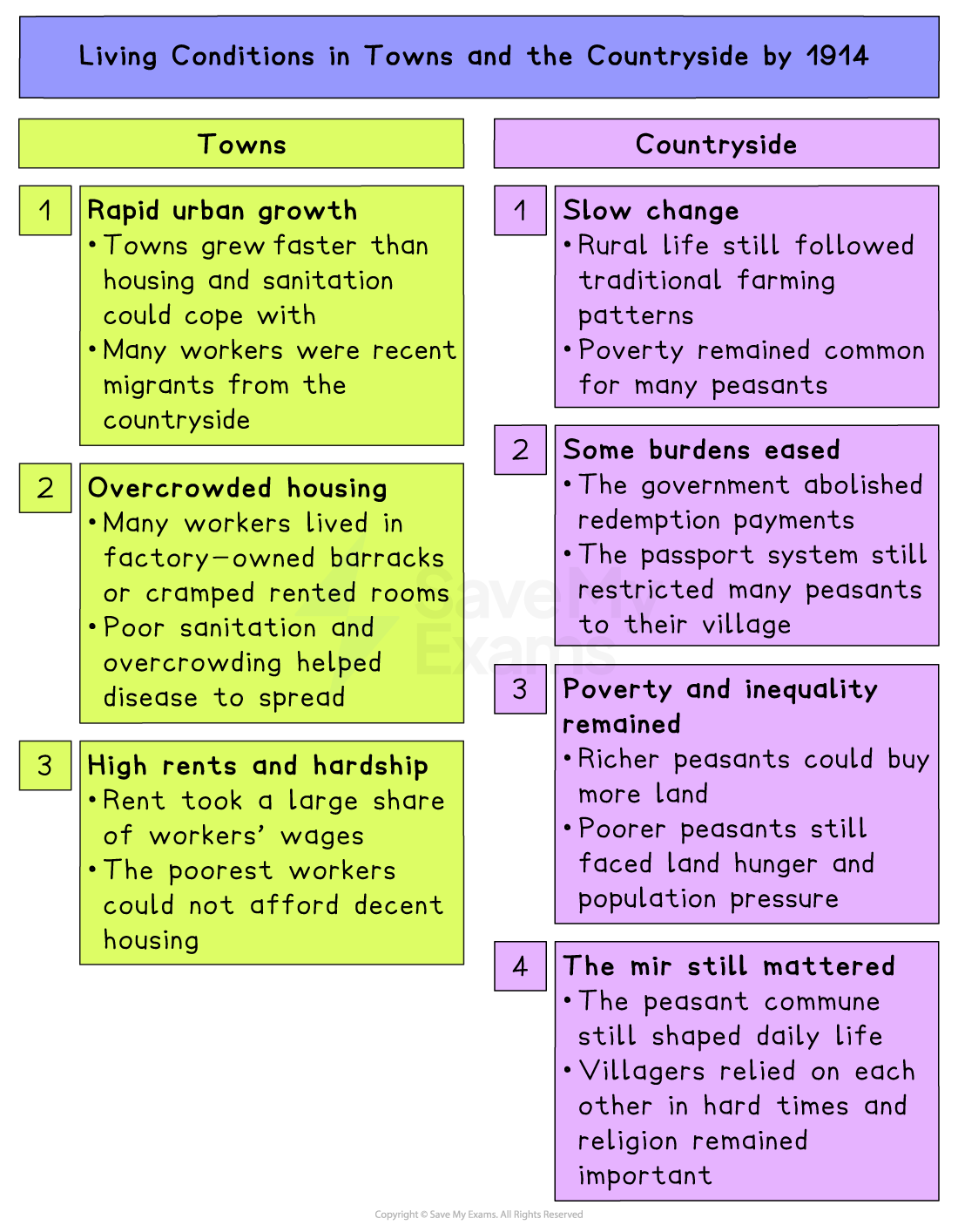
Rapid urbanisation packed people into towns built for far fewer
The urban population quadrupled from 7 to 28 million between 1867 and 1917
By 1914, 3 in 4 people in St Petersburg were peasants by birth
Half of the capital's population had arrived in just the previous 20 years
Most workers lived in overcrowded, factory-owned housing
Barrack-like buildings lacked sanitation
Such housing often counted as payment in kind, tying workers to the factory
Disease could spread easily in these conditions
Around 40% of St Petersburg houses had no running water or sewage
Cholera killed 30,000 people in the city in 1908 – 09
High rents trapped workers in poor housing
Rent could swallow up to half of workers' wages
Those who could not pay slept by their machines or on the street
“One cannot but note the premature decrepitude of the factory woman. A woman of 50 who has worked at the factory 30 or more years frequently looks about 70 years old. She sees and hears poorly, her head trembles, she is sharply hunched over. While elderly workers have pensions, our women workers, having given decades to the factory soot, are prematurely enfeebled, can expect nothing better than to live out their last days as latrine attendants.”
L. Katenina, working for a zemstvo, 1913
The countryside changed far more slowly
Rural life still rested on old patterns of farming
Strip farming continued on 90% of the land
Widespread poverty remained the norm for most peasants
Some old burdens did ease
Redemption payments were finally scrapped in 1907
Yet the passport system still tied many peasants to their village
The gap between richer and poorer peasants widened
Kulaks used bank loans to buy out their poorer neighbours
The poorest peasants found life getting harsher
Few could escape the pressure of a growing population
Government schemes from 1896 encouraged migration to Siberia
Only 3.5 million of nearly 97 million peasants took up the offer
The scheme was far too small to ease overcrowding
The commune (mir) still shaped everyday peasant life
The proportion of land held by the commune fell only from 73% to 60% after Stolypin's reforms
Villagers still supported each other through bad harvests and hard times
Religion still thrived in the peasant community, shaping their way of life
Examiner Tips and Tricks
Ensure you treat urban and rural poverty separately, as they have different causes.
Were industrial workers better off than agricultural workers by 1914?
By 1914, the lives of industrial workers and peasants had both changed, but in very different ways
Historians disagree over who was really better off
A strong answer weighs the case on each side
The case that workers were better off
Town life opened doors that the village did not
Workers earned cash wages instead of living off subsistence farming
Some attended workers' schools or borrowed from workers' libraries
Workers built a shared urban culture
Taverns, dances and out-of-town walks gave them a social life
After 1905, many joined trade unions or political groups
Education offered a route to a better life
Primary school provision rose by 85% between 1905 and 1914
Key historian
“The pace of work clearly left little time for leisure, nonetheless, workers did have some time to themselves, much of which was spent in the tavern. The minority who moved away from it attended workers’ schools, some of which specialised in Sunday courses to meet their needs; took part in ‘social’ activities such as dances or out-of-town walks that might involve illicit political discussion; involved themselves in trade union or political activities in the semi-legal conditions of post-1905.”
C. Read, From Tsar to Soviets (1996)
Read highlights the new opportunities that town life created:
Schools, libraries, social life and political activity that the village could not offer
This supports the view that industrial workers, for all their hardships, gained advantages that peasants lacked
The case that workers were no better off
Factory conditions were brutal and often dangerous
Workers faced overcrowded barracks and long, exhausting shifts
Real wages fell as prices rose faster than pay
Insecurity and discontent grew across the towns
Strikes rose sharply, reaching 3,574 stoppages in 1914
The state answered unrest with repression, not reform (on the whole)
Peasants kept advantages that many workers had lost
Villagers had land, the commune and mutual support to fall back on
Many migrants kept their village ties as a safety net
Key historian
“The development of a modern, market-based economy brought many changes, including profound social change, to Russia in the final decades of the nineteenth century and the years up to 1914. The old hierarchy broke down, and a new and more dynamic system began to take shape which saw the emergence of new ‘middle classes’. Millions of peasants moved into the towns, or worked in rural factories or mines, although factory conditions were terrible and growing numbers of strikes reflected growing industrial discontent.”
O. Figes, Revolutionary Russia, 1891-1991 (2014)
Figes stresses that the move to the towns brought terrible factory conditions and rising strikes
This supports the view that the urban worker’s gains were undercut by squalor and discontent, leaving them no clearly better off than the peasantry
Examiner Tips and Tricks
Be precise about which workers you mean: a skilled metalworker, a low-paid woman in a textile mill and a landless labourer were in very different positions.

Unlock more, it's free!
Join the 100,000+ Students that ❤️ Save My Exams
the (exam) results speak for themselves:

Was this revision note helpful?
