The Russian Civil War, 1918–1921: Causes, Events and Consequences (AQA A Level History: Component 1: Breadth study): Revision Note
Exam code: 7042

Summary
The Russian Civil War (1918-1921) set the Bolshevik Reds against a loose coalition of the Whites
Opposition grew after the Treaty of Brest-Litovsk, Bolshevik one-party rule and the closure of the Constituent Assembly
The Czech Legion revolt in May 1918 helped turn opposition into a full civil war
Foreign powers, including Britain, France and the USA, supported the Whites
Their help was limited and unpopular
The Reds won by 1921 through their central position, unified command under Trotsky, and benefited from White disunity
Victory came at a cost
Around 10 million died
The war strengthened centralisation, terror and one-party rule
Historians debate whether the Civil War forged the Bolshevik state or mainly left Russia ruined
Figes argues that the totalitarian state had its origins in the Civil War
Pares stresses that by 1921, Russia was ruined, with industry and transport almost broken down
Causes of the Russian Civil War
Why opposition turned into a civil war
The Bolsheviks quickly created enemies after taking power in October 1917
They banned the opposition press
They shut out every other party except a few left-wing Socialist Revolutionaries (SRs)
They ruled through the Sovnarkom alone
Many opponents saw Bolshevik rule as a betrayal of the revolution
Urban workers had wanted the Soviet government, not one-party Bolshevik rule
The forced closure of the Constituent Assembly after one day in January 1918 enraged moderates
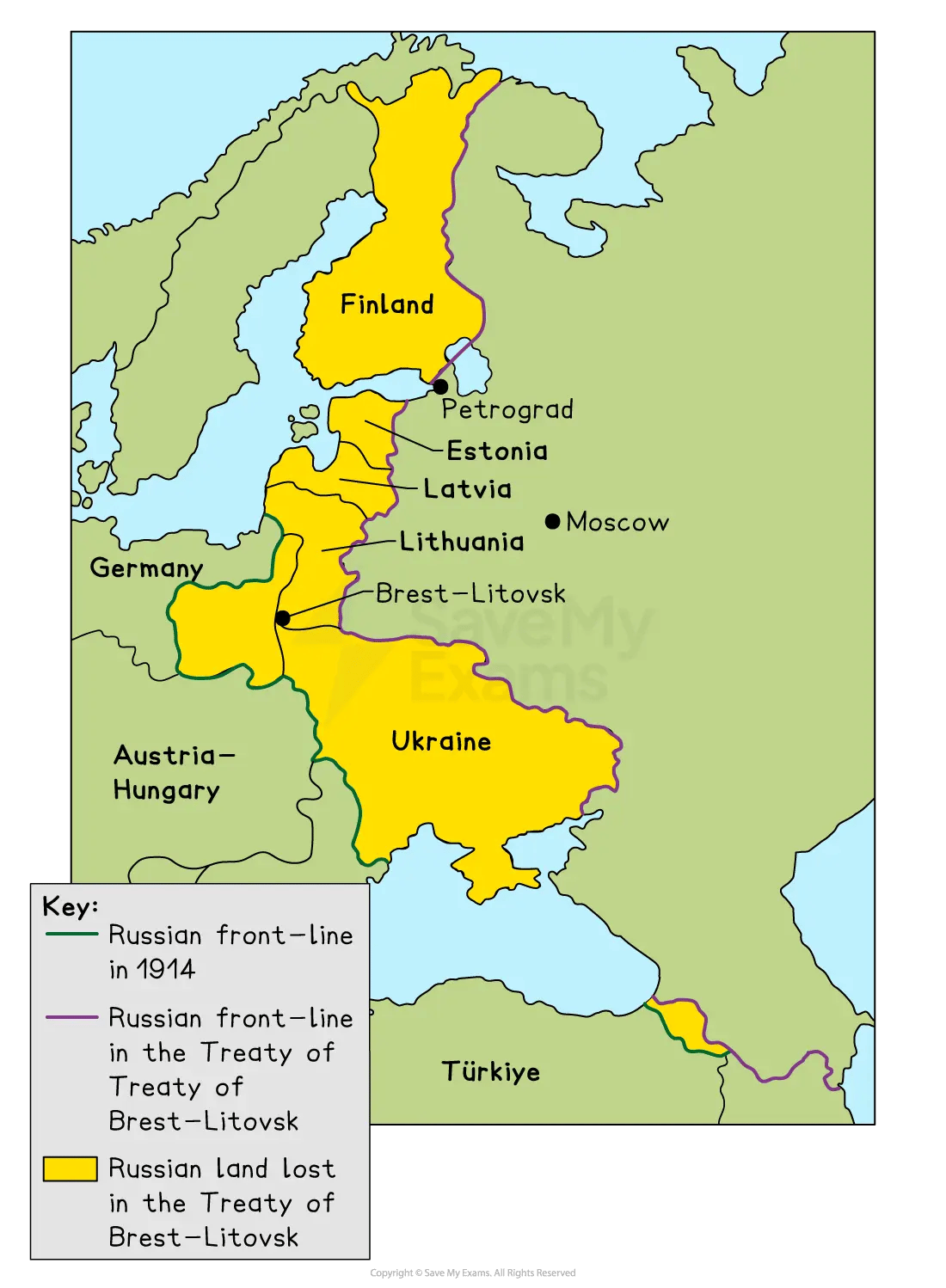
The Treaty of Brest-Litovsk became the major trigger
Many people welcomed the end of Russia's involvement in the First World War
However, Russia had to give up a large proportion of its land to Germany
This included around one-sixth of its population, around 62 million people
The treaty became a symbol of national humiliation and caused deep anger
Foreign powers wanted to stop Bolshevism from spreading
France, Britain, the USA and Japan all opposed Bolshevism
More importantly, they wanted Russia to reopen the Eastern Front
Germany now directed its fighting towards the Western Front
The Whites opposed the Bolsheviks, but they were a loose coalition, not a united movement
They included:
Anarchists, who opposed government altogether
Nationalists, who wanted independence from Russian rule
The SRs and Mensheviks, who wanted more democracy
Senior army officers, who wanted to restore tsarism
Their only shared aim was to bring down the Bolsheviks
The Czech Legion and the civil war
The Czech Legion was a foreign army trying to leave Russia
It was a 45,000-strong force of Czech and Slovak troops
They had been fighting Germany and Austria-Hungary in the war
They wanted to leave Russia and rejoin the fight against Germany
In March 1918, the Bolsheviks allowed the Legion to move east along the Trans-Siberian Railway
A clash in May 1918 turned the Legion against the Bolsheviks
Bolshevik officials tried to arrest some of the soldiers
Fighting broke out as the force moved along the railway
The revolt turned scattered opposition into a full civil war
The Legion seized the railway across much of the country
It joined forces with the anti-Bolshevik groups
Together, they began to advance on Moscow
Three years of fighting followed across the former empire
Examiner Tips and Tricks
Examiners reward precise triggers. Lead with the Treaty of Brest-Litovsk, the closure of the Constituent Assembly and the Czech Legion’s revolt, rather than saying vaguely that the Bolsheviks were unpopular.
Events of the Russian Civil War: Reds vs Whites
How the war was fought
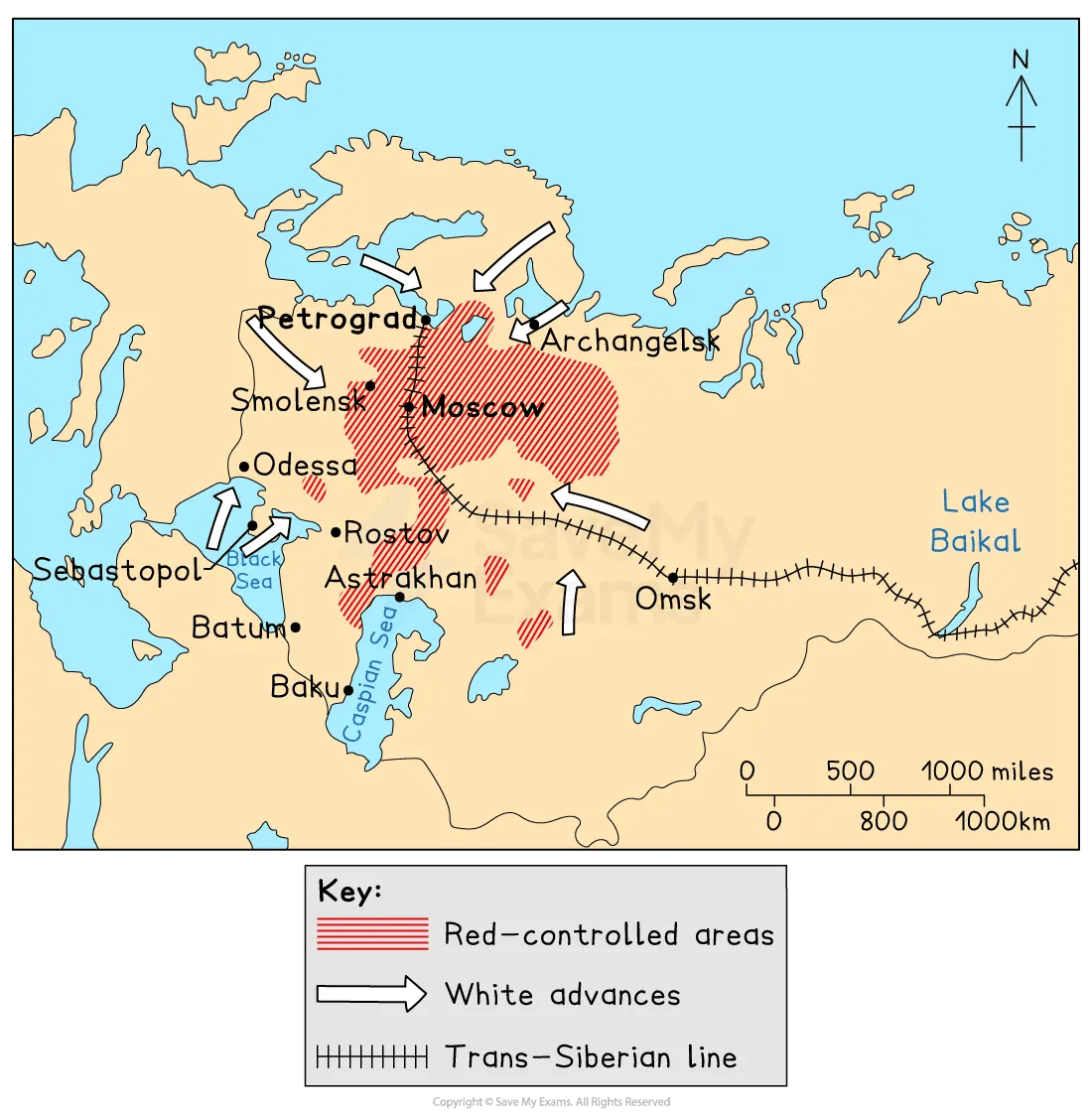
The Reds held the centre while the Whites attacked from the edges
Red territory was based around Moscow and Petrograd
White forces pressed in from the east, south and northwest
The Whites fought on several separate fronts
Admiral Kolchak led the White forces in the east, in Siberia
General Denikin commanded the White Army in the south
General Yudenich attacked towards Petrograd from the northwest
Foreign powers backed the Whites, but only to a limited extent
Britain, France and the USA all sent support
They opposed communism and wanted Russia back in the war, fighting against Germany
They also resented the Bolshevik refusal to repay tsarist debts
Their support declined further after the First World War ended
The early fighting, 1918
Anti-Bolshevik forces took shape early in 1918
General Kornilov led the anti-Bolshevik Volunteer Army in the south
Socialist Revolutionaries and liberals set up a rival government at Omsk
By summer, the fighting had grown into a full-scale civil war
The Bolsheviks moved to secure their position
They shifted the capital from Petrograd to Moscow in March 1918
The Tsar and his family were shot at Yekaterinburg in July 1918
Local officials feared the Whites would rescue him as a figurehead
They feared he could be restored to the throne
Trotsky built the Red Army into a fighting force
He reintroduced conscription to raise its numbers quickly
This gave him an army of around 300,000 men
He enforced strict discipline
The death penalty was used for desertion or disloyalty
He appointed political commissars to keep units loyal
The Reds gain the upper hand, 1919-1920
The Whites reached the height of their success by June 1919
They had seized a large amount of territory
However, they still fought as separate forces
The Reds turned the tide before the end of 1919
They used their central position to fight the White armies one at a time
Kolchak pushed west from Siberia but was driven back
Denikin attacked from the south and threatened Moscow
His advance was halted and he was forced into retreat
Yudenich struck at Petrograd from the northwest but was pushed back
The final stage and the cost, 1920-1921
The last White resistance was crushed in 1920
General Wrangel took over from Denikin in the south
His forces were defeated in the Crimea in 1920
Nationalist uprisings, including those in Ukraine, were put down
The war also ended as a struggle against Poland
Polish forces invaded western Ukraine and reached Kiev (Kyiv) in May 1920
Marshal Tukhachevsky led a Red counter-offensive on Lenin's orders
The Poles fought back and defeated the Red Army
The Treaty of Riga ended the Polish war in March 1921
Poland gained self-rule plus Galicia and parts of Belorussia (Belarus)
The independence of Estonia, Latvia and Lithuania were confirmed
Lenin's order to drive into Poland divided the Bolsheviks
The Reds had won the Civil War by 1921
Victory came at a terrible cost
Around 10 million people died from hunger, disease and combat
Why did the Reds win?
Weaknesses of the Whites
The Whites never fought as one united force
Their generals operated independently
They were scattered across the less-developed edges of the country
Their separate advances could be defeated one at a time
The Whites had no shared goal beyond beating the Bolsheviks
Hatred of Bolshevism was not enough to hold them together
They could not agree on what Russia should become afterwards
The Whites struggled to win popular support
They were tied to unpopular tsarist-era policies
A lack of discipline within the White armies was common
Strengths of the Reds
The Reds controlled the heartland and its resources
They held Moscow and Petrograd, the main industrial centres
This gave them factories, supplies and manpower
They controlled the main communications and railway hubs
This let them move troops and equipment between fronts
Trotsky gave the Red Army strong, unified leadership
He built it into a single, disciplined fighting force
One command structure made the Reds better organised than the Whites
Trotsky personally visited the front lines and gave speeches to motivate the troops
Red policy won more support than the White cause
Red land policies to redistribute land to the peasants were generally more appealing than what the Whites offered
Hostility to foreign intervention worked in the Reds' favour
Examiner Tips and Tricks
Resist the urge to simply list battles. A strong answer explains how the Reds’ central position and single command became decisive advantages. The Whites were too divided and wanted different things for Russia.
Political Impacts of the Russian Civil War
The war forced power to the centre
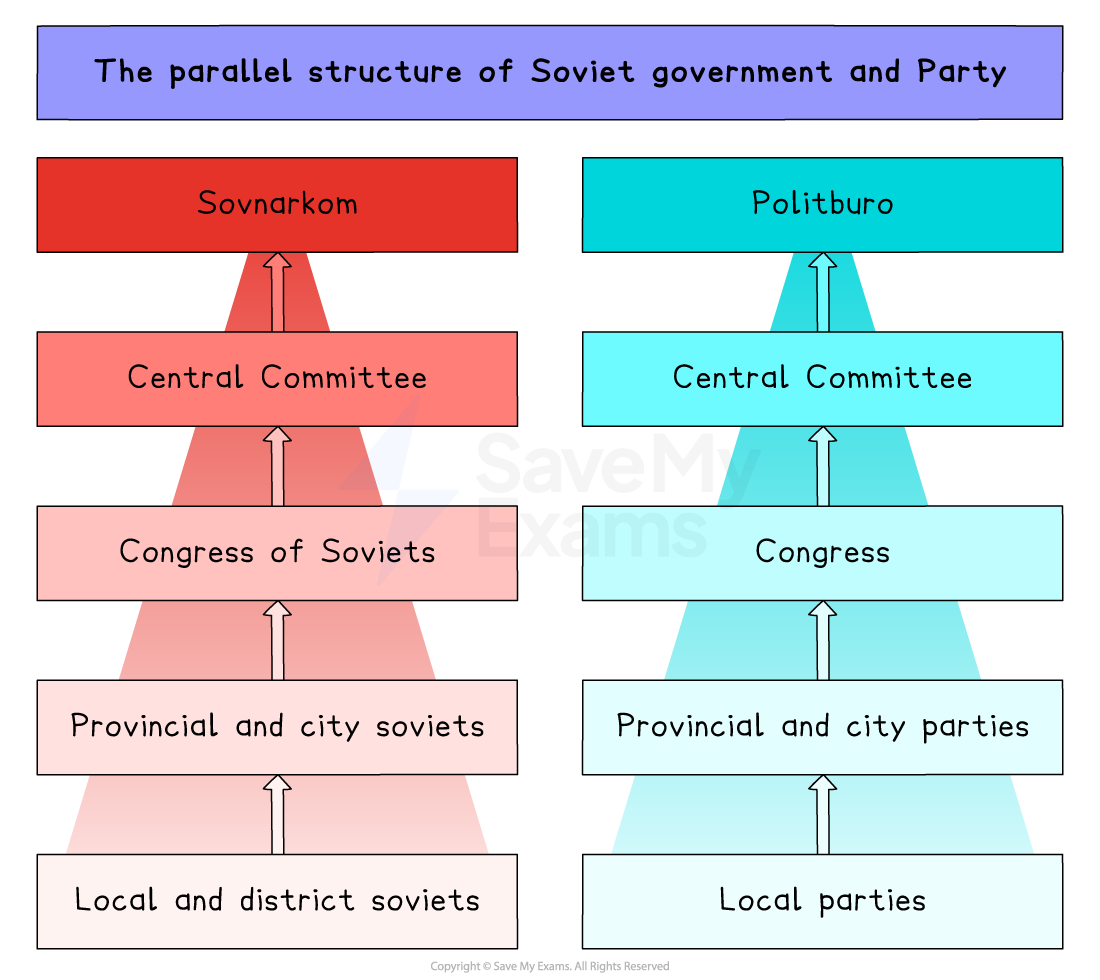
The Civil War pushed the Bolsheviks towards tight central control
Survival demanded fast decisions and strict obedience
Terror was used systematically to crush opposition
Weak Bolshevik control pushed the regime towards a more centralised system
Real power shifted to the Party rather than the soviets
The Politburo, set up in 1919, became the true centre of power
Its first members included Lenin, Trotsky and Stalin
The Sovnarkom and the soviets met and mattered less
A militarised, swollen state
Government grew into a vast bureaucracy during the war
There were twice as many officials as workers in Soviet Russia
These officials became the main social base of the new regime
The Party took on a permanent military style
It spoke in terms of front, battles and campaigns
It treated all opponents as enemies to be hunted down
This habit of command and struggle outlasted the war
Tighter rule over the people and minorities
The state moved away from earlier promises after the war
Self-determination for national minorities was dropped
Independence movements were branded as counter-revolutionary
Georgia's demands for independence were crushed in 1922
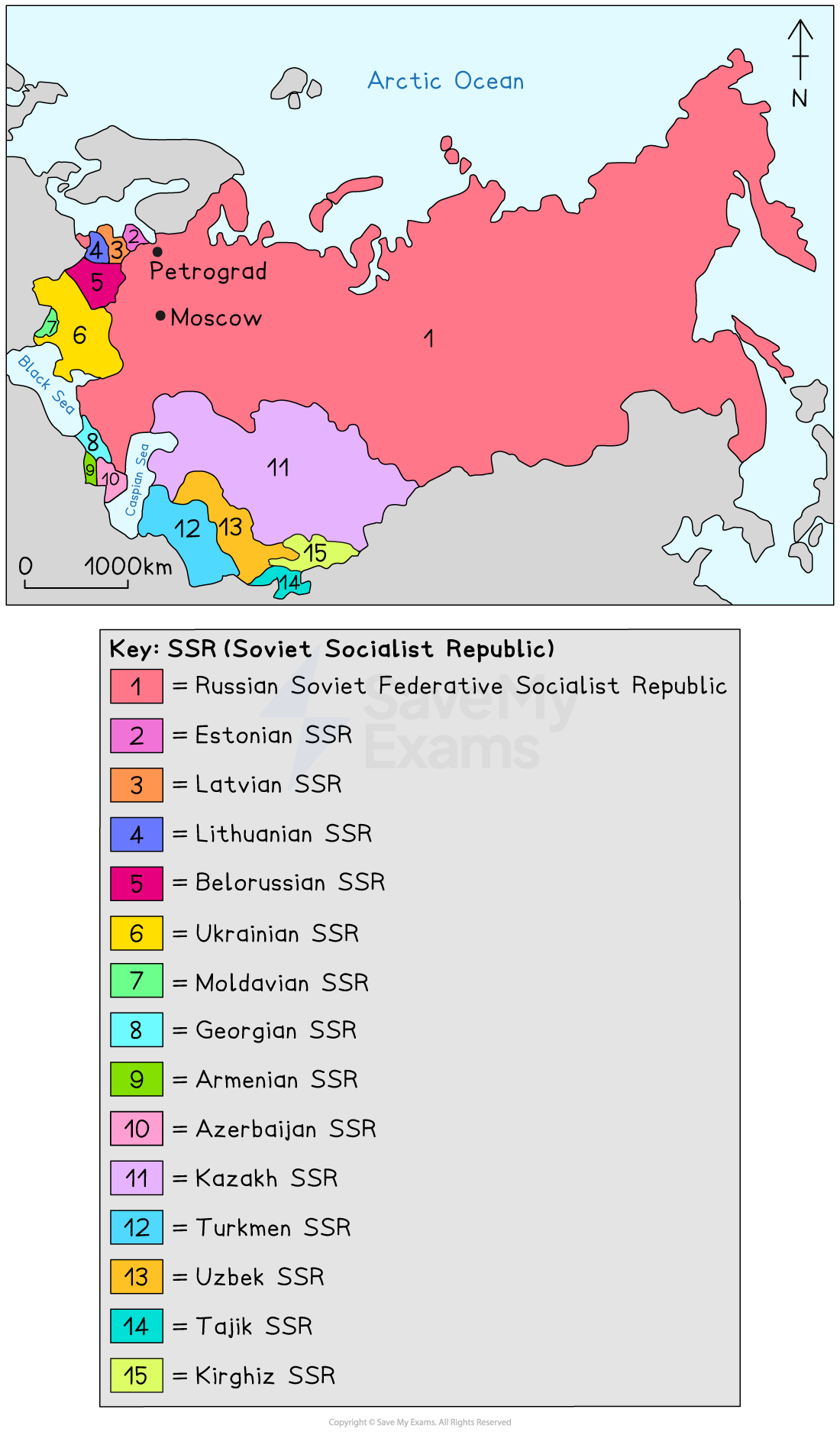
Bolshevik authority was rebuilt as one centralised union
The RSFSR became the USSR in December 1922
In theory, it was a federation of equal republics
In practice, Moscow kept firm control over them all
Examiner Tips and Tricks
Do not treat the Civil War as only a military conflict. Its biggest political impact was that it changed how the Bolsheviks governed. Central control, terror, bureaucracy and Party discipline all became normal during the war, and many of these methods remained afterwards.
The strongest answers link emergency wartime measures to the later one-party state. The Politburo, the growth of bureaucracy, the weakening of the soviets and the creation of the USSR all show power moving away from popular democracy and towards centralised Party control.
How Important Was the Russian Civil War to the Success of Bolshevism?
The Civil War secured Bolshevik power
But historians disagree about how far it explains the regime that followed
The Civil War forged the Bolshevik state
The war turned a fragile takeover into a hardened regime
Victory gave the Bolsheviks a powerful founding myth
It proved the Party could survive against the odds
It removed rival parties and armed opponents
The war built the tools the regime would continue using
The Red Army became a mass, disciplined force
Terror and central planning became normal in these years
The militarised command style outlasted the fighting
The state that emerged was shaped by the war for decades
Bureaucracy ballooned to 5.4 million officials by 1920
The habits of struggle and command became permanent
Key historian
“The totalitarian state had its origins in the civil war, when it was necessary to control every aspect of the economy and society. For this reason the Soviet bureaucracy ballooned spectacularly during the civil war. By 1920, 5.4 million people worked for the government. There were twice as many officials as there were workers in Soviet Russia and these officials were the main social base of the new regime. This was not a dictatorship of the proletariat but a dictatorship of the bureaucracy. The civil war became a model of success and shaped political habits until 1941.”
O. Figes, Revolutionary Russia (2014)
Figes argues that the Civil War, not 1917 alone, created the centralised and bureaucratic state of Soviet rule
This supports the view that the war was decisive in shaping what Bolshevism became
The war's importance lay in its cost, not its strength
Bolshevik victory owed much to White failure
The Whites were divided and scattered from the start
The Reds simply held the centre and outlasted them
This was survival as much as positive achievement
The human and economic cost was huge
Around 10 million people died across the conflict
Industry was reduced to a fraction of its former size
The country was left exhausted and close to collapse
The damage created crises the regime could not ignore
War Communism triggered famine and bitter unrest
These pressures forced the retreat to the New Economic Policy (opens in a new tab)
The cost of victory shaped the hard choices that followed
Key historian
“By 1921 Russia was ruined. The ruin had begun in the First World War. It grew in dimensions under the Provisional Government. The wild, initial experiments of the Bolsheviks were fast completing it. Fantastic inflation and hopeless deficits marked the abandonment of all conventional principles of exchange. Industry was more than five sixths gone. Transport had worn out most of its existing reserves and, in the failure of repair and production, except for military purposes it had broken down almost completely.”
B. Pares, A History of Russia (1949)
Pares stresses the scale of devastation by 1921
Industry and transport were almost destroyed
This supports the view that the war’s true importance lay in the ruin it left behind, not in any positive strength it gave the Bolsheviks
Examiner Tips and Tricks
With this type of question, decide what “success” means before judging. Surviving the war, tightening one-party rule and building a state that lasted are not the same thing. The Civil War can look more or less important depending on which definition you use. Aim for a clear, supported view rather than leaving both sides evenly balanced.

Unlock more, it's free!
Join the 100,000+ Students that ❤️ Save My Exams
the (exam) results speak for themselves:

Was this revision note helpful?
