Russification and the Treatment of National Minorities (AQA A Level History: Component 1: Breadth study): Revision Note
Exam code: 7042

Summary
The Russian Empire contained around 125 distinct nationalities
By 1881, non-Russians made up approximately 55% of the population
This made cultural and religious diversity a major challenge for tsarist rule
Russification intensified under Alexander III
It was shaped by Pobedonostsev's belief in the Russian language, Orthodox Christianity and ethnic Russian identity as the basis of imperial unity
Jewish people faced the most systematic persecution
They had been confined to the Pale of Settlement since 1791
From 1881, they were targeted by state-tolerated pogroms
The May Laws of 1882 restricted Jewish residency, property rights and access to education
Russification increased, rather than reduced, minority nationalism
Polish, Finnish, Georgian and Latvian movements developed organised political structures in response
By the 1890s, some minority groups were strongly represented in socialist and revolutionary parties
Radicalised Jewish people were particularly prominent in opposition networks that challenged Tsarism in 1905 and contributed to its collapse in 1917
Historians debate whether Russification weakened the tsarist regime or was a coherent response to the problem of imperial unity
Read argues that Russification fundamentally weakened Tsarism
Moss presents it as a coherent, though counterproductive, response to real pressures for national unity
Why were national minorities an issue for the tsars?
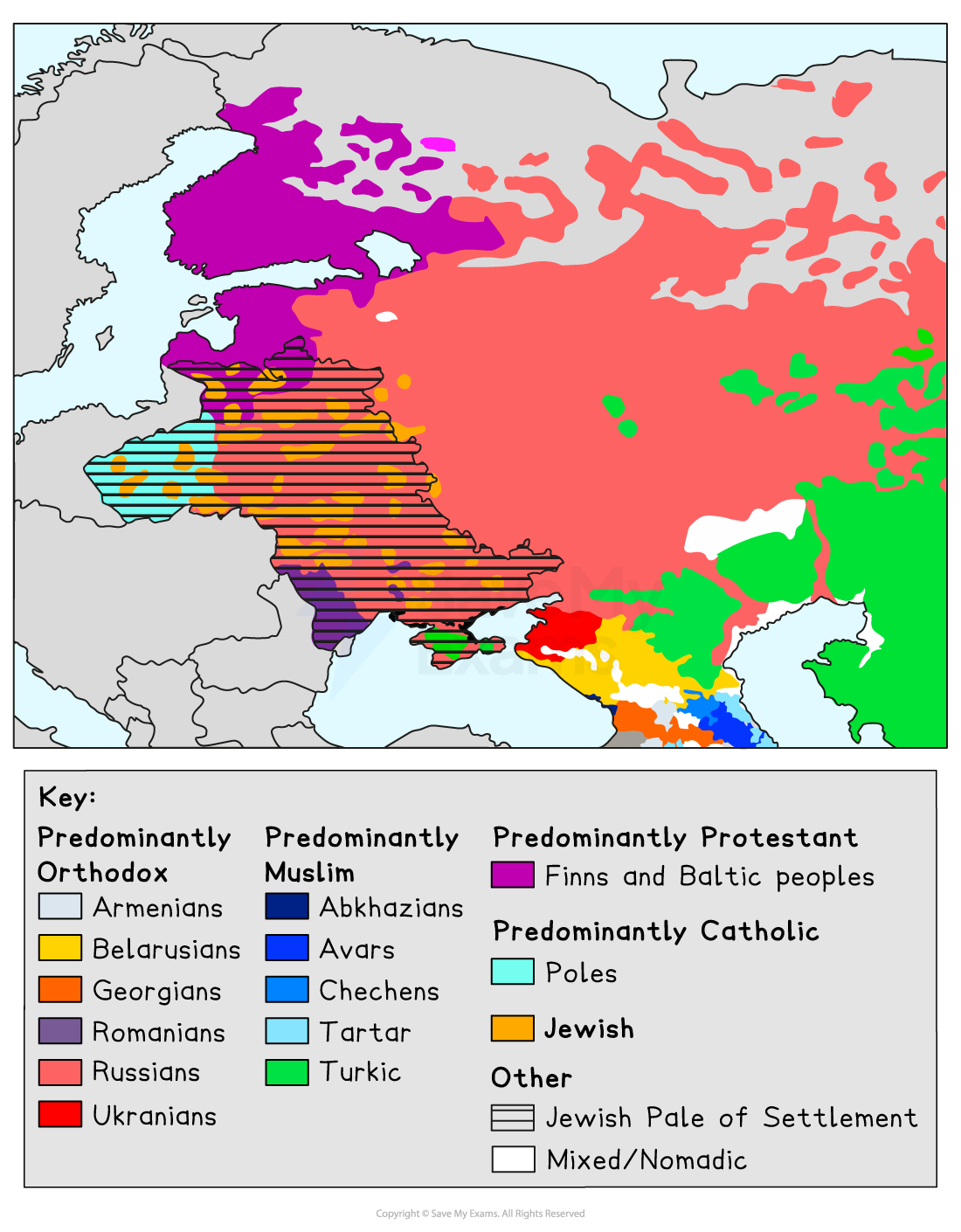
The Russian Empire was one of the most ethnically and religiously diverse states in the world
Around 125 distinct nationalities lived within its borders by the 1880s
Non-Russians constituted approximately 55% of the total population, meaning ethnic Russians were a demographic minority within their own empire
Major groups included Poles, Ukrainians, Belarusians, Finns, Baltic Germans, Georgians, Armenians, Tartars and Central Asian peoples, each with distinct languages, religions and cultural traditions
Governing this diversity within an autocratic, centralised system created fundamental tensions
The empire was administered from St Petersburg, with Russian as the language of law and the Orthodox Church as the state religion
Many non-Russian peoples maintained their own legal institutions, languages and religious structures
These sat uneasily within a framework of autocratic uniformity
As the historian R. Service notes, national consciousness was 'only patchily developed', even among Russians themselves
This made imperial cohesion even harder to engineer from the centre
The 1863 Polish revolt was the critical turning point in tsarist attitudes towards minority autonomy
Alexander II had initially permitted Poland a degree of self-governance, including a separate Sejm (parliament) established in 1815
The January Uprising of 1863 shattered that toleration
Russian forces suppressed the revolt and the Sejm was abolished
The experience convinced the tsarist government that cultural difference was a political security threat, not just an administrative inconvenience to be managed
The assassination of Alexander II in 1881 reinforced the reactionary instincts that drove Russification forward under Alexander III
Minority autonomy was seen by Alexander III and his chief ideologue, Pobedonostsev, as a sign of weakness rather than responsible leadership.
This created the political conditions in which a systematic programme of cultural imposition, rather than managed diversity, became state policy
“We do not want coercion or persecution or constraints against ethnic peculiarities, dialects and languages, or still less against the religious conscience of non-Russians; but we do indeed propose that the Russian government should be solely Russian, throughout the whole expanse of the possessions of the Russian power, which have been gained by Russian blood.”
Mikhail Katkov, Russian journalist, 1865
Katkov's 1865 article captures the ideological logic of Russification two decades before it became state policy under Alexander III: not crude persecution of cultural difference, but the insistence that political authority must be ethnically and linguistically Russian. It shows that Russification had intellectual roots well before 1881.
Examiner Tips and Tricks
Russification is often described as if it were a single, uniform policy introduced overnight by Alexander III. It was not. The process intensified over time, with Alexander III accelerating what had already begun after 1863. When answering questions on this topic, be specific about which tsar, which minority group and which decade you are discussing. Treating all of Russification as one block will cost you analytical marks.
The process of Russification: language, religion & culture
The ideological framework came from Konstantin Pobedonostsev, Chief Procurator of the Holy Synod from 1880, serving both Alexander III and Nicholas II
He championed the slogan 'Orthodoxy, Autocracy and Nationality' as the three pillars of legitimate Russian identity and political order
Pobedonostsev treated religious non-conformity and ethnic distinctiveness as threats to political stability
He used inflammatory language against minority groups, most notably directing the slogan "Beat the Yids, Save Russia" against the Jewish people
Language was the primary instrument of Russification across schools, courts and official administration
Russian was made compulsory in all schools across minority regions, replacing local languages
In Poland, Russian replaced Polish in schools from 1885; Polish history and literature were removed from the curriculum entirely
In the Baltic provinces, German-language education was removed and Russian was imposed in its place, targeting an administrative elite that had previously served the tsars loyally
In Finland, the February Manifesto of 1899 stripped Finnish constitutional autonomy, it imposed Russian as the official language of government and subjected Finland to Russian imperial law
Religion was deployed through the Orthodox Church as an instrument of cultural control
Conversion to Orthodoxy was encouraged through social and legal incentives
Pressure on Catholics and Lutherans to convert intensified under Alexander III
Catholic practice in Poland was suppressed
Restrictions were placed on building churches, holding public religious processions and maintaining monastic institutions
Lutheran churches in the Baltic provinces faced similar disadvantages
Orthodox missionaries were deployed across the minority regions of the empire
The Church became, in C. Read's phrase, the regime's 'spiritual policeman', associating religious authority with political repression rather than pastoral care
The administrative apparatus of the empire was simultaneously Russified, excluding non-Russians from senior posts in their own regions
Russian officials were imported to govern minority territories; non-Russians were systematically excluded from senior administrative posts
In Poland, the title 'Kingdom of Poland' was abolished and replaced with 'Vistula Land', erasing even nominal political distinctiveness
In Armenia and Georgia in the Caucasus, Russian was imposed in schools and local cultural organisations were suppressed; Armenian Church property was nationalised from 1903
“The official creed of Pobedonostsev, 'Autocracy, Orthodoxy, Nationality', became a theory of Russia's apartness from the rest of the world. Everything was done in this period to enforce official Orthodoxy and this unifying policy weighed heavily on nationality.”
B. Pares, A History of Russia (1926)
Pares, a leading British historian of Russia in the early twentieth century, identifies Pobedonostsev as the ideological driving force behind Russification. His phrase 'weighed heavily on nationality' captures how the policy functioned as cultural suppression rather than as a coherent integration strategy
Examiner Tips and Tricks
Be precise about terminology. Russification refers specifically to the imposition of the Russian language and Orthodox culture across the empire. It is distinct from anti-Semitism, which is covered in the next section: Jewish people were subjected to specific legal persecution that went well beyond the general Russification programme. Conflating them in an exam answer weakens your analysis.
Be able to distinguish between regions. The experience of Russification in Finland (which had genuine constitutional autonomy before 1899) was qualitatively different from its application in Poland (where tsarist control was already tight after 1863). Examiners reward students who show this kind of regional specificity rather than treating all minority groups as a single undifferentiated category.
Anti-Semitism & pogroms in tsarist Russia
Jewish people occupied a uniquely precarious legal position within the empire before Russification even began
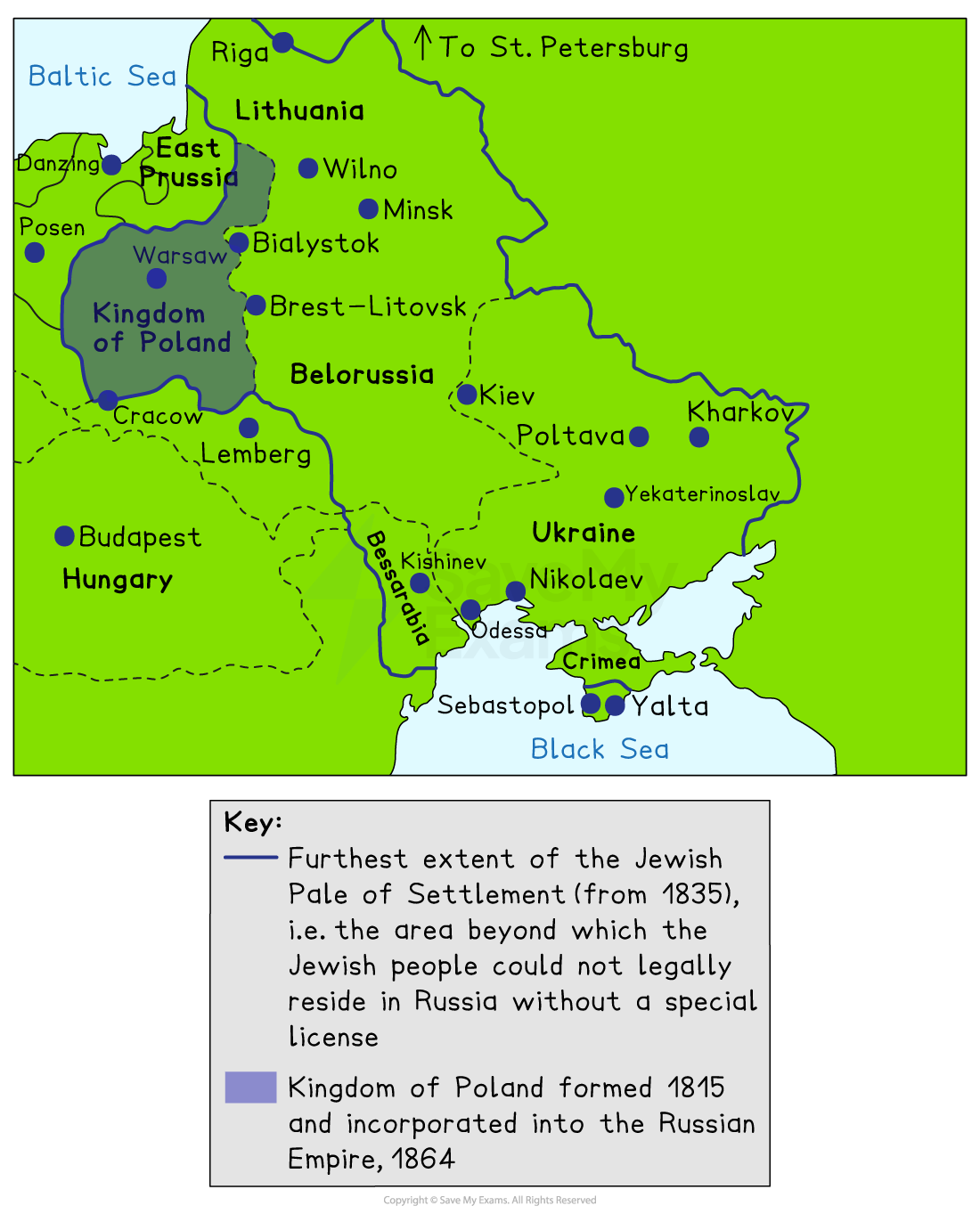
Around 5 million Jewish people lived within the Pale of Settlement, a designated zone in the western empire established by Catherine the Great in 1791
The Pale encompassed parts of present-day Poland, Ukraine, Belarus, Lithuania and Moldova
Jewish people could not legally reside outside it without special permission
A limited number of privileged categories, including wealthy merchants and university graduates, could live outside the Pale, but the vast majority could not
Anti-Semitism intensified sharply from 1881, driven from the top of the tsarist government downward
Alexander III was personally anti-Semitic
He wrote in the margin of a document urging reduced Jewish persecution that Jewish people 'have crucified our Master and have shed his precious blood'
Pobedonostsev promoted inflammatory slogans against Jewish people and reportedly predicted that 1/3 would emigrate, 1/3 would die, and 1/3 would assimilate through conversion
The right-wing press actively encouraged the belief that Jewish people had orchestrated Alexander II's assassination in 1881, providing a pretext for organised violence
The pogroms of 1881 to 1884 were the most violent outbreak of anti-Jewish violence in the empire to that point
The trigger was the assassination of Alexander II in March 1881
Violence began in Yelizavetgrad (Ukraine) in April 1881 and spread quickly to Odessa, Kyiv, Warsaw and beyond
Around 16 major cities experienced pogroms
Jewish people were killed, their property looted and destroyed, and communities devastated
The governing authorities did very little to prevent the attacks
The 'Holy League', an organisation linked to Pobedonostsev, coordinated early violence before being officially banned in 1882
Mass emigration followed: approximately 2 million Jewish people left Russia between 1881 and 1914, mainly to Western Europe and the United States
The May Laws of 1882 entrenched discrimination in legislation, tightening restrictions on Jewish people even within the Pale itself
Jewish people were forbidden from settling in rural areas even within the Pale, concentrating them further in already overcrowded urban communities
Jewish property contracts outside cities were voided
Jewish people were banned from doing business on Sundays and Christian holidays
University entry quotas were imposed:
10% within the Pale, 5% outside it, 3% in Moscow and St Petersburg
These legal restrictions created a large population with little stake in the stability of the tsarist regime and every incentive to support those who opposed it
Case Study
The May Laws, 1882 (Articles 1-3)
“Article 1. Jews are forbidden to settle hereafter outside cities and towns of fewer than ten thousand people. Exception is made with regard to Jewish villages already in existence where the Jews are engaged in agriculture.
Article 2. All contracts for the mortgaging or renting of property situated outside cities and towns to a Jew, shall be of no effect.
Article 3. Jews are forbidden to do business on Sundays and Christian holidays; the laws compelling Christians to close their places of business on those days will be applied to Jewish places of business.”
The May Laws demonstrate that anti-Jewish discrimination was not merely tolerated mob violence: it was codified state policy. The articles reveal how the law operated to restrict Jewish economic activity and movement simultaneously, making the legal position of Jewish people structurally worse with each decade of tsarist rule.
Examiner Tips and Tricks
Do not describe pogroms as random or accidental. The stronger analytical point is that they were tolerated and in some cases actively encouraged by the government. The role of the 'Holy League' and of Pobedonostsev himself is evidence that anti-Semitism was semi-official policy, not simply popular prejudice that the state failed to control.
Be careful of the date range in your questions. The 1881 to 1884 pogroms belong to the Alexander III period. The later wave of 1903 to 1906 (Kishinev 1903, the Odessa pogrom of 1905) belongs to the Nicholas II period and the 1905 Revolution context. Keep them separate in your answers unless the question explicitly covers both reigns.
The impacts of Russification
Regional responses at a glance
Region | Minority Group | Key Russification Policy | Nationalist Response |
|---|---|---|---|
Poland | Poles (Catholic) |
|
|
Finland | Finns (Lutheran) |
|
|
Baltic Provinces | Latvians, Estonians, Baltic Germans |
|
|
Caucasus | Georgians, Armenians |
|
|
Pale of Settlement | Jewish people |
|
|
Russification accelerated, rather than contained, minority nationalism across the empire
By the 1890s, Polish, Finnish, Ukrainian, Georgian and Armenian movements had all developed political structures that would have been weaker or absent without the provocation of Russification
Rather than forging a unified Russian imperial identity, the policy gave minorities a shared grievance and a political cause that cut across their different cultural backgrounds
The Orthodox Church was damaged by its close identification with the repression apparatus
Using the Church as the regime's cultural enforcer meant that non-Orthodox populations came to associate Russian Orthodoxy with state coercion rather than genuine spiritual authority
This eroded the Church's independent moral credibility and weakened one of the key pillars on which tsarist legitimacy rested
Minority groups were disproportionately represented in socialist and revolutionary organisations by the 1890s
Jewish people joined socialist parties in large numbers, partly because socialist parties were the only political organisations that explicitly opposed anti-Semitism
The General Jewish Labour Bund, founded in 1897, became one of the largest socialist organisations in the empire, with over 35,000 members by 1905: larger than the Bolshevik Party at that point
Radicalised minority groups fed into the broader revolutionary coalitions that challenged Tsarism in 1905 and contributed to the collapse of the regime in 1917
The empire's administrative coherence was not improved by Russification, despite its stated aims
Russian was never successfully imposed as a working language across the full extent of the empire
Local languages persisted in practice even where formally banned
The policy consumed substantial administrative resources in surveillance and suppression without producing the cultural uniformity it promised
Examiner Tips and Tricks
When writing about the impacts of Russification, resist the temptation to treat them as the same everywhere and for everyone.
The impact on Finland (which lost genuine constitutional autonomy in 1899) was different in kind from the impact on Georgia (which had always been more directly administered). The impact on Jewish people was qualitatively different again, involving state-tolerated violence and legislative discrimination, not merely cultural imposition. Examiners reward this kind of differentiation.
A useful analytical move is to note that the populations most damaged by Russification were often also the people who became most active in opposition movements. This is the mechanism by which Russification weakened the regime: it did not just create discontent, it created organised, politically sophisticated discontent.
Did policies towards national minorities weaken the tsarist regime?
Did Russification serve the regime or undermine its long-term stability?
This is the central historiographical question on this topic and the one AQA examiners most consistently reward you for engaging with analytically
Both sides of the argument have evidential weight: neither should be dismissed
Russification fundamentally weakened the regime
The policy generated organised nationalist opposition that the regime then had to spend resources suppressing, creating a self-defeating cycle of repression and resistance
Polish, Finnish and Armenian movements all developed structured political organisations directly in response to Russification
These would have been far weaker, or non-existent in their organised form, without the policy
Finland is the sharpest example: before the 1899 February Manifesto, Finnish opinion was broadly cooperative with tsarist rule
Within a decade, the Manifesto had converted a loyal population into a hostile one
The treatment of Jewish people created a large, radicalised minority population with little incentive to support the regime's survival
By 1905, Jewish people were over-represented in the leadership of every major socialist party, including both the Bolshevik and Menshevik factions of the Social Democratic Workers' Party (RSDLP)
The Bund alone had 35,000 members by 1905, making it larger than the Bolshevik Party
The regime had manufactured one of its most formidable opponents through its own discriminatory legislation
Mass emigration also removed approximately 2 million of the most economically active members of the Jewish community, depriving the empire of entrepreneurial and professional talent
The 1905 Revolution drew heavily on national minority discontent alongside class-based opposition
The Baltic provinces, Poland and the Caucasus all experienced major upheaval in 1905
These revolts were explicitly connected to Russification policies
The regime was forced to concede autonomy in Finland and elsewhere in 1905 and 1906, effectively acknowledging that Russification had failed as a strategy for securing minority loyalty
Key historian
“From the time of Alexander III, it was decided that political loyalty would be best preserved by engaging in a policy of Russification, based on making the Russian language and religion the dominant focus of the cultural life of the whole patchwork Empire. This official chauvinism brought protests from nationalities as far apart as Latvians and Georgians and gave a great boost to local nationalist and separatist movements. What compensatory benefit Russification brought to the government is unclear. It also entangled the Church in politics, associating it closely with the regime as its spiritual policeman.”
C. Read, From Tsar to Soviets, (1996)
Read argues that Russification was not only counterproductive but that its benefits to the regime were essentially unidentifiable
His phrase 'What compensatory benefit Russification brought to the government is unclear' is a direct challenge to the view that the policy served any coherent strategic purpose
The rationale for Russification was coherent and it was not uniquely destabilising
The desire for administrative and cultural unity in a vast multi-ethnic empire was not irrational, and the policy had explicit external models
Germany's Germanisation of its Polish lands after 1870 provided a direct precedent that the tsarist government observed closely and cited as justification
Every major European empire faced the challenge of governing linguistic and religious diversity within a centralised state
Russification was Russia's version of a common imperial strategy, not an aberration
The tsarist regime survived for three decades after the most intense period of Russification without collapsing, primarily because of minority discontent
The 1905 Revolution was triggered by military defeat in Manchuria and a deep economic crisis, as much as by national minority unrest
Attributing the Revolution primarily to Russification overstates the policy's independent causal weight
The 1917 Revolution was driven by the catastrophic strain of the First World War
The regime might well have survived without the war, whatever the long-term effects of Russification had been
Russification had some genuine integrative effect among Russian-speaking populations, strengthening a form of ethnic Russian nationalist loyalty
Pan-Slavist sentiment grew stronger among the Russian peasantry and the urban lower middle class throughout the 1880s and 1890s
The promoted role of the Orthodox Church gave this sentiment fresh energy
This created a reservoir of ethnic Russian nationalist loyalty
The regime drew on it in 1914, when the outbreak of war produced an initial surge of patriotic support across Russian society
Without some degree of cultural unification, the empire risked fragmentation along ethnic lines
Russification reflected a real concern for imperial cohesion, even if it was crudely executed
Key historian
“Although in retrospect Russification may seem foolish and counterproductive, there were many factors nudging the government in the direction it took, primarily the desire to maintain a strong unified Russia. Among the foreign powers, Germany's growing strength after 1870 most impressed its neighbours. In minority areas, such as its Polish lands, it imposed Germanisation by such measures as demanding the use of German in administration and schools.”
W. Moss, A History of Russia Since 1855 (2003)
Moss contextualises Russification within the broader pressures of late nineteenth-century European nationalism and great power competition
His argument that the policy had coherent motivations, even if its outcomes were counterproductive, provides a necessary corrective to treating Russification as straightforwardly irrational.
Examiner Tips and Tricks
This is the section AQA examiners most consistently reward students for engaging with analytically. The 2024 examiner report noted that strong answers on Nicholas II 'recognised his inheritance from Alexander III, including the effects of Russification'. This means you should be able to show how the consequences of Russification structured the problems Nicholas II inherited: an alienated Finland, a radicalised Jewish population, and a growing nationalist challenge from Poland. These were not new problems in 1894; they were the accumulated costs of twenty years of policy.
Do not simply describe the policy and list its effects. The mark scheme rewards evaluation: how significant was Russification in weakening the regime, compared to other factors such as economic strain, military failure and the growth of class-based opposition? Was the damage it caused decisive, or did the regime collapse for reasons that had relatively little to do with how it treated national minorities? Build a line of argument, not a list of consequences.
Finally, watch your chronology. Russification is primarily an Alexander III policy in its most systematic form, but its consequences run through the Nicholas II period and beyond. Examiners will penalise answers that treat 1881 to 1894 and 1894 to 1917 as a single undifferentiated bloc.

Unlock more, it's free!
Join the 100,000+ Students that ❤️ Save My Exams
the (exam) results speak for themselves:

Was this revision note helpful?
