The Condition of the Soviet Union by 1941 (AQA A Level History: Component 1: Breadth study): Revision Note
Exam code: 7042

Summary
By 1941, the USSR had become Stalin's personal dictatorship, ruling through the NKVD
The Five-Year Plans made the USSR a major industrial power
However, consumer goods and living standards lagged behind
Collectivisation gave the state control over agriculture
But it caused mass suffering and contributed towards the 1932-33 famine
The old landed and propertied classes had been swept away
Literacy had improved
Millions of women had entered industry
After the mid-1930s, radical early policies on family and culture gave way to conservative 'traditional' values
Historians debate whether the change by 1941 was genuine social progress or the loss of the Revolution’s early promise
Acton stresses broad progress in industry, literacy and opportunity
Nettl stresses the loss of early freedoms after 1929
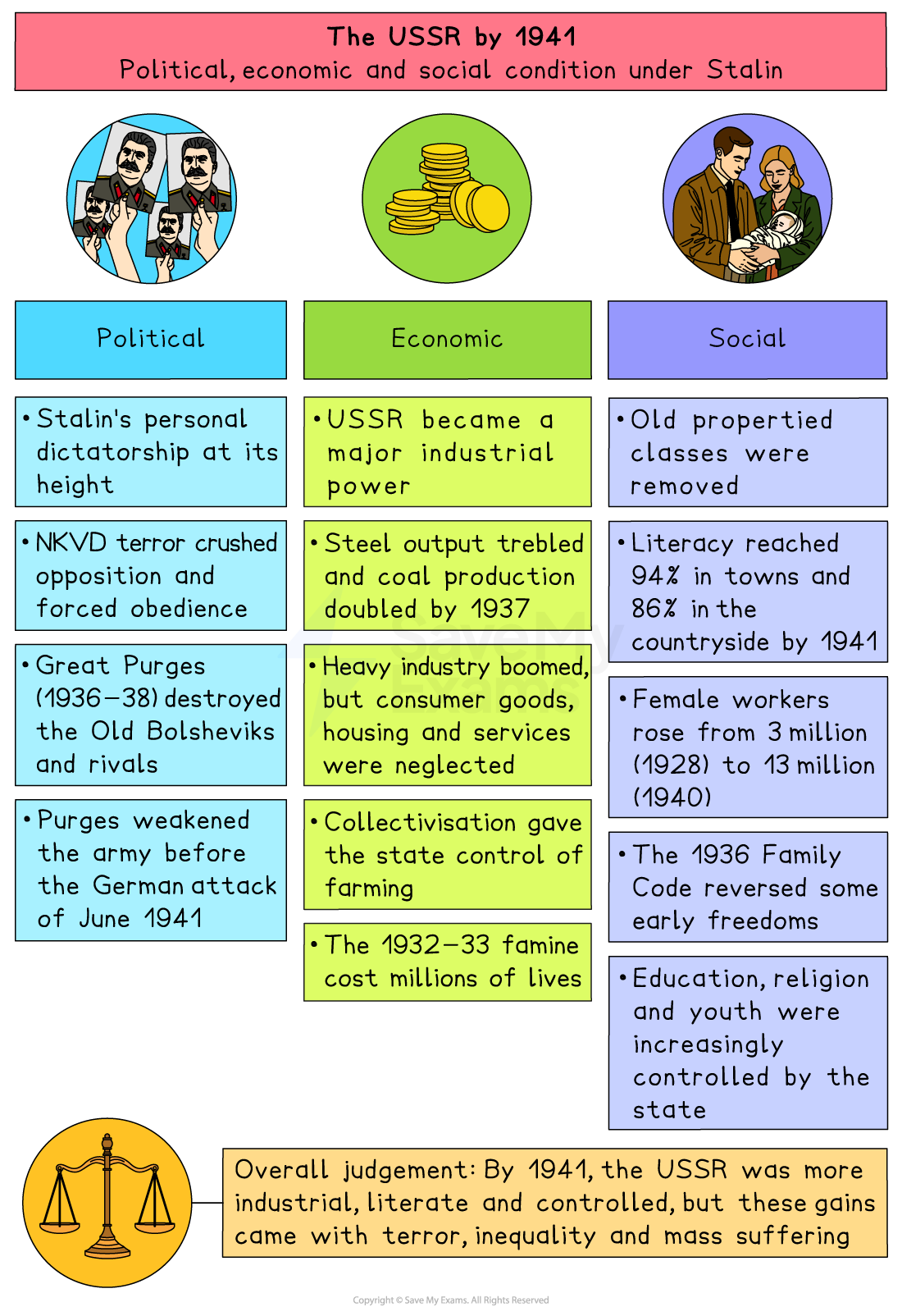
The political condition of the USSR by 1941
Theme | By 1941 | Key detail |
|---|---|---|
Personal power |
|
|
Terror and the NKVD |
|
|
Propaganda and the cult |
|
|
“Possibly the outstanding feature of the Stalinist system in the 1930s was its arbitrariness. No official, no specialist, no policeman could ever feel absolutely safe in his position… But not all the coercion in the world would have driven the Soviet Union forward had the population not been in sympathy with the goals of the Five Year Plans.”
M. McCauley, The Soviet Union, 1917–1991 (1981)
Examiner Tips and Tricks
Be precise with terminology. By 1941, the USSR is best described as a personal dictatorship, not loosely as a ‘totalitarian state’. Examiners reward students who show that Stalin’s power had outgrown the Party, while still noting the practical limits on his control.
The economic condition of the USSR by 1941
Area | Achievements by 1941 | Costs and weaknesses |
|---|---|---|
Industry |
|
|
Defence |
|
|
Agriculture |
|
|
Examiner Tips and Tricks
Weigh achievements against costs rather than just listing successes. Strong answers call the economy lop-sided: heavy industry advanced rapidly while consumer goods and farming fell behind. Decide what counts as success, such as output, armaments or feeding the cities, before you judge.
The social condition of the USSR by 1941
Theme | Gains | Costs and limits |
|---|---|---|
Class |
|
|
Women and family |
|
|
Education and literacy |
|
|
Religion and nation |
|
|
Youth |
|
|
Examiner Tips and Tricks
In essay questions, track change over time. Contrast the freer early years, with new rights for women and bold changes in family and culture, with Stalin’s "Great Retreat" to more traditional values from the mid-1930s. Support this with exact evidence, such as literacy rates, and treat different groups separately instead of writing about ‘society’ as a single block.
How had the USSR changed under Lenin & Stalin by 1941?
By 1941, the USSR had been transformed since 1917
Historians disagree over whether this was progress or the loss of the revolution’s early promise
A genuine and broadly positive transformation
The changes since 1917 added up to real and lasting social progress
A "backward", agrarian country had become a major industrial and military power within a generation
Mass literacy, wider education provisions and new openings for women and workers expanded opportunities for millions
The privileges of the old landed and propertied elite had been swept away, in line with the revolution's aims
Key historian
“The Communist state brought some impressive social changes… In the early 1930s, some of the more extreme social experimentation was curbed, which helped make life more settled, but society continued to progress.”
E. Acton, Russia: The Tsarist and Soviet Legacy (1995)
Acton stresses the breadth of change across the whole period
He presents Soviet transformation as broad, if uneven, social progress
A revolution whose liberating promise had faded
The early revolution's freedoms gave way to coercion and hardship, especially after 1929
Terror, the Gulag and the purges had made fear a permanent condition of Soviet life
Collectivisation and the 1932-33 famine brought immense suffering to the countryside
Radical early experiments in family, gender and culture were rolled back after the mid-1930s
This narrowed the personal freedoms that the revolution had first opened up
Key historian
“In its early years, the new Communist state brought relative social freedom… After 1929, however, everything changed. Individuality disappeared and the ‘good times under Lenin’ were remembered nostalgically.”
J.P. Nettl, The Soviet Achievement (1967)
Nettl contrasts the more liberating early Revolution with the harsher society that emerged after 1929
On this view, change brought loss as well as gain
Examiner Tips and Tricks
Which interpretation is more convincing depends on what you weigh most heavily: material and educational gains, or the human cost and loss of freedom. Either way, the USSR of 1941 was very different from the one Lenin inherited in 1917.

Unlock more, it's free!
Join the 100,000+ Students that ❤️ Save My Exams
the (exam) results speak for themselves:

Was this revision note helpful?
