Russia in the First World War, 1914–1917: The Road to Revolution (AQA A Level History: Component 1: Breadth study): Revision Note
Exam code: 7042

Summary
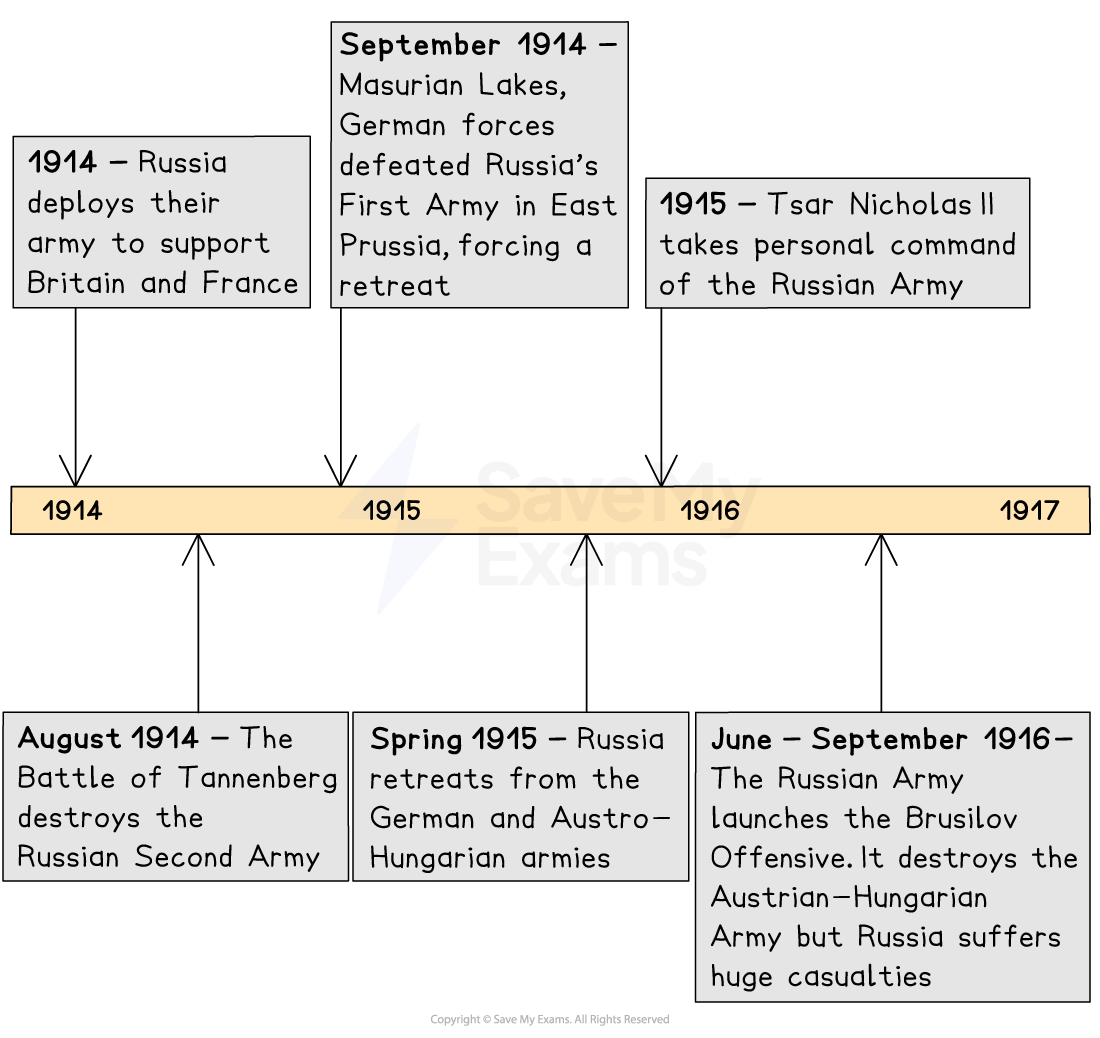
Russia entered the war in August 1914 with real public enthusiasm
Early defeats at Tannenberg and the Masurian Lakes quickly ended the mood of national unity
The army was huge but badly supplied and lacked proper training
Nicholas II took personal command of the army in September 1915
A mistake, as it linked him to every defeat and left the government controlled by Alexandra and Grigori Rasputin
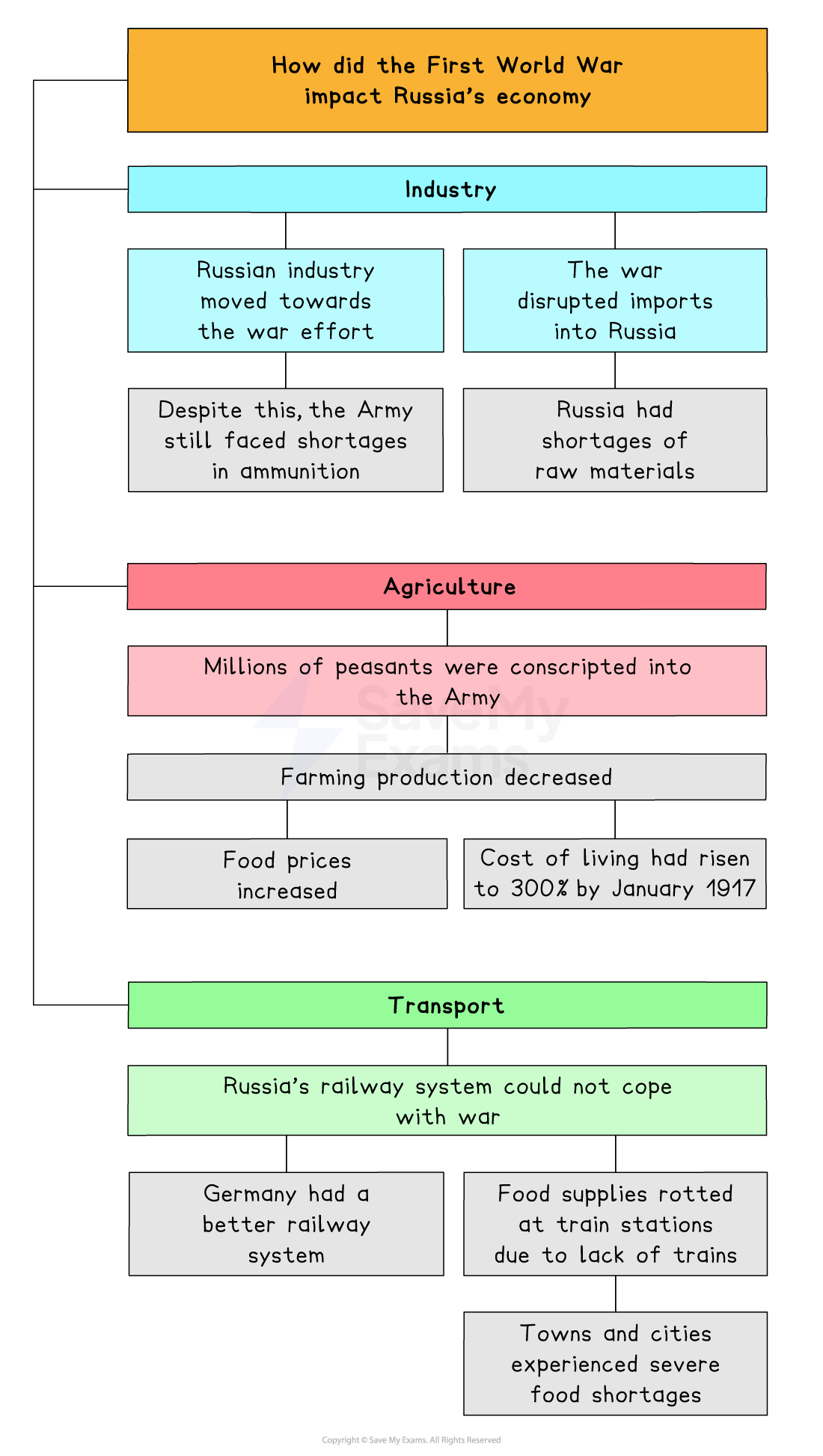
The war wrecked the economy
Transport collapsed, food failed to reach the cities and the cost of living rose
By the start of 1917, strikes, desertion and food shortages had turned wartime strain into an open political crisis
Historians debate whether Tsarist Russia was already heading for collapse before 1914 or whether a workable regime was destroyed by the pressures of total war
Haimson argued that deep social and political divisions were pushing Russia towards revolution before the war began
Service argues that without the Great War, the fall of the monarchy and a communist takeover would have been unlikely
Why did Russia go to war in 1914?
Russia's road to war
Russia's foreign policy after 1905 turned towards the Balkans
Defeat by Japan in 1905 had blocked expansion in the Far East
Agreements with Britain in 1907 reduced rivalry in Persia and Afghanistan
Pan-Slav feeling pushed Russia to protect Serbia
Russia saw itself as the natural defender of the Slavic peoples
It hoped to extend its influence in south-eastern Europe
The assassination at Sarajevo in June 1914 triggered the crisis
Austria-Hungary threatened Serbia after the killing of Archduke Franz Ferdinand
Russia mobilised in support of Serbia in July 1914
Mobilisation drew Russia into war with Germany and Austria-Hungary
Russia fought alongside Britain and France against the Central Powers
It carried the main burden of the Eastern Front largely alone
A popular start to the war
The decision to fight was widely supported in 1914
A wave of anti-German feeling united much of the country
Strike activity stopped and many radicals were imprisoned
The Duma showed patriotism by standing aside
Deputies voted for war credits to fund the war effort
The Duma dissolved itself, stating it did not want to burden the war with politics
To avoid sounding German, the capital was renamed
St Petersburg became the more Slavic Petrograd
Some historians suggest the war also suited the regime
A foreign enemy united the masses and distracted attention from problems at home
This early unity did not survive the first defeats
Examiner Tips and Tricks
It is tempting to treat the patriotic mood of 1914 as proof that the regime was secure. Examiners reward more careful answers that note how quickly this unity faded once the defeats began.
Military problems during the First World War
Early defeats, 1914
Russia mobilised faster than Germany expected
A large Russian army reached the Eastern Front within weeks
This force was nicknamed the "Russian Steamroller"
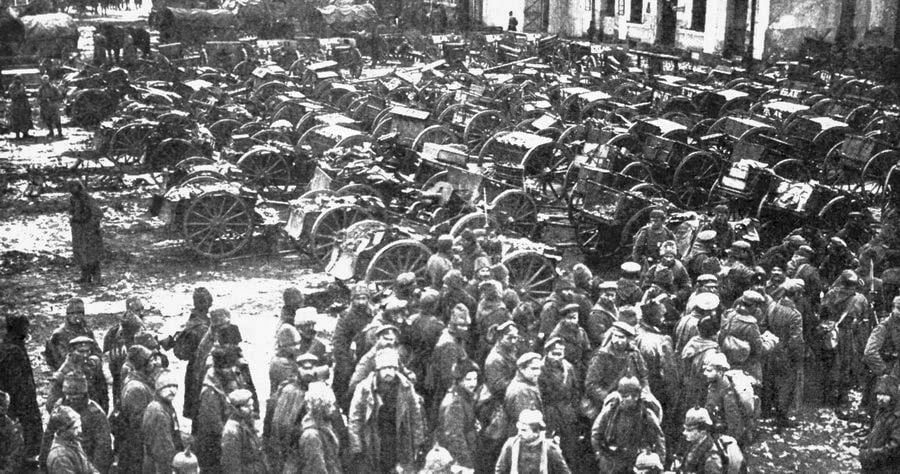
Early advances soon turned into a heavy defeat
The Battle of Tannenberg in August 1914 cost Russia around 170,000 casualties
Combined with the Masurian Lakes defeat in September, total Russian losses in East Prussia reached around 300,000
Russia did better against Austria-Hungary in the south
But it was clear there would be no quick victory
Reports of military failure fed discontent at home
“Our losses of men have been colossal, though if it were merely a matter of replacing wastage we could soon do so as we have more than 800,000 men waiting in our depots. But we're short of rifles to arm and train these men. Our magazines are nearly empty. The position is hardly less difficult as regards gun ammunition. Our entire reserve is exhausted. The armies need 45,000 rounds a day; we hope it will reach 20,000 by about 15 February. Until that date, the situation of our armies will not only be difficult but dangerous.”
The army Chief of Staff to the French ambassador, December 1914
Shortages and supply problems
The army was huge but poorly equipped
Around 15 million men were mobilised between 1914 and 1917
However, this was only around 9% of the population, against 20% in Germany and France
Basic weapons and supplies ran short
In 1914, there were reportedly only two rifles for every three soldiers
In 1915, artillery was often limited to two or three shells per day
Many soldiers reached the front without warm clothing or proper boots
Supply improved during the quieter winter of 1915 – 1916
Rifle production doubled and heavy artillery output quadrupled by 1916
This came at the expense of civilian production, deepening shortages at home
The Brusilov Offensive, 1916
The Brusilov Offensive in June 1916 was Russia's last major success
General Brusilov broke through the Austro-Hungarian lines in the south-west
The Austrian army was badly damaged and needed German support
The offensive could not be sustained
German railways moved reinforcements faster than Russia could advance
The attack ground to a halt within three months
The cost to morale was severe
Most experienced officers had been killed in the early fighting
Around 1.5 million men deserted in 1916 as morale collapsed
Examiner Tips and Tricks
A common mistake is to turn an answer about the war into a list of battles. Examiners want you to use military problems as evidence, not as the whole story.
Instead, pick a few precise details, such as two rifles for every three men or the 1.5 million desertions in 1916, and use them to explain why confidence in the regime fell. Quality of detail matters more than the number of battles you can name.
Political, economic & social impacts of the First World War on Russia
Political impact
Wartime rule by "military zones" pushed civilians aside
From July 1914, the army controlled large areas under military command
This shut out the zemstva, who felt they could do more to help
Public bodies organised to fill the gaps the state left
The zemstva and town councils joined to form Zemgor in 1915, chaired by Prince Georgy Lvov
Industrialists set up War Industries Committees to boost production
Nicholas distrusted these bodies and blamed them for stirring up trouble, even though they increased output
The Progressive Bloc demanded a share in government in August 1915
Kadets, Octobrists and Progressives joined together
They asked for a "government of public confidence" answerable to the Duma
Nicholas refused and suspended the Duma in September 1915
Nicholas took personal command of the army in September 1915
He left for the army headquarters in Stavka, far from the capital
This tied him personally to every later defeat
Government at home became linked to Alexandra and Rasputin
The German-born Tsarina was widely, though wrongly, suspected of disloyalty
Frequent changes of minister became known as "ministerial leapfrog"
Rasputin's murder in December 1916 did little to repair the damage
“On the path of victory there lies a fatal obstacle; an obstacle created by all the old vices of our political system; we mean irresponsible power, the absence of any link between the government and the country. A drastic change is required in place of our present governors. We must have men who enjoy the confidence of the nation. The work of the Duma must be resumed without delay.”
The Zemgor declaration, September 1915
Economic impact
War spending far outran what Russia could afford
Spending rose from 1,500 million roubles in 1914 to 14,500 million by 1918
Transport and supply broke down
Railways were given over to moving troops and equipment at the front
Locomotive production roughly halved between 1913 and 1916
Grain rotted at railway sidings while cities went short
Industry and trade were badly hit
German advances overran industry in Poland and western Russia
Naval blockades closed the Baltic and Black Sea ports, cutting off trade
Social impact
Food and fuel shortages hit the towns hardest
Peasants hoarded grain when prices were too low to make selling worthwhile, especially as consumer goods to buy with their earnings were scarce
Cities grew as workers arrived for war industries, raising demand for food
Living standards collapsed for ordinary people
The cost of living rose by around 300%
Poor housing and diet pushed many families towards starvation
Unrest grew sharply by the start of 1917
In January 1917, 30,000 workers struck in Moscow and 145,000 in Petrograd
These strikes pointed towards the revolution that followed in February
Examiner Tips and Tricks
Do not just describe military defeats. Explain how the war created political, economic and social pressures together that made the Tsar's position far weaker. Weaving the three strands together is what separates top answers from narrative ones.
Was Tsarist Russia doomed before the First World War?
This is one of the central debates regarding the fall of the Romanovs:
Was the monarchy already on course for revolution before 1914, or was it a workable regime brought down by the strain of total war?
Russia was already heading for collapse
Deep divisions existed in Russian society well before the war
A widening gulf separated the regime from an educated, professional society
Workers in the city were increasingly drawn to revolutionary ideas
Unrest was rising again in the years just before 1914
The Lena Goldfields Massacre in 1912 set off a new wave of strikes
Strike numbers climbed sharply from 1912 to 1914
The regime had refused to share real power
The Dumas had limited authority and were often dismissed or ignored
On this view, the war exposed and sped up a crisis that already existed
Key historian
“By 1914 a dangerous process of polarization appeared to be taking place in Russia’s major urban centers between an obshchestvo that had now reabsorbed the vast majority of the once alienated elements of its intelligentsia … and a growing discontented and disaffected mass of industrial workers, now left largely exposed to the pleas of an embittered revolutionary minority.”
L. Haimson, ‘The Problem of Social Stability in Urban Russia, 1905–1917’, Slavic Review (1964)
Haimson argues that by 1914, Russia’s cities were splitting into two camps:
an educated society (the obshchestvo he names) drifting back towards the regime
an angry, isolated mass of workers
This anchors the case that deep divisions were pushing Russia towards revolution before the war, though Haimson also held that Bolshevik ties to the workers were still fragile
The regime was destroyed by the war
Russia was modernising and stabilising before 1914
Industrial output and the railway network had grown rapidly
Stolypin's reforms aimed to build a loyal, landowning peasantry
The political system was slowly developing
The Dumas gave Russia limited but real parliamentary experience
The years before 1914 saw no organised force able to topple the Tsar
The war turned manageable problems into fatal ones
Total war placed demands on Russia that no part of the system could meet
On this view, without the war, the monarchy may well have survived
Key historian
“Nicholas II leapt into the darkness of the Great War without anyone pushing him. The decisions of the European powers had consequences of massive significance. The Great War produced the situation that shattered the Romanov monarchy. It also made possible the Bolshevik seizure of power in October 1917. Except for the Great War, Lenin would have remained an émigré theorist scribbling in Swiss libraries, and even if Nicholas II had been deposed in a peacetime transfer of power, the inception of a communist order would hardly have been likely.”
R. Service, Russia (1997)
Service argues that the war, not pre-war weakness alone, produced the collapse of the monarchy and made a communist takeover possible
This supports the case that Russia was not doomed before 1914.
Examiner Tips and Tricks
A strong answer might accept that serious long-term weaknesses existed while arguing that the war was what made them fatal.

Unlock more, it's free!
Join the 100,000+ Students that ❤️ Save My Exams
the (exam) results speak for themselves:

Was this revision note helpful?
