Soviet Attitudes Toward the Family and Youth (AQA A Level History: Component 1: Breadth study): Revision Note
Exam code: 7042

Summary
The Bolsheviks saw the family as key to creating the new Soviet person
Controlling family life helped shape behaviour, raise the birth rate and support industry
Under Lenin (1917-1928), family law was liberalised
Civil marriage was introduced
Divorce became easier
Abortion was legalised
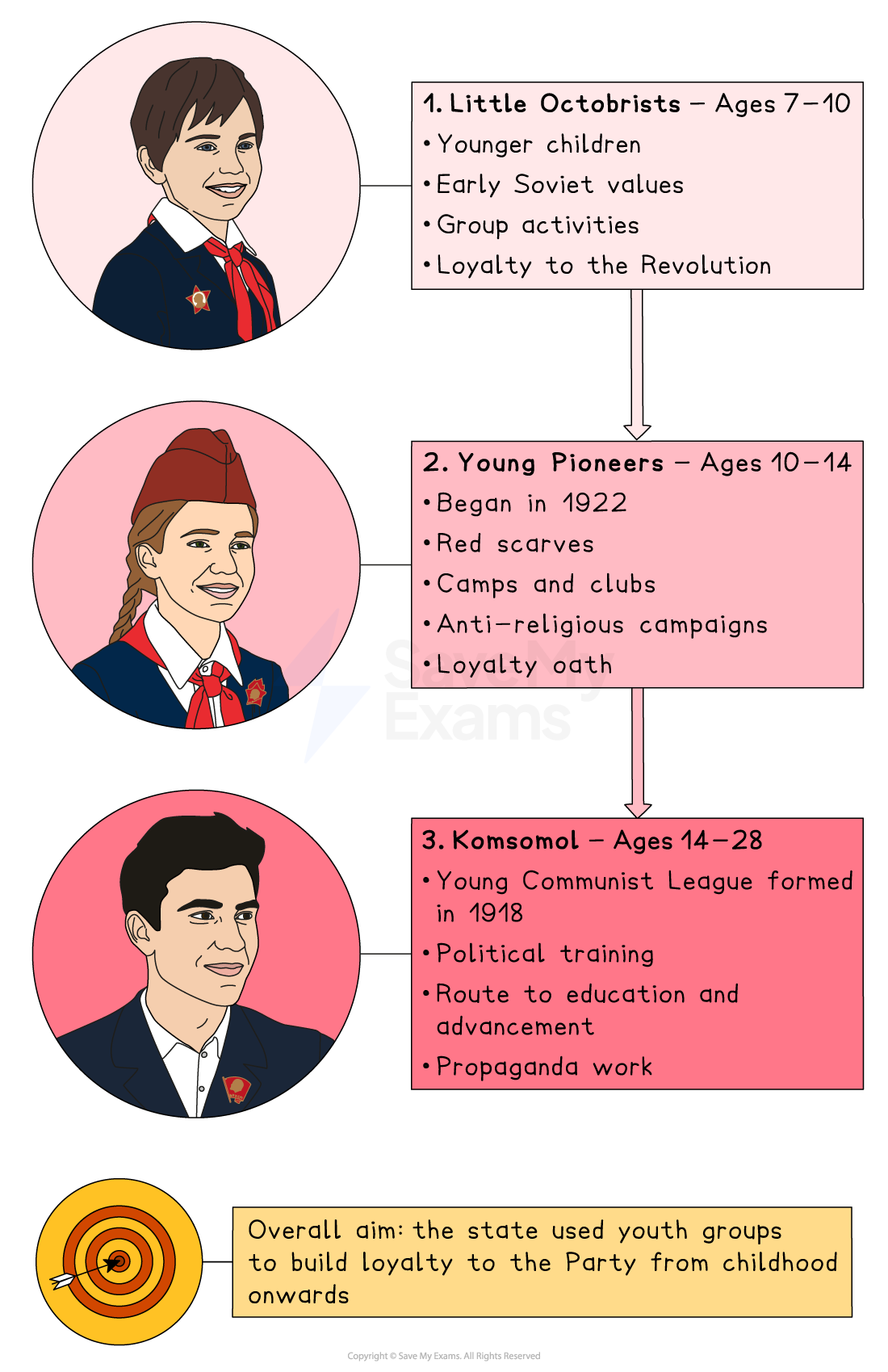
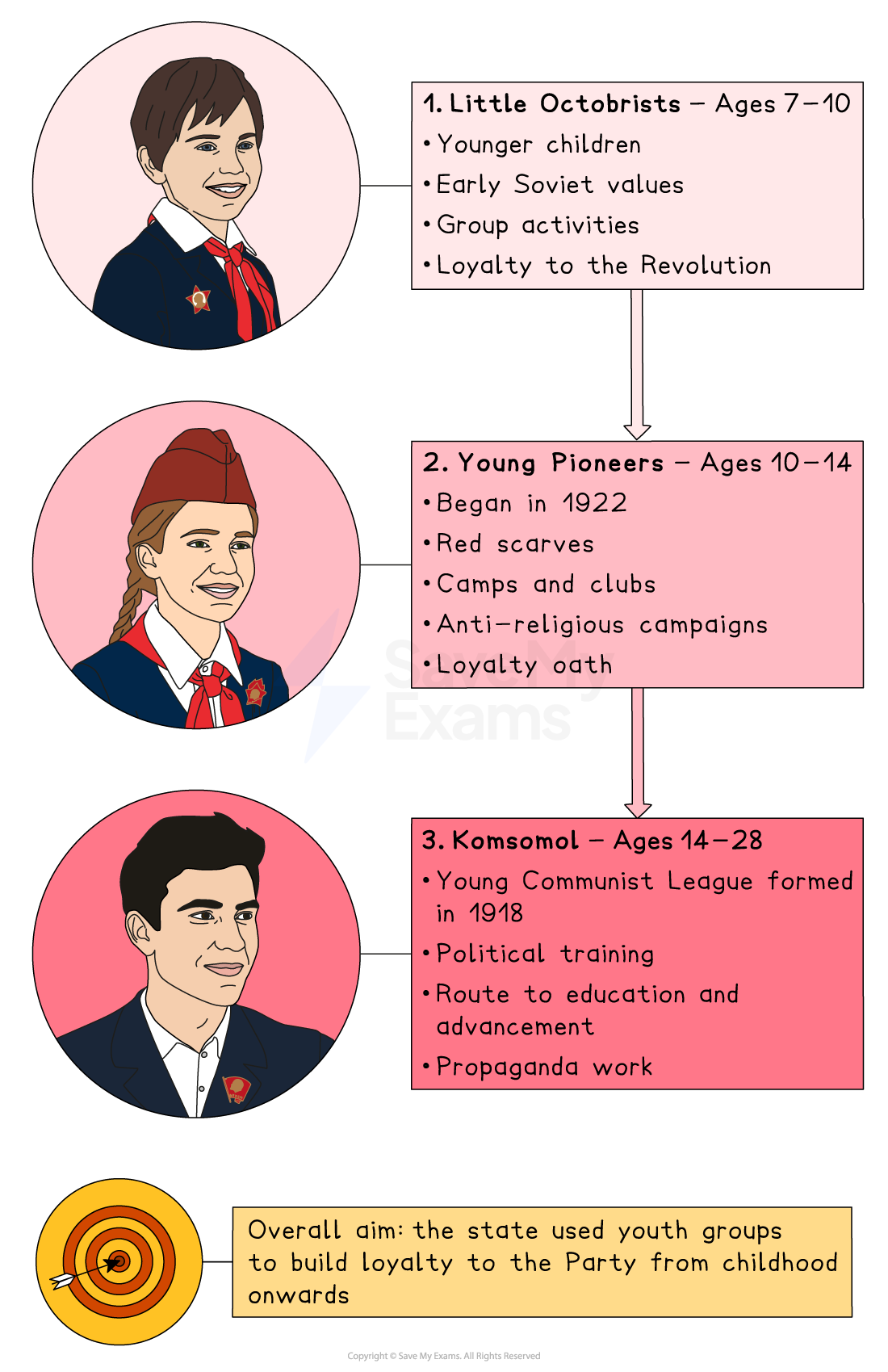
Youth groups, the Komsomol and Young Pioneers, built Party loyalty from a young age
Historians debate whether these policies improved lives or mainly strengthened state control
Goldman argues early reform was a real, principled break from the past
Fainsod argues the regime’s grip on the young was patchy, especially in rural areas
Why was the family important to Soviet politicians?
The family as a political tool
The family shaped children's earliest values
A loyal young generation would secure the future of the Revolution
Marxists expected the old "bourgeois" family to fade away
The state would take over key roles, including:
childcare
education
welfare
What the state wanted from the family
The state used the family to:
Rebuild the population after the Civil War
Provide a stable workforce for industrialisation and the Five-Year Plans
Influence behaviour and maintain social order
Lenin and Stalin used the family as a political tool
However, their policies changed sharply over time
Examiner Tips and Tricks
Link family policy to the regime’s bigger aims: population, labour and social order. Do not reduce it to morality.
Lenin’s and Stalin’s policies toward the family: from revolution to tradition
Lenin: freeing up the family, 1917-1928
The Bolsheviks attacked the family as a "bourgeois" institution
Early decrees changed family law quickly
Only civil marriage was recognised in 1917
Divorce was made cheaper and quicker
Known as the "postcard divorce"
Abortion was legalised in 1920
Free contraception advice was provided
The 1926 Family Code went further
Common-law couples gained the same rights as married couples
Wedding rings were banned in 1928 as "bourgeois"
The Zhenotdel
The Zhenotdel was the Party's women's department
It was founded in 1919
It helped put the early family reforms into practice
It supported women and working families
It set up childcare, crèches and reading rooms
It promoted equal rights
Its impact was limited
Soviet courts had little power
This made new rights hard to enforce
The end of communal living
Radicals like Kollontai wanted to replace the family with communal living
By 1925, these experiments had ended
The 1926 Marriage Code restored a more traditional view
Marriage was treated as the basic model for society
Adoption became easier
Common-law (de facto) marriage gained equal legal status
The New Economic Policy (NEP) did not fund crèches or daycare properly
Many children were orphaned during the Civil War and then went on to form street gangs
Stalin: a return to tradition from 1936
In the 1930s, Stalin shifted to pro-natalist policies
These were designed to encourage more births
He had clear reasons:
The birth rate was falling
Collectivisation and poor living conditions caused upheaval
War seemed increasingly likely
Propaganda now praised marriage and the family
Stalin was presented as an “ideal family man” and father figure to the Soviet people
This image was propaganda rather than reality, as Stalin’s own family life was troubled
Abortion, legal since 1920, came under threat
The 1936 family measures
Measure | What Changed? |
|---|---|
Divorce |
|
Adultery |
|
Contraception |
|
Large families |
|
Did the policies work?
Many women kept working despite the new focus on the home
Female industrial workers rose from 3 million in 1928 to 13 million in 1940
Women were 43% of the industrial workforce by 1940
Promised gains were uneven
Women still earned about 40% less than men
Nurseries, creches and canteens expanded, but provision was patchy
Key targets were missed
Moscow's divorce rate was still 37% in 1934
There were 150,000 abortions to every 57,000 live births
Population growth kept falling from 1928 to 1940
Marriage did stay common:
91% of men and 82% of women in their 30s were married by 1937
Khrushchev later eased some of these rules
Examiner Tips and Tricks
Use a few key statistics rather than vague claims that policy “changed”. Figures on women’s work, abortion, divorce and marriage help show how far policy worked in practice.
Youth groups in the USSR: the Komsomol & Young Pioneers
The organisations
The Bolsheviks built youth groups to train loyal communists early
They developed in stages
The Komsomol
The Young Communist League, known as the Komsomol, formed in 1918
It was for older young people, roughly aged 14 to 28
It promoted political training, propaganda work and loyalty to the Party
It became directly tied to the Party in 1939
The Little Octobrists
The Little Octobrists were created for younger children
They were usually aged around 7 to 10
They introduced children to basic Soviet values before they joined the Young Pioneers
The Young Pioneers
The Young Pioneers began in 1922
They were for younger children, roughly aged 10 to 14
Members wore red scarves
They took part in camps and clubs, and joined anti-religious campaigns
The Young Pioneers prepared children for later Komsomol membership
Growth
Growth was slow at first
Only around 6% of eligible young people joined at first
Membership grew under Stalin
What did the youth groups do?
They promoted communist values
Smoking, drinking and subscribing to religion were discouraged
They served the Party
Members took an oath to the Fatherland and "the great Lenin"
They handed out propaganda
They joined anti-religious campaigns
In the 1930s, some were urged to report on their own parents
Komsomolskaia Pravda, founded in 1925, became the youth newspaper
It promoted family values
It encouraged respect for parents
Why did young people join?
Membership brought real rewards
Pioneer Palaces and free camps offered community
The red neckerchief uniform marked members out
Membership opened doors to education and social mobility
Resistance and opting out
Not everyone joined the groups
Some preferred Western cinema, fashion and jazz
This was labelled as "hooliganism"
A few formed small secret groups
Open defiance to the state, however, was rare
Examiner Tips and Tricks
Do not present youth policy as a simple contradiction. Young people were taught to respect their parents, but in the 1930s some were also encouraged to report on them. The Party framed this as helping parents follow the correct Soviet path.
Did Soviet attitudes toward the family & youth improve life in the USSR?
This type of question asks you to weigh real gains against the state's use of the family for control
The evidence points both ways, so judge it carefully
Soviet attitudes improved life in the USSR
Early reforms gave people new freedoms
Civil marriage, easier divorce and legal abortion widened choice under Lenin
The 1926 Family Code protected common-law partners
The state tried to support families
Nurseries, creches and clinics expanded
Youth groups offered structure and opportunity
Camps and clubs provided community
Membership could support social mobility
Key historian
“Their commitment to the socialization of housework and the withering away of the family were direct responses to capitalism’s assault on the family and traditional gender roles ... By 1918, the Bolsheviks stood heir to a multifaceted vision of women’s liberation rooted in a long revolutionary tradition. They had taken the first decisive steps toward their ideals in a new Family Code that radically broke with the laws and mores of their country’s past.”
W. Goldman, Women, the State and Revolution (1995)
Goldman sees early Bolshevik reform as a real, principled break with the past
It was not just a temporary tactic
This supports the view that the early reforms aimed at genuine change
Soviet attitudes did not clearly improve life in the USSR
Policy often meant control, not freedom
Stalin's 1936 rules made divorce costly
Contraception was banned
The family became a tool for discipline and population growth
Promised gains often fell short
Divorce and abortion rates stayed high
Many women still faced the "double burden" of work and home
The state's grip on youth was incomplete
Few joined at first
Rural areas lagged behind
Key historian
“The peasant youth in the villages and collective farms appears to be another category in which Communist indoctrination is at a relatively low level. Komsomol enrollment in rural areas has always been significantly lower than in the urban industrial centers ... the relative weakness of the Communist apparatus in the villages contributes to the strength of family influences ... New converts are won for Komsomol and Party, but how genuinely and profoundly fundamental attitudes shift is by no means clear.”
M. Fainsod, The Komsomols: A Study of Youth under Dictatorship (1951)
Fainsod argues the regime’s grip on the young was patchy
This was especially true in the countryside
Family and religion stayed strong in rural areas
This supports the view that youth policy reshaped life less than propaganda claimed
Examiner Tips and Tricks
Note the change in policy over time. Try to explain why policy shifted from early freedom to Stalinist control, such as the falling birth rate, social disorder and the pressure of approaching war.

Unlock more, it's free!
Join the 100,000+ Students that ❤️ Save My Exams
the (exam) results speak for themselves:

Was this revision note helpful?
