The Rural Economy in Tsarist Russia: Land, Peasants and Agriculture (AQA A Level History: Component 1: Breadth study): Revision Note
Exam code: 7042

Summary
Russia’s rural economy in 1855 was built on serfdom
Around 80% of the population were peasants, and many people were legally bound to noble landowners
The Emancipation Edict of 1861 freed the serfs but created new problems
Peasants received small land allotments, remained tied to the mir and had to pay redemption payments over 49 years
Two land banks were created in the 1880s to address rural problems
The Peasants’ Land Bank of 1883 offered limited credit to peasants wishing to buy land
The Noble Land Bank of 1885 supported the declining nobility with cheap mortgage loans
State pressure to export grain kept many peasants poor
Periodic famines, especially the famine of 1891 – 92, exposed the fragility of the rural economy
A small group of kulaks emerged after emancipation
They were prosperous peasants who accumulated land and traded successfully
Historians debate whether the land issue was the main cause of Russia’s underdevelopment
Offord emphasises the importance of land hunger and rural poverty
Moon argues that peasants showed more resilience and agency than is often assumed
The problems with the rural economy in Tsarist Russia
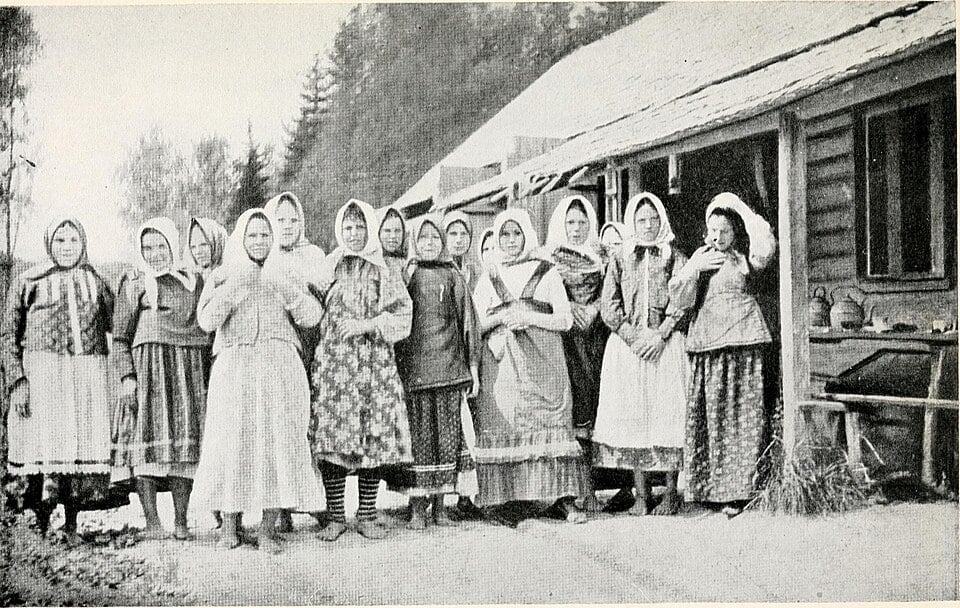
The legacy of serfdom
Russia's rural economy in 1855 was organised almost entirely around serfdom
Around 80% of the population were peasants; the majority were serfs
Serfs were legally bound to their lord's land and could be bought, sold and punished at will
Landowners had no incentive to modernise
Unlimited cheap serf labour made machinery pointless
Agricultural techniques were primitive by Western European standards
Grain was cut by hand with sickles; wooden ploughs were shared between households
No equivalent of the crop rotation methods that had transformed British and German productivity
Russia's grain yields per acre were a fraction of those in France, Britain or Germany
The mir (peasant commune) organised all aspects of rural life
Land was divided into narrow strips across open fields
These were allocated by the commune to each household
Collective decision-making slowed any change to farming practice: no individual could alter their strips unilaterally
Movement away from the commune required noble permission and an internal passport
In practice, most serfs had no freedom to leave
There was almost no internal market demand in the Russian countryside
Peasants farmed at subsistence level
They produced enough to eat and pay dues, little more
Money was largely irrelevant in rural areas
Barter was the normal form of exchange
This kept the rural economy disconnected from any commercial development and suppressed demand for manufactured goods
"Russia's problems were deeply rooted in its economy and society, although it must be emphasised that the picture varied from one part of the Empire to another. However, there was one underlying factor of pre-eminent importance. The survival of serfdom to 1861 was, in many important respects, a fundamental source of many other difficulties. Reliance on unlimited cheap labour had inhibited the development of a productive labour force, distorted the distribution of the population, and removed incentives to modernise and mechanise agriculture."
C. Read, From Tsar to Soviets (1996)
Read identifies serfdom's legacy, not just serfdom itself, as Russia's core economic problem. The key phrase is 'inhibited incentives to modernise': even after 1861, those habits and structures persisted.
What the Emancipation Edict (1861) changed and what it did not
The Emancipation Edict legally freed approximately 51 million serfs (private and eventually state)
Serfs gained personal freedom
They could marry without permission, own property and trade
They received land allotments, typically around half the land they had previously farmed for their lord
But emancipation left the structural problems of the rural economy largely intact
Land allotments were often smaller than the strips peasants had previously farmed for their lord
Especially in fertile black-earth regions where land was most valuable
Peasants remained collectively tied to the mir, which held joint responsibility for redemption payment debts
Agricultural techniques changed very little in the decades that followed emancipation
Population growth turned land scarcity into a crisis
Russia's rural population rose rapidly after 1861, but the total area of peasant land did not
Under inheritance customs, land was divided between sons, making individual plots progressively smaller
By the 1880s and 1890s, many households farmed strips too small to produce a reliable surplus
Periodic famines exposed how little had changed
The famine of 1891 to 1892 was the worst of the century
Estimates suggest between 400,000 and 500,000 people died
Further famines struck in 1897, 1898 and 1901
Even as starvation set in, grain was still being exported
This exposed the tension between state fiscal priorities and peasant welfare
Examiner Tips and Tricks
Be precise about chronology. In a question covering 1855 to 1894, serfdom (abolished 1861) and emancipation’s aftermath are both relevant. Avoid blurring pre- and post-1861 conditions: they are distinct periods with distinct problems.
Peasants, Noble Land Banks & grain requisitioning
The burden of redemption payments
After emancipation, peasants were required to make redemption payments to the state
The state had compensated noble landowners for their lost serf labour and land allotments
Peasants repaid the state in annual instalments over 49 years
Payments were managed collectively by the mir
The whole commune was liable if individual households fell behind
Redemption payments created a serious and worsening financial burden
By the 1880s, arrears were accumulating rapidly across many provinces
The payments absorbed a significant share of what little cash income peasant households generated
They were not abolished until 1907, under pressure following the 1905 Revolution
The Noble Land Bank (1885)
The Noble Land Bank was established in 1885 under Alexander III
It offered low-interest mortgage loans to members of the nobility
Its purpose was to help the declining landowning class retain their estates after losing serf labour in 1861
What the Noble Land Bank did | Why it mattered |
|---|---|
|
|
|
|
|
|
|
|
The Peasants' Land Bank (1883)
The Peasants' Land Bank was established in 1883, two years before the Noble Land Bank
It provided credit to peasants who wanted to purchase additional land
In principle, it offered a route out of strip farming for peasants who could save a deposit
In practice, its impact before 1894 was very limited
Interest rates, though lower than commercial alternatives, were still difficult for poor peasants to afford
Strict eligibility criteria and deposit requirements excluded the majority of peasants
The Bank reached only a small fraction of the peasantry before Pyotr Stolypin massively expanded it after 1906
Grain taxation and export pressure
Taxation meant that the state indirectly forced peasants to sell grain
All taxes had to be paid in cash
This meant that peasants had to sell grain to raise the money needed
This happened even when harvests were poor, leaving peasants very little for themselves
Grain exports were prioritised to fund industrialisation at peasant expense
The finance minister Vyshnegradsky, drove grain exports aggressively in the late 1880s and early 1890s
His approach meant grain left the country even when domestic supplies were low
The 1891 to 1892 famine was the catastrophic result of this policy
Starvation occurred alongside continued state-driven grain exports
Examiner Tips and Tricks
Do not amalgamate the Noble Land Bank and the Peasants' Land Bank. Students often confuse the two.
The Noble Land Bank (1885) was set up to protect the landowners
The Peasants’ Land Bank (1883) was meant, in theory, to help peasants get land.
Their purposes were different, their clientele was different, and their effectiveness was different.
The creation of kulaks: wealthy peasants in rural Russia
The term kulak in this period (1861 to 1894) describes a prosperous peasant who had accumulated land, livestock or capital above the subsistence level of their neighbours
It is a descriptive economic label, not a political one
How kulaks emerged after emancipation
Emancipation in 1861 created unequal starting points among the peasantry
Former house serfs and serfs on poor estates often received smaller or no land allotments
Some serfs received better-quality land, while others received smaller or poorer allotments
This initial inequality meant some could generate a surplus while most could not
Some peasants exploited the new economic freedoms after 1861
They leased additional land from nobles who could no longer farm their estates profitably
Participation in cottage industries (weaving, leather-working, carpentry) generated small amounts of capital
A minority lent money or rented out equipment to poorer neighbours, building wealth gradually
Route to kulak status | How it worked | Limitation |
|---|---|---|
Better land allotment at emancipation |
|
|
Leasing additional noble land |
|
|
Cottage industry income |
|
|
Money-lending within the commune |
|
|
The kulak class remained small and geographically uneven before 1894
It was more common in areas near towns with accessible grain markets, such as the black earth regions
In most of rural Russia, the vast majority of peasants remained at or near subsistence level
The commune system itself worked against individual accumulation
The mir periodically redistributed strips, penalising those who had improved their plot
The commune created social pressure against standing out
Successful families could face communal demands to contribute more to collective obligations
Kulaks were often resented by their neighbours, creating social tension within the village
Examiner Tips and Tricks
The word kulak can catch students out. In the context of tsarist Russia before 1894, it simply describes a prosperous peasant. Do not write about kulaks being persecuted or liquidated in this period: that belongs to Stalin’s collectivisation campaign from 1929, which is a completely different part of the course. Mixing the two periods is a common and costly error.
How important was the issue of land in Tsarist Russia?
This question asks you to assess the significance of the land issue as an explanation for Russia’s economic backwardness and social instability in the period to 1894
The debate is not about whether land mattered: it clearly did
The argument is about whether it was the overriding, structural cause of Russia’s problems or one of several interlocking factors
The land issue was a fundamental obstacle to Russia's development
Russia was the last major European state to abolish serfdom, doing so only in 1861
Western European states had moved beyond comparable institutions centuries earlier
This delay meant Russia entered the industrial age with an agrarian economy still organised along medieval lines
The land problem directly blocked economic modernisation
Without a productive agricultural sector, Russia could not generate the domestic capital surplus needed to fund industrialisation independently
Peasant poverty meant there was no consumer base to drive commercial or industrial development
Crop yields remained far below those of Britain, France and Germany
The mir system locked agriculture into inefficiency
Strip farming prevented the consolidation of land into productive holdings
Collective decision-making made individual innovation almost impossible without communal consent
The mir's joint liability for redemption payments trapped even motivated peasants in the system
Land hunger was the primary driver of peasant discontent
Populist movements in the 1870s recognised the peasantry as a revolutionary force precisely because of land grievances
Unrest in the countryside was almost always about land, not political ideology
The famine of 1891 to 1892 demonstrated how a single harvest failure could push millions to the edge of survival
Key historian
"It is impossible to overstate the importance of the late survival in Russia of serfdom, an institution that in Western Europe is associated with medieval times and had begun to decline from the end of the thirteenth century. By tying the bulk of the population to the land and preventing the movement of a free labour force, it acted as an impediment to the development of a middle class. This social gap had a profound effect on political as well as economic development. It accounts for the relative weakness in nineteenth-century Russia of moderate liberal political opinion."
D. Offord, Nineteenth Century Russia: Opposition to Autocracy (1998)
Offord argues that serfdom's late survival was not just an economic problem but a civilisational delay with profound social and political consequences
Note the phrase 'impossible to overstate': this is a deliberately strong claim
In an essay, you might use Offord to anchor the argument that the land issue was fundamental to Russia's entire trajectory, not just its agricultural output.
The significance of the land issue should not be overstated
Peasants were not simply passive victims of the land system
After 1861, many actively adapted the commune to serve their needs and protect themselves from risk
The mir distributed land and liability collectively, providing a rational safety net in bad harvest years
Collective farming arrangements reflected reasoned choices, not just ignorance or tradition
Some adaptation and change did occur in the rural economy after 1861
The emergence of a kulak stratum showed that differentiation and accumulation were possible within the system
Some peasants obtained internal passports to work in towns seasonally, showing growing mobility
Grain production did gradually increase in the decades after emancipation
The land issue was one structural problem among several
Russia also lacked adequate railways to move agricultural produce to markets effectively
The absence of accessible rural credit independently constrained peasant enterprise, regardless of land size
Alexander III’s Land Captains (1889) re-imposed noble authority at the local level
This compounded agrarian problems through political repression
Regional variation complicates any single explanation
Conditions in the fertile black earth regions of southern Russia were very different from those in the north of Russia
The picture of uniform backwardness overstates the case: some areas were more commercially integrated than others
Key historian
"Between 1861 and 1914, the abolition of serfdom and urbanisation forced Russian peasants to adapt to cope with changes. It is inaccurate, however, to speak of processes of change affecting peasants; the peasants themselves shaped the changes. Rather than undermining peasants' ways of life, some changes reinforced peasant customs. Abolition did not fundamentally alter peasant society. It reinforced peasant self-government and reinforced, rather than weakened, peasants' existing legal ties to the land by allowing them to secure control over their land by purchase (redemption)."
D. Moon, The Russian Peasantry 1600–1930 (1999)
Moon's argument is subtle: he does not deny that change happened after 1861, but insists that peasants were agents in that process rather than objects of it
This challenges straightforward interpretations of the land issue as simply oppressive
Moon is helpful to argue that the commune was not purely an obstacle: it also reflected peasant choices and provided genuine social functions
Examiner Tips and Tricks
There are lots of individual reforms and policies during this period, which can sometimes make it confusing for your essay planning. Try grouping them into factors or themes, e.g. social impact, instead.

Unlock more, it's free!
Join the 100,000+ Students that ❤️ Save My Exams
the (exam) results speak for themselves:

Was this revision note helpful?
