Economic Development Under the Tsars: Industrialisation to 1892 (AQA A Level History: Component 1: Breadth study): Revision Note
Exam code: 7042

Summary
Russia’s industrialisation after 1861 was driven by the state
Finance Minister Mikhail von Reutern modernised the financial system, using the State Bank, ending tax-farming and attracting foreign capital
Ivan Vyshnegradsky accelerated industrial growth between 1887 and 1892
He used protective tariffs, indirect taxation and forced grain exports to achieve a budget surplus by 1892
Railway construction expanded rapidly
The network grew from around 1,600 km in 1861 to over 30,000 km by 1891
The Trans-Siberian Railway was authorised in 1891 as a major strategic and economic project
Industrialisation produced real gains, but remained limited
Growth was concentrated in European Russia
It depended heavily on foreign capital and a weak domestic market
The famine of 1891 to 92 exposed the human cost of state-led growth
Vyshnegradsky’s grain-export drive stripped peasants of reserves and contributed to his dismissal
Historians debate whether industrialisation before 1892 marked genuine progress or remained too limited and socially costly
Falkus argues that it laid important foundations for future growth
Kochan argues that its social costs and structural limits outweighed the gains
Reutern & early industrialisation: finance & the State Bank
Russia's economic position before Reutern
Russia in 1861 was an overwhelmingly agricultural economy with limited industrial capacity
Textiles dominated industry
Coal, iron and oil extraction were only beginning to develop
The railway network stood at around 1,600 km
Tiny compared with Britain's 15,000 km or Germany's expanding network
Serfdom had suppressed industrial growth by keeping labour immobile and the domestic market restricted
The emancipation of the serfs in 1861 removed a key structural barrier to industrialisation
Freed serfs could move to towns and factories, creating the beginnings of an urban working class
In practice, redemption payments kept many peasants tied to the land financially, limiting labour mobility
Reutern's financial reforms, 1862 – 78
Mikhail von Reutern served as Finance Minister from 1862 to 1878 under Alexander II
His approach was cautious and market-oriented rather than state-directed
He worked within the framework of the State Bank, established in 1860, which provided credit and helped stabilise the currency
Reutern introduced a package of financial reforms designed to stimulate growth:
Tax-farming was abolished
The state took direct control of revenue collection, reducing corruption and increasing efficiency
Import duties were reduced from 1863
This was to encourage trade and attract foreign technical expertise
Government subsidies were offered to private railway entrepreneurs to expand the network
State-guaranteed annual dividends were introduced to attract foreign investors into the Russian railways
Joint-stock companies were made subject to new regulations
This aimed to protect investors and encourage enterprise
Government support given for the development of the cotton and mining industries
The three finance ministers at a glance
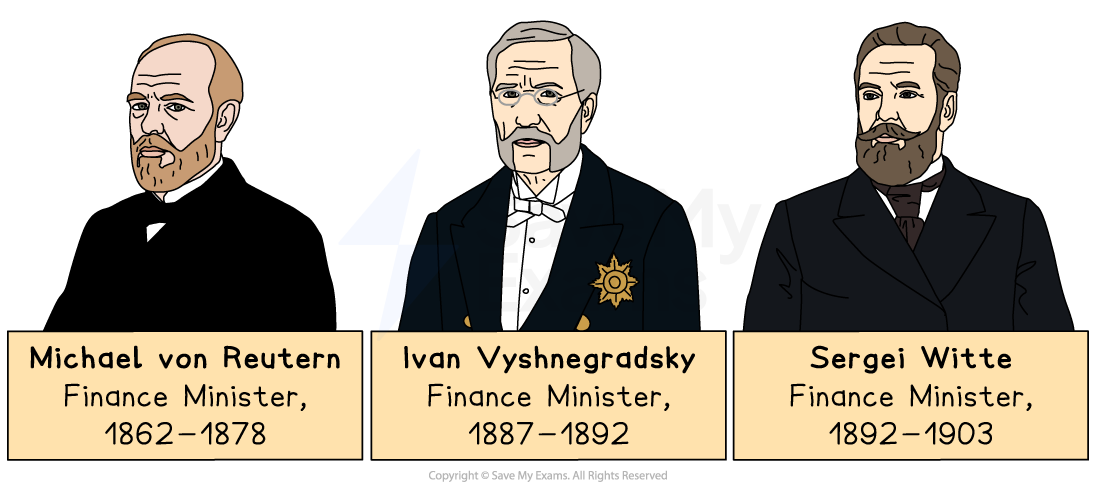
Finance Minister | Key Approach | Main Instruments |
|---|---|---|
Mikhail von Reutern (1862-78) |
|
|
Ivan Vyshnegradsky (1887-92) |
|
|
Sergei Witte (from 1892) |
|
|
Results of Reutern's tenure
Strengths | Limitations |
|---|---|
|
|
|
|
|
|
|
|
Examiner Tips and Tricks
Treat Reutern, Vyshnegradsky and Witte as three distinct phases of economic strategy rather than a single policy. Reutern was cautious and market-oriented: he reduced tariffs and relied on private entrepreneurs. Vyshnegradsky was aggressive and extractive: high tariffs, forced grain exports and heavy indirect taxation. Witte was state-directed and interventionist. Identifying these differences, rather than treating pre-1892 industrialisation as one undifferentiated process, is exactly what examiners are looking for.
Note that Nikolai Bunge was Finance Minister between Reutern and Vyshnegradsky, from 1881 to 1886, but he is not covered here.
Vyshnegradsky: taxation, grain exports & the push for growth
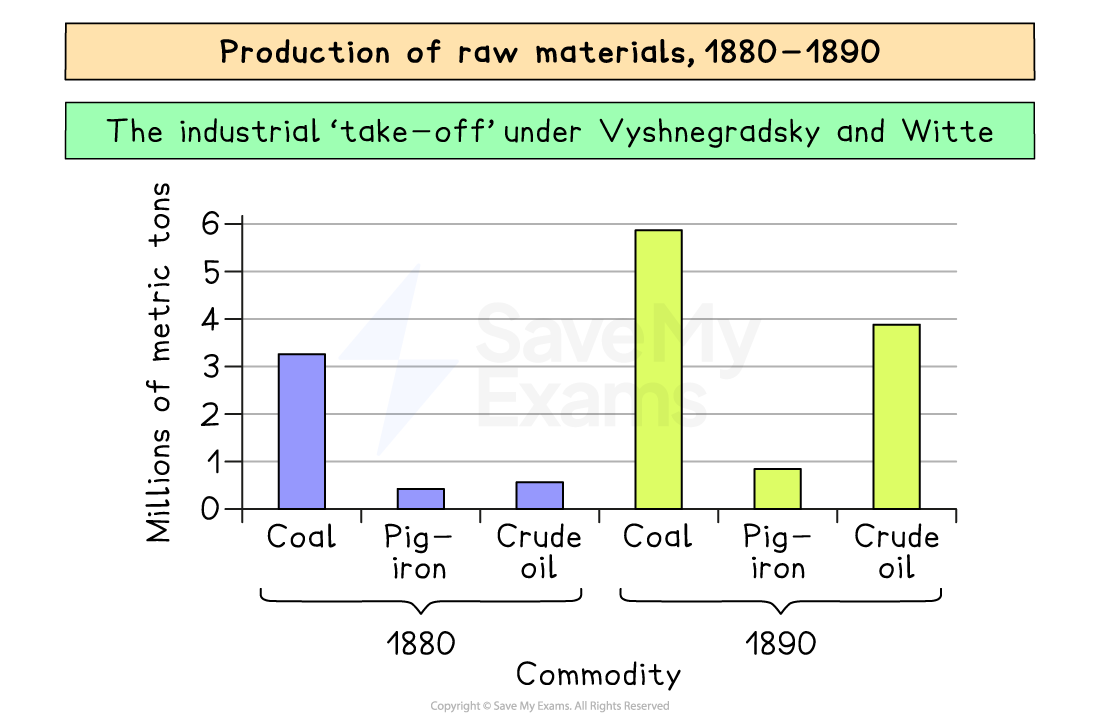
Vyshnegradsky's strategy for rapid growth, 1887 – 92
Ivan Vyshnegradsky became Finance Minister in 1887 under Alexander III
He replaced the Reutern-era market approach with an aggressive strategy focused on rapid capital accumulation
His central aim was to generate the revenue needed to accelerate industrial and railway expansion
Vyshnegradsky used three main instruments to raise state revenue and promote growth:
Protective tariffs
A high tariff of 30% on the value of imported raw materials was introduced
This shielded the Russian industry from foreign competition and generated significant government income
Domestic producers in textiles, iron and coal benefited from the protection
Indirect taxation
Taxes on consumer goods were increased substantially
These taxes fell disproportionately on ordinary consumers, particularly peasants
This generated revenue but further reduced purchasing power among the poorest sections of society
The grain export drive
Vyshnegradsky mounted a systematic drive to increase grain exports, summarised in his phrase "we may go hungry, but we will export"
Loans were negotiated and grain requisitioning was intensified
Grain exports increased by 18% as a proportion of total Russian exports between 1881 and 1891
The Russian budget was in surplus by 1892 for the first time in a generation
The costs: the famine of 1891 – 92
Vyshnegradsky's export drive stripped peasants of the grain reserves they needed to survive a poor harvest
Peasants were forced to pay taxes and export their grain even in years of low yield
Many were left with no reserves to see them through winter
Bad harvests in 1891, combined with the export pressure, produced catastrophic results:
Widespread famine spread across central and southern Russia
Hundreds of thousands of people died; the scale shocked Russian and European observers
The famine triggered a surge in social unrest and political radicalisation across the country
The political consequences were immediate:
Vyshnegradsky was dismissed from office in 1892
Sergei Witte succeeded him as Finance Minister and changed direction
The famine became a turning point that revealed the human cost of state-driven growth funded by peasant extraction
Examiner Tips and Tricks
Examiner reports note that weaker answers on this topic stray into developments after 1892, particularly Witte's policies or the impact of the completed Trans-Siberian Railway. The question is about 'a period of relatively slow economic development which acted as a preparation for what was to come.' Your job is to evaluate what Reutern and Vyshnegradsky achieved on their own terms, not to measure them against Witte.
Always check your questions' date parameters!
The expansion of the railways: The Trans-Siberian Railway
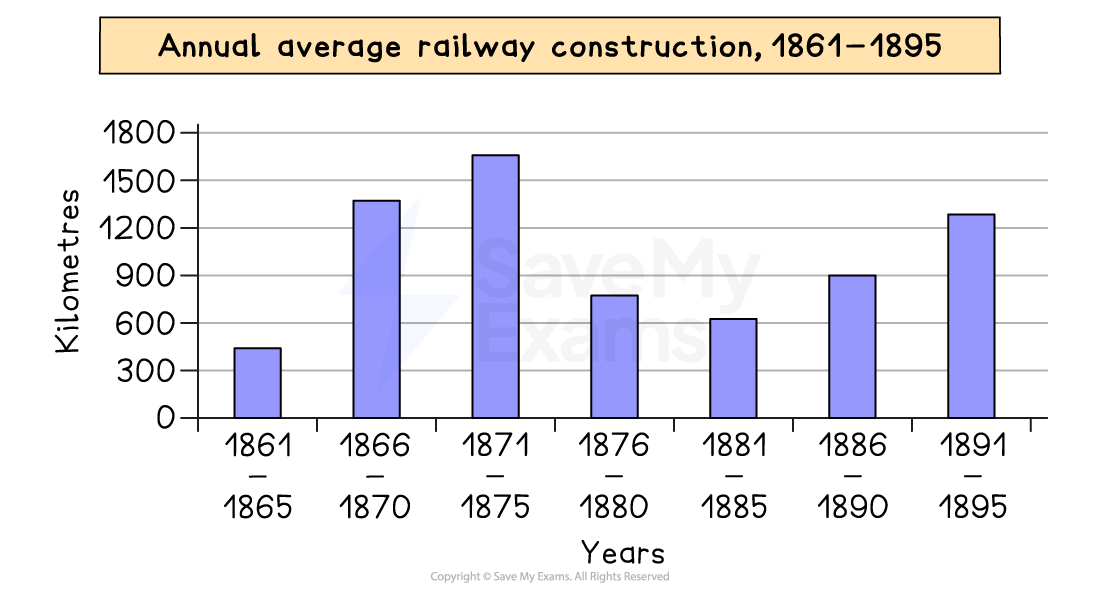
Railway expansion under Reutern and Vyshnegradsky
Railway construction was the most visible symbol of Russia's industrialisation drive
The network grew from around 1,600 km in 1861 to over 30,000 km by 1891
This represented a substantial achievement given Russia's vast distances and difficult terrain
The state used a combination of incentives to drive railway construction:
Government subsidies offered to private railway entrepreneurs
State-guaranteed annual dividends were introduced to attract foreign investors
Direct state construction in regions where private capital was unavailable
Railways served multiple strategic and economic functions:
Transporting grain from agricultural regions to Baltic and Black Sea ports for export
Connecting industrial areas to raw material sources such as coal fields and iron deposits
Moving troops and military supplies across Russia's vast territory
Opening new areas to settlement and commercial activity
Despite the growth, Russia's network remained small by European standards:
Britain had over 20,000 km of railway by the 1870s; Germany was expanding even more rapidly
Russia's lines were spread across a far larger territory, reducing their economic density
Key industrial regions remained poorly connected to ports and markets
The Trans-Siberian Railway: the decision to build
The Trans-Siberian Railway was formally authorised by Tsar Alexander III in 1891
Construction formally began the same year, with the first section starting from Vladivostok
It was planned to run approximately 9,000 km from Moscow to Vladivostok on the Pacific coast
Siberia at this point remained remote, largely uncolonised and economically unexploited
The decision to build reflected several overlapping motives:
Strategic
Connect European Russia to the Far East and project military reach into a region contested with China and Japan
Economic
Open Siberia to settlement, agriculture and resource extraction
Political
Demonstrate Russian imperial power and ambition at a time of growing international rivalry
The Trans-Siberian represented a qualitative shift in scale from earlier railway building:
Previous lines were primarily commercial or regional in purpose
The Trans-Siberian was a project of imperial ambition, unprecedented in scale
Its authorisation in 1891 marked a boundary between earlier railway expansion and the more ambitious, state-led railway programme later associated with Witte
Examiner Tips and Tricks
Keep a clear distinction between two things: the general railway expansion of the 1860s-80s (commercially driven, incentivised by subsidies and dividends) and the Trans-Siberian Railway specifically (a state project of imperial scale, authorised in 1891). Examiners penalise answers that treat all railway building as a single, undifferentiated process.
How successfully had Russia industrialised by 1892?
By 1892, Russia had achieved real industrial growth
But structural limitations, geographic concentration and severe social costs make the picture more mixed than the headline output figures suggest
Russia had made significant industrial progress by 1892
The railway network expanded dramatically, from around 1,600 km in 1861 to over 30,000 km by 1891:
Connected previously isolated regions to markets, ports and raw materials
Provided a vital infrastructure for further economic development
State-directed financial reform created stable conditions for growth:
The State Bank provided a credit infrastructure that had not previously existed
Foreign investment was regularised and protected through guaranteed dividends
The budget moved into surplus by 1892 for the first time in a generation
Key industrial sectors showed real, measurable growth over the period:
Coal and iron production increased
Iron ore from Krivoi Rog was taken to the ironworks in places such as Donetsk
Oil extraction began in the Baku region
The cotton industry expanded significantly in regions such as Moscow and the central industrial area
Russia's grain exports made it one of the world's largest exporters by the 1880s
The emancipation of 1861 removed the structural barrier that had most directly suppressed industrial development:
A mobile labour force, however small, now existed in cities such as St Petersburg and Moscow
The legal preconditions for a market economy began to take shape
This foundation made the Witte-era expansion structurally possible
Key historian
"The emancipation of the serfs in 1861 removed a considerable barrier to industrial growth. Serfdom was clearly incompatible with the requirements of an industrialising society. The basis of such a society was agriculture, and serfdom ensured a restricted home market, a low level of agricultural technology, and a largely immobile population. The simple pyramid structure of this stratified society, with its huge peasant base and small elite of landed gentry, left little room for the development of a prosperous middle class."
M. E. Falkus, The Industrialisation of Russia 1700-1914 (1972)
Falkus argues that the emancipation cleared the principal structural obstacle to modern industrialisation
His emphasis on the removal of barriers, rather than on what had been positively built, supports the case that 1892 represents a solid foundation: the preconditions for sustained growth had been established, even if they had not yet been fully exploited
This is the strongest basis for the argument that industrialisation to 1892 was a meaningful success
Industrialisation remained fundamentally incomplete and socially costly by 1892
Russia's industrial output remained far behind its major European competitors:
Britain, Germany and France were significantly more industrialised by every measure
Russia ranked fourth or fifth among European powers in industrial output, despite its vast size
The gap between Russia and the leading industrial powers was not narrowing
Industrialisation was geographically concentrated and structurally uneven:
Growth was confined to certain regions of European Russia, particularly the north-west and parts of Ukraine
Siberia remained economically unexploited despite its resource potential
Russia remained dangerously dependent on foreign capital and vulnerable to external shocks:
Around a third of all government expenditure was committed to debt repayment
The rouble remained unstable, deterring some investors and complicating planning
Any withdrawal of foreign investment could destabilise the whole programme
The domestic market was too poor and too small to sustain growth independently:
Most peasants had little purchasing power; consumer demand was minimal
The poll tax had burdened male peasants for generations
Although abolished between 1883 and 1886, it had helped entrench rural poverty
Most peasants entered the 1890s with almost no spare income
Growth relied on state demand, export markets and foreign capital, not domestic consumption
This structural weakness remained unresolved throughout the period
The famine of 1891 – 92 was the most damning single indictment of the period's achievements:
Vyshnegradsky's export drive had stripped peasants of their grain reserves
When harvests failed, there was nothing to fall back on
The resulting famine killed hundreds of thousands and triggered widespread radicalisation
Social conditions for industrial workers remained extremely poor throughout:
Long hours, low wages and overcrowded housing characterised urban factory life
Workers had almost no legal protection or collective bargaining rights
The growth achieved by 1892 had not improved ordinary lives in any meaningful way
Key historian
"For at least a decade before the 1905 Revolution, the radicalisation of all sections of Russian society had been taking on more and more extreme forms. The exact number of strikers is unascertainable, but there is no doubt that the general trend was upwards. In the main, the government's answer was repression, and the arrest and deportation of strike leaders. In the countryside peasant discontent was aggravated by a series of famines; in 1891-92, 1897, 1898 and 1901."
L. Kochan, The Making of Modern Russia (1962)
Kochan identifies the famine of 1891-92 as the opening of a pattern of social crisis driven directly by the limits of industrialisation
For Kochan, the unrest that culminated in 1905 was not a sudden eruption but the accumulation of a decade of grievances: forced grain exports, failed harvests and industrial growth that improved nothing for those who bore its costs
This supports the case that by 1892, the social foundations of the tsarist economic model were already severely strained
Examiner Tips and Tricks
The question 'How successfully had Russia industrialised by 1892?' demands a benchmark. Success compared to what? Examiners reward answers that measure Russian progress against Western Europe rather than in purely absolute terms. A ~5% annual average growth rate between 1861 and 1881 sounds impressive until you note that Russia was industrialising from a much lower base and that Britain had been industrialising for a century.

Unlock more, it's free!
Join the 100,000+ Students that ❤️ Save My Exams
the (exam) results speak for themselves:

Was this revision note helpful?
