Opposition to Tsarism: Ideas, Ideologies and the Intelligentsia (AQA A Level History: Component 1: Breadth study): Revision Note
Exam code: 7042

Summary
The intelligentsia was a small, educated minority that challenged tsarist authority from the 1840s onwards
It was drawn mainly from the nobility and professional classes
The Slavophile/Westerniser debate of the 1840s shaped later opposition
Slavophiles argued Russia should follow its own traditions
Westernisers wanted Russia to adopt the liberal model of Western Europe
More radical ideas developed in the mid-19th century
Nihilism rejected existing authority
Anarchism, associated with Mikhail Bakunin, rejected the state itself
Populism tried to awaken revolution among the peasantry
The failure of Going to the People in 1874 pushed some radicals towards terrorism
The People’s Will turned to targeted assassination
It killed Alexander II in March 1881 but produced a conservative backlash rather than revolution
Marxism arrived in Russia in the 1880s
It focused on the growing urban working class rather than the conservative peasantry
The intelligentsia & the origins of opposition in Russia
Who were the intelligentsia?
The intelligentsia was a cultural identity, not a social class
Members included writers, lawyers, journalists, students and professors
They were unified by outlook, not occupation
What united them was the belief that Russia's political order was wrong
Most members came from the nobility or professional classes
The intelligentsia had no independent mass base among ordinary Russians
It challenged a system that depended on people like itself to function
How Alexander II's reforms shaped the intelligentsia
Alexander II's reforms in the 1860s gave the intelligentsia new platforms
The zemstvo (1864) gave educated professionals a space to debate and campaign
The relaxation of censorship allowed radical ideas to circulate more freely
University expansion produced a new generation of independently minded students
But the reforms also created the frustrations that radicalised many
Emancipation left the peasantry debt-ridden and land-poor
The zemstvo had no power over the central government's decisions
Many people who had welcomed Alexander's early reforms were disappointed when they fell short of the changes they hoped for
What the intelligentsia wanted
What the intelligentsia wanted ranged from cautious reform to outright revolution
Liberals wanted a constitution and representative government through legal means
Radicals rejected gradualism as too slow and too willing to work with the existing order
The historian Figes shows that many zemstvo professionals had shifted towards Marxist ideas after the 1891 famine
Examiner Tips and Tricks
The intelligentsia was never a single, united movement. Liberals, Narodniks and Marxists all came from the same educated background but disagreed completely on aims and methods.
Slavophiles vs Westernisers: the great debate
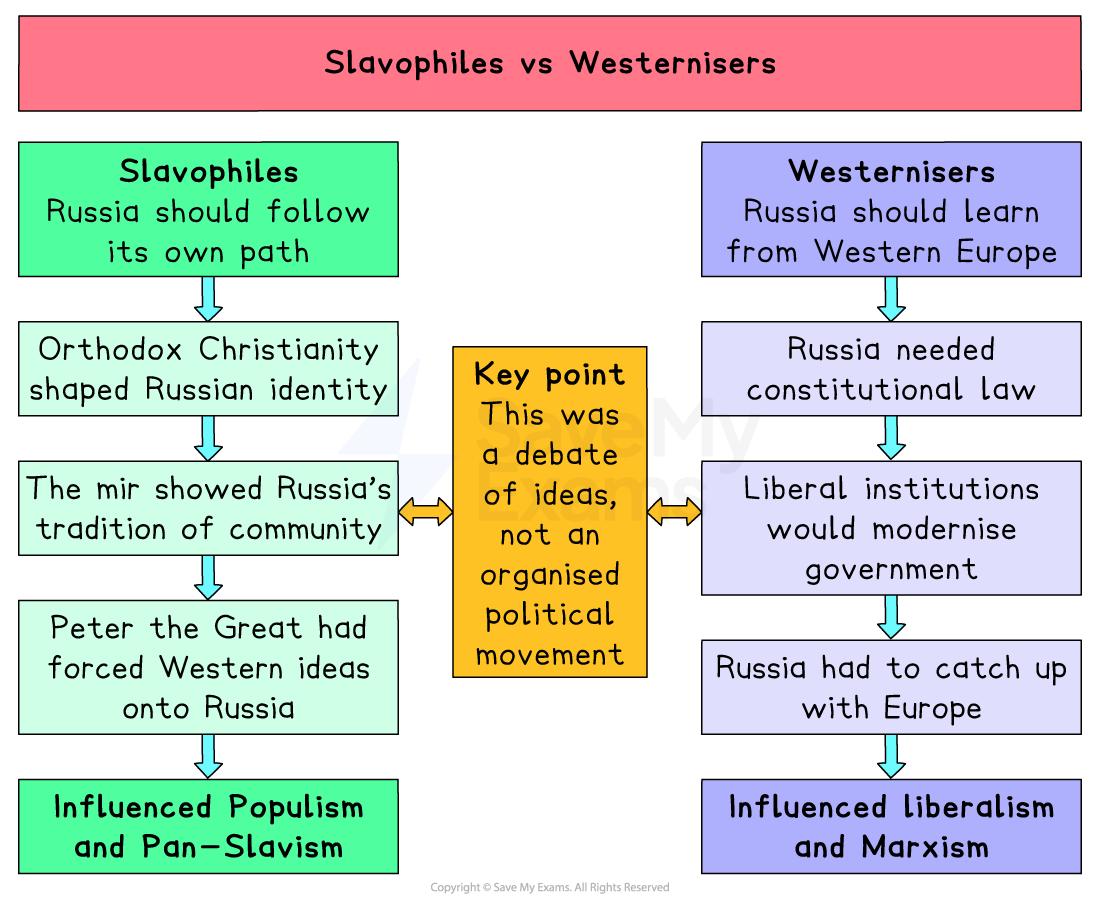
The Slavophile/Westerniser debate was a philosophical argument within the intelligentsia, not a political movement
There were no party structures, programmes or mass membership
The debates took place in salons, journals and lecture rooms in the 1840s and 1850s
The Slavophile position
Slavophiles believed Russia had its own path, separate from the West
They saw Orthodox Christianity and the mir as Russia's authentic foundations
They criticised Peter the Great for imposing an artificial Western identity on Russia
Many were not simply pro-autocracy: they wanted a more spiritual bond between tsar and people
Key thinkers included:
Aleksey Khomyakov
Ivan Kireevsky
Konstantin Aksakov
The Westerniser position
Westernisers simply believed that Russia was behind Western Europe and needed to catch up
They called for constitutional law, rational governance and liberal institutions
Alexander Herzen later developed his own agrarian socialism, which fed directly into Populism
The Westerniser tradition eventually fed into Russian Marxism through Georgi Plekhanov
Key thinkers included:
Vissarion Belinsky
Alexander Herzen
The debate shaped every major opposition that followed
Each later group had to answer the same question: Russia's own path, or the Western model?
Slavophile ideas fed into Pan-Slavism and Populist belief in the commune
Westerniser ideas fed into liberalism and, through Plekhanov, into Marxism
Examiner Tips and Tricks
Slavophiles and Westernisers were not political parties. They were an intellectual argument that rarely produced organised action against the regime.
Herzen is the key bridge figure. He started as a Westerniser but developed agrarian socialism, which led directly into Populism. Know his trajectory: it explains how the debate connected to later movements.
Liberal opposition: the Westerniser tradition & zemstvo constitutionalism
The liberal tradition
Liberal opposition was the most moderate strand of anti-tsarist dissent
Liberals drew on the Westerniser tradition: they wanted constitutional law and representative government, not revolution
They believed change should come through legal means and gradual public pressure
This set them apart from the nihilists and populists who came from the same educated class but rejected gradualism entirely
Boris Chicherin was one of the clearest examples of moderate Russian liberalism
He supported constitutional law, individual rights and legal reform
However, he rejected revolution and believed change should come gradually through the state
The zemstvo as a platform for liberal pressure
The zemstvo (established 1864) became the main institutional base for liberal opposition
Elected local councils gave professionals a legitimate space to debate policy and push for change
By the 1870s and 1880s, zemstvo assemblies were passing resolutions calling for a national consultative assembly
The zemstvo liberal tradition would grow significantly after 1894 and eventually form the basis of the Kadet party
Liberal pressure remained legal and cautious throughout the period from 1855 to 1894
Liberals had no mass base among the peasantry, who were conservative and loyal to the Tsar
The conservative backlash under Alexander III restricted zemstvo activities and pushed liberal voices to the margins
Why liberals stayed separate from radicals
The liberal and radical traditions shared a social origin but disagreed completely on strategy
Liberals believed the existing legal and institutional framework could be improved from within
Radicals believed the whole system needed to be destroyed before anything new could be built
Events like the assassination of Alexander II appalled liberal opinion
Terrorism gave the regime the excuse to crack down on everyone, including moderate reformers
Examiner Tips and Tricks
The key distinction is strategy: liberals believed in legal, gradual change through institutions like the zemstvo; radicals rejected the entire order. Keep this distinction clear in your essays and use it to show you understand the opposition was not a single movement.
Nihilism & anarchism: Bakunin & revolutionary violence
Nihilism
Nihilism emerged in the 1860s as a rejection of all existing authority and values
Nihilists argued that the existing order must be destroyed before anything new could be built
The term was popularised by Turgenev's character Bazarov in Fathers and Sons (1862)
Nihilists rejected religion, the family and established conventions as tools of social control
Nikolai Chernyshevsky's What Is to Be Done? (1863) became the key text of the radical intelligentsia
It presented the 'new people': devoted revolutionaries who lived austerely and gave everything to the cause
The novel circulated secretly and shaped a whole generation of radicals
Lenin later borrowed the title for his own 1902 political pamphlet
Bakunin and anarchism
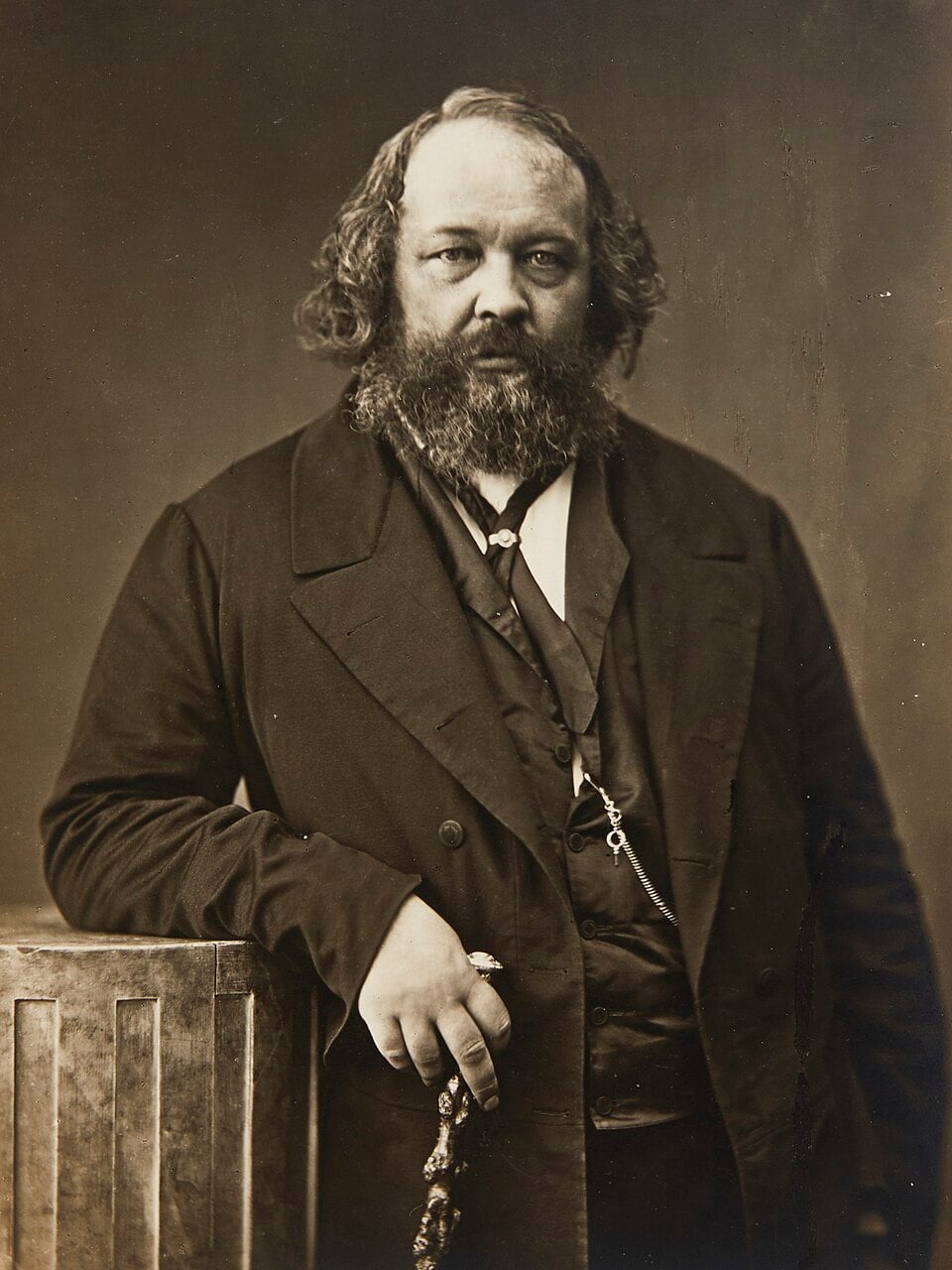
Mikhail Bakunin (1814-1876) was the central figure of Russian anarchism
He believed all states were inherently oppressive, not just the tsarist one
He rejected Marx's 'dictatorship of the proletariat': any revolutionary state would just create a new ruling class
He called for the immediate abolition of all state authority
Bakunin's conflict with Marx at the First International (1864 – 1872) produced a lasting split in European revolutionary thought
Marx believed the working class must seize state power to achieve socialism
Bakunin believed this would simply replace one form of oppression with another
Bakunin was expelled from the International in 1872
The split anticipated the lasting divide between Marxist and anarchist traditions across Europe
Nechaev and revolutionary violence
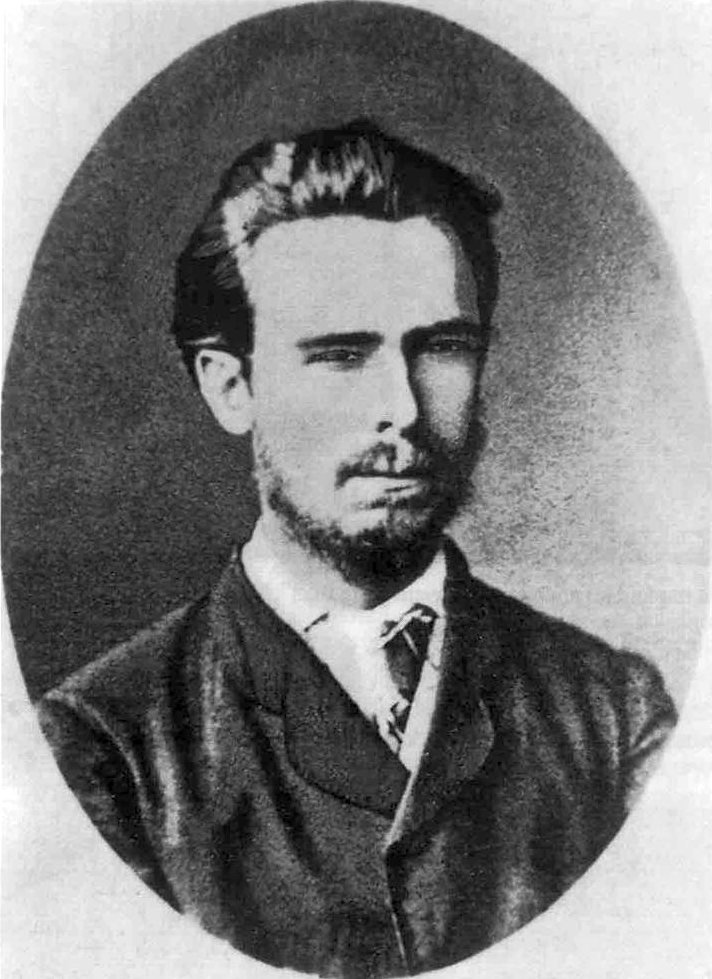
Sergei Nechaev's Revolutionary Catechism (1869) pushed nihilist logic to its extreme
It argued that the revolutionary must be ruthless, amoral and entirely devoted to the cause
Nechaev himself murdered a fellow revolutionary whom he suspected of disloyalty
His ideas still influenced the development of the underground revolutionary organisation in Russia
Examiner Tips and Tricks
The key distinction is between Bakunin vs Marx on the state. Bakunin rejected all state authority, including a post-revolutionary one. Marx argued for a temporary revolutionary state that would eventually wither away.
When a question asks about radical ideas, that is the distinction that separates strong answers from weak ones.
Populism (Narodniks): ‘Going to the People’
The Narodnik movement
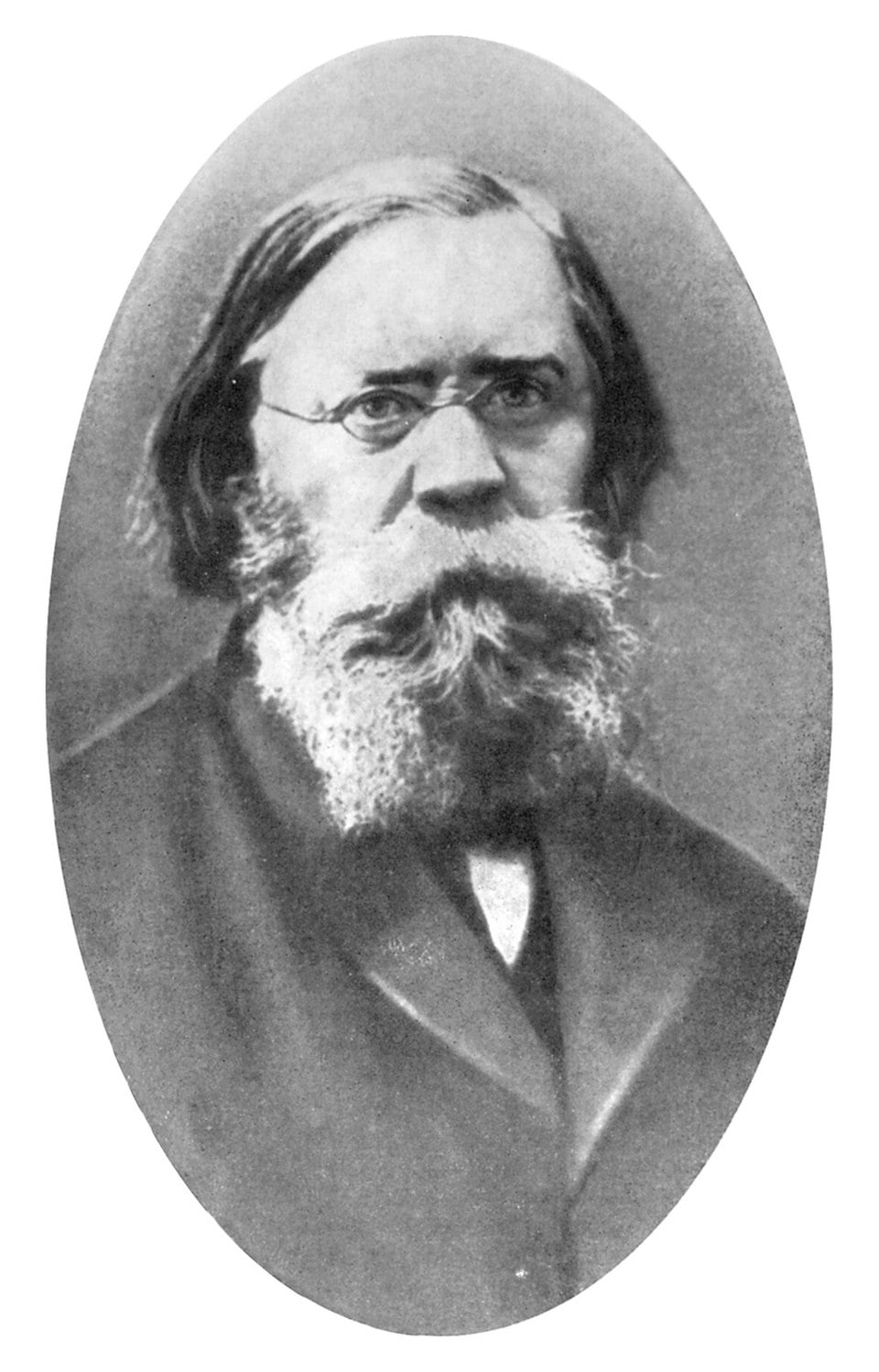
The Narodniks believed the peasantry would lead Russia's revolution
The name comes from narod, Russian for 'the people', the Narondiks:
Drew on Herzen's idea of agrarian socialism
Saw the peasant commune as a ready-made proto-socialist institution
Rejected the Marxist idea that Russia must first pass through a capitalist stage
Pyotr Lavrov and Nikolai Mikhailovsky were the leading Narodnik theorists
Lavrov argued that the intelligentsia owed a moral debt to the peasants
The peasants' labour had funded their education
Mikhailovsky argued the commune had a natural capacity for collective organisation
'Going to the people' (1873 – 74)
'Going to the People' was the defining moment of Populism and its greatest failure
Thousands of young intellectuals left the cities to live and work among the peasants
They expected to awaken a revolutionary consciousness
The peasantry was conservative, loyal to the Tsar and suspicious of educated outsiders
Many peasants reported the agitators to the police
Mass arrests followed; the Trial of the 193 (1877 to 1878) produced martyrs but no revolution
Around 90 out of 193 defendants were acquitted; the open courtroom spread Populist ideas to a national audience
The regime moved political cases to closed courts after the embarrassing verdicts
The failure of 'Going to the People' and the split
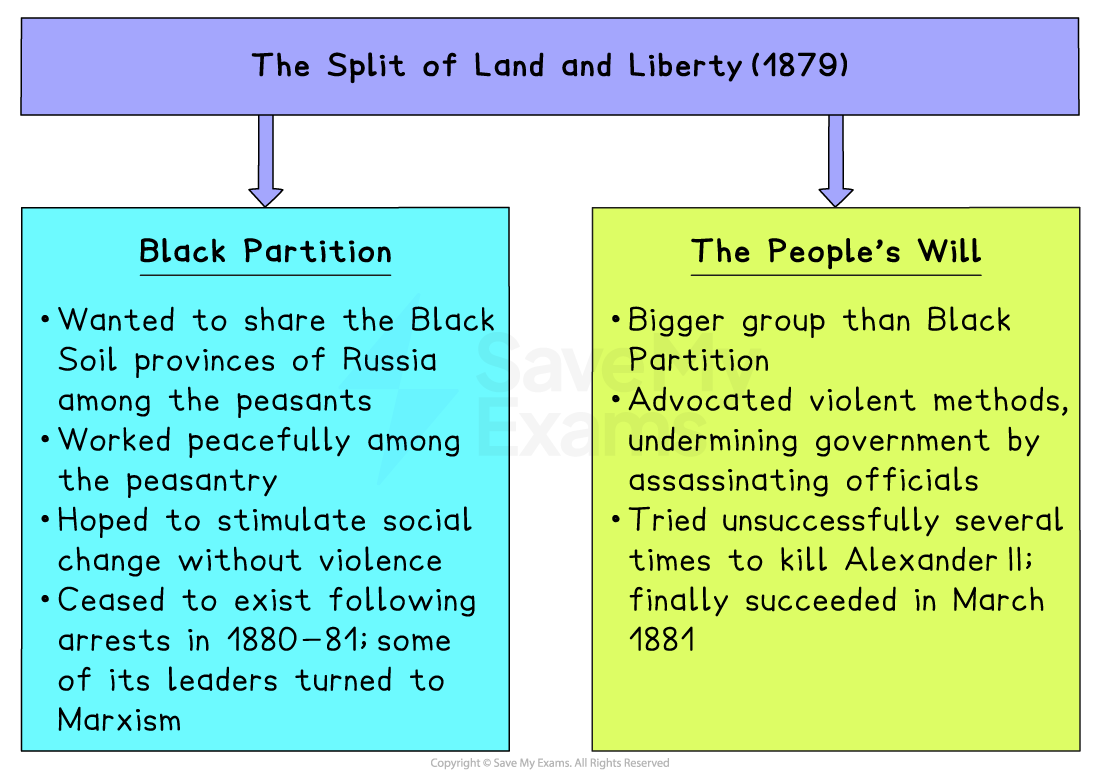
The failure forced a fundamental split in the Populist movement in 1879
Sixsmith identifies the decisive lesson the Narodniks drew from the experience
If the peasants would not drive a revolution, professional revolutionaries would have to impose it
This logic directly anticipated Lenin's later theory of the Vanguard party
Land and Liberty split into two organisations with opposite strategies
Black Repartition (Cherny Peredel) continued trying to organise the peasantry; it dissolved quickly and its leaders moved toward Marxism
People's Will turned to targeted assassination
"The experience was enough to convince the revolutionaries that the people were never going to be a reliable basis on which to stage a revolution. It was a realisation that would have a dramatic impact. From that point onwards, the conviction began to grow that the revolution must be brought about and imposed on society by a clique of dedicated professionals. The 'people's revolution' was going to be based, not on the will of the people, but on the determination of a small group of activists."
M. Sixsmith, Russia (2011)
Sixsmith identifies the crucial ideological conclusion the Narodniks drew from the failure of 1874: if the people would not make revolution spontaneously, a professional elite would have to do it for them. This is exactly the theory Lenin later applied in building the Bolshevik party.
Examiner Tips and Tricks
The Narodniks' failure matters not just as a story of defeat but because of what it led to. The shift from mass organisation to professional terrorism explains how People's Will emerged, and how Lenin later justified the vanguard party. Make sure you follow this chain of cause and effect.
People's Will: from populism to political terrorism
The formation and strategy of People's Will
People's Will (Narodnaya Volya) was formed in 1879 from the split within Land and Liberty
Its founders concluded that killing the tsar and senior officials would cause the regime to collapse
They formed a small Executive Committee with tight discipline and a willingness to sacrifice members
Key figures included:
Andrei Zhelyabov
Sofia Perovskaya
People's Will believed terrorism could succeed where mass organisation had failed
A small, disciplined cell could act where the peasantry would not
The regime, they argued, was only held together by its leaders; remove the leaders and it would fall
The assassination campaign, 1879-1881
People's Will mounted a systematic assassination campaign against Alexander II
In November 1879, they mined the tsar's railway line
In February 1880, they bombed the Winter Palace dining room, killing eleven guards
Each failed attempt increased their determination and strengthened their reputation among radical circles
On 1 March 1881, two bombs were thrown at Alexander's carriage on the Catherine Canal in St Petersburg
The first bomb missed the tsar but wounded bystanders; Alexander left his carriage to check on the wounded
The second bomb was thrown at close range and fatally wounded him; he died within hours
The consequences for People's Will
The assassination produced the opposite of what People's Will intended: not revolution, but a conservative backlash
The peasantry did not rise
The working class remained quiet
The regime did not collapse
People's Will was destroyed as an organisation
Within a month of the assassination, its leaders were arrested and executed
The Loris-Melikov proposals for moderate reform were shelved immediately
The assassination demonstrated two contradictory things at once
A small, disciplined cell could reach the tsar despite the full resources of tsarist security
But terrorism alone, without mass support, could not produce revolution
Black Repartition | People's Will | |
|---|---|---|
Founded |
|
|
Key figures |
|
|
Strategy |
|
|
Key action |
|
|
Outcome |
|
|
Examiner Tips and Tricks
Do not describe the assassination as a success for People's Will. The only outcome was triggering the most repressive regime since Nicholas I.
Every act of violence gave the conservatives the justification they needed to demand more repression and delay further reform.
Marxism in Russia: the origins of Russian socialism
Why Marxism appealed to Russian radicals
Marx's ideas reached Russia in the 1870s and 1880s, filling the gap left by Populism's failure
The failure of 'Going to the People' had created an opening for new ideas about how revolution could work
Marx argued that capitalism would produce a working class that would eventually overthrow it
Russia's rapid industrialisation was beginning to create exactly the urban working class Marx described
Marxism offered answers that Populism could not
It explained poverty not as a moral failure but as the product of a specific economic system
It provided a scientific framework: revolution was not just desirable but historically inevitable
The 1891 famine deepened Marxism's appeal
Historian Orlando Figes shows how zemstvo professionals turned to Marxist explanations of peasant poverty
Key figures in early Russian Marxism
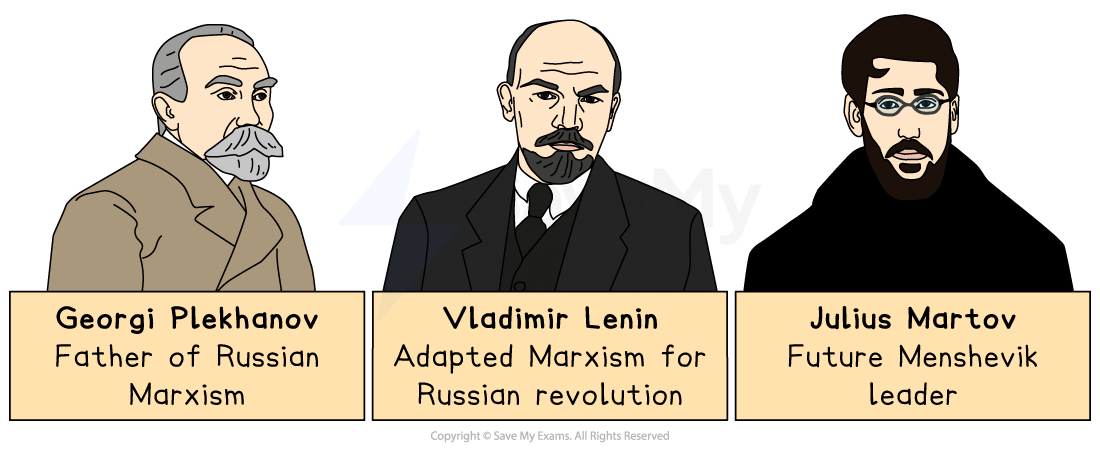
Georgi Plekhanov is often called the 'father of Russian Marxism'
He broke from Populism after the failure of 'Going to the People' and founded the Emancipation of Labour group in Geneva in 1883
He translated Marxist texts into Russian for the first time
He argued that Russia must pass through a capitalist stage before a socialist revolution was possible
Plekhanov created the intellectual framework that Lenin later inherited and transformed
Without Plekhanov, there was no Russian Marxist movement for Lenin to join in the 1890s
The two would later split bitterly over the organisation and direction of the revolutionary party
Figure | Key Contributions | Significance |
|---|---|---|
Georgi Plekhanov (1856 to 1918) |
|
|
Lenin (Vladimir Ulyanov, 1870 to 1924) |
|
|
Julius Martov (1873 to 1923) |
|
|
The central problem in Russian Marxism
Russian Marxism faced a fundamental problem from the start: Marx wrote about industrialised Western Europe, but Russia was still overwhelmingly agrarian
Over 80 per cent of Russians were peasants, not industrial workers
Plekhanov's answer was to wait for capitalism to develop first before expecting revolution
This meant Russian Marxists were theoretically supporting the capitalist stage that they ultimately wanted to overthrow
Despite this tension, Russian Marxism grew steadily in the 1880s and 1890s
The 1891 famine significantly widened its appeal among university students and zemstvo professionals
By 1895, Lenin and Martov had formed the League of Struggle in St Petersburg, the direct predecessor of the Bolshevik Party
Examiner Tips and Tricks
Plekhanov is often underrated. Without him, Lenin had no movement to join. Plekhanov created Russian Marxism; Lenin transformed it. Make sure you can explain why Plekhanov mattered before you move on to Lenin.

Unlock more, it's free!
Join the 100,000+ Students that ❤️ Save My Exams
the (exam) results speak for themselves:

Was this revision note helpful?
