War Communism and the New Economic Policy (NEP), 1918–1928 (AQA A Level History: Component 1: Breadth study): Revision Note
Exam code: 7042

Summary
War Communism was an emergency Civil War policy based on state control, grain requisitioning, nationalisation and rationing
By 1921, it had helped push the economy into crisis
Industrial output at around 20% of pre-war levels
Unrest spread at Tambov and Kronstadt
Lenin replaced War Communism with the New Economic Policy (NEP) in 1921
Private trade returned
Grain requisitioning was replaced by a tax in kind
The state kept control of heavy industry
The NEP restored production to 1913 levels by 1928
However, it also created inequality
Many Bolsheviks saw it as a retreat from socialism
Historians debate whether the NEP was a pragmatic rescue or an ideological retreat
Freeze stresses rapid economic recovery
Ulam argues that survival forced the Bolsheviks away from socialist goals
Why was War Communism introduced?
A response to the Civil War
War Communism began in June 1918 as civil war spread across Soviet Russia
The Bolsheviks needed to feed the Red Army and the cities
Food supplies and industrial output had already collapsed since 1917
The government therefore, moved towards emergency control of the economy
The policy also strengthened Bolshevik political control
Workers, peasants and local markets were brought under central direction
Centralised control made opposition easier to suppress
Survival in the Civil War became the main justification for coercion
Ideology and the leap to socialism
Some Bolsheviks saw War Communism as more than an emergency policy
Lenin and Bukharin argued it could move Russia closer to a socialist economy
Abolishing money and private trade appeared to match Marxist theory
Critics later argued this was an attempt to leap straight to socialism
Examiner Tips and Tricks
When explaining why War Communism began, balance both motives. It was a desperate response to the Civil War, but it was also ideological because some Bolsheviks saw it as a step towards socialism.
Key features and impacts of War Communism: famine, unrest and the Kronstadt Rebellion
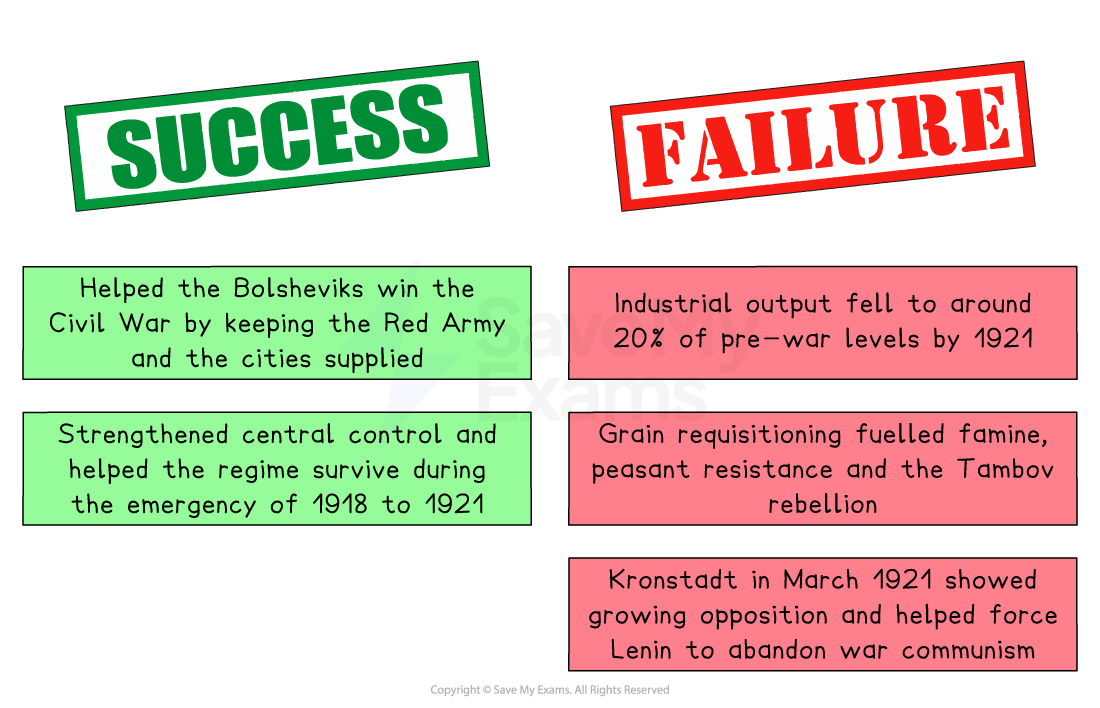
The key features of War Communism
War Communism gave the Bolshevik state direct control over food, industry, labour and trade
It also supported the war effort
It also reflected Bolshevik hopes for a socialist economy based on state control
Grain requisitioning forced peasants to hand over food without payment
The Cheka and requisition squads seized grain to feed the cities and army
This created deep anger in the countryside
The state nationalised the industry and banned private trade
Sugar was nationalised in May 1918, oil in June, and nearly all industry by November 1920
Local markets became illegal
Goods were meant to move only through state channels
Rationing was organised by class
Workers and soldiers received the most rations
The "former people", such as nobles and former elites, received the least
Food distribution became political as well as practical
Labour discipline tightened sharply
The 1918 Constitution declared: "He who does not work shall not eat"
From 1919, all able-bodied people aged 16 to 50 had to work
Labour was treated as a duty owed to the revolution
Hyperinflation destroyed the currency
The government printed so much money that it became worthless
Money was increasingly abandoned in everyday life
Workers were now paid in rations and public transport became free
Economic collapse and famine
War Communism wrecked production
Industrial output fell to around 20% of pre-war levels by 1921
Disease epidemics killed more than 3 million people in 1920
Workers fled the starving cities
By the end of 1920, Moscow had lost 44.5% of its population, while Petrograd had lost 57.5%
The 1921 famine devastated the countryside
The 1921 harvest was only 48% of the 1913 level
An estimated 5 million people died, mostly in the Volga region
Russia's population fell from 170.9 million in 1913 to 130.9 million by 1921
Unrest and the Kronstadt Rebellion
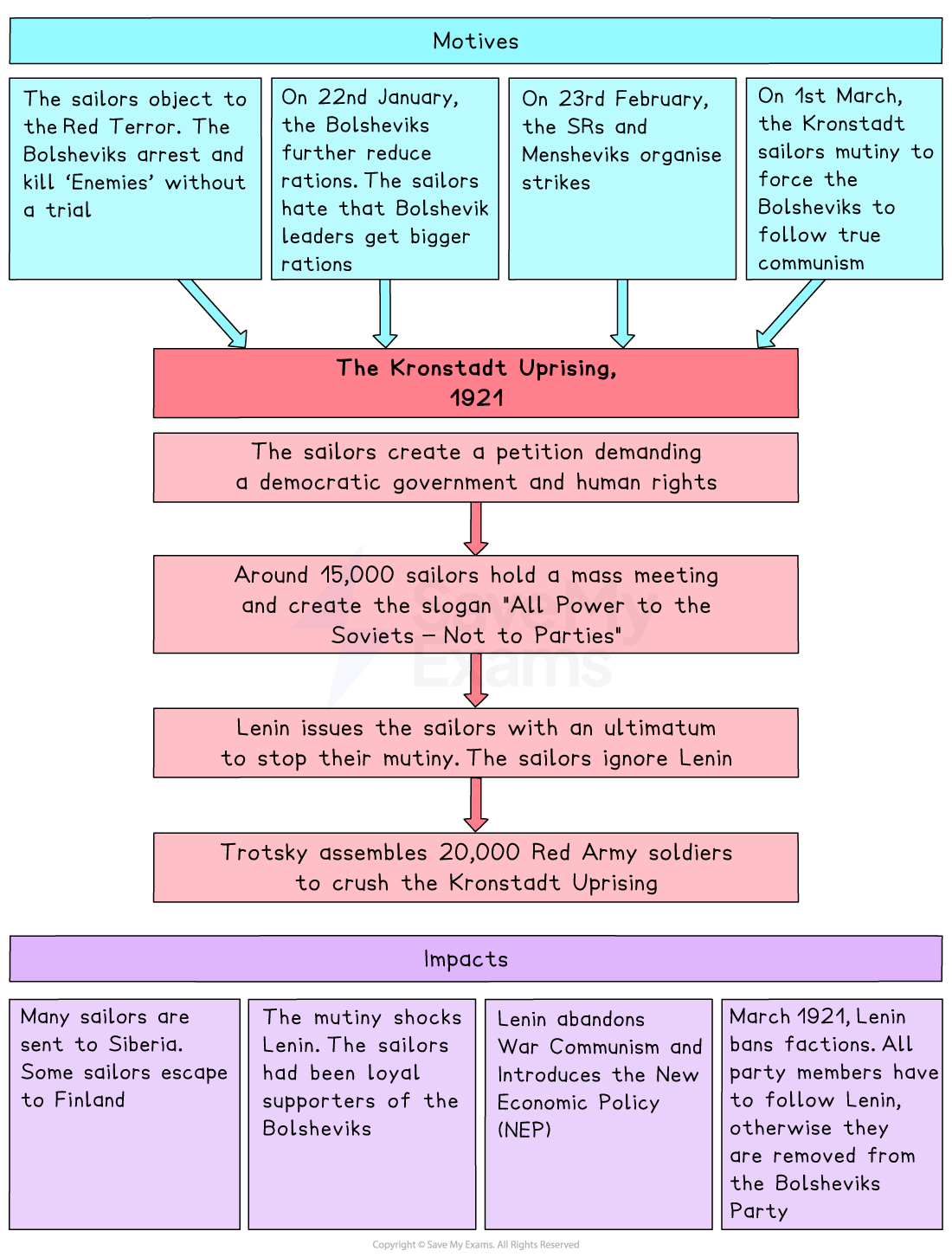
Peasant resistance became violent
Peasants hid or destroyed their crops rather than surrender them
The Tambov Rebellion (1920 to 1921) raised a 70,000-strong peasant army
With the use of poison gas, about 100,000 Red Army soldiers destroyed the Rebellion
The Kronstadt Rebellion shook the regime in March 1921
Around 15,000 sailors, once the regime's strongest supporters, demanded an end to one-party rule
The Red Army crossed five miles of ice and took 15,000 prisoners
Lenin called the rebels "White Traitors", but the revolt pushed him to abandon War Communism for the NEP
Examiner Tips and Tricks
Do not just list the features of War Communism. Link each feature to its consequence. For example, requisitioning made peasants grow less food, which deepened famine and helped fuel revolt.
Why was the NEP introduced?
Crisis forced a retreat
By 1921, War Communism had pushed Russia to breaking point
Famine, economic collapse and revolt threatened Bolshevik survival
Kronstadt and Tambov showed the regime was losing peasant and worker support
Lenin needed to restore food supplies and rebuild the economy
In February 1921, Gosplan was created to advise on a new economic policy
Lenin announces the NEP
Lenin announced the NEP at the Tenth Party Congress in March 1921
He presented it as a temporary retreat, not an abandonment of socialism
He argued the state would keep the "commanding heights" of the economy
Many rank-and-file Bolsheviks still saw the NEP as an ideological betrayal
Examiner Tips and Tricks
Get the timing right. The NEP was announced in 1921. It was not a calm, long-term plan, but a retreat made when the regime was close to losing control.
Key features and impacts of the NEP: Nepmen, recovery and inequality
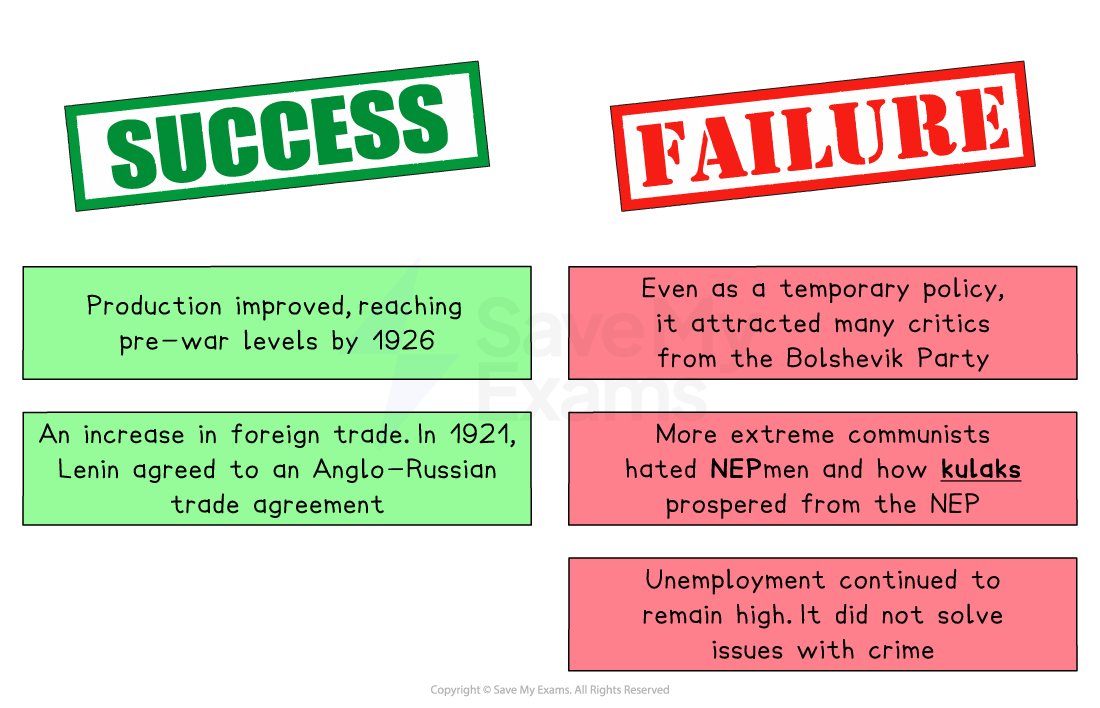
The key features of the NEP
Grain requisitioning ended and was replaced with tax in kind
Peasants paid the state a fixed share
They could sell their surplus grain for a profit
Private trade and small businesses returned
Firms with fewer than 20 workers could be privately owned
Money was reintroduced
People paid for public transport again
The state kept the "commanding heights"
Heavy industry, banking, transport and foreign trade stayed under state control
Recovery and foreign trade
The NEP got the economy moving again
Production reached 1913 levels
The famine ended as peasants grew more food to sell
Foreign trade revived
Favourable trade agreements followed with Britain and Germany
Nepmen, kulaks and inequality
A new class of private traders, known as the Nepmen, emerged
They controlled around 75% of retail trade by 1923
Many Bolsheviks despised them as "parasites" and "class enemies"
Wealthier peasants, the kulaks, prospered again
Visible inequality angered Party members
Many feared capitalism was returning
The Scissors Crisis exposed the NEP's fragility in 1923
Agriculture recovered faster than industry, so farm prices fell while industrial goods stayed expensive
Peasants held back grain rather than sell it cheaply
The state capped industrial prices to keep the worker-peasant alliance intact
Examiner Tips and Tricks
Use precise figures, such as production returning to 1913 levels by 1926, but balance this against the rise of the Nepmen, the prospering kulaks and Party hostility. The Scissors Crisis shows that recovery was uneven.
How successful was Lenin’s economic policy?
Judging Lenin's economic policy depends on the criteria used:
economic recovery
the survival of the regime
loyalty to socialist principles
Lenin's economic policy was a practical success
War Communism helped the Bolsheviks win the Civil War, despite its cost
Centralised control kept the Red Army supplied during the conflict
The NEP rescued a collapsing economy
It ended the famine
It restored production to 1913 levels
It ended the revolts that had threatened the regime
The retreat secured Bolshevik survival
Lenin treated the NEP as a breathing space to rebuild socialism later
Key historian
“The Russian economy was certainly in need of rescue in 1921, but by 1924 it had already begun to revive.”
G.L. Freeze, Russia: A History (1997)
Freeze stresses the speed of recovery after the NEP replaced War Communism
This supports the view that Lenin’s economic policy succeeded as a pragmatic rescue
Lenin's economic policy was a retreat forced by survival
War Communism was an economic catastrophe
It triggered famine, industrial collapse and widespread revolt
The NEP compromised socialist principles
It reintroduced private trade, Nepmen and growing inequality
Many Bolsheviks saw it as a betrayal of the revolution
The NEP left deep problems unresolved
The Scissors Crisis showed it could not satisfy peasants and workers at the same time
It did not deliver the rapid industrialisation that socialism seemed to require
Key historian
“But, the imperative necessity of preserving power made the Bolsheviks enact or tolerate policies and tendencies that clashed head on with the ideologically prescribed conditions for an orderly march toward socialism.”
A. Ulam, A History of Soviet Russia (1976)
Ulam frames both policies as survival measures
They kept the Bolsheviks in power
However, they pulled the regime away from socialist aims
This supports the view that Lenin’s economic policy was a forced ideological retreat
Examiner Tips and Tricks
Watch your dates on War Communism and the NEP. Keep this question focused on Lenin’s economic policies and avoid drifting into Stalin’s policies.

Unlock more, it's free!
Join the 100,000+ Students that ❤️ Save My Exams
the (exam) results speak for themselves:

Was this revision note helpful?