Stalin’s Power After the War: High Stalinism, 1945–1953 (AQA A Level History: Component 1: Breadth study): Revision Note
Exam code: 7042
Summary
After 1945, Stalin rebuilt his personal dominance
He sidelined the Party, the army and the government
The temporary easing of control during the war came to an end
Repression increased again, targeting returning soldiers and anyone suspected of disloyalty
The Zhdanovshchina, from 1946, crushed independent culture and revived state anti-Semitism
Stalin's cult of personality reached its height, presenting Stalin as a god-like genius and saviour
Stalin's death in March 1953 left a power vacuum
A ruling troika of Beria, Malenkov and Molotov emerged
Historians debate whether Stalin's control by 1953 was total personal dictatorship or a system decaying from within
Freeze emphasises Stalin's unwavering personal control and godlike cult
Davies sees an "armoured dinosaur" held up by terror and routine
High Stalinism, 1945–1953: key features of post-war rule
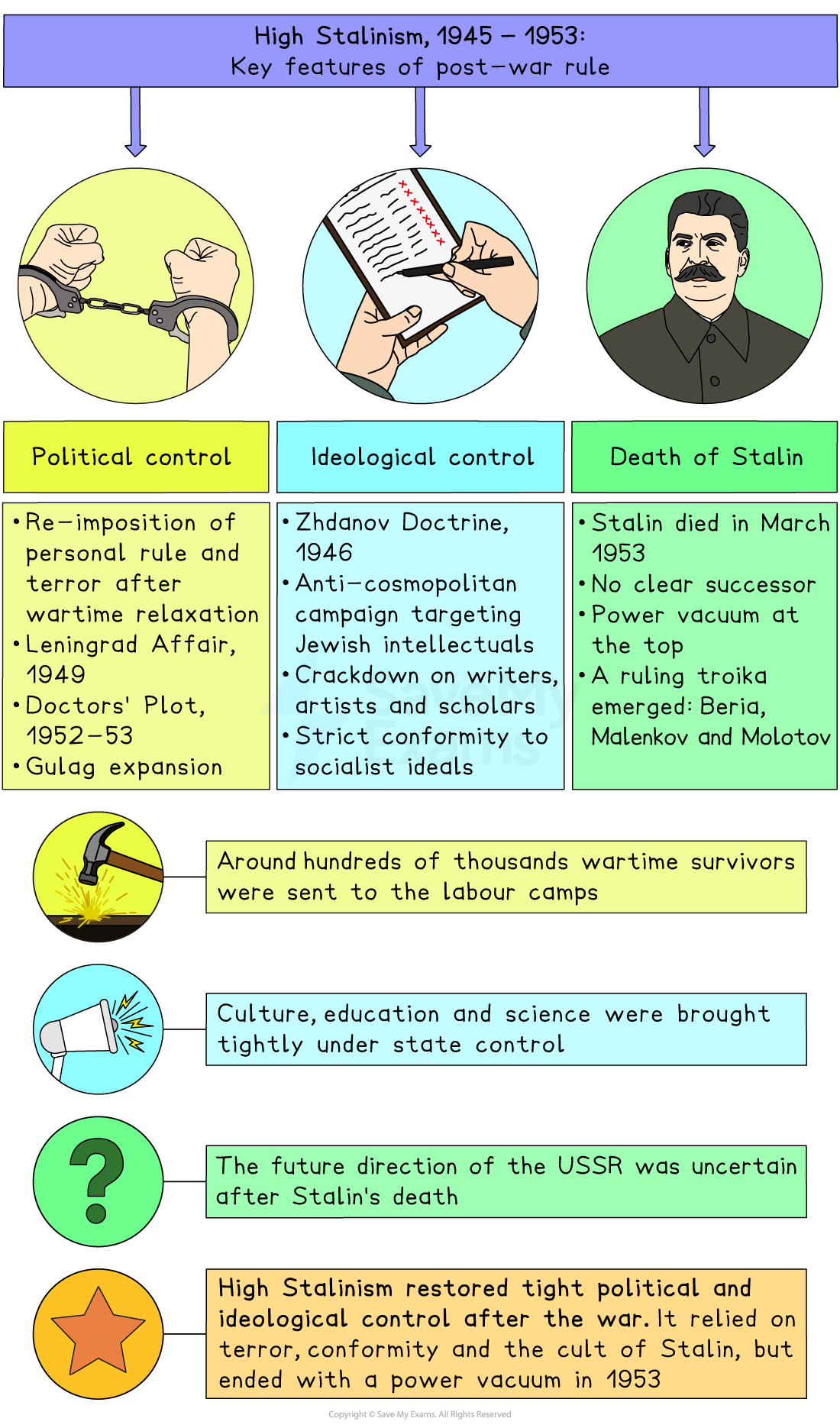
High Stalinism described Stalin's rule after the Second World War
It was marked by:
re-imposed personal rule
renewed terror
cultural control
anti-western isolation
a more intense cult of personality
no clear plan for succession
Reasserting personal control
Stalin's post-war approach
Stalin's approach to post-war rule was "back to the future"
He revived tight personal control after the wartime relaxation
The wartime growth in Party membership made it harder to manage
The army's prestige after victory was higher than Stalin wanted
Ending wartime structures
The State Defence Committee (GKO) was dissolved on the 4th September 1945
Its powers returned to government ministries
Stalin remained People’s Commissar for Defence until February 1946
Cutting down war heroes
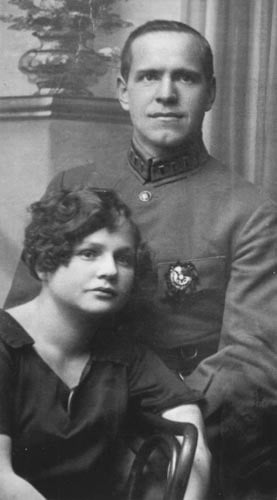
Popular war heroes were reduced in status
Marshal Zhukov was demoted and sent to command in Odessa
Potential competitors for public praise were thus eliminated
Sidelining the Party and government
Dividing senior figures
Stalin played senior figures off against one another
Zhdanov and Malenkov competed for Stalin's favour
Their shifting fortunes prevented either from becoming too powerful
Weakening Party institutions
The Party's own institutions were left to deteriorate
No Party congress met between 1939 and 1952
Only six full meetings of the Central Committee were held in that time
Reducing the Politburo
The Politburo became more like an advisory body
It waited for the "official" line from Stalin or his spokesperson
Key decisions were taken in small, informal meetings of Stalin's inner circle
A changing Party membership
By 1952, the Party had nearly seven million members
New recruits came from administrative ranks
They did not come from workers or peasants
Many became cautious "faceless bureaucrats"
They followed orders rather than leading policy
Examiner Tips and Tricks
Focus on how Stalin rebuilt personal control, not just that he had it. The strongest answers show the mechanisms: the army downgraded, Party congresses were suspended and the Politburo bypassed.
The revival of terror after the Second World War
The revival of terror
Terror returns
High Stalinism brought a deliberate revival of terror after a relaxation during wartime
Stalin feared "ideological contamination"
This meant Soviet citizens being influenced by contact with the outside world
Returning prisoners-of-war and former officers were treated as suspect
Even relatives of those who had been abroad could be condemned
Policing everyday life
Everyday life was policed for signs of disloyalty
A careless word could lead to the Gulag
Contact with a foreigner could also be dangerous
A 1947 law banned marriages between Soviet citizens and foreigners
Rebuilding the security apparatus
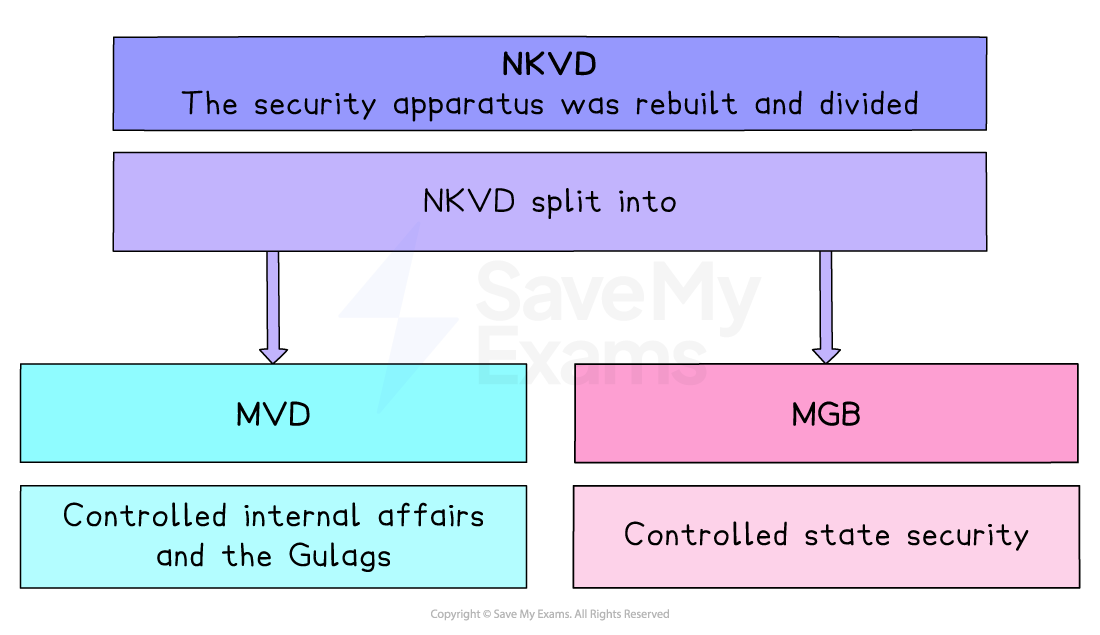
The security apparatus was rebuilt and divided
The NKVD was split into the MVD and MGB
The MVD controlled internal affairs and the Gulags
The MGB controlled state security
Lavrenti Beria oversaw a huge expansion of the camps
He was a deputy prime minister and Politburo minister
The scale of repression
Repression was widespread, though less intense than the 1930s
Tens of thousands were arrested each year for "counter-revolutionary activities"
Hundreds of thousands of returning prisoners of war and forced labourers were sent to camps or exile
The Zhdanovshchina and the attack on culture
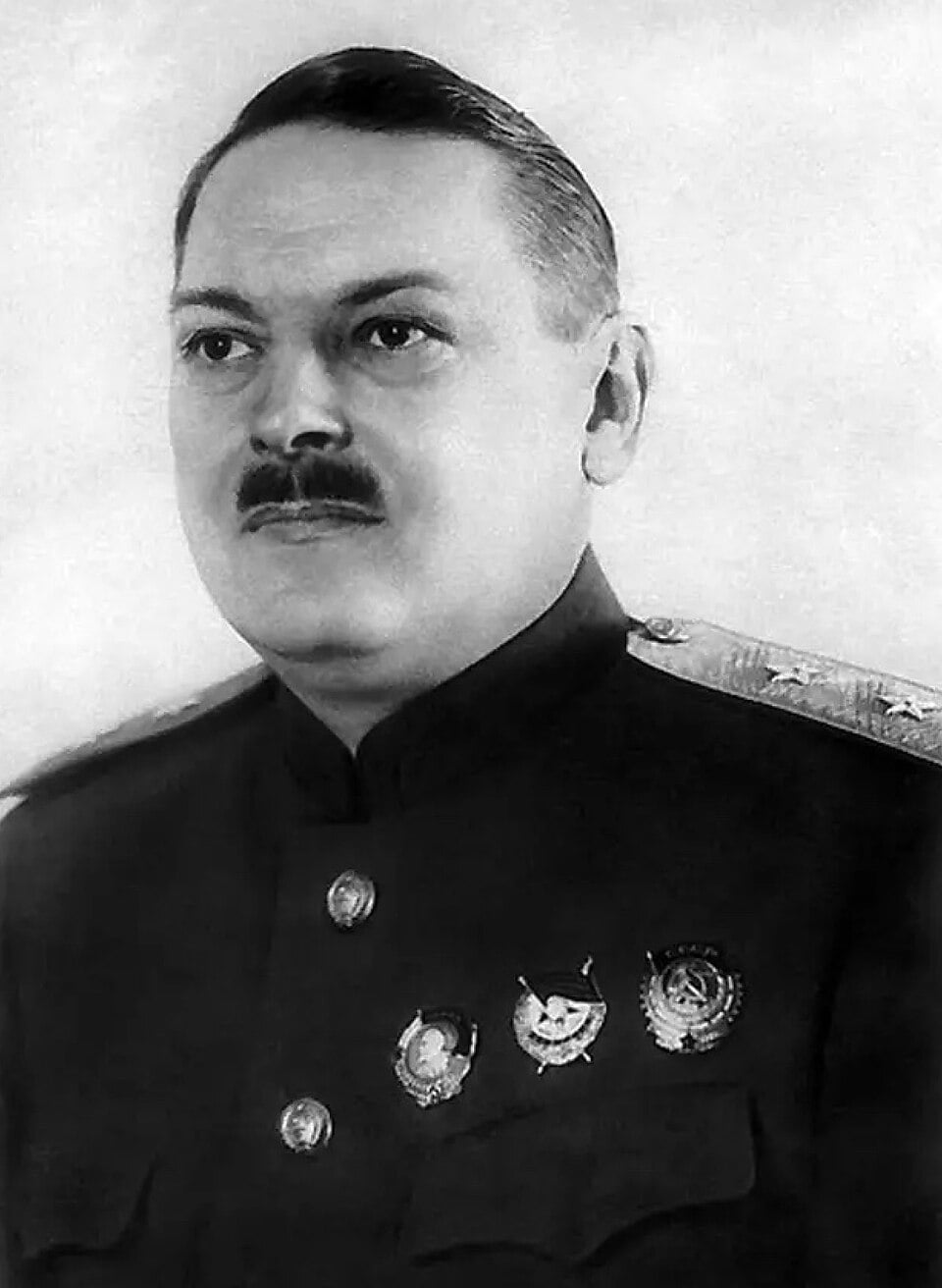
Cultural purge
From 1946, Andrei Zhdanov led a cultural purge
This was known as the Zhdanovshchina
It demanded strict conformity to socialist ideals
Everything western was labelled as bourgeois
Everything Russian was praised
Writers and artists
Writers and artists were publicly disciplined
The satirist Zoshchenko and the poet Akhmatova were expelled from the Writers' Union
Composers Shostakovich and Prokofiev were condemned and forced to recant
Science and scholarship
Soviet science and scholarship were brought into line
Zhdanov backed Lysenko’s discredited theories in biology in 1948
Russian was declared the model language in 1950
Stalin published his own economic theory in 1952
“a savage attack on modernism (‘formalism’) and foreign influence on Russian culture (‘cosmopolitanism’)”
Adapted from S.S Montefiore, Stalin: The Court of the Red Tsar (2003)
The anti-cosmopolitan campaign and anti-Semitism
Rootless cosmopolitanism
A campaign against "rootless cosmopolitanism" revived state anti-Semitism
"Cosmopolitan" became a coded label for Jewish intellectuals accused of disloyalty
Jewish critics, writers and the last Jewish newspaper were silenced
Key cases
The Leningrad Affair, 1949, purged the city's Party leaders on false charges
Four, including Voznesensky, were later found to have been executed
The theatre director Solomon Mikhoels was killed in a staged car accident in 1948
The Mingrelian Case (1951-52) targeted Beria's followers in Georgia
The Doctors' Plot, 1952
The accusation
In 1952, Stalin revived an old accusation against Kremlin doctors
Nine, mostly Jewish, doctors were accused of a "Zionist" plot
They were accused of planning to murder Soviet leaders
Hundreds of doctors were arrested
They were tortured to extract confessions
The accused doctors were released after Stalin's death in 1953
A wider anti-Jewish purge
The plot widened into a broader anti-Jewish purge
Thousands of ordinary Jews were deported to remote regions
The press encouraged anti-Jewish hysteria
Examiner Tips and Tricks
Weigh how far Stalin's fears and paranoia reflected real opposition or threats he invented. Use Zhukov, Beria and the Doctors’ Plot as test cases for whether Stalin’s targets were genuine rivals or manufactured ones.
The cult of Stalin: propaganda & personality
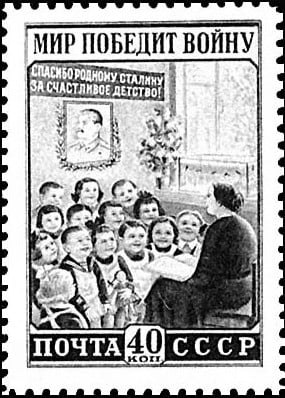
The cult of personality
A god-like image
After the war, Stalin's cult of personality reached new heights
A mild stroke in 1946 may have deepened his paranoia and reclusiveness
His wartime role as saviour of the nation became the foundation of the cult
Stalin as a universal "genius"
Propaganda presented Stalin as a universal genius
He was shown as supreme in philosophy, economics and political theory
A 1948 biography named him the "modern Lenin"
It also presented him as the leading Marxist thinker
Managing the image
Stalin's image was carefully managed
It became customary to open and close academic works with praise of Stalin
His photographs were airbrushed to remove pockmarks from his face
The cult in everyday life
Stalin "everywhere"
Stalin's name and image seemed to be everywhere
Towns were renamed after him
This included Stalingrad and Stalinsk
Stalin Prizes were created to rival the Western Nobel Prizes
Stalin's 70th birthday
Stalin's 70th birthday in 1949 became a national event
Newspapers were given over entirely to his praise
A giant portrait was lit over Red Square by searchlights
Stalin's isolation
In reality, Stalin was remote from the people he claimed to represent
He had not visited a village or farm for 25 years
He relied on films and reports
He was potentially misled by his own propagandists
Examiner Tips and Tricks
Treat the cult as a tool of control, not background colour. It helped make Stalin unchallengeable and squeezed out any rival or successor.
Stalin’s death & the political vacuum, 1953
Stalin's final months
Stalin became increasingly frail and isolated in his final year
He spent long nights with a close small circle
He made no clear plan for a successor
The 19th Party Congress
The 19th Party Congress met in October 1952
It was the first Congress since 1939
The Politburo was renamed and enlarged as the Presidium
Many read this as preparation for another purge
Death and the vacuum
Stalin died at the age of 74 in March 1953
He suffered a severe stroke and was unattended to for around 12-14 hours
This was due to fear from the guards of interrupting Stalin
His death left the country demoralised
There were huge public displays of grief
Crowds queued to view his body lying in state
Collective leadership
Power passed to a collective leadership, not a single heir
A ruling troika emerged:
Beria
Malenkov
Molotov
The troika left out Nikita Khrushchev
His grip on the Party machine would prove decisive in the succession struggle to come
Examiner Tips and Tricks
The consequences of Stalin's paranoia are evident in his own death. He kept isolated, only interacting with his close circle. He trimmed his guards down, and they feared any reaction from Stalin being interrupted.
How total was Stalin’s control of the USSR by 1953?
By 1953, Stalin's authority appeared complete
Historians disagree over how solid that control really was
Stalin's control was effectively total and personal
Stalin's power no longer depended on the Party or any institution
He ruled through his private secretariat
No congress or rival body could check him
Terror and the cult of personality left little room for opposition
Fear kept officials and the population in line
The cult made Stalin appear infallible
No successor was allowed to emerge
Potential rivals were kept in competition with one another
Even Stalin's closest colleagues feared they might be targeted next
Key historian
“Stalin was accorded god-like veneration in the post-war years: he was the hero of plays and the subject of folksongs … However gratifying, universal adulation did not relax Stalin’s vigilant concern for his personal power.”
G. Freeze, Russia, A History (2009)
Freeze presents Stalin’s post-war cult and personal grip as evidence that his control remained total
The system looked unbeatable but was decaying from within
The reliance on terror can suggest insecurity rather than strength
Stalin's paranoia drove purges of loyal officials, not just enemies
A fully secure ruler would arguably not need constant terror
The machinery of government became rigid and hollow
Party life had withered
Decision-making narrowed to one man
"Faceless bureaucrats" followed orders rather than governing well
So much rested on one ageing leader
No stable way to replace him had been built
Stalin's death exposed how much depended on him personally
Key historian
“To all outward appearances it was unimaginably strong. At the same time its internal processes were decomposing … an armoured dinosaur that was dying on its feet. Stalin’s last years brought no relief to the long night of fear and suffering.”
N. Davies, Europe (1996)
Davies presents post-war strength as partly an illusion
Terror and routine masked internal decay
Examiner Tips and Tricks
For a “how total” question, reach a balanced judgement rather than asserting one side. The cult and personal rule point one way; the reliance on terror and the fragile succession point the other.

Unlock more, it's free!
Join the 100,000+ Students that ❤️ Save My Exams
the (exam) results speak for themselves:

Was this revision note helpful?
