Nicholas II: Character, Rule and the Condition of Russia, 1894–1905 (AQA A Level History: Component 1: Breadth study): Revision Note
Exam code: 7042

Summary
Nicholas II succeeded his father, Alexander III, in 1894
Alexander's death was sudden, meaning Nicholas was largely unprepared for rule
He was devout and committed to autocracy, but shy and uneasy with the work of ruling
The Khodynka Field disaster of 1896 killed around 1,400 people at the coronation
He inherited a vast, "backward" empire facing growing and organised opposition
Historians debate whether Nicholas continued his predecessor's tradition or proved a far weaker ruler
Rogger stresses his unbending hostility to political change, much like Alexander III
Figes argues he lacked his father's strength and could only "play at" being an autocrat
Nicholas II’s personality: was he suited to be tsar?
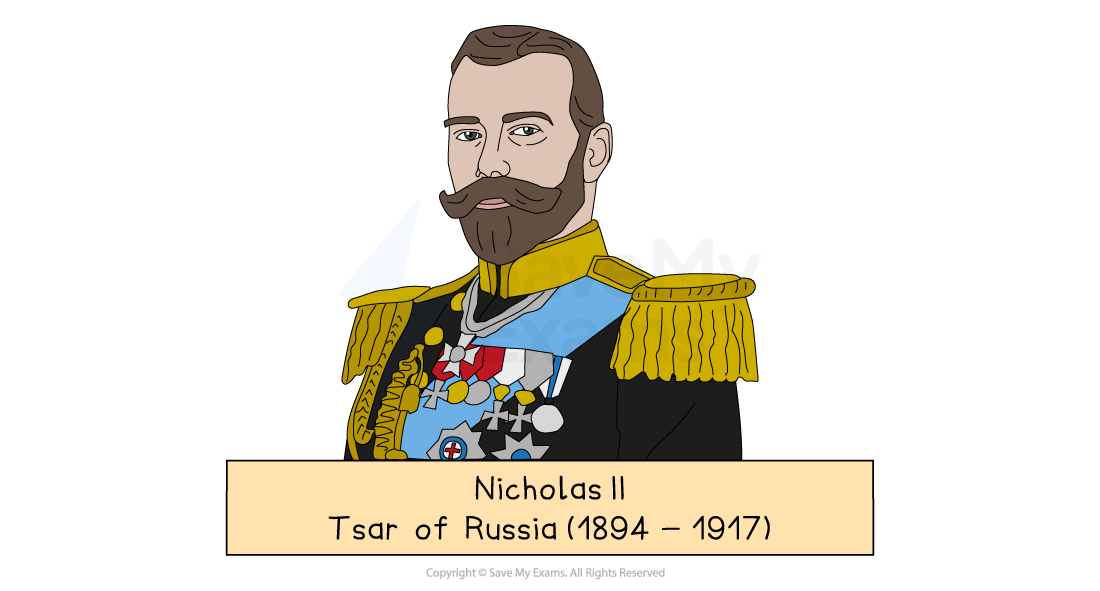
Nicholas II became Tsar in 1894, aged 26
His father, Alexander III, died suddenly, aged only 49
He felt unprepared and reportedly dreaded the responsibility
Nicholas's character traits
Deeply devout/pious and autocratic
He was sincerely loyal to the Orthodox Church
He saw autocracy and the divine right of the Tsar as God-given
His tutor Konstantin Pobedonostsev had hardened these convictions
Conscientious but indecisive
He was hard-working and dutiful in his daily routine
He disliked making difficult decisions and avoided confrontation
Shy and easily influenced
He was reserved and uneasy with people he did not know
He was often swayed by the last person to advise him
Devoted to family, indifferent to politics
He found the daily details of government dull
He valued private family life over the work of ruling
Hostile to reform
He distrusted change and feared losing his inherited authority
In 1895, he dismissed zemstvo hopes for a national voice as a "senseless dream"
An ominous start: Khodynka Field, 1896
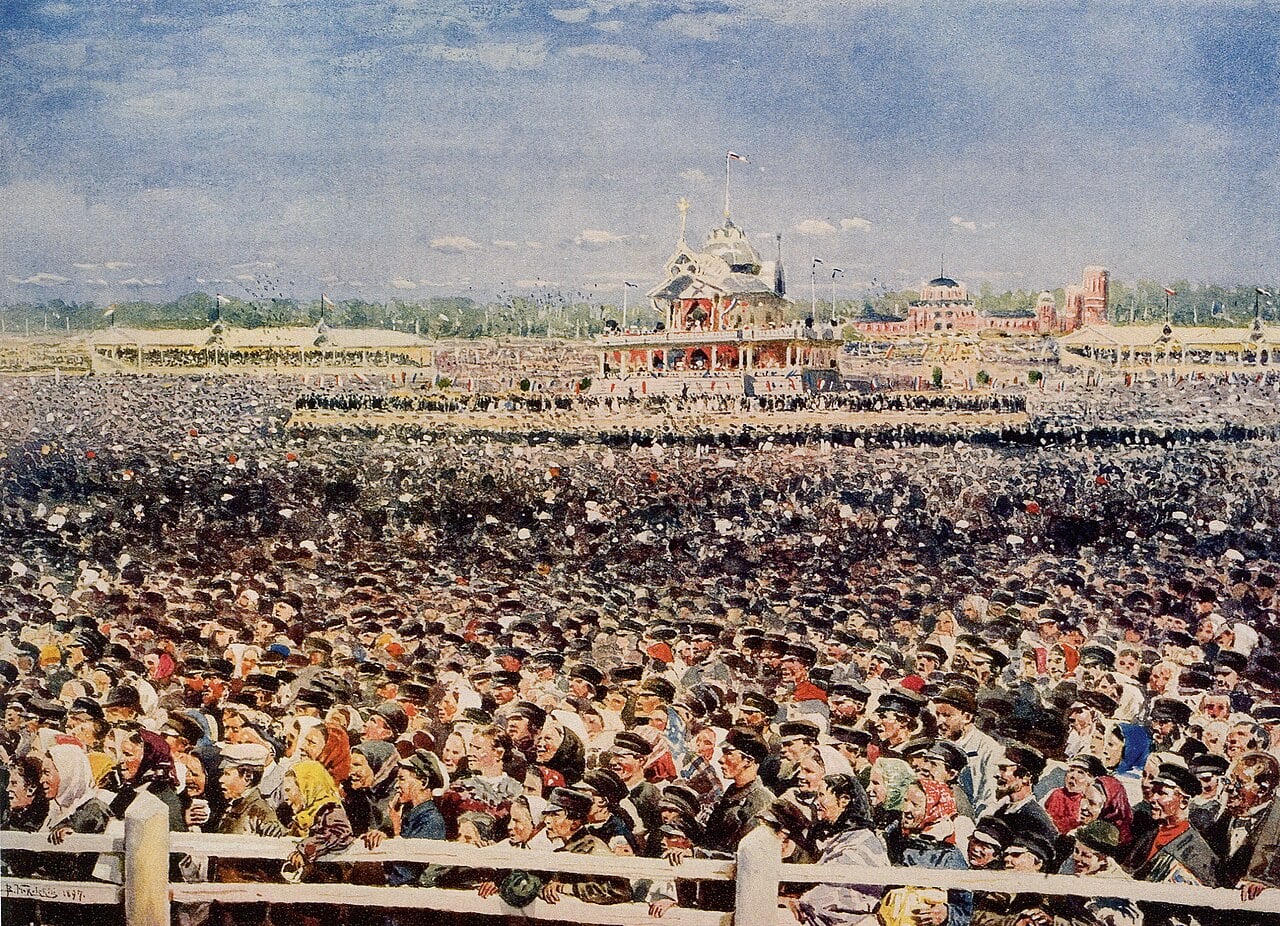
Nicholas II's coronation celebrations ended in disaster at Khodynka Field, near Moscow
People gathered, attracted by the promise of free food, drinks and gifts as a celebration
A crush in the vast crowd killed around 1,400 people
The royal couple attended a ball later the same evening
Many saw this response as a lack of care
However, Nicholas was reported to have visited the hospital and given money to the families of those people who had died
Examiner Tips and Tricks
Do not dismiss Nicholas as simply 'weak'. A better argument is that he combined a genuinely inflexible belief in autocracy with a personality poorly suited to enforcing it. This theme will keep coming up in future events such as the 1905 Revolution.
Tsarina Alexandra: influence & controversy
Nicholas married Alexandra of Hesse in 1894, weeks after his accession
She was a granddaughter of Britain's Queen Victoria
The wedding came just days after Alexander III's funeral
Alexandra's character traits
Foreign-born and intensely Orthodox
She was a German princess, raised Lutheran
She converted to the Orthodox Church on her marriage to Nicholas
Her devotion was unusually strong, even by Russian standards
Reserved and unpopular at court
She was shy and ill at ease in formal Russian society
Many courtiers regarded her as cold and aloof
Her German background later fuelled public suspicion of her loyalty
A firm supporter of unbending autocracy
She urged Nicholas to defend his inherited powers without compromise
Her conviction reinforced his resistance to political change
Her influence grew stronger as the reign went on
A devoted mother under pressure
The couple longed for a son to secure the succession to the crown
Four daughters were born before the heir arrived
Their son Alexei was born in 1904 but had haemophilia
The family kept his condition a closely guarded secret
Alexandra increasingly turned to faith healers in search of help
This allowed Rasputin to gain influence over Alexandra, who believed he had helped ease Alexei’s suffering
Examiner Tips and Tricks
Keep Alexandra's significance in proportion for this period. Her links to Rasputin and her German heritage are usually addressed in questions regarding the First World War.
The condition of Russia by 1894: what did Nicholas II inherit?
A vast and diverse empire
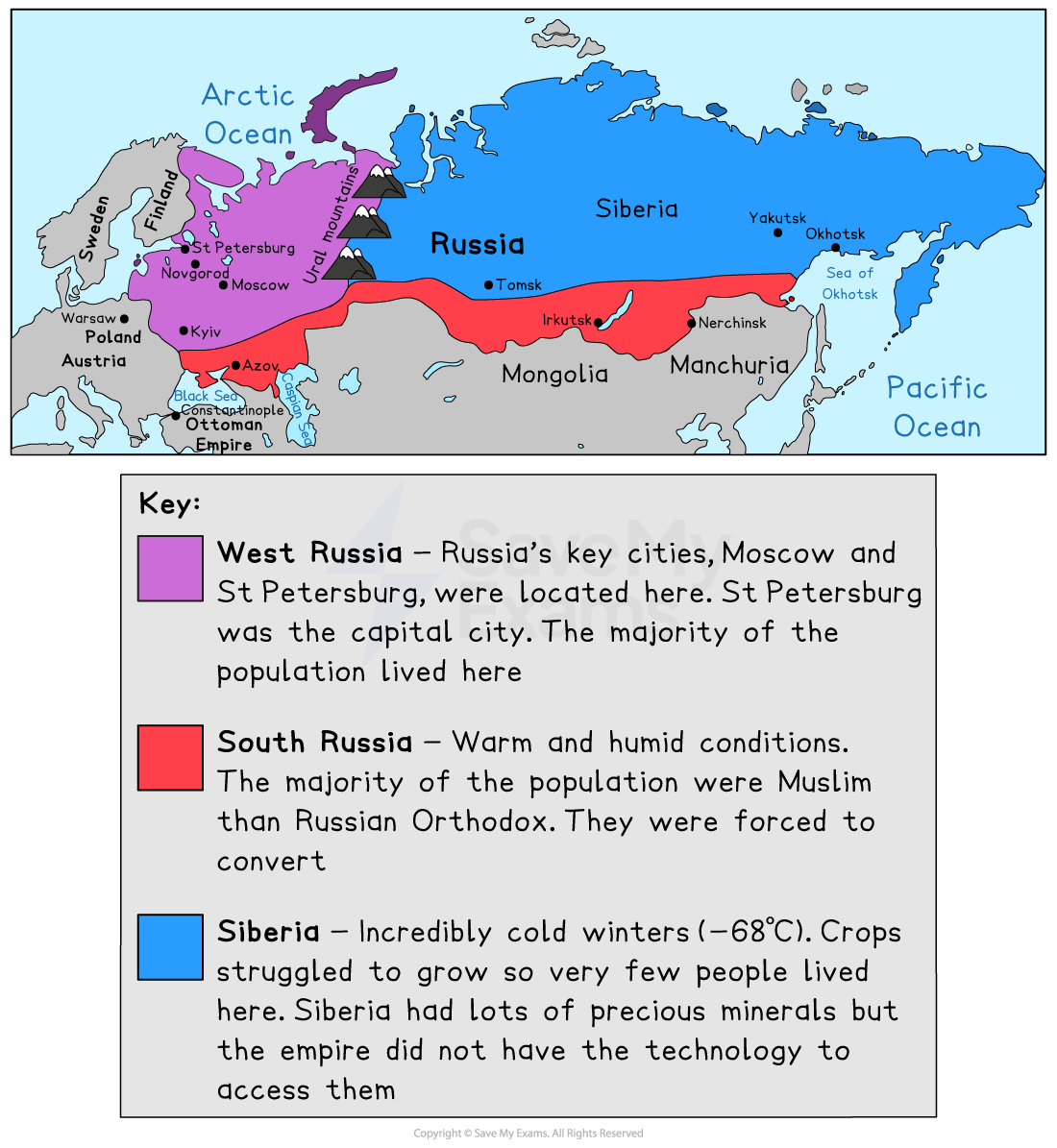
Nicholas ruled the largest land empire in the world
It stretched from Poland in the west to the Pacific Ocean in the east
It held many nationalities, languages and religions
It also experienced a variety of climates, which made certain industries and types of agriculture difficult
Most subjects were poor peasants living far from cities
A shared national identity was weak across the empire
Autocracy reasserted under Alexander III
Nicholas inherited an autocracy recently hardened by his father
The Manifesto of Unshakeable Autocracy (1881) had rejected reform
Russification pressed the Russian language and culture on minorities
The Okhrana watched and suppressed political opposition
The Church backed the throne through the Holy Synod
A state-appointed Over-Procurator controlled Church affairs
Jewish subjects were confined to the Pale of Settlement
Economic backwardness and early change
Russia's economy lagged far behind Western Europe
Industry and railways were only beginning to expand
Farming stayed inefficient
State-led industrialisation had only just begun by 1894
Its full impact came in the years after Nicholas's accession
Rising and better-organised opposition
Opposition to Tsarism was growing more confident by 1894
The famine of 1891 – 92 had exposed government failures
Educated professionals increasingly demanded a political voice
The regime still relied on repression rather than reform
Examiner Tips and Tricks
Avoid drifting into Witte's industrial 'Great Spurt' of the 1905 Revolution here. Remember, always check the date parameters of essay questions.
How different was Nicholas II from Alexander II & Alexander III?
Historians disagree over how far Nicholas marked a break from the two tsars before him
The debate weighs his beliefs against his capacity as a ruler
Note that this section deals mainly with his character immediately after his accession, not later events in his reign
Nicholas continued his predecessor's autocratic tradition
Like Alexander III, Nicholas firmly believed in unchecked autocracy
He kept Pobedonostsev, his father's chief adviser, at the centre
He refused to make any move towards becoming a constitutional monarch
He continued reaction, Russification and reliance on the Okhrana
In 1895, he called hopes of reform a "senseless dream"
This echoed Alexander III's rejection of representative government
Key historian
“Such disregard for political change remained a feature of his rule. The result was that his prestige was critically damaged, and with it, that of the autocracy. Nicholas was convinced, until the very end, that he was the best judge of the country's mood.”
H. Rogger, Russia in the Age of Modernisation and Revolution, 1881–1917 (1983)
Rogger stresses continuity: Nicholas shared his predecessors' refusal to share power, treating dissent as the work of agitators
This supports the view that his outlook differed little from Alexander III's
Nicholas lacked his predecessor's strength as a ruler
Alexander III had been forceful, decisive and physically commanding
Nicholas was shy, hesitant and easily swayed by others
He lacked his father's strength of character and intelligence
Unlike Alexander II, he offered no reforms to ease Russia’s political, social and economic pressures
Yet he could not impose his will with real authority
Many historians argue that he only "played at" being an autocrat
Key historian
“Nicholas had been blessed with neither his father's strength of character, nor his intelligence... With his limitations, he could only play at the part of an autocrat … He was far too mild-mannered and shy to command any real authority among his subordinates.”
O. Figes, A People's Tragedy (1996)
Figes stresses the difference: Nicholas held the same autocratic beliefs but lacked the personal force to act on them, unlike the commanding Alexander III
This supports the view that the contrast lay in capacity, not ideology
Examiner Tips and Tricks
Strong answers to this type of question judge 'how different' on two levels. Nicholas showed clear continuity in his beliefs and methods, but a sharp difference in personal capacity.

Unlock more, it's free!
Join the 100,000+ Students that ❤️ Save My Exams
the (exam) results speak for themselves:

Was this revision note helpful?
