The Growth of Education in the USSR: Literacy, Schools and Universities (AQA A Level History: Component 1: Breadth study): Revision Note
Exam code: 7042

Summary
The Bolsheviks inherited mass illiteracy
They saw education as essential for building socialism, creating loyal citizens and training skilled workers
Lenin set up the Commissariat of Enlightenment (Narkompros)
Schooling was free and co-educational
Under Stalin, early educational experiments were reversed
Exams, uniforms and a stricter curriculum returned
Education was made to serve industry
The literacy campaign achieved major gains
The curriculum became a tool of ideology
Teachers were watched and could be purged
Historians debate whether education by 1941 was real modernisation or remained limited by control and unequal access
Why Was Education Important to Soviet Politicians?
Education and socialism
The Bolsheviks saw education as a way to build a socialist society
It would shape loyal citizens
It would pass on socialist values, not just knowledge
Lenin argued that socialism could not be built with people who could not read
Basic literacy allowed workers to follow instructions
It also helped them understand political ideas
Education and a modern economy
A modern economy needed a literate, skilled workforce
The Five-Year Plans needed workers who could read
They also needed workers who could do basic maths
Mass literacy helped the regime spread propaganda
More readers meant a larger audience for newspapers, posters and textbooks
Education and social mobility
Lenin set up the Commissariat of Enlightenment (Narkompros) to run education and culture
Its first head, Anatoly Lunacharsky, promised free education at all levels
Schools were made co-educational, so boys and girls learned together
Education gave workers and peasants a way to advance socially
In theory, they could rise into skilled, technical and office jobs
This let the regime claim it offered chances the tsars denied
Examiner Tips and Tricks
Examiners often reward a social focus. Link each point back to what the regime wanted education to do, such as raising literacy to create better workers for the Five-Year Plans.
Growth in Primary, Secondary and Higher Education in the USSR
Schools under Lenin
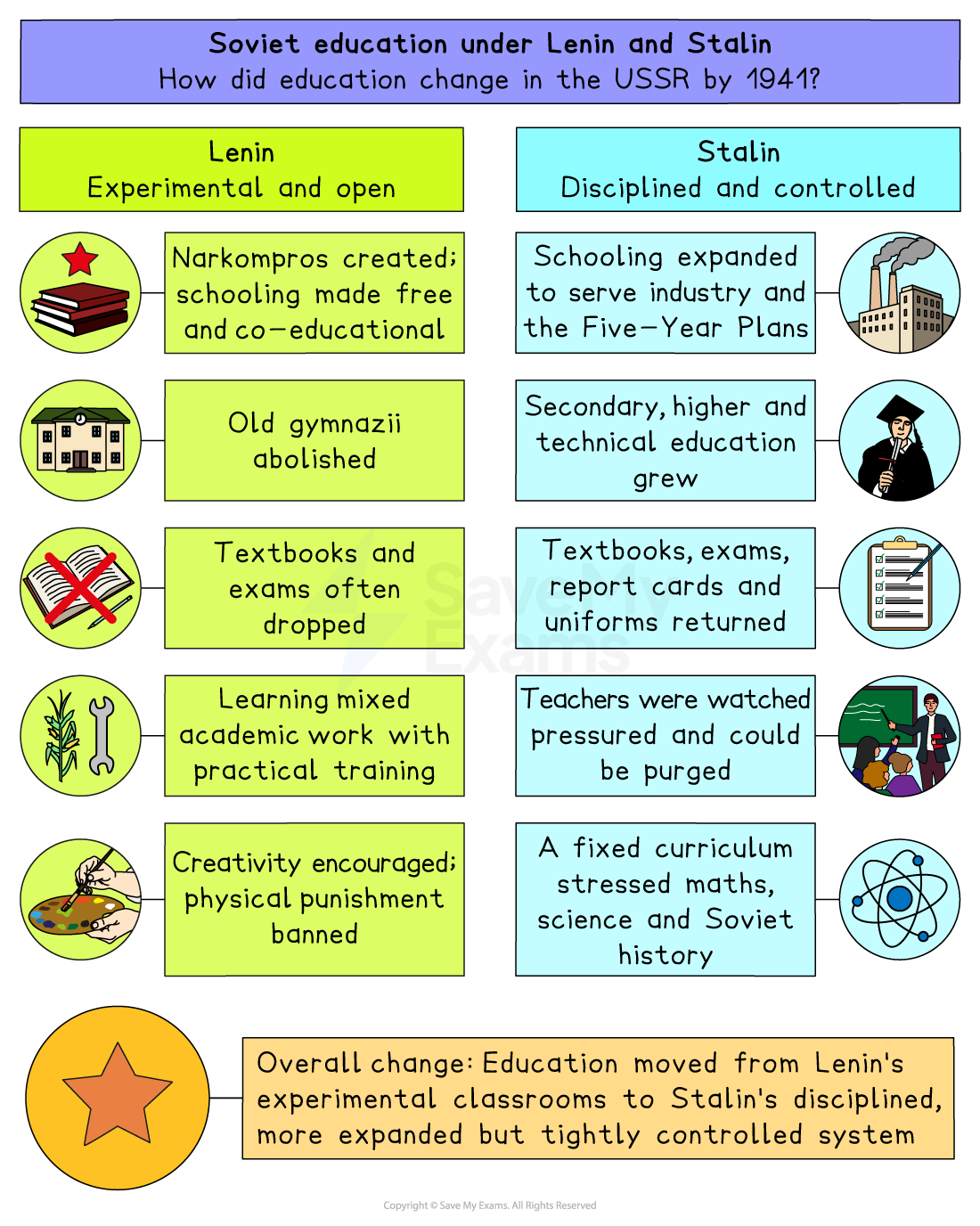
Lenin's 1918 decrees aimed to widen schooling and end tsarist elitism
The old elite secondary schools (gymnazii) were abolished
New schools mixed general lessons with vocational training
Pupils learned academic subjects and practical work side by side
Progress was slow at first
The Civil War limited resources
The New Economic Policy (NEP) budgets held back expansion
Schools under Stalin
Stalin expanded schooling quickly to support industry
Most growth was at the secondary and higher levels
Weaker pupils were pushed towards "practical" work for the Five-Year Plans
Schools and universities were tied to the economy
Many schools were handed over to collective farms or town factories to run
Universities were linked to economic planning under Vesenkha until it was dissolved in 1932
Higher education
Higher education grew and served the economy
By the late 1930s, the USSR was producing strong science graduates
Workers' faculties (rabfak) gave workers and peasants a route into university
Military training was added in middle and higher schools before the war
Who actually got access?
At first, quotas helped working-class pupils
A set share of secondary places was reserved for working-class children
Access was narrowed later in the 1930s
The working-class quota was scrapped in 1935
Selection then applied to everyone, including non-workers
Working-class numbers at university and higher secondary schools therefore, fell
Examiner Tips and Tricks
Do not treat education as one single issue. Primary, secondary, vocational and higher education grew at different speeds.
Showing that primary access widened while higher education became more selective after 1935 is stronger than a general claim that education improved.
The War Against Illiteracy and Soviet Control of the Curriculum
The literacy campaign
Under Lenin
Ending illiteracy was an early political priority
A mass literacy drive (the likbez campaign) taught adults to read and write
It used reading rooms, classes and volunteer teachers
Early results were limited
The Civil War slowed progress
Shortages also held back the campaign
Under Stalin
Stalin pushed the campaign much harder
It was tied to compulsory schooling
It supported the drive to industrialise
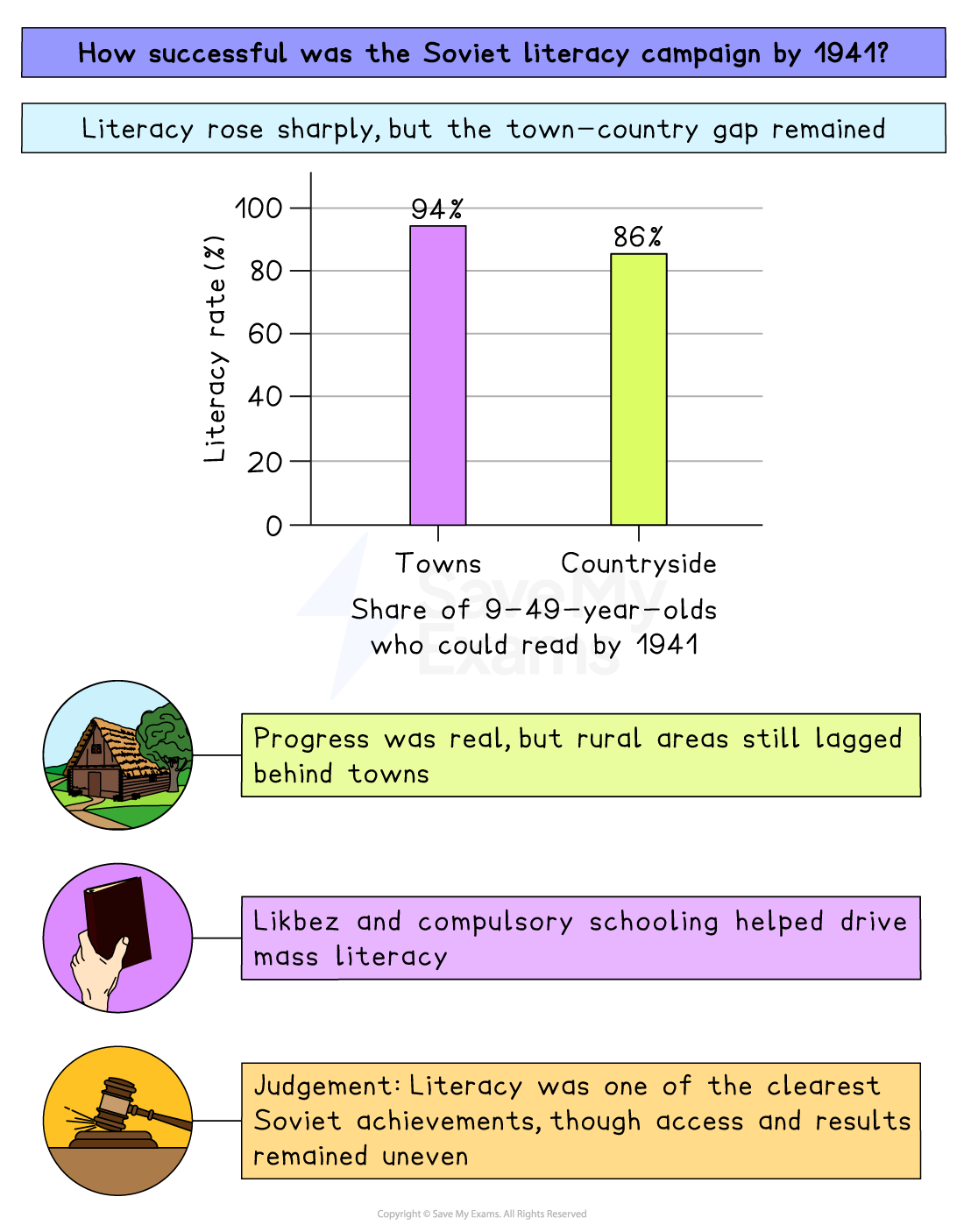
By 1941, the results were striking
About 94% of 9-49-year-olds in towns were literate
Around 86% of those in the countryside were literate
The town-rural gap shows the gains were real but uneven
The curriculum
Under Lenin
Lenin's classrooms were deliberately experimental
Most schools dropped textbooks and exams
There were not many textbooks written from a communist viewpoint yet
Learning was meant to be active
Academic work was combined with physical work
Creativity was encouraged
Physical punishment was banned
Under Stalin
Stalin reversed Lenin's experiments and brought back discipline
Textbooks returned
Exams, report cards and uniforms returned
A fixed academic timetable was set for every school
The curriculum carried a clear ideological message
Soviet-style history was promoted
Nationalism was promoted
Atheist teaching supported the wider attack on religion
History was rewritten to glorify Stalin and the Party
Rivals were played down or erased
Pupils were taught this revised version as fact
How school time was split under Stalin
Subject Area | Approx. Share of the Timetable |
|---|---|
Russian language and literature | 30% |
Mathematics | 20% |
Science | 15% |
Soviet-style History | 10% |
Teachers under pressure
Teachers had to deliver both literacy and loyalty
The Stakhanovite drive reached teaching
Teachers were set high targets based on pupil outcomes
Teachers were closely watched
They could be arrested
If their pupils did badly, teachers could be blamed or purged
Examiner Tips and Tricks
Literacy is one of the clearest signs of Soviet modernisation. A statistic such as 94% literacy in towns by 1941 gives your argument a precise factual base.
How Much Did Education Change in the USSR by 1941?
By 1941, Soviet education looked very different from the tsarist system
How far this was real change is open to debate
Education was transformed
Mass literacy was a major achievement
This was a major change from mass illiteracy
Schooling widened significantly
Free, co-educational schooling was established
Primary access grew
Higher and technical education expanded
The USSR trained the science and engineering graduates for the growing industry
Some workers and peasants gained new opportunities
For a time, quotas helped them into secondary and higher education
Changes to education were limited or controlled
Literacy served the state as well as the individual
Reading skills widened the audience for propaganda
Education helped create disciplined workers and loyal citizens
The curriculum was a tool of ideology
Soviet history, nationalism and atheism were built into lessons
There was little room for independent thought
Access narrowed again in the 1930s
The working-class quota was scrapped in 1935
A town-country gap remained
Rural areas still lagged behind
The Stalinist classroom returned to old, tsarist methods
Exams, discipline and uniforms returned
Examiner Tips and Tricks
Change-and-continuity questions reward judgement, not just description. Students often lose marks by leaving out the social focus, so cover literacy, access, class opportunity and state control.

Unlock more, it's free!
Join the 100,000+ Students that ❤️ Save My Exams
the (exam) results speak for themselves:

Was this revision note helpful?
