The Russo-Japanese War and the 1905 Revolution (AQA A Level History: Component 1: Breadth study): Revision Note
Exam code: 7042

Summary
Russia and Japan clashed over rival ambitions in Manchuria and Korea, going to war in February 1904
Defeats at Port Arthur, Mukden and Tsushima exposed Russia's military, logistical and command weaknesses
Bloody Sunday in January 1905 destroyed the myth of the benevolent Tsar and triggered nationwide unrest
An October general strike forced Nicholas to issue the October Manifesto, promising civil liberties and a Duma
Order was restored by early 1906 once the army returned from Manchuria, but the deeper problems remained
Historians debate whether 1905 forced real change on tsarism or was a contained crisis that the regime survived
R.B. McKean argues that the explosion of 1905 forced absolutism to give way to a constitutional monarchy
A. Wood argues that, despite the drama, the Romanov Empire remained bruised but unbroken
Causes of the Russo-Japanese War, 1904 – 1905
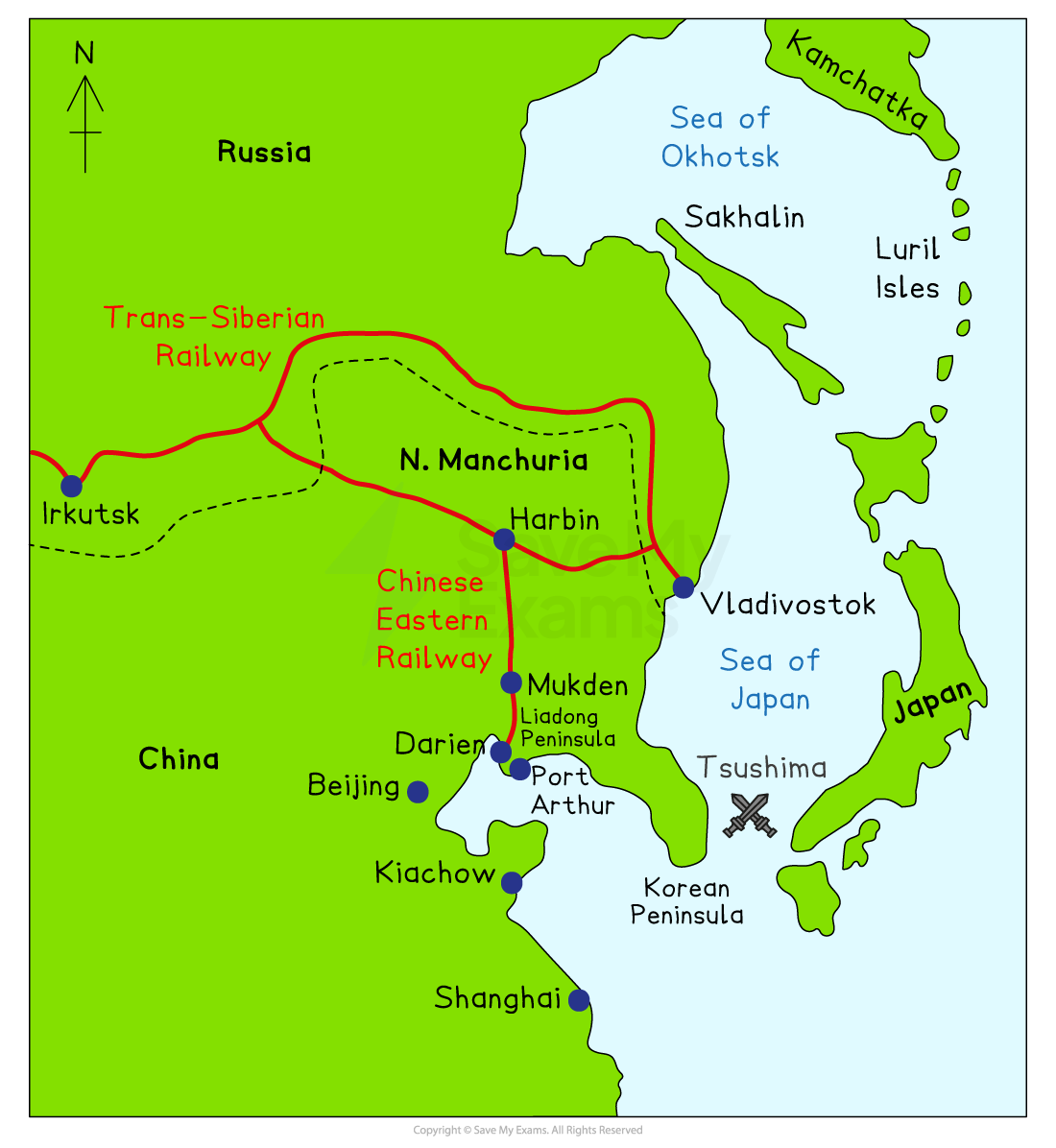
Russian expansion in the Far East
Russia pursued Pacific expansion from the 1890s onwards
The Trans-Siberian Railway gave Russia a route into the Far East from 1891
The Chinese Eastern Railway extended this line through Manchuria from 1896
Russia leased Port Arthur from China in 1898 for 25 years
Port Arthur sat on the Liaodong peninsula in north-east China
It gave Russia its first ice-free Pacific port
Japan had been forced to give up the same peninsula three years earlier
Russian troops stayed in Manchuria after the 1900 Boxer Rebellion
Russia had promised withdrawal but kept around 10,000 soldiers in place
Japan concluded that diplomacy would not stop Russian expansion
The clash over Korea
The two empires also competed for influence in Korea
Russia secured timber concessions on the Yalu River from 1903
Japan saw Korea as essential to its own strategic security
Japanese diplomatic offers to divide spheres of influence were rejected
Nicholas II underestimated the Japanese military capacity
Court advisers dismissed Japan as a non-European power not worth negotiating with
A 'small victorious war'
Vyacheslav Plehve, Minister of the Interior, reportedly wanted a quick war to ease unrest at home
He is said to have told War Minister Kuropatkin that Russia needed 'a short, victorious war'
The hope was that a quick victory over Japan would increase patriotic feeling in Russia and weaken revolutionary movements at home
Japan launched a surprise attack on the Russian Pacific Fleet at Port Arthur
The attack came on 8 February 1904, without a formal declaration of war
Russia expected a quick win and underestimated Japan from the start
Examiner Tips and Tricks
Develop your answer around three drivers: imperial expansion (the Trans-Siberian and Manchuria), the Korean clash with Japan, and Plehve’s hope that a quick war would distract from domestic unrest. Get those three on the page and you have a working framework you can develop in any direction the question asks.
Why did Russia lose the Russo-Japanese War?
Logistical weakness
Russia struggled to supply its troops at the front
The Trans-Siberian Railway ran as a single track for most of its 6,000 miles
A section around Lake Baikal was still unfinished when the war began
Reinforcements reached the front slowly and arrived exhausted
Japan held a clear geographical advantage
Japanese supply lines from the home islands to Korea were short and reliable
Russia had to project force across Asia from St Petersburg and Moscow
Military and naval defeats
The Russian command was poorly coordinated and outdated
General Kuropatkin kept retreating, handing the initiative to Japan
Russian tactics still relied on mass infantry and cavalry charges
Port Arthur fell to Japan in January 1905 after a six-month siege
The Russian Pacific Fleet was destroyed inside the harbour
Around 23,000 Russian troops surrendered to Japan
Russia lost the Battle of Mukden in February and March 1905
It was the largest land battle in history before the First World War
Around 90,000 Russian casualties forced a retreat further north
The Baltic Fleet was destroyed at the Battle of Tsushima in May 1905
The fleet had sailed 18,000 miles around Africa to reach the Pacific
Japan sank 21 ships and crippled the rest in under 24 hours
This was the most catastrophic naval defeat in modern Russian history
The Treaty of Portsmouth
Russia accepted peace terms in September 1905
US President Theodore Roosevelt mediated the negotiations
Russia ceded Port Arthur and the southern half of Sakhalin to Japan
Russia also recognised Japanese predominance in Korea
The defeat was a major blow to Russian prestige
Russia was the first European great power to be defeated by an Asian state in modern times
The defeat poured fuel on the political crisis already brewing at home
Examiner Tips and Tricks
Examiners reward causal weighting, not narration. Group your reasons into factors, such as logistical (the railway, the distances), military (command, tactics, naval inferiority) and political (the low priority Nicholas gave to the Far East).
Rank your factors and justify your ranking. That single step takes you from a Level 3 to a Level 5 answer.
Causes of the 1905 Revolution
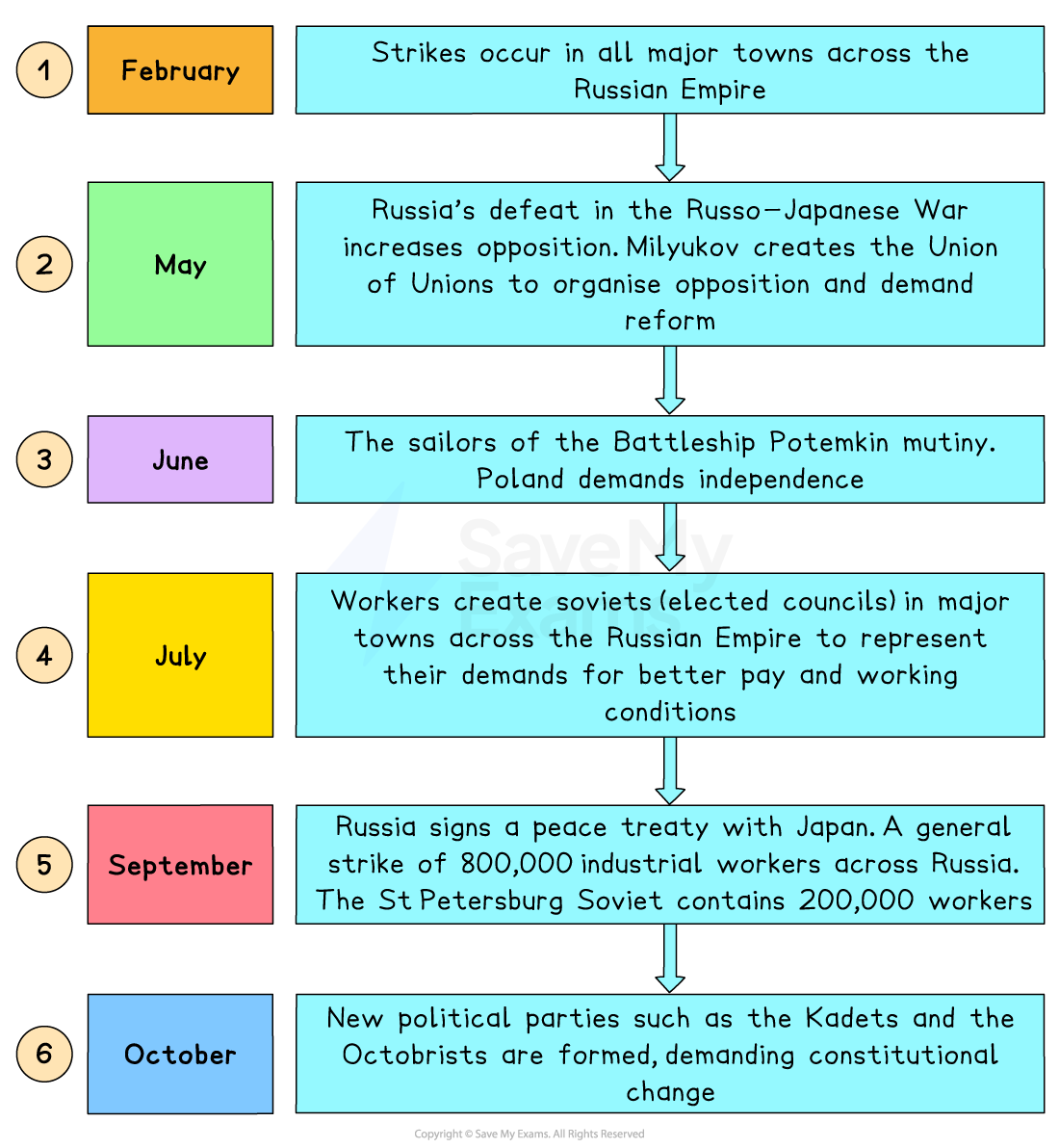
Long-term political grievances
Nicholas II refused all calls for representative government
In 1895, he had dismissed zemstvo hopes for a national role as "senseless dreams"
Professional bodies and the educated public had no voice in national policy
Opposition movements had been growing throughout the 1890s
The Social Democratic Workers' Party was founded in 1898 and split in 1903
The Socialist Revolutionaries used political assassinations from 1901
Economic and social strain
Sergei Witte's industrialisation drive increased pressure on urban workers
Wages stagnated while working days stretched to 11 hours or more
Workers lived in overcrowded factory barracks with no rights or representation
Peasants suffered from land hunger and failing living standards
Redemption payments still affected rural incomes 44 years after emancipation
The population had grown faster than the land available to cultivate
A recession from 1900 to 1903 sharpened discontent
Tens of thousands of workers were laid off in the main cities
Famine returned to the central provinces in 1901
National and military triggers
National minorities resented Russification policies
Poles, Finns, Jews and Baltic peoples opposed forced cultural assimilation
Anti-Jewish pogroms increased from 1903, drawing wider condemnation
The Russo-Japanese War accelerated and exposed every weakness
Defeats discredited the regime and its army in the eyes of the public
The cost of the war piled a new strain on already-stretched finances
By December 1904, a political crisis was already brewing in St Petersburg
Examiner Tips and Tricks
Treat the Russo-Japanese War as an accelerator of existing discontent, not the only cause. The strongest answers separate long-term causes from short-term triggers and weigh them against each other.
Bloody Sunday, 9 January 1905: events & significance
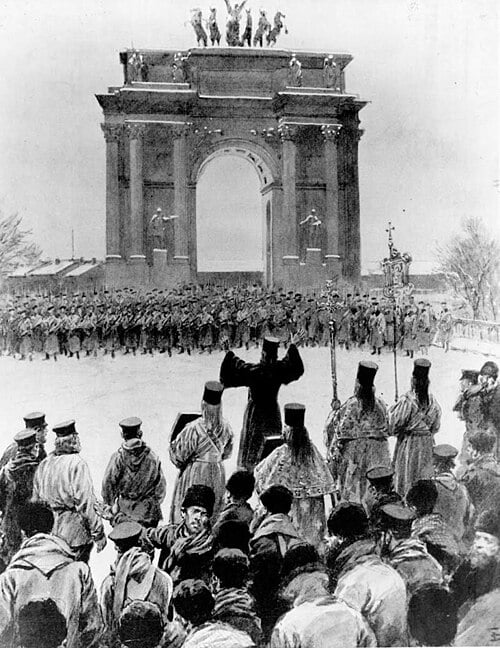
The Putilov strike and Gapon's march
A strike at the Putilov ironworks, St Petersburg, in December 1904, helped trigger wider unrest in the capital
Workers demanded an eight-hour day and the right to elect representatives
Around 15,000 workers across St Petersburg joined the strike by early January
Father Gapon led the workers' Assembly of St Petersburg Factory Workers
The union had been founded with Okhrana backing in 1904
Gapon planned a peaceful procession to present a petition to the Tsar
The march took place on Sunday, 9 January 1905
Around 150,000 marchers approached the Winter Palace in groups from across the city
They carried religious icons, portraits of Nicholas and church banners
The shooting
The petition called for political and social reform in respectful language
It demanded an elected Constituent Assembly
The wording addressed Nicholas as 'Sovereign' and asked him to hear his people
Tsarist troops opened fire on the unarmed marchers
Around 150-200 people were killed and many more were wounded
Cossack cavalry charged groups of marchers in several parts of the city
Nicholas II himself was not in St Petersburg that day
The event became known as 'Bloody Sunday'
"Sovereign! We, workers and inhabitants of the city of St Petersburg, members of various sosloviia, our wives, children, and helpless old parents, have come to you, Sovereign, to seek justice and protection.
We have reached the limit of our patience. We have come to that terrible moment when it is better to die than to continue unbearable sufferings.
Tear down the wall that separates you from your people and let it rule the country together with you"
Extract from the petition carried to the Winter Palace, 9 January 1905
Significance
The killings shattered the myth of the benevolent Tsar
For the first time, mass opinion turned directly against Nicholas himself
Radical circles began calling him 'Bloody Nicholas'
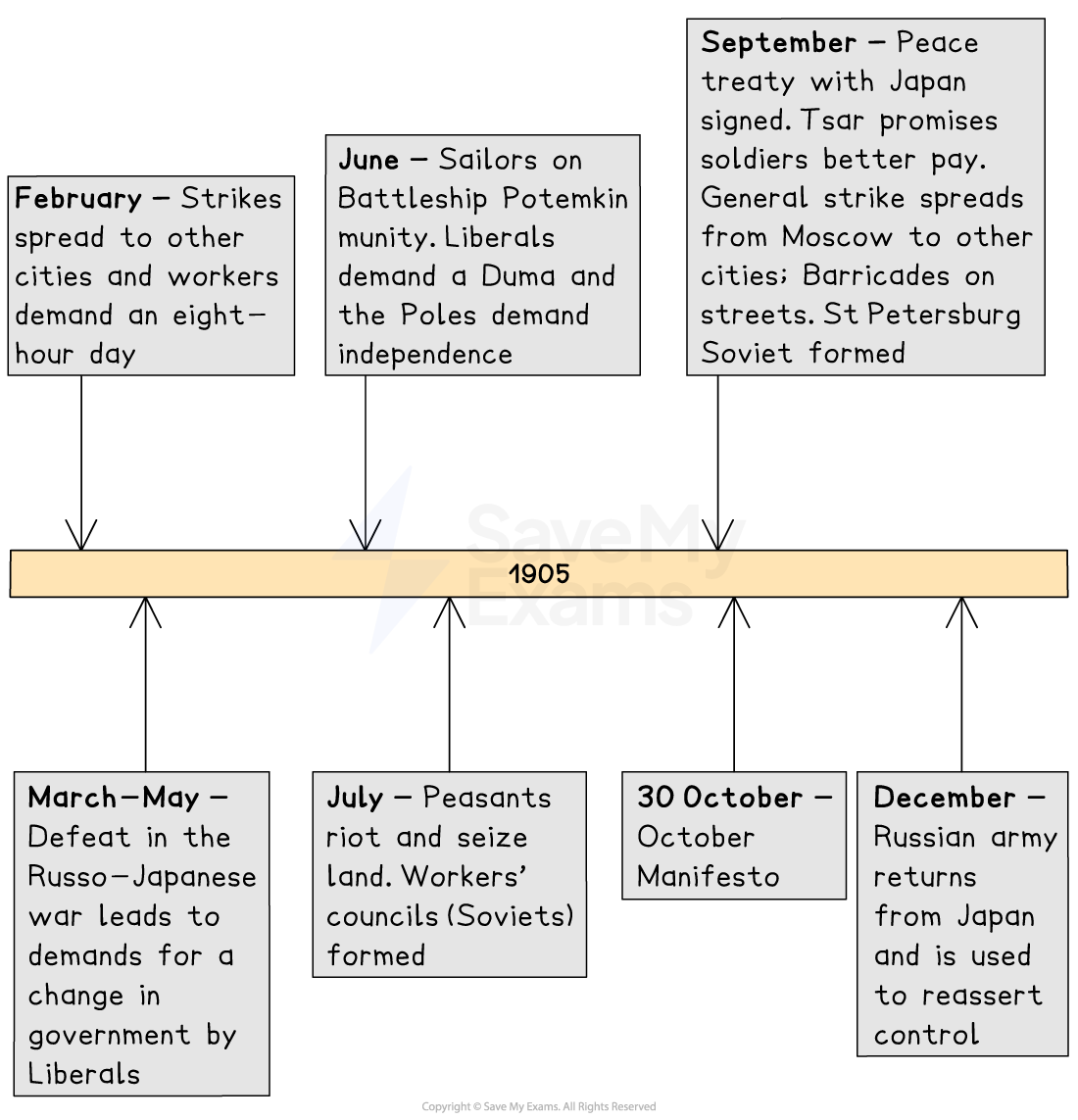
Bloody Sunday triggered a wave of unrest across the empire
Around 400,000 workers were on strike across Russia within weeks
Peasant disturbances and student protests followed in February and March
This made Bloody Sunday the trigger event of the 1905 Revolution
Examiner Tips and Tricks
Get the framing right when writing about Bloody Sunday. The march was loyal, not revolutionary. The marchers carried icons and royal portraits, and Gapon’s petition addressed Nicholas as ‘Sovereign’ and ‘Father’.
The shock lay in the troops firing on a procession that still saw the Tsar as its protector. Examiners want to see that you understand the destruction of the Tsar-as-Father myth.
How dangerous was the 1905 Revolution to the Tsar?
The unrest of 1905 was the most serious challenge tsarism had faced since the assassination of Alexander II
Historians disagree on how close the regime came to falling, and on how far the October Manifesto was a real retreat or successful crisis management
1905 was a serious threat to the Tsar
The scale of strike action was unprecedented in Russian history
Over 2.7 million workers took part in strikes during 1905
The October general strike paralysed railways, postal services and most cities
Workers' councils, known as soviets, emerged in major cities and challenged the authority of the Tsar's government
The St Petersburg Soviet claimed to represent 200,000 workers by October
Around 50 soviets were established across the empire
The peasantry rose in widespread revolt
Around 3,000 peasant disturbances were recorded in 1905
Manor houses were burned and landowners were attacked in the central provinces
Mutinies showed that the regime's control over the military was beginning to weaken
The crew of the battleship Potemkin mutinied in June 1905
Over 200 mutinies were recorded in the army and navy during the year
National minorities used the crisis to demand autonomy
Poland, Finland, the Baltic provinces and the Caucasus all saw nationalist unrest
Russification policies broke down across the empire during 1905
Nicholas was forced into a major constitutional concession
The October Manifesto promised civil liberties and an elected Duma
This was the first formal limit on autocratic power in Russian history
Witte warned Nicholas that the only alternative was military dictatorship
Key historian
“There were significant strains and tensions in Tsarist society before 1917… The consequent explosion in 1905 and the granting of the October Manifesto offered Tsardom a new opportunity to foster stability. Absolutism gave way to constitutional monarchy.”
R.B. McKean, The Russian Constitutional Monarchy, 1907–17 (1977)
McKean argues that the 1905 crisis was so severe that Nicholas had to abandon pure autocracy
For McKean, the October Manifesto was a real political shift, not a tactical retreat, and that shift was evidence of how seriously 1905 had threatened the regime
Tsarism contained the crisis and survived intact
The opposition was fragmented and never developed a unified leadership
Liberals, socialists, peasants and nationalities pursued different aims
There was no equivalent of the 1917 Petrograd Soviet directing the unrest
The armed forces stayed mostly loyal to the regime
Mutinies were localised and short-lived, not the basis of wider collapse
Cossack regiments were used decisively against strikers and demonstrators
The end of the Russo-Japanese War freed troops for repression
The army returned from Manchuria from late 1905 onwards
Punitive expeditions crushed peasant unrest in the countryside by mid-1906
The October Manifesto split the opposition rather than satisfying it
Moderate liberals formed the Octobrists and accepted the concession
This isolated the more radical Kadets, Socialist Revolutionaries and Bolsheviks
Nicholas kept every key pillar of power
Ministers, treasury, army and police all remained under his direct control
The Fundamental Laws of 1906 would soon claw back much of the Manifesto
Russian society itself was unchanged by the crisis
Landownership, the nobility's status and the Orthodox Church remained intact
The autocracy that emerged from 1905 was politically bruised but structurally unchanged
Key historian
“A tragic drama it certainly was; a revolution it was not. After 1905 there was no real devolution of political power, which still rested in the hands of an irresolute Emperor and his appointed ministers… the Romanov Empire remained – bruised but unbroken.”
A. Wood, The Russian Revolution (1993)
Wood argues that 1905 produced spectacle and violence but no real shift in power
For Wood, the traditional institutions of the state continued to function, and the autocracy survived the crisis with its essential authority intact
Examiner Tips and Tricks
For this type of question, weigh how close the regime came to collapse against how completely it recovered

Unlock more, it's free!
Join the 100,000+ Students that ❤️ Save My Exams
the (exam) results speak for themselves:

Was this revision note helpful?
