Opposition to Tsarism by 1914: Moderates, Liberals and Radicals (AQA A Level History: Component 1: Breadth study): Revision Note
Exam code: 7042

Summary
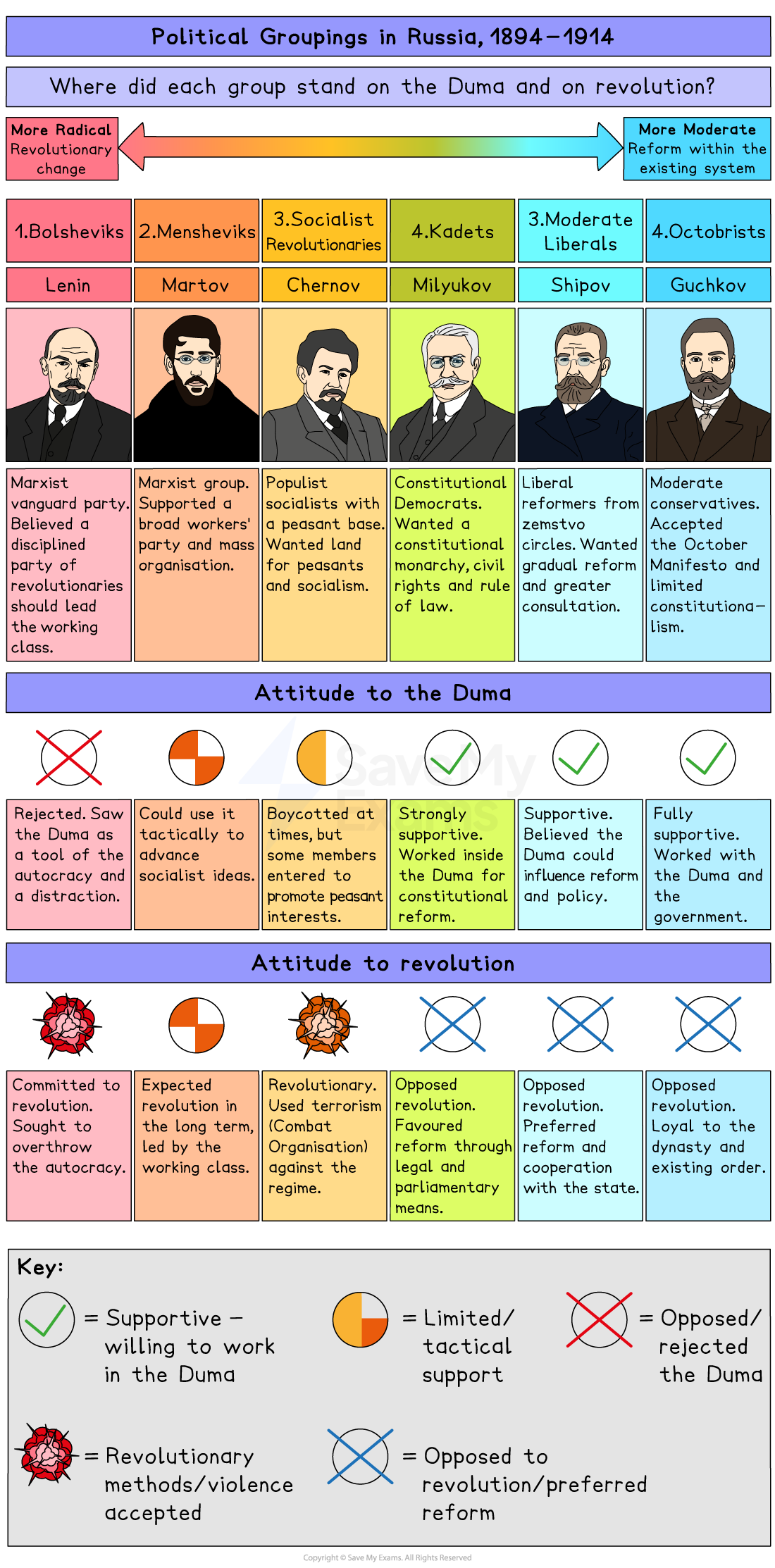
Liberal opposition split into the Kadets and the more moderate Octobrists
Radical opposition was led by the peasant-based Socialist Revolutionaries and the Marxist Social Democrats
The Social Democrats split in 1903 into Lenin's Bolsheviks and Martov's Mensheviks
By 1914, opposition was legal but deeply divided, with no shared aims and little mass support
Most radical leaders were in exile or prison
The strike wave of 1912 to 1914 was largely spontaneous rather than party-led
Historians debate how important opposition was to Russia's political development by 1914
Acton argues that liberal social forces were becoming a powerful base for peaceful, liberal change
Waldron argues that opposition was confined to a narrow social elite and shared the regime's own background
Moderate & liberal opposition: Kadets & Octobrists
The roots of liberal opposition
Liberal opposition grew out of the zemstva, Russia's elected local councils
Reforming nobles and professionals used them to call for change
Dmitry Shipov led the moderate zemstvo constitutionalist movement
Liberals wanted a constitution and a parliament, not a revolution
They looked to Western Europe as their political model
Their methods were largely legal and peaceful, based on persuasion
The 1905 Revolution and the October Manifesto gave them a legal platform
Political parties became legal for the first time
The new Duma gave liberals a national stage
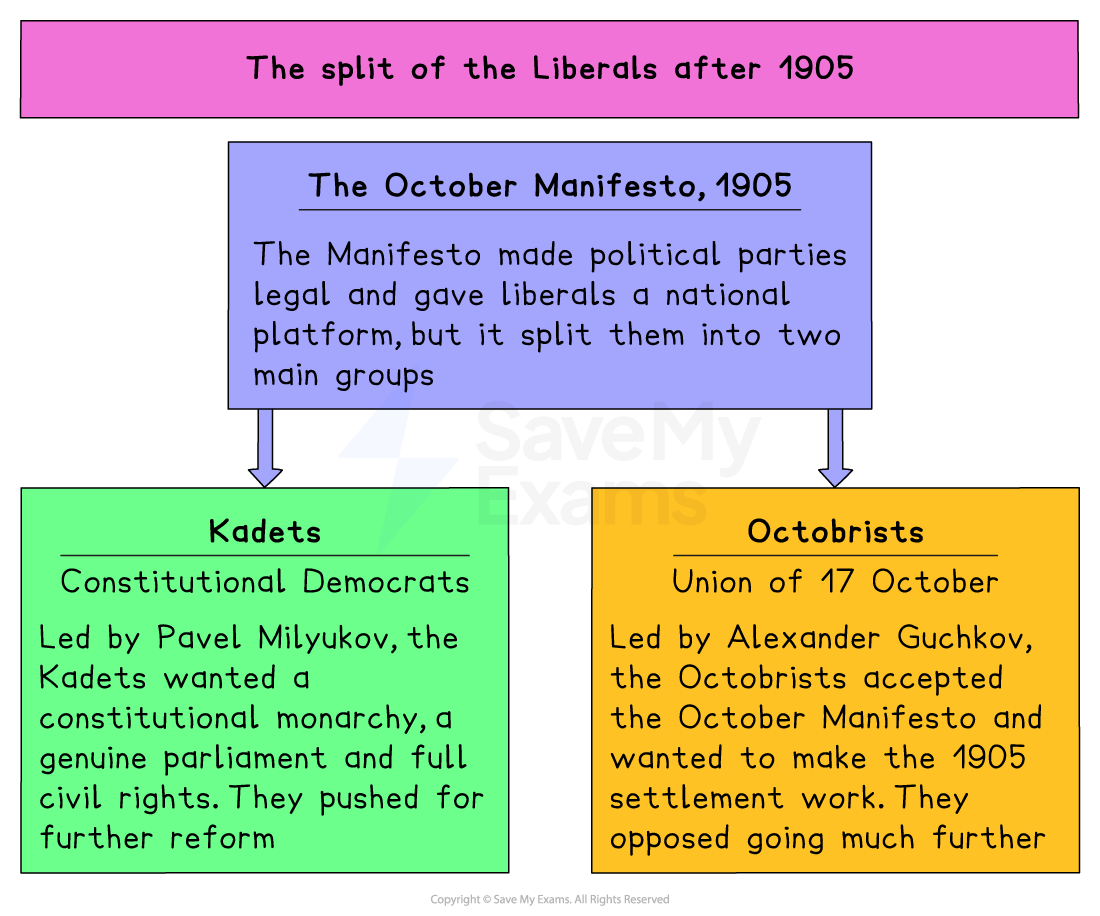
The Manifesto then split the liberal movement in two
The Kadets welcomed it but demanded much more far-reaching reform
The Octobrists accepted it as enough and opposed going further
The Kadets (Constitutional Democrats)
The Kadets were led by Pavel Milyukov; they:
Wanted a constitutional monarchy with a genuine parliament
Demanded full civil rights and the rule of law
Backed land reform to win over the peasantry
Large estates would be redistributed, but owners would be compensated
The Kadets dominated the First Duma elections in 1906
They won 182 seats, the largest bloc of any party
Radical groups boycotted these elections, leaving liberal parties dominant
The Octobrists (Union of 17 October)
The Octobrists were moderate conservatives, led by Alexander Guchkov; they:
Took their name from the October Manifesto, which they accepted
Wanted to make the 1905 settlement work, not push beyond it
Opposed further concessions to workers and peasants
Their support came from wealthy landowners and industrialists
Their influence grew after the franchise was changed in 1907
They became the largest party in the Third Duma with 154 seats
The Kadets fell to 54 seats as the rules shifted rightwards
Liberal influence now depended on cooperating with the government
How effective was liberal opposition?
Liberal opposition was legal, organised and articulate, but limited
It worked through the Duma rather than against the system
Its leaders were lawyers, professors, and professionals, not the masses
Liberals were divided among themselves over how far to push
Kadets wanted to transform the system; Octobrists wanted to preserve it
This split weakened any united liberal challenge to the Tsar
Examiner Tips and Tricks
Treating both as a single “liberal” block or measuring them against the same goal will cost you marks. Show that you understand why liberals disagreed with each other, not just with the Tsar.
Radical opposition: Socialist Revolutionaries, Bolsheviks & Mensheviks
The Socialist Revolutionaries (SRs)
The Socialist Revolutionaries (SRs) were a radical party rooted in the populist tradition
They formed around 1901 under the theorist Victor Chernov
They believed Russia's future lay with the peasantry, not the workers
Their programme centred on giving land to the peasants
They wanted the land socialised and handed to the peasants, with no compensation to the owners
The left wing of the party used political terrorism
It assassinated government officials to weaken the regime
Plehve, the Minister of the Interior, was assassinated in 1904
The Okhrana infiltrated the SRs, leading to around 4,500 arrests
The Social Democrats and the 1903 split
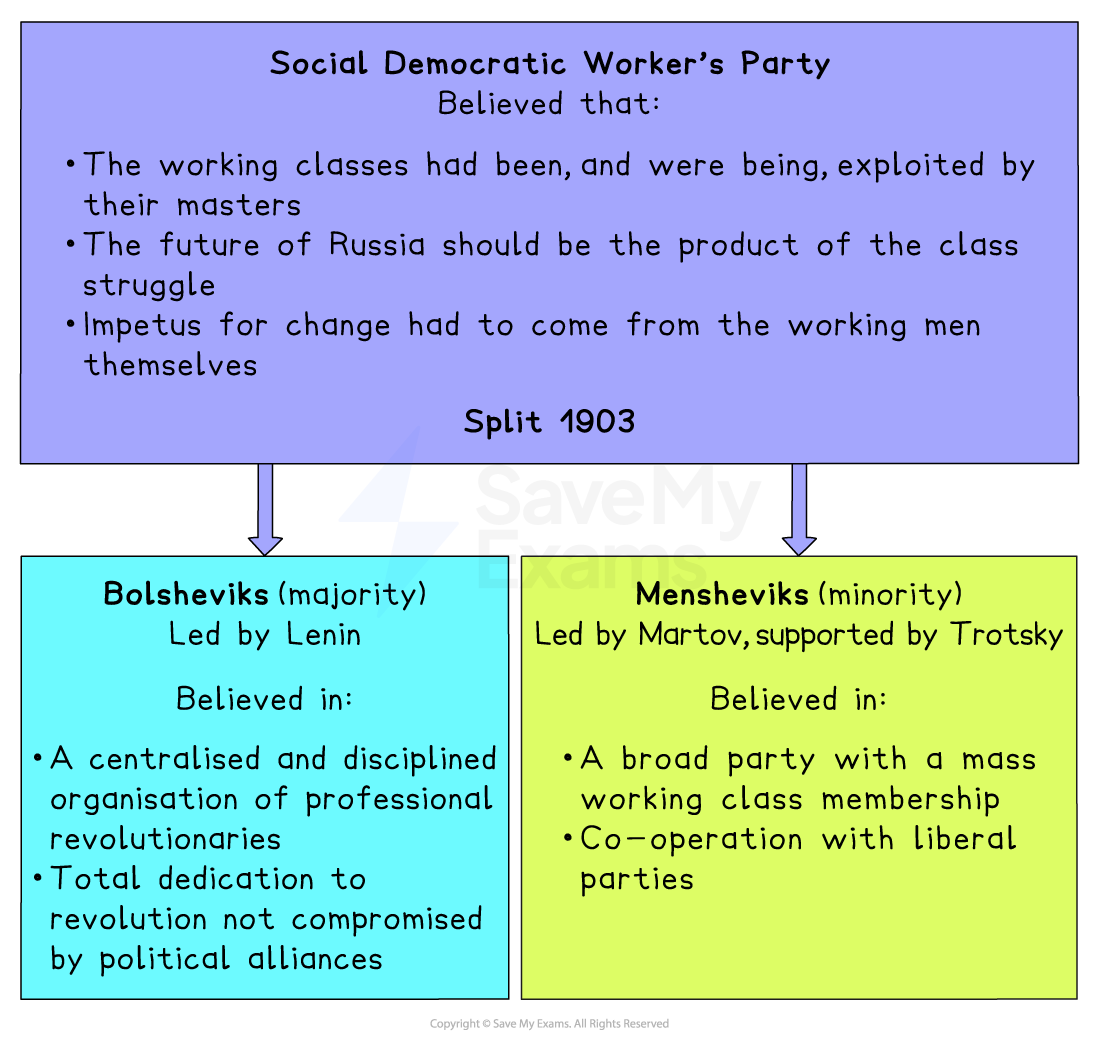
The Social Democratic Workers' Party was Russia's main Marxist party
Founded in 1898, it believed revolution would come from the workers
Marxism taught that the industrial proletariat would overthrow capitalism
The party split at its second congress in 1903 into the Bolsheviks and Mensheviks
The two sides disagreed over how a revolutionary party should be run
The split became permanent and divided the Marxist movement
Bolsheviks
The Bolsheviks, led by Lenin, wanted a small, disciplined party
They favoured a tight group of professional revolutionaries
Lenin argued that workers could not become revolutionary on their own
Mensheviks
The Mensheviks, led by Julius Martov, wanted a broad mass party
They believed Russia must first pass through the capitalist stage
They were willing to work with liberals and use legal methods
How serious a threat were the radicals by 1914?
The radical parties were small, divided and heavily monitored
Police infiltration and arrests kept them weak and disorganised
Their main leaders were in exile, prison or Siberia
Lenin and Martov spent the pre-war years abroad in Europe
They had little control over the workers they claimed to lead
The strike wave of 1912 to 1914 was largely spontaneous, not party-led
The Jewish Bund alone had over 35,000 members, more than the Bolsheviks
The wider political spectrum
Other groups sat between and beyond the main parties
The Trudoviks were a moderate labour group backing peasant land reform
The Progressives were businessmen who wanted gentle reform
Not every party in the Duma opposed the Tsar
The Union of the Russian People defended autocracy from the far right
The Black Hundred gangs attacked the left and staged pogroms
Examiner Tips and Tricks
Do not just describe what each radical group believed. Examiners want you to assess how serious a threat each one actually posed.
The strongest answers note that the parties were small, that their leaders were in exile or prison, and that the strikes of 1912 to 1914 were largely spontaneous rather than party-led.
How important was opposition to the political development of Russia by 1914?
By 1914, Russia had a wide range of opposition groups
But historians disagree about how far they actually shaped the country's political development
Opposition was an important and growing force
Opposition had become a permanent and legal part of politics
Parties, newspapers and the Duma gave it a public platform after 1905
Liberal ideas were spreading through Russia's growing middle class
Professionals, the "third element", filled the zemstva and town councils
A new class of independent farmers was emerging after Stolypin's reforms
The regime could no longer silence opposition as easily as before
It had been forced to agree to a parliament and civil liberties in 1905
Each crisis showed the autocracy was under growing pressure
Key historian
“By 1914, there was a rapid increase in the power and influence of social groups in favour of liberal, rather than violent, change. In the countryside, the new class of farmers provided a mass base for liberal democracy, while the rapidly-growing ‘third element’ – doctors, teachers, midwives and agricultural experts – provided a natural base for liberal reformism.”
E. Acton, Rethinking the Russian Revolution (1990)
Acton argues that opposition mattered because liberal social forces were broadening
This supports the view that Russia was developing a real base for peaceful, liberal change by 1914
Opposition was divided and posed little real threat
Opposition was deeply divided and could not act together
Liberals and radicals distrusted each other and shared no common aim
The Marxists themselves had split into Bolsheviks and Mensheviks
The radical parties were small and cut off from the masses
Their leaders were abroad or in prison for most of the period
The 1912 – 1914 strikes were spontaneous, not organised by the parties
Opposition came largely from the same narrow elite as the regime
Its leaders were nobles, professionals and intellectuals, not from the masses
It had no mass following capable of toppling the autocracy
Key historian
“Russian political life before 1917 was overwhelmingly the preserve of social elites. The formal structures of government and bureaucracy were dominated by educated noblemen. The middle classes which were making their mark on the politics of Western Europe were much slower to emerge in Russia. In addition, the groups and individuals who manifested opposition to the autocracy came in large part from the same social background as those who made up the regime which they sought to reform or destroy.”
P. Waldron,The End of Imperial Russia, 1855–1917 (1997)
Waldron argues that opposition was narrow and elite-led
This supports the view that it shared the regime’s own social base and lacked the mass roots to threaten the autocracy
Looking ahead
The picture would change completely after 1914
The strains of the First World War would turn weak opposition into revolution
Examiner Tips and Tricks
This topic asks you to cover the whole period to 1914, not a single moment. Examiner reports criticised answers that ignored opposition before 1905 or stopped at 1906. Track how opposition changed across the period and weigh the moderates against the radicals.
But take care not to drift into the war years or 1917. Confusing 1914 with 1917 is a common and costly error.

Unlock more, it's free!
Join the 100,000+ Students that ❤️ Save My Exams
the (exam) results speak for themselves:

Was this revision note helpful?
