Khrushchev’s Economic Reforms: Industry, Agriculture and the Virgin Lands Scheme (AQA A Level History: Component 1: Breadth study): Revision Note
Exam code: 7042

Summary
After Stalin, Khrushchev shifted economic priorities away from heavy industry
He focused more on light industry, chemicals and consumer goods
The Seven-Year Plan of 1959 promised rising living standards
It promised a 40-hour working week
It also pledged to overtake the USA
In 1957, Khrushchev decentralised industrial planning
He created 105 regional economic councils (sovnarkhozy) to replace central ministries
Agriculture became a central focus, with higher procurement prices, reduced quotas and the Virgin Lands Scheme
The Virgin Lands Scheme, from 1954, ploughed huge areas of Kazakhstan and western Siberia
It created a short-term grain boom
Soil exhaustion and the 1963 harvest crisis later exposed its weaknesses
Historians debate whether Khrushchev's economic reforms modernised the USSR or damaged it through poor planning
Figes stresses rapid growth, expanding consumer ownership and rising Soviet prestige
Deutscher argues the Virgin Lands and maize campaigns were imposed recklessly, against expert warnings
Why did Khrushchev focus on light industry, chemicals & consumer goods?
Heavy industry dominated the economy that Khrushchev inherited
Stalin's economy had prioritised heavy industry and the military
Consumer goods and needs had been neglected
By 1950, real household consumption was only a tenth higher than in 1928
Housing, clothing and household goods were in seriously short supply
Khrushchev believed higher living standards would strengthen loyalty to the regime
A better daily life would show that socialism could outperform Western capitalism
His motives combined ideology, politics and economics
Ideologically, Khrushchev linked consumer abundance to full communism
The 1961 Party Programme declared that communism would be fully built by 1980
Politically, moving away from heavy industry helped separate Khrushchev from Stalin
He eased Cold War pressure by cutting military spending from 12% of GDP to 9% in 1958
Economically, chemicals were treated as the key to modernisation
Chemical fertilisers would raise crop yields
Synthetic fibres would help supply clothing needs
“We must help the people to eat well, dress well and live well. You cannot put theory into your soup or Marxism into your clothes. If, after 40 years of communism, a person cannot have a glass of milk or a pair of shoes, he will not believe that communism is a good thing, no matter what you tell him.”
Nikita Khrushchev, Speaking in April 1964
Examiner Tips and Tricks
Keep Khrushchev’s motives distinct when analysing his reforms. Ideological, pragmatic and political factors all influenced his decisions, and it is important to recognise how each contributed.
Consider the relative importance of ideas and ideology alongside other influences, rather than explaining the reforms through a single cause.
Reforms to light industry, chemicals & consumer goods under Khrushchev
The Seven-Year Plan set the new economic direction
Khrushchev launched the Seven-Year Plan in 1959
It replaced the over-ambitious Sixth Five-Year Plan
The plan promised:
a 40-hour working week
a 40% wage rise by 1965
to catch up and overtake the USA by 1970
Light industry and chemicals expanded

Investment was redirected into:
chemicals
plastics
fertilisers
artificial fibres
Housing factories produced prefabricated sections for new flats
Consumer durables were produced in much greater numbers
Output | 1955 | 1958 | 1965 |
|---|---|---|---|
Woollen fabric (million square metres) | 316 | 385 | 466 |
Television sets (thousands) | 495 | 979 | 3655 |
Refrigerators (thousands) | 151 | 360 | 1675 |
Retail, including food (billions of roubles) | 50.2 | 67.2 | 104.8 |
Industrial planning was decentralised in 1957
In 1957, Khrushchev abolished around 60 central ministries in Moscow
He, instead, created 105 regional economic councils
These were called sovnarkhozy
The aims were to:
make planning more responsive to local needs
cut bureaucracy
A Supreme Economic Council was set up in 1959
This restored some central coordination
The reforms exposed weaknesses in the command economy
Centrally set targets encouraged quantity over quality
Targets were often set by weight
This meant factories favoured heavy goods, even if people did not need them
The sovnarkhoz reform created confusion rather than efficiency
Factories were unsure whether to follow regional councils or central planners
The decentralised system was largely reversed and abandoned by 1965
Industrial growth slowed despite the new priorities
Annual growth fell from over 10% in the previous decade to 7.5% by 1964
Examiner Tips and Tricks
Do not treat light industry and consumer goods as the same thing. Light industry produces materials, such as textiles. Consumer goods are finished items, such as clothing, that people actually buy.
Why did Khrushchev reform agriculture?
Soviet agriculture was in crisis after Stalin
Stalin's focus on heavy industry had left farming neglected and under-mechanised again
The 1945 harvest produced less than 60% of pre-war output
Collective farms remained inefficient
Yields were low
Incentives were weak
In 1953, Khrushchev told the Central Committee that grain and livestock output had fallen below the last years of tsarist Russia
Reform was also a political necessity
Khrushchev had defeated his rival Malenkov partly on agricultural policy
Delivering more food became central to:
Khrushchev's authority
his promise of abundance
Incentives to raise output
Khrushchev raised the price the state paid for farm produce
Grain procurement prices rose by about 25% between 1953 and 1956
He reduced compulsory quotas
He cut taxes on peasants' private plots
Private plots made up only 3% of cultivated land
However, they supplied over 30% of produce
Reorganisation of the collective farm system
The number of collective farms was roughly halved between 1950 and 1960
Farms merged into larger units
The Machine Tractor Stations were disbanded in 1958
Their machinery was sold directly to collectives
Examiner Tips and Tricks
Frame agriculture against the Stalinist baseline of neglect, emphasising both change and continuity rather than presenting it as a standalone success story.
Also consider the political dimension. Khrushchev staked his authority on solving the food problem, which explains why later failures damaged him so badly.
The Virgin Lands Scheme: aims, implementation & impact
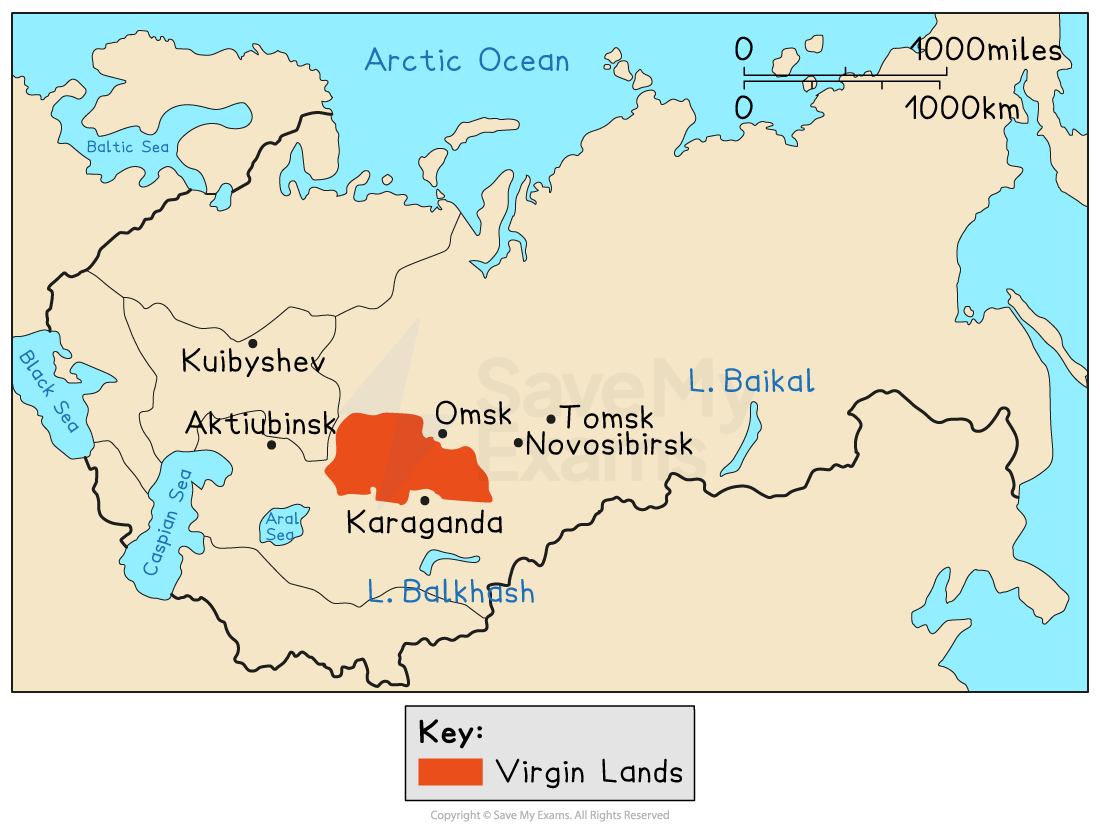
The scheme aimed to expand grain production rapidly
From 1954, Khrushchev ordered the ploughing of grazing land in Kazakhstan and western Siberia
These semi-arid steppes had never been put under the work of the plough before
The state mobilised huge resources to settle and work the land
Komsomol volunteers were sent to build settlements and farm the new land
By 1956, 35.9 million hectares had been ploughed
This was equal to the entire cultivated area of Canada
The corn campaign extended Khrushchev's agricultural vision
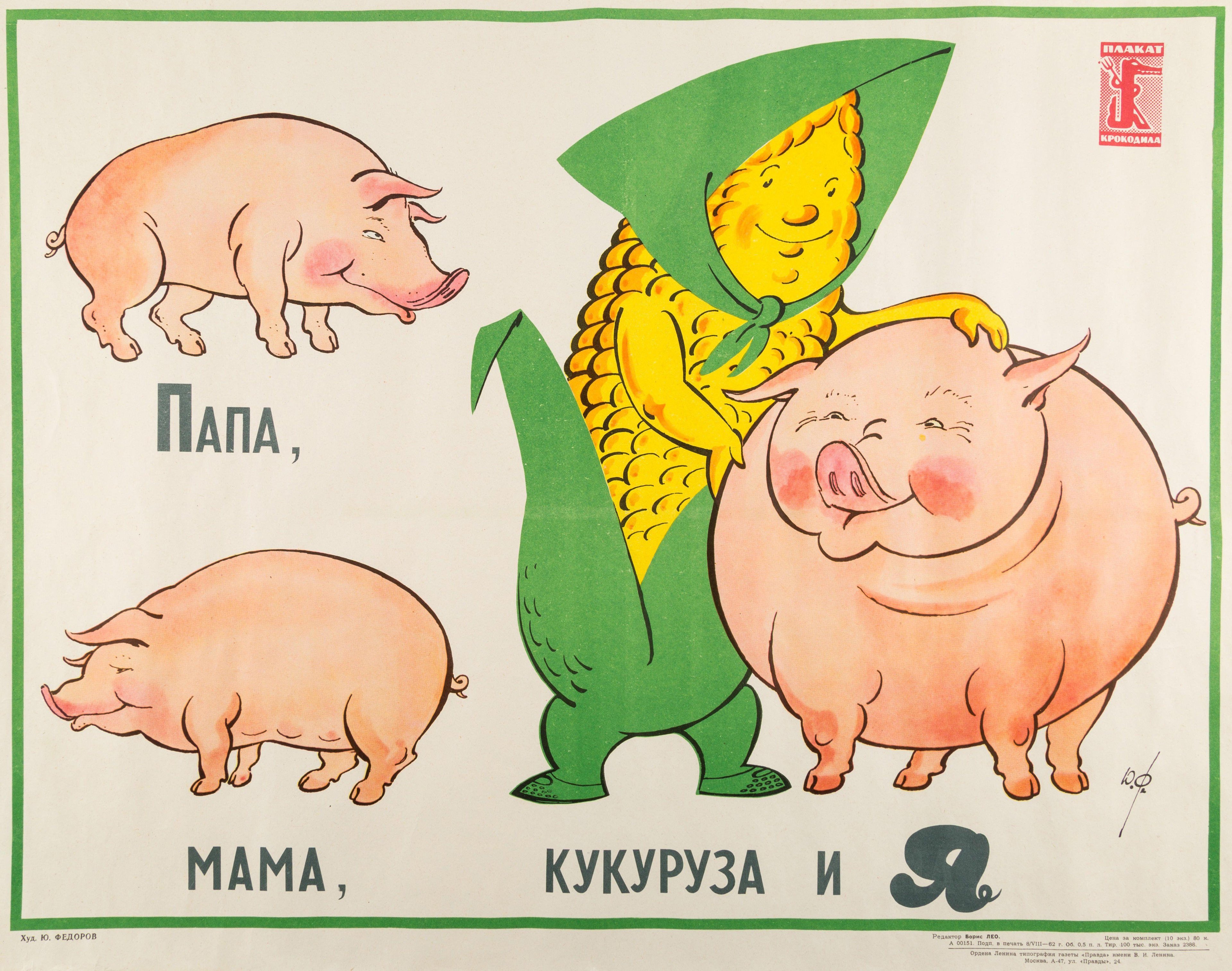
From 1958, Khrushchev promoted maize as the answer to feeding livestock
After visiting the USA in 1959, he pushed maize cultivation across the country
He also planned "agrocities"
These never moved beyond the planning stage
The scheme delivered early successes
Grain harvests rose sharply at first
Meat and milk output also climbed as investment increased
Average production, in millions of tons
Output | 1952 | 1953-56 | 1957-60 | 1961-64 |
|---|---|---|---|---|
Cereals (excluding maize) | 82 | 99 | 120 | 132 |
Meat | 5.2 | 6.3 | 8.2 | 9.1 |
Milk | 36 | 42 | 59 | 63 |
Longer-term results were disappointing
The land was farmed too intensively
Crop rotation was not used correctly
Soil erosion set in
Yields began to fall after 1958
The wider campaigns ran into practical problems
Maize was often planted in unsuitable soil and climate
Fertiliser shortfalls caused heavy waste
A poor harvest in 1963 forced the USSR to import grain from North America
Khrushchev's target of 180 million tons of cereals was never met
Examiner Tips and Tricks
It is important to avoid a simple judgement of “success” or “failure” when assessing the Virgin Lands Scheme. A clearer understanding comes from distinguishing between the short-term boom by 1956 and the longer-term problems of soil exhaustion and the 1963 import crisis.
Did Khrushchev’s economic reforms help or hinder the Soviet economy?
Khrushchev's reforms produced real gains, but they also caused serious disruption
Historians weight these two sides differently
The reforms modernised the economy and raised living standards
The economy grew strongly in the second half of the 1950s
The output of consumer durables and food rose sharply across the period
The shift towards chemicals and consumer goods broke from Stalinist priorities
This was a genuine attempt to modernise and diversify the economy
Scientific and technological success raised Soviet prestige
The space programme became a powerful symbol of Soviet progress
Key historian
“The Soviet economy grew by almost 10 per cent a year between 1955 and 1960. Fridges and TVs were introduced in many Soviet homes. There was a boom in construction, allowing millions of families to move into apartments on their own. The Sputnik programme was the highest symbol of Soviet progress ... For countries struggling to free themselves from colonial rule and US dominance the Soviet ‘economic miracle’ offered an alternative.”
Adapted from O. Figes, Revolutionary Russia (2014)
Figes points to:
rapid growth
expanding consumer ownership
rising international prestige
This supports the view that Khrushchev's reforms delivered genuine, if uneven, progress
The reforms were erratic and ultimately fell short
Agricultural gains were not sustained
Virgin Lands yields declined
The 1963 crisis forced grain imports
Constant reorganisation destabilised the planning system
The sovnarkhoz experiment caused confusion
It was later reversed
Cold War pressures diverted resources away from the reforms
Military spending rose from 9% of GDP in 1958 to 11% by 1964
Industrial growth slowed, with many targets missed
Key historian
“He wilfully promoted extensive farming on immense areas of virgin land in preference to intensive cultivation; and in doing so he disregarded opposition within the party, expert advice, and warnings about the danger of soil erosion and of crop failures on the virgin lands. He was so confident that he had the answer to the chronic shortage of meat ... that he forced cultivation of maize all over the country, regardless of soil and climate.”
Adapted from I. Deutscher, The Failure of Khrushchevism (1965)
Deutscher sees the agricultural campaigns as reckless
They were imposed against expert advice
They exhausted the soil
They ignored local conditions in the search for quick results
Examiner Tips and Tricks
When assessing Khrushchev’s economic reforms, it is important to avoid a one-sided interpretation. The genuine gains in growth and consumer goods should be weighed against the erratic execution of policies and the agricultural collapse of the early 1960s.
A clear evaluation distinguishes between short-term and long-term outcomes. Reforms that produced early successes often created problems later, so it is important to be precise about the period being considered.

Unlock more, it's free!
Join the 100,000+ Students that ❤️ Save My Exams
the (exam) results speak for themselves:

Was this revision note helpful?
