The Russian Orthodox Church and Cultural Developments to 1894 (AQA A Level History: Component 1: Breadth study): Revision Note
Exam code: 7042

Summary
Around 70% of the Russian Empire’s population was Orthodox, making the Church a major force in daily life and a key support for tsarist authority
Since 1721, the Church had been controlled by the Holy Synod under a state-appointed Over-Procurator
This gave the Tsar effective control over Church affairs
Parish priests helped connect the state to local communities
They read imperial decrees, recorded births and deaths, and reported suspicious activity to the police
The Church was also used to support wider government policy
Pyotr Valuev investigated clerical poverty in 1862
From 1880, Konstantin Pobedonostsev used the Church to enforce Russification under Alexander III
By the 1890s, the Church remained central to the legitimacy of autocracy, but its influence was weakening
Urban workers were increasingly drawn to socialism
Peasant religion often mixed Orthodoxy with folk superstition
Minority faiths faced persecution rather than persuasion
The importance of the Russian Orthodox Church in tsarist society
How big was the Church?
Orthodoxy was the dominant religion of the Russian Empire
Around 70% of the population identified as Orthodox in 1855
The total population was around 69 million people
Other faiths were concentrated in particular regions:
Catholics in Poland
Lutherans in the Baltic
Muslims in Central Asia
Jews in the Pale of Settlement
Buddhists in Siberia
How was the Church organised?
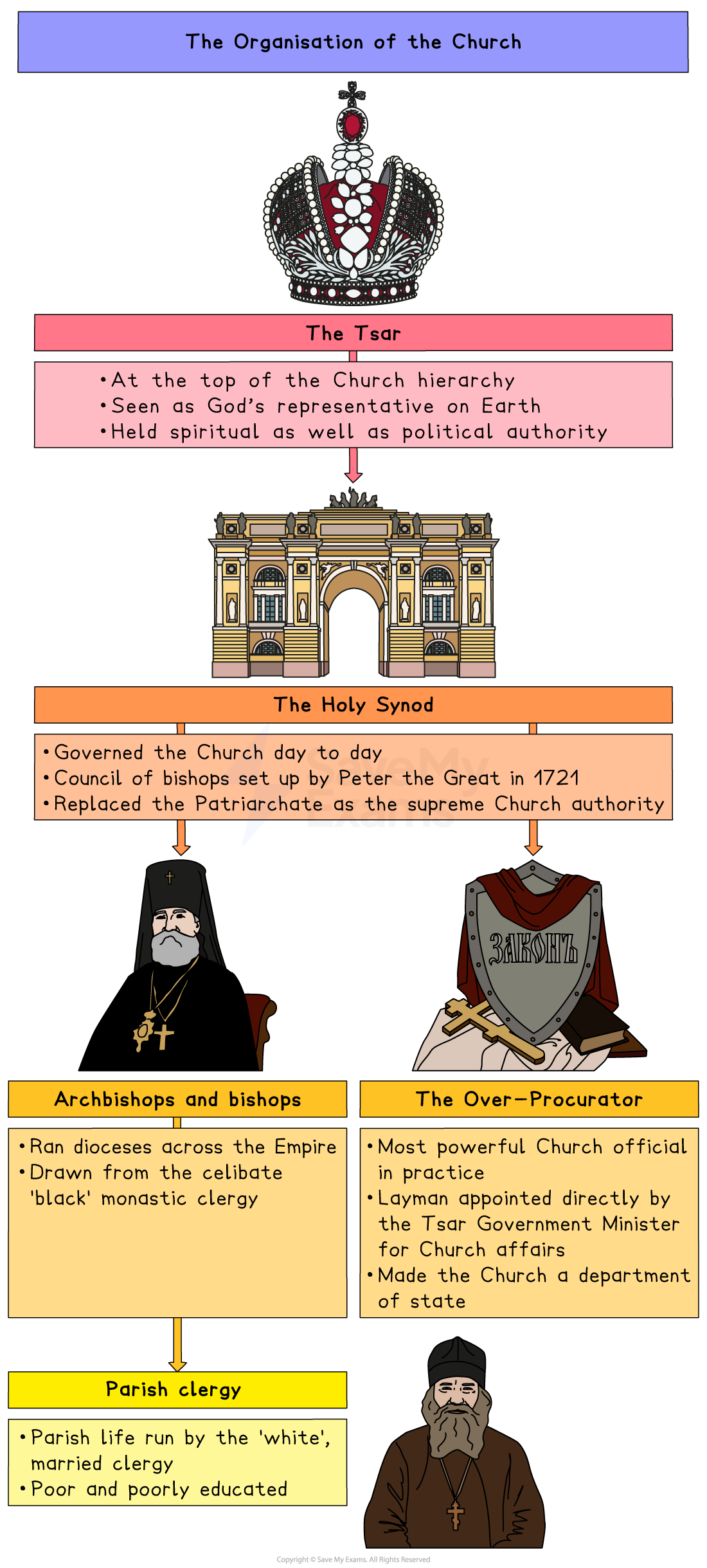
The Tsar sat at the top of the Church hierarchy
Tsarist ideology held that the Tsar was God's representative on Earth
This gave him spiritual as well as political authority
The Holy Synod governed the Church on a day-to-day basis
It was a council of bishops set up by Peter the Great in 1721
The Synod replaced the Patriarchate as the supreme Church authority
The Over-Procurator was the most powerful Church official in practice
He was a layman appointed directly by the Tsar
He acted as a government minister responsible for Church affairs
This made the Church a department of state rather than an independent body
Below the Synod, archbishops and bishops ran dioceses across the Empire
These senior clergy came from the celibate "black" monastic clergy
Parish life was run by the "white" married clergy, who were poor and poorly educated
The cultural influence of the Church
Orthodoxy shaped the spiritual life of the peasant majority
Almost every peasant home had an icon displayed in a sacred corner
Saints' days, fasts, pilgrimages and church festivals shaped the year
Major life events (birth, marriage, death) were all marked by Church ritual
Peasant religion mixed Orthodox doctrine with folk belief and superstition
Older customs survived around the harvest, illness, and the changing seasons
Priests usually tolerated this in practice, since strict orthodoxy was impossible to enforce in remote villages
The Church controlled primary education through its parish schools
Priests ran basic village schools that taught children to read using the catechism and prayer books
Until the zemstvo schools expanded under Alexander II, parish schools were the main route to literacy for peasants
Orthodox architecture and ceremony gave the regime a visible religious identity
Onion-domed cathedrals, the Kremlin's Cathedral of the Assumption and monasteries like the Trinity Lavra of St Sergius were national symbols
Coronations and royal weddings were performed as Church liturgy. This fused the dynasty and the faith into a single public spectacle
Orthodoxy acted as a marker of Russian national identity
In tsarist ideology, to be Russian was to be Orthodox
This link became more political under Alexander III, when Russification used Orthodoxy to assimilate non-Russian peoples
Examiner Tips and Tricks
Use "Russian Orthodox Church" and "Orthodoxy" with initial capitals when you mean the institution and its doctrine. Use lower-case "orthodox" only when you mean conventional. Examiners notice this kind of precision.
The relationship between the Church & the tsarist regime
The Church as a tool of the state
The Church operated as a branch of the tsarist government
Senior appointments, finances, censorship and religious education all needed state approval
The Over-Procurator turned tsarist policy into Church directives
Parish priests carried out state duties that made them part of the local government
They read imperial manifestos and decrees from the pulpit, so government messages reached every village
They kept records of births, marriages and deaths, since Russia had no civil register
They reported suspicious activity to the police
They were even expected to pass on information given in confession, despite this breaking Church law
Church and state under Alexander II, 1855 – 1881
Alexander II's ministers worried that the Church was too weak to do its job properly
Clerical poverty was widespread and the social status of priests was low
A weak Church could not act as an effective tool of social control
In 1862, Pyotr Valuev set up an Ecclesiastical Commission
Valuev was Minister of Internal Affairs
The Commission investigated Church organisation and the condition of the clergy
In 1868, the state reformed seminary training to improve the education of priests
The Church kept its powers of moral discipline throughout
Church courts continued to judge moral and social "crimes"
Punishments could include confinement in a monastery
These changes were administrative, not ideological
The state wanted a more useful Church, not a more independent one
Church and state under Alexander III, 1881 – 1894
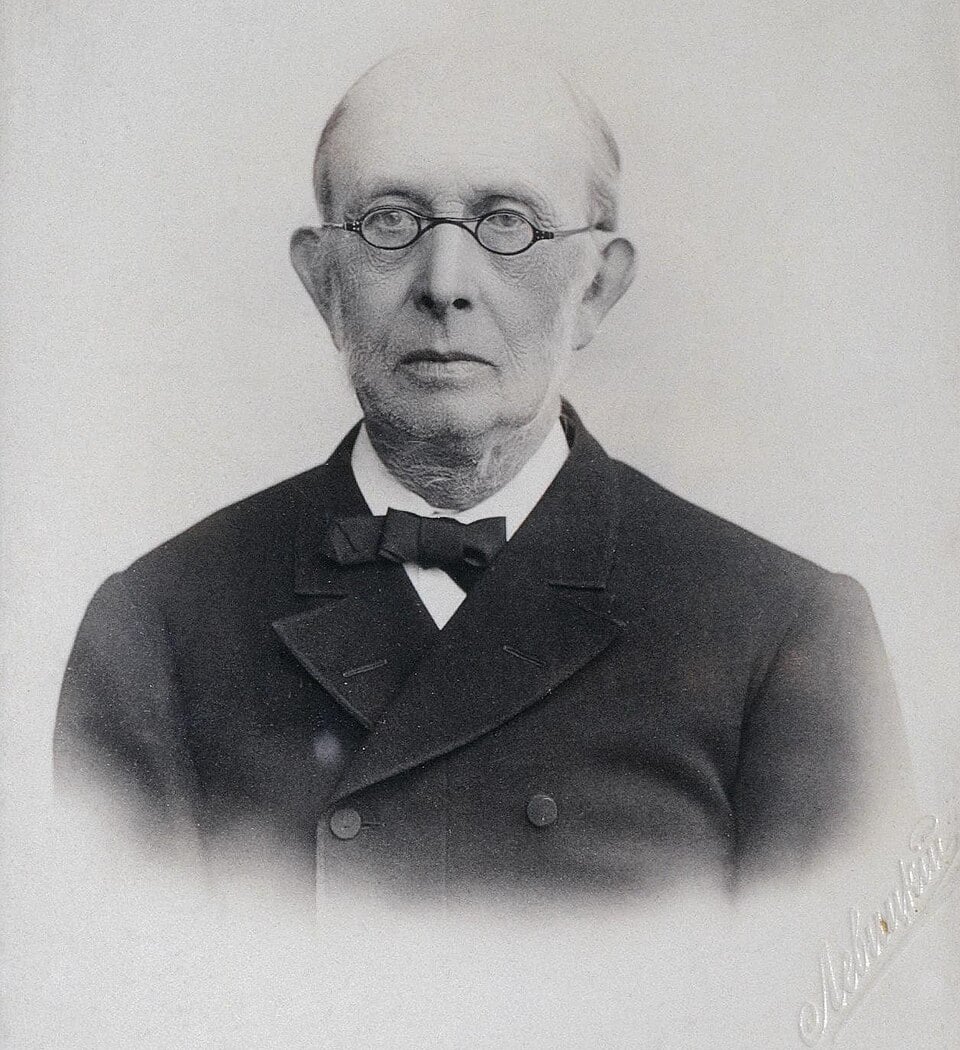
The appointment of Konstantin Pobedonostsev as Over-Procurator in 1880 transformed Church-state relations
Pobedonostsev had tutored both Alexander III and the future Nicholas II
He held the post for 25 years and shaped Alexander III's whole reign
He was a fierce opponent of liberalism, parliamentary government and religious toleration
Under Pobedonostsev, the Church was used to enforce Russification
Converting away from Orthodoxy became a criminal offence
Publishing criticism of the Church was banned
Orthodox missionaries were funded across the Empire to convert non-Russian peoples, often with state coercion
From 1884, the Church took direct control of parish schools
This rolled back zemstvo control of primary education, one of Alexander II's reforms
The change was driven by Ivan Delyanov, Alexander III's Minister of Education
The aim was to teach peasant children loyalty to both Tsar and Church from an early age
Examiner Tips and Tricks
Treat the Church as a working part of the tsarist state, not as a separate religious institution. Concrete links like priests as informers, Church courts as moral police, and parish schools as Russification tools score much better than vague claims that the Church "supported" tsarism.
Opposition to the Russian Orthodox Church
Internal reform pressure
Some liberal clergy wanted to reform the Church from within
They argued the Church was being damaged by its identification with state repression
They believed priests should be teachers of conscience, not agents of the police
These reformist voices were systematically suppressed
Pobedonostsev and the senior hierarchy blocked any reform of Church-state relations
Reformist clergy were removed from their posts or sent to obscure parishes
Their writings were censored
The result was a Church unable to adapt to industrial society from within
Sectarian opposition: the Old Believers
The Old Believers had broken from the Church in the seventeenth century
They rejected the liturgical reforms of Patriarch Nikon
Many fled to Siberia and remote borderlands to escape persecution
Their communities survived into the nineteenth century despite repeated state attempts to convert or suppress them
Under Alexander III, persecution of the Old Believers intensified as part of Russification
Their continued resistance showed the limits of Church-state coercion
A religiously motivated minority could withstand generations of pressure without converting
Rival faiths within the Empire
The Uniate Church was a particular target
The Uniates recognised the Pope but observed Orthodox rites
They were concentrated in Ukraine and Belarus
Most had already been forced into Orthodoxy earlier in the century; remaining communities faced renewed pressure under Alexander III
The Armenian Church was harassed despite being Christian
It had its own hierarchy and non-Orthodox practices
Mass conversions of non-Christian minorities were claimed under Alexander III
Around 8,500 Muslims and 50,000 pagans were recorded as converted
Around 40,000 Catholics and Lutherans in Poland and the Baltic provinces were pressured to convert
These figures inflated the appearance of Orthodox dominance but built deep resentment in non-Russian regions
Secular and intellectual opposition
The Church was losing its grip on the urban working class
Parish provision had not kept up with the growth of cities
The world of the factory and the tenement was remote from village Orthodoxy
Workers were more drawn to socialism, which they often saw as an alternative moral framework
The intelligentsia had drifted toward religious scepticism
Nihilism, materialism and Marxism all offered openly anti-religious worldviews
One nineteenth-century priest complained that the clergy were mocked openly from drawing rooms to peasant huts
Examiner Tips and Tricks
Examiners reward students who track the Church's opposition from multiple directions at once: liberal clergy inside, Old Believers and Uniates outside, the urban working class drifting toward socialism, and the intelligentsia rejecting religion altogether. Showing all four pressures running in parallel is a high-level analytical move
How vital was the Orthodox Church to the stability of tsarist Russia?
The Church's role in propping up autocracy across the period 1855 – 1894 is contested
The Church was vital to tsarist stability
The Church gave autocracy religious legitimacy
Casting the Tsar as God's representative turned political obedience into a religious duty
For the peasant majority, opposing the Tsar meant defying God
The Church provided a nationwide surveillance network
Priests reported on the local mood and recorded the population
Church courts disciplined moral and social offences
This extended the reach of a state with limited police resources
Russification entrenched Orthodoxy as the glue of a multi-ethnic empire
Pobedonostsev built a coherent ideological order on Orthodoxy, autocracy and nationality
This gave Alexander III's reign a clarity of purpose his father's reforms had lacked
Cultural saturation made the regime hard to escape
The Church calendar, parish schooling, royal ceremonial and village ritual all reinforced the same message
No opposition movement could match this level of cultural integration before the 1890s
The Church's influence should not be overstated
The Church was losing its grip on the urbanising population
Parish provision had not kept pace with the growth of factory cities
Workers in industrialising St Petersburg and Moscow encountered socialism more readily than priests
Even in the countryside, Orthodox doctrine was diluted by folk superstition
Peasant religion was a mix of Orthodoxy and pre-Christian custom
Loyalty to the Tsar was tied as much to localism and habit as to formal Church teaching
Persecution of minorities built resentment, not loyalty
Forced conversions of Muslims, Catholics, Lutherans and Uniates created reservoirs of grievance
These grievances fed into the opposition that Nicholas II would inherit
The Church could not reform itself
Liberal clergy proposing renewal were silenced by Pobedonostsev
The Church entered the 1890s rigid and out of new ideas
It could not compete with socialism for the loyalty of the new working class
Contempt for the clergy was visible across society
Educated Russians openly mocked priests
Even parishioners disparaged their local clergy, suggesting obedience was habitual rather than heartfelt
Examiner Tips and Tricks
Consider change over time. The Church was a more secure pillar of stability in 1855 than in 1894. The gap between those two states is what a strong essay should explain.

Unlock more, it's free!
Join the 100,000+ Students that ❤️ Save My Exams
the (exam) results speak for themselves:

Was this revision note helpful?
