The October Manifesto, Fundamental Laws and the Dumas, 1905–1914 (AQA A Level History: Component 1: Breadth study): Revision Note
Exam code: 7042

Summary
Nicholas II issued the October Manifesto on 17 October 1905 to end the general strike paralysing Russia
The Manifesto promised civil liberties, an elected State Duma and a wider franchise, but the wording was deliberately vague
The Fundamental Laws of April 1906 reasserted the Tsar's autocratic power before the First Duma even met
Four State Dumas sat between 1906 and 1917, but Pyotr Stolypin's coup of 3 June 1907 rewrote the franchise to favour landowners
By 1914, repression had restored order, yet strike action was rising sharply and liberal expectations had been disappointed
Historians debate whether the Dumas preserved autocracy or undermined it by 1914
Read argues that few contemporaries saw the regime as genuinely liberalising
Hayes argues that the Dumas’ failure strengthened extremists on both ends of the political spectrum
The October Manifesto, 1905: concessions & limitations
Why Nicholas II issued the Manifesto
Nicholas II issued the Manifesto under duress, not as a planned reform
The October general strike had paralysed railways, factories and the postal service
Around 800,000 workers had walked out by mid-October 1905
Sergei Witte drafted the document and pressed the Tsar to sign it
Witte's argument to the Tsar was practical, not principled
The choice was limited reform or military dictatorship under Grand Duke Nicholas
The Grand Duke refused the dictatorship role and backed Witte
Nicholas signed the Manifesto on 17 October
Nicholas later called it a "moment of weakness"
What the Manifesto promised
The Manifesto contained three concrete pledges to the Russian people
Civil liberties of conscience, speech, assembly and association
An elected State Duma with the right to veto legislation
A wider franchise extending to classes previously excluded from voting
Witte's strategic intent was to divide the opposition movement
Liberal demands could be met without surrendering autocratic power
Workers and peasants could be drawn away from the revolutionary parties
These concessions isolated the radical left, making it easier for the regime to repress revolutionary groups
‘Fundamental civil freedoms will be granted to the population, including real personal inviolability, freedom of conscience, speech, assembly and association.’
‘It is established as an unshakeable rule that no law can come into force without its approval by the State Duma.’
Manifesto of 17 October 1905, Polnoe sobranie zakonov Rossiiskoi Imperii, 3rd series, vol. XXV/I, no. 26803
How the opposition reacted
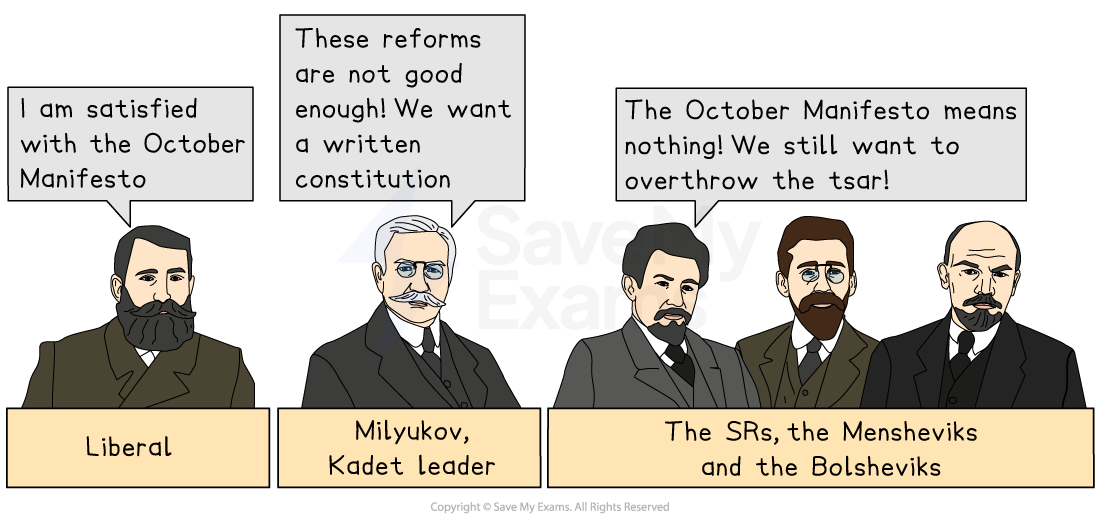
The Manifesto produced an immediate split among the regime's opponents
Liberals welcomed it and formed the Octobrist Party under Alexander Guchkov
The Kadets, led by Pavel Milyukov, demanded a full written constitution
The St Petersburg Soviet, the Socialist Revolutionaries (SRs) and the Bolsheviks rejected it outright
The concessions had clear limitations, even on the day they were granted
There was no written constitution or formal bill of rights
Ministers remained appointed by the Tsar and answerable only to him
Civil liberties were promised in principle but not anchored in law
Examiner Tips and Tricks
Treat the Manifesto and the Fundamental Laws as a single political strategy: the Manifesto bought time, and the Fundamental Laws then clawed back the substance. Essays that make this link explicit consistently score higher.
The Fundamental Laws, 1906: restoring autocratic power
Tsar Nicholas issued the Fundamental Laws on 23 April 1906
This was five days before the First Duma was due to meet
It was a unilateral act, made before any deputy had taken their seat
The day before, Witte had resigned, believing that the October concession was already lost
What the Fundamental Laws restored to the Tsar
Article 4 placed supreme autocratic power back with the Tsar
The text declared the Tsar's authority a matter of conscience as well as fear
The Manifesto's 'rights' were now recast as gifts from the autocrat
The political vocabulary of 1906 was preserved, but the substance was not
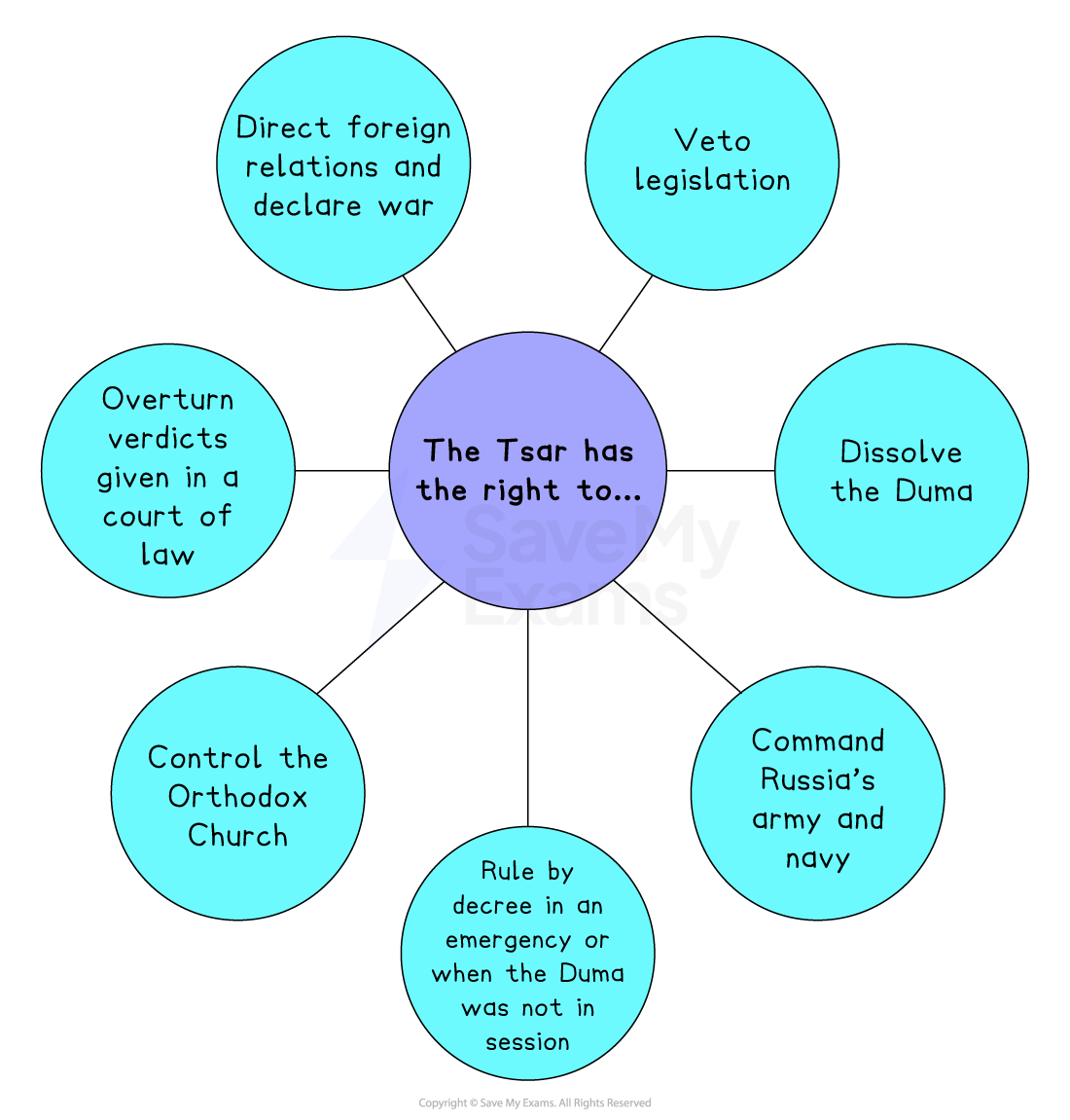
The Tsar retained a long list of powers that bypassed the Duma altogether
Command of the armed forces and the conduct of foreign policy
Sole right to amend the Fundamental Laws themselves
A full veto over all legislation passed by the Duma
The right to dissolve the Duma at any time
Article 87 gave the Tsar the power to rule by decree
He could issue emergency laws when the Duma was not in session
Stolypin used Article 87 repeatedly between 1906 and 1911
A second chamber designed to block the Duma
A second chamber, the State Council, was placed above the Duma
Half of its members were directly appointed by the Tsar
The other half were elected by the nobility, the Church and the universities
Any Duma bill required State Council approval to become law
The result was a constitutional monarchy in name only
The forms of representative government were now in place
Yet every meaningful lever of power remained in the Tsar's hands
‘ART. 4. The supreme autocratic power is vested in the Tsar of all the Russias. It is God’s command that his authority should be obeyed not only through fear but for conscience’ sake.’
‘ART. 86. No new law shall go into force without the sanction of both the Council of the Empire and the Duma and the ratification of the Tsar.’
Russian Fundamental Laws of 1906, in Readings in Modern European History, ed. J. H. Robinson and C. Beard (Boston, 1909), vol. 2.
Examiner Tips and Tricks
Do not describe the Fundamental Laws as a ‘constitution’. Examiners reward precision here. The document was issued unilaterally by the Tsar to reassert autocratic power, not negotiated as a constitutional settlement.
The Four Dumas, 1906 – 1917: Russia’s experiment with parliament
Comparing the four Dumas
Duma | Dates | Dominant Bloc | Outcome |
|---|---|---|---|
First Duma | Apr-Jul 1906 | Kadets, Trudoviks |
|
Second Duma | Feb-Jun 1907 | Democrats |
|
Third Duma | 1907-1912 | Octobrists, nationalists |
|
Fourth Duma | 1912-1917 | Octobrists, nationalists, Progressives |
|
The First and Second Dumas, 1906 – 1907
The Tsar's instinct from the start was to dissolve oppositional Dumas
The First Duma demanded radical land reform and ministerial responsibility
Nicholas dissolved it after 72 days, in July 1906
200 Kadet and other liberal deputies signed the Vyborg Manifesto in protest
Signatories were tried, fined and barred from the Second Duma
The Second Duma was more radical than the first, not less
SRs and Social Democrats stood for election instead of boycotting it
Stolypin found the chamber unworkable for his reform programme
He dissolved it on 3rd June 1907 after only four months
The coup of 3 June 1907
Stolypin's rewriting of the electoral law was a decisive intervention
He changed the law without consulting the Duma
This broke the Fundamental Laws, which the Tsar himself imposed
The new law weighted votes heavily towards landowners and the urban wealthy
The richest 1% gained influence over roughly half the Duma’s seats
Peasant and worker representation was sharply reduced
Critics nicknamed it the “Duma of Lords and Lackeys”
Stolypin's repressive arm
Stolypin combined Duma management with severe repression
Military field tribunals executed over 1,000 people after 1906
The hangman's noose became known as 'Stolypin's necktie'
Around 20,000 political opponents were exiled to Siberia
Revolutionary parties were forced abroad or underground
Lenin, Trotsky and other leading figures were in exile by 1914
Open revolutionary activity inside Russia was hard to sustain
The Third and Fourth Dumas, 1907 – 1914
The Third Duma was the regime's tame parliament
Octobrists under Guchkov and nationalists dominated the chamber
It ran its full five-year term, the only Duma to do so
It passed reforms on land, primary education and local government
Even tame Dumas could not prevent serious political friction
Stolypin was assassinated at the Kyiv Opera House in September 1911
His replacement, Vladimir Kokovtsov, lacked his political authority
The Fourth Duma still functioned in 1914, but many deputies were losing patience with the limits of tsarist constitutional reform
Examiner Tips and Tricks
The nickname of the Third Duma as being the 'Duma of Lords and Lackeys' reflects the change in the voting system well and shows good detail when mentioned in the exam.
Had Nicholas II restored & maintained autocratic power by 1914?
By 1914, Nicholas II had survived the 1905 crisis and presided over what appeared to be a functioning constitutional system
Whether this meant constitutional power had been substantially restored, or only papered over, remains contested
Autocratic power was substantially restored
The Fundamental Laws had neutralised the Manifesto's concessions before the First Duma even met
Article 4 returned 'supreme autocratic power' to the Tsar
The Tsar kept his veto, his power of dissolution and his right to rule by decree
The coup of 3 June 1907 showed Nicholas would act unilaterally when needed
He broke his own Fundamental Laws without serious political cost
There was no mass uprising in response, unlike in October 1905
The Third and Fourth Dumas were politically manageable
The Octobrist majority accepted the post-1907 settlement
Reform legislation was passed only with the regime's cooperation
Stolypin's repressive arm had pushed the revolutionary leadership abroad
An open revolutionary organisation inside Russia was hard to sustain after 1907
The regime faced no sustained mass challenge between 1907 and 1914
The coup of 3 June 1907 produced no popular response, unlike October 1905
Strike levels fell sharply after 1907 and only revived gradually from 1912
Key historian
‘In the first place the Dumas were arenas for conflict; they were not centres of reconciliation. Secondly, they brought a new round of reaction from traditionalists who resented the changes and began to fear the autocracy was going too far. Even some conservatives saw tsarism as an obstacle to progress. No one at the time seriously believed the autocracy was liberalising.’
C. Read, From Tsar to Soviets (1996)
Read’s argument is that the constitutional vocabulary of 1905 to 1906 never translated into a genuine erosion of autocratic power
Contemporaries on every side recognised that Nicholas had retained, not surrendered, real authority
This supports the case that autocracy had been substantially preserved by 1914
Autocratic power was maintained only in appearance
The 1905 settlement created political expectations that the regime then betrayed
Civil liberties promised in October were curtailed by 1907
The Fundamental Laws cancelled most of what the Manifesto had granted
Successive Dumas failed to deliver constitutional progress
The First and Second Dumas were dissolved within months
The 1907 electoral law made the chamber unrepresentative
Liberal hopes for a real parliament had collapsed by 1908
Strike action returned to revolutionary levels by 1912
Over 3,000 strikes were recorded across Russia in the first half of 1914
Many of these strikes were political, not purely economic
The post-1907 industrial calm proved temporary
Liberal opinion had survived the 1907 settlement intact
The Kadets remained the largest liberal party despite the electoral changes
Liberal demands for genuine parliamentary government had not gone away
The political class created by 1905 could not be suppressed back into silence
The post-1905 system of limited constitutional government was running beyond Nicholas’s personal capacity
Stolypin's assassination in 1911 removed the last politically capable minister
Nicholas had no replacement of equivalent skill
The Fourth Duma was already growing impatient with palace politics
Key historian
‘By the early twentieth century the violent overthrow of the system was increasingly seen as the only answer to autocracy. The failure of successive Dumas to make any headway in the struggle for constitutionalism disillusioned both democrats and moderate reformers and strengthened extremists at both ends of the political spectrum. In the last few years before 1914, political strikes became much more common.’
P. Hayes, Russia and Austria-Hungary: Empires Under Pressure (1992)
Hayes’s argument is that even if autocratic power survived in 1914, it survived at a growing political cost
The Dumas had failed in their stated purpose, the regime had no real reformist base left, and revolutionary politics was once again on the rise
This supports the case that the 1906 settlement had bought time, not stability
Examiner Tips and Tricks
Do not fall into the trap of thinking 1905 is the end of autocracy. The question is whether the 1906 to 1914 settlement was a genuine power-sharing settlement or a controlled restoration. Your two main examples to use are the Fundamental Laws and the coup of June 3, 1907.

Unlock more, it's free!
Join the 100,000+ Students that ❤️ Save My Exams
the (exam) results speak for themselves:

Was this revision note helpful?
