Soviet Attacks on Religion: Communism vs the Church (AQA A Level History: Component 1: Breadth study): Revision Note
Exam code: 7042

Summary
Communism was an atheist ideology that saw religion as a rival authority
The Bolsheviks wanted loyalty to the state, Party and science to replace religious faith
Lenin promised freedom of worship, but in practice, the regime seized Church property and persecuted clergy
The state promoted atheism through propaganda, anti-religious education and the League of the Godless
Stalin intensified the attack through collectivisation, the purges and the 1936 Constitution
The campaign targeted every major faith
However, most people still identified as believers by 1941
Historians debate whether anti-religious policy advanced the regime’s secular aims or failed to win people to atheism
Steeves stresses the long-term alienation of younger generations from the Church
Anderson argues that few believers were genuinely converted to atheism
Communism & religion: why were they incompatible?
Communism was an atheist ideology that saw no place for organised religion
Marx described religion as the "opium of the people"
He believed it kept workers passive
He argued that it distracted them from the class struggle
Communism still claimed to treat all people as equal
This included people with different beliefs
However, the Bolsheviks wanted loyalty to the state, Party and science to replace faith
Religion as a rival authority
Organised religion could command loyalty that competed with the Party
Churches had their own hierarchy
They owned property
They influenced millions of people
The Russian Orthodox Church had been a key pillar of tsarism
It preached obedience to the Tsar as God's chosen ruler
It reinforced social hierarchy and obedience
Attacking the Church also weakened a foundation of the old regime
Why was religion important in the Russian Empire?
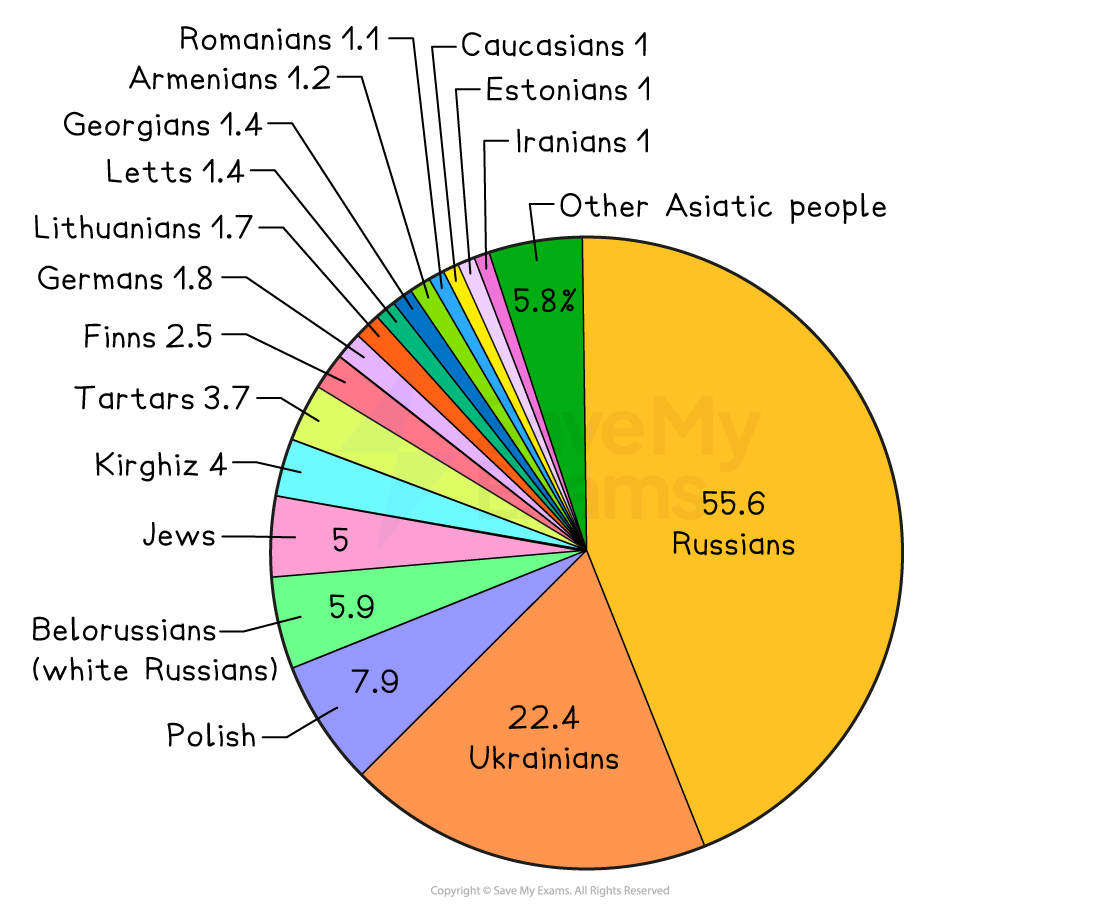
By 1900, the Russian Empire was home to over 200 nationalities
Religion was central to identity
It was often tied to ethnicity
This meant that later attacks on religion affected many different communities
Key faiths
Russian Orthodoxy
The state-supported religion in Tsarist Russia
Around 70% of the population was Russian Orthodox
Islam
Widespread in Central Asia and the Caucasus
Catholicism
Strong in Poland and parts of the western empire
Linked to Polish nationalism
Judaism
Concentrated in the Pale of Settlement in the West of the Empire
The widespread nature of religion shaped how far the later Soviet attack would reach
Religious policies under Lenin
Key laws
Law and Date | Effect |
|---|---|
Decree on Land (October 1917) |
|
Decree on the Separation of Church and State (January 1918) |
|
First year in power
On paper, Lenin allowed freedom of worship after the October Revolution
A small atheist Bolshevik minority could not openly confront an Orthodox majority
In practice, the regime quickly moved against the Church
In 1918, the Cheka received an order from the Politburo to execute Orthodox priests
Within two years, the Cheka had killed some of the most well-known and respected priests
Repression during the Civil War
The Civil War brought severe persecution of the Orthodox Church
Orthodox churches were shut down
The state seized Church property
Church bells and treasures were confiscated, officially to fund the famine relief
This continued during the 1921 famine
Priests were persecuted, deported and executed
Hundreds died after being deprived of rations during War Communism
Around 8,000 priests were executed under Lenin in 1921
Many were killed for resisting the seizure of Church valuables
The regime broke the Church's leadership
Patriarch Tikhon was arrested in 1922
He later recanted and was released
His successor Sergius, was jailed
He was freed in 1927 after pledging to stay out of politics
Islamic organisations were treated more cautiously at first
Islamic charities were seized
Communist leaders later reversed the policy and encouraged Muslims to join the Party
The propaganda war on religion
The state built machinery to promote atheism
The newspaper The Godless appeared in 1923
The League of the Militant Godless was founded in 1925
It coordinated anti-religious propaganda across Soviet society
The state tried to discredit religion publicly
Komsomol members ransacked churches
Sacred relics were "exposed" as fakes
Weakening religion from within after the Civil War
The Party tried to weaken the Orthodox Church internally
It backed the Living Church
This faction was run by the secret police, later the GPU
It was designed to split the Orthodox Church
It was banned from public debate in 1925 after the Civil War
The state also targeted Islam after the Civil War
Mosques were closed
Islamic shrines were attacked
Muslims were accused of "crimes based on customs" against women
Campaigns targeted women wearing the chador
Examiner Tips and Tricks
Distinguish stated policy from reality. On paper Lenin’s decrees promised freedom of conscience, yet the Civil War years brought closures, seizures and executions.
Showing that gap between promise and practice is what demonstrates evaluation, rather than simply describing the measures.
Religious policies under Stalin
As a Georgian, Stalin came from one of the Russian Empire's ethnic minorities
This gave him direct experience of the Empire's national and cultural diversity
His attitude to religion was mainly pragmatic
Lenin later appointed him Commissar for Nationalities
Religion was not usually Stalin's main focus
However, many national and cultural policies affected religious communities
Religion was often caught up in wider campaigns to control non-Russian groups and strengthen soviet society
Collectivisation
Collectivisation brought a new wave of church closures from the late 1920s
Village churches were closed
Clergy who resisted were arrested
By 1939, only around one in 40 churches remained open compared with 1917
Every day worship was made harder
From 1929, worship was restricted to "registered congregations"
The "uninterrupted working week" (1929-1940) removed Sunday
New Year and May Day replaced Christmas and Easter
The purges
The purges targeted the clergy alongside other "enemies"
Priests were imprisoned or executed
The 1936 Constitution criminalised religious propaganda
The attack reached every major faith, not just Orthodoxy
Mosques were closed
Sharia courts abolished
Wearing the veil was forbidden
Pilgrimages to Mecca were banned from 1935
Buddhists and the Armenian and Georgian Churches were also targeted
In parts of Central Asia, traditionalists murdered those who obeyed Soviet bans
Faith | Key measures | Position by 1941 |
|---|---|---|
Russian Orthodox Church | Land and schools seized; Patriarch arrested; clergy killed; churches closed or converted | Institutional power broken, but belief still widespread |
Islam | Charities and mosques seized; Sharia courts abolished; veil and Mecca pilgrimage banned | Worship driven underground, especially in Central Asia |
Other faiths | Buddhist, Armenian, Georgian and Jewish places of worship closed; clergy persecuted | Practice continued quietly despite repression |
The Second World War
By 1941, the institutional Church had been badly weakened, but religious belief had survived
Nearly 40,000 churches and 25,000 mosques had been closed or converted
In 1937, around 57% of people still described themselves as believers
Persecution during collectivisation and the purges may have strengthened private faith
The war forced Stalin to change course
He formed an alliance with the Russian Orthodox Church in order to strengthen patriotism and morale against Nazi Germany
Orthodoxy was linked to national identity
The Church comforted and provided support for grieving families
Religion reassured soldiers that they would go to Heaven if they died
The state eased pressure on religion further during the war
414 Orthodox churches reopened
Numbers of other Christian religions also increased
Anti-religious propaganda ended
The state promised to end censorship of religious publications
Examiner Tips and Tricks
Show the breadth of the attack on religion. Do not confine it to the Orthodox Church. Islam, Judaism, Buddhism and other Christian traditions were also affected.
Did the Soviet attitude towards religion cause more issues than it solved?
Historians disagree over whether the anti-religious campaign served the regime’s aims or created more problems than it removed
Suppression broke the Church's power and advanced a secular state
The Church lost the political and institutional power it had held under the tsars
Its land, schools, funding and leadership were stripped away
By the late 1930s, most churches and mosques were closed
Removing a rival authority helped the Party consolidate control
No independent Church remained to rally opposition to the regime
Long-term anti-religious education shaped a more secular society
Schooling and youth organisations promoted atheism to a whole generation
Key historian
“The persecution of the Church was accompanied by a highly organized campaign to promote atheism and to destroy Russia’s religious culture... Children from 8-14 years of age were enrolled in Groups of Godless Youth, and the League of Communist Youth (Komsomol) took a vigorous antireligious line... Much of this antireligious propaganda was extremely crude— embarrassingly so for some party intellectuals — and probably did not greatly harm the Church, though the long-term programme of indoctrinating children and young people in atheism has clearly helped to produce two generations of adults who are largely alienated from the Church and from Russia’s traditional culture and piety.”
P. D. Steeves, Keeping the Faiths: Religion and Ideology in the Soviet Union (1989)
Steeves accepts that much propaganda was crude
However, he argues that its long-term effect was to detach younger generations from the Church
This supports the view that the campaign slowly advanced the regime’s secular aims
Repression entrenched belief and failed to win people to atheism
Faith proved resilient despite decades of pressure
A majority still identified as believers of a faith in the late 1930s
Worship continued underground
This was especially true in rural areas and Muslim communities
Persecution alienated key groups
Peasants, national minorities and clergy were pushed further from the state
In Central Asia, some communities violently resisted bans on religious practice
The aim of converting people to atheism was largely unmet
Falling belief owed as much to coercion as to genuine persuasion
Key historian
“In terms of winning believers to atheism success is yet harder to evaluate. Such statistics as are available do suggest a general decrease in the number of believers, but it remains difficult to ascribe this to propaganda and educational activities alone, for the decline took place during a harsh anti-religious campaign when public confession of faith could lead to discrimination and job loss, and during which the number of open places of worship was radically reduced. Propaganda messages repeated over time probably had some effect in shaping the perception of religion held by ordinary citizens, but it seems unlikely that many believers were genuinely converted to atheism as a result of such measures.”
J. Anderson, Religion, State and Politics in the Soviet Union and Successor States (1994)
Anderson argues that any fall in belief is hard to separate from coercion
He concludes that few people were genuinely persuaded into atheism
This supports the view that the policy’s central aim was largely unmet
Examiner Tips and Tricks
The strongest answers assess consequences rather than listing attacks. The evidence cuts both ways: tens of thousands of churches were closed and thousands of clergy were killed, yet most people still identified as believers by the late 1930s.

Unlock more, it's free!
Join the 100,000+ Students that ❤️ Save My Exams
the (exam) results speak for themselves:

Was this revision note helpful?
