The Status of Soviet Women in Towns and the Countryside (AQA A Level History: Component 1: Breadth study): Revision Note
Exam code: 7042

Summary
Soviet women gained major legal rights after 1917
These included equality, easier divorce, property rights and legal abortion in 1920
Industrialisation drew millions of women into paid work
Female workers rose from 3 million in 1928 to 13 million in 1940
Real equality remained limited
Women earned around 40% less than men
They carried a double burden of work and home
Collectivisation made women central to the kolkhoz workforce
However, they usually worked in the lowest-paid and least mechanised roles
Women stayed politically marginal
They made up only around 12% of Party membership in the 1920s
They remained almost absent from leadership
Historians debate whether Soviet policy transformed women’s lives or masked continuing inequality
Fitzpatrick stresses women’s entry into work and higher education
Attwood stresses the unresolved tension between production and reproduction
Soviet attitudes toward women in 1917 & the impact of the Civil War
The Marxist promise of equality
Marxist theory treated women's oppression as a product of capitalism
Liberation would come through economic independence
Collective childcare would free women from domestic labour
Women were framed as "workers first, mothers second"
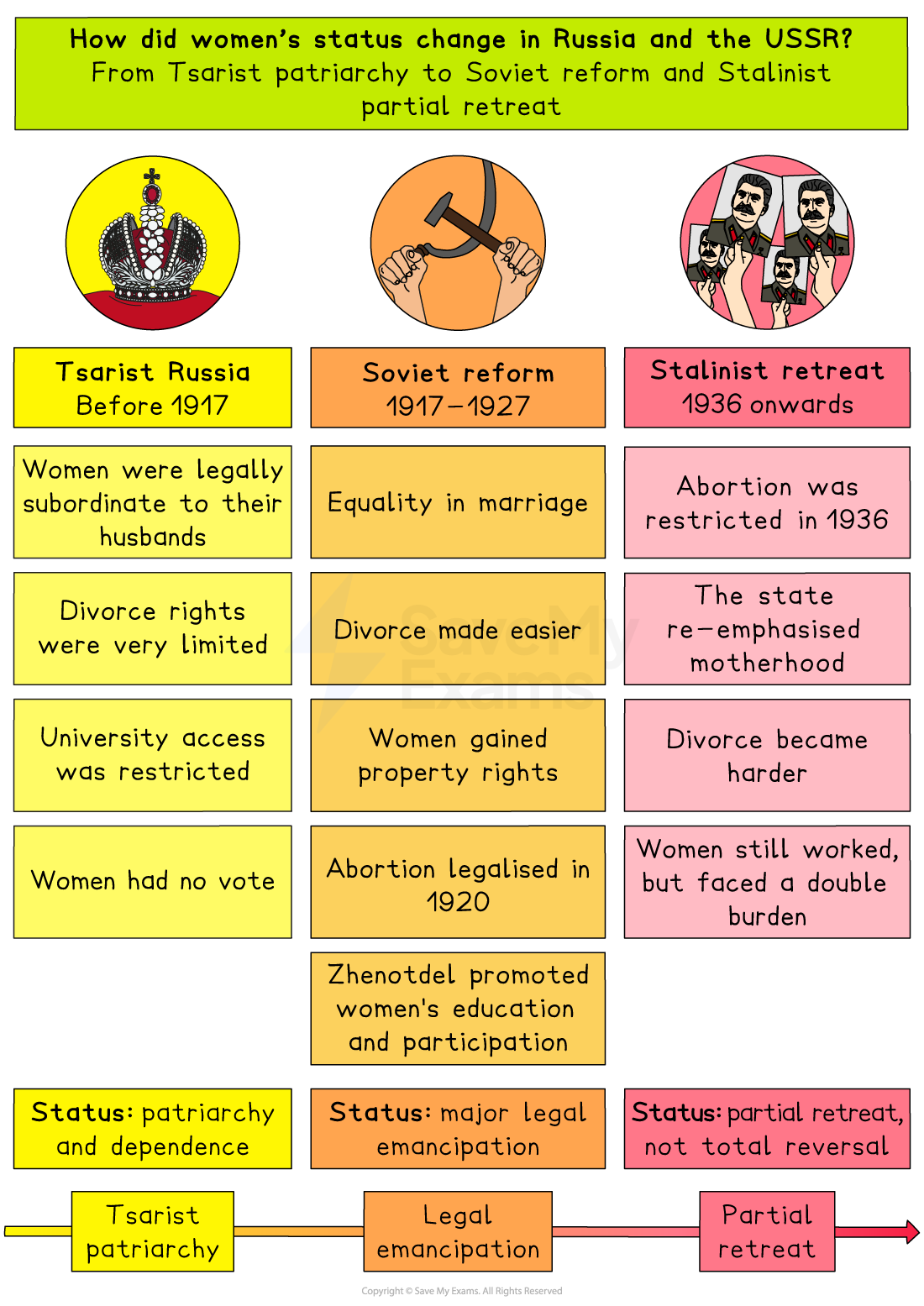
The 1917 decrees
The new government moved quickly to dismantle the tsarist patriarchy
A decree of November 1917 outlawed discrimination based on a person's sex
Women gained property rights
Divorce was made easier and less expensive
Abortion was legalised in 1920
The USSR was the first country in the world to do this
Free contraceptive advice was also provided
The 1926 Family Code gave common-law partners the same rights as civil marriage
Kollontai and Zhenotdel
The Party created institutions to draw women into Soviet life
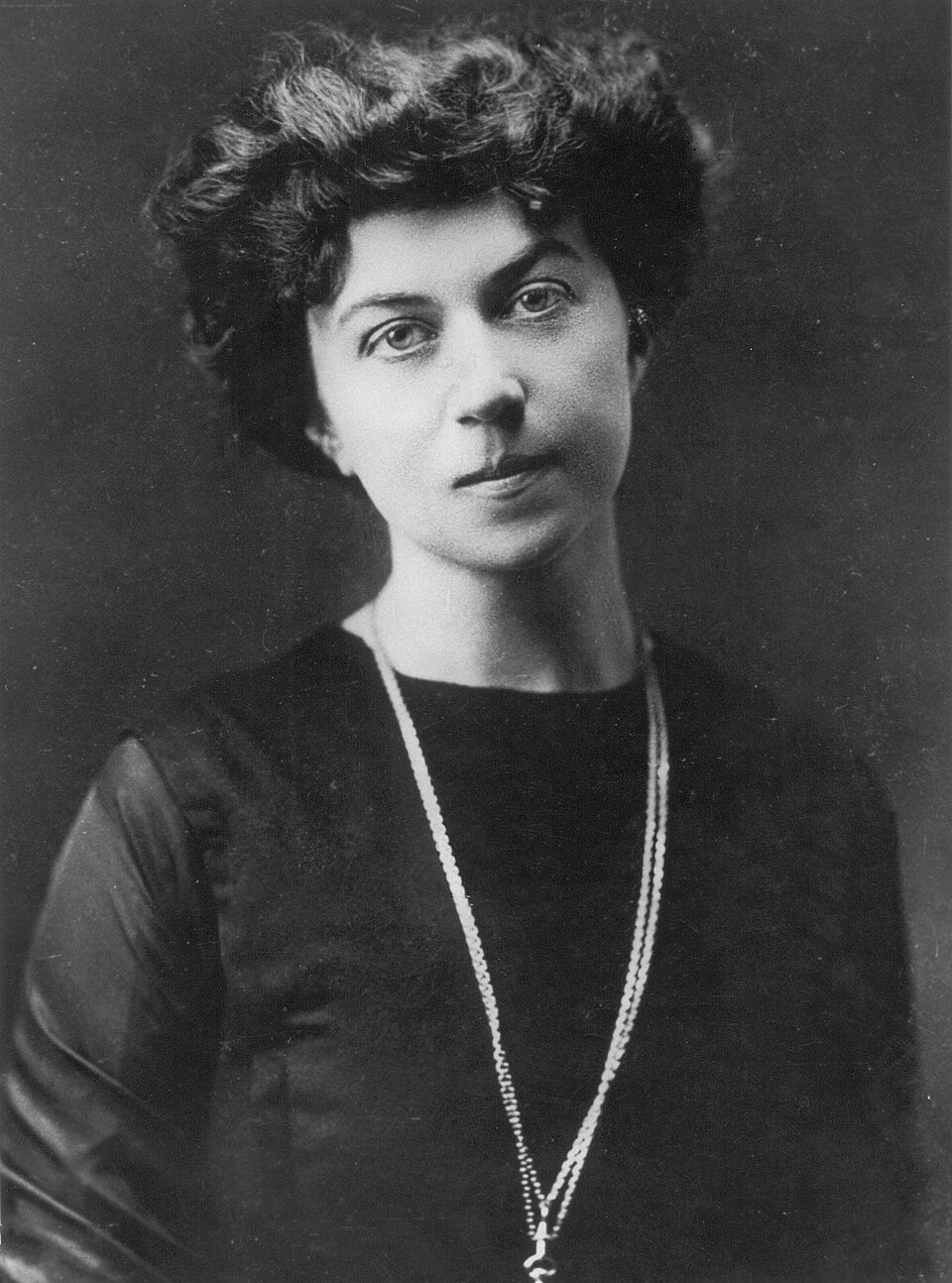
Alexandra Kollontai became Commissar for Social Welfare
She was the first woman minister in modern Europe
The Zhenotdel, founded in 1919, worked directly with women
It ran literacy campaigns
It set up childcare centres
It organised training programmes
The impact of the Civil War
War and economic collapse narrowed the early gains
Propaganda cast women as mothers, nurses and wives rather than revolutionaries
Under the NEP, many women lost industrial jobs
Female unemployment rose
Women's economic independence declined sharply as a result
Examiner Tips and Tricks
Keep the focus on contradiction. Divorce and abortion looked like liberation, but ask whether these freedoms improved women’s lives or mainly served the state’s economic and ideological needs.
The impact of industrialisation on women in Soviet towns
A surge into the workforce
The Five-Year Plans pulled millions of women into industry
Female industrial workers rose from 3 million in 1928 to 13 million in 1940
Women made up 29% of the industrial workforce in 1929
This rose to 43% by 1940
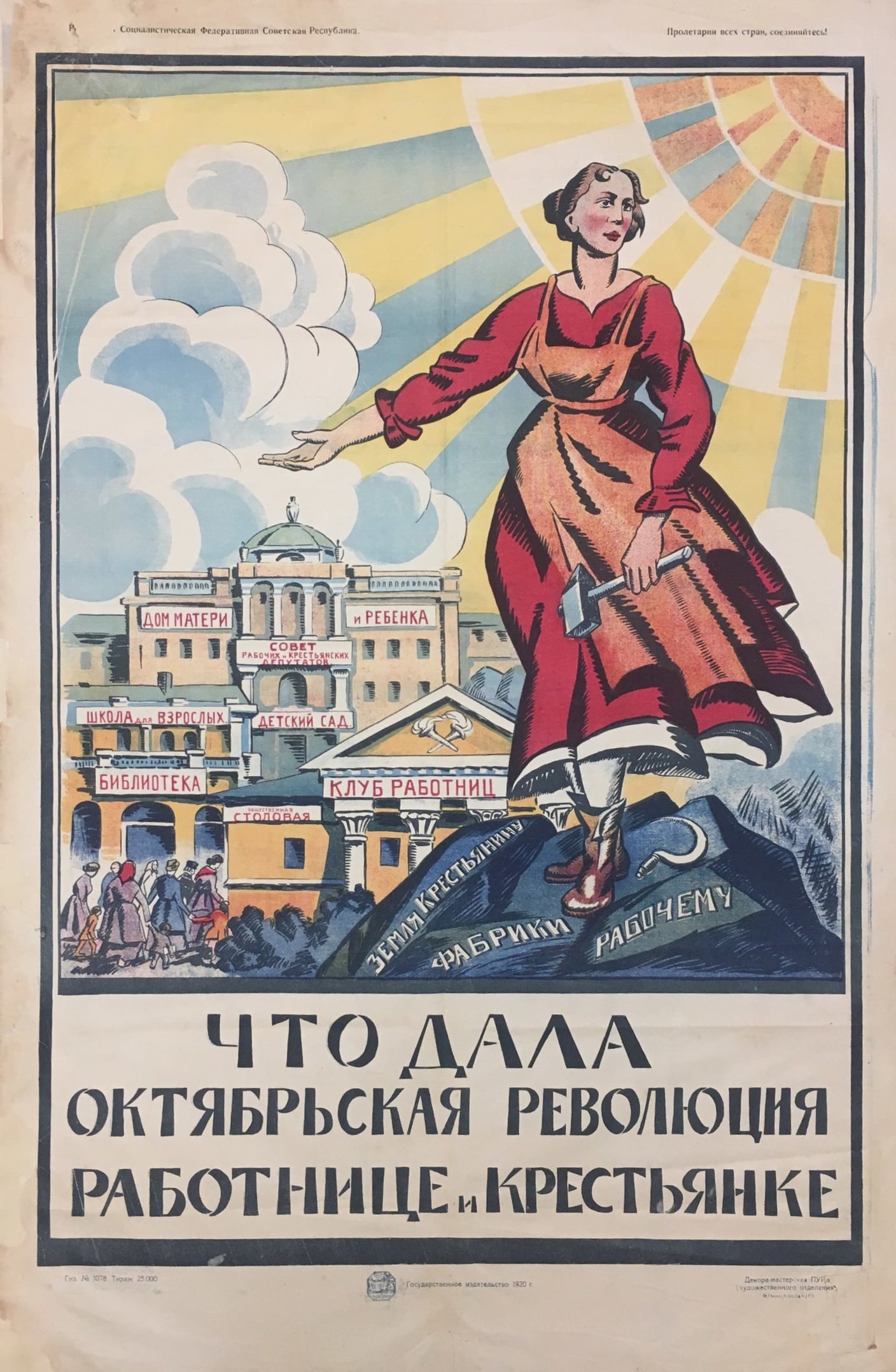
Propaganda celebrated the heroic female worker
The Stakhanovite woman became an ideal image of Soviet labour
Support for working women
The state expanded provisions to help women combine work and home
Nurseries grew rapidly
Creches, canteens and child clinics expanded
The number of women in education doubled across the period
The limits of equality
Formal equality concealed persistent disadvantage
Women earned, on average, 40% less than men
Higher administrative posts were still mostly held by men
Women carried a double burden of paid work alongside household tasks and long food queues
Daily life remained difficult
Long food queues added to women's unpaid labour at home
Examiner Tips and Tricks
Always specify that you are describing urban women. Their opportunities in industry and education were greater than those of women in the countryside, so avoid generalising about all Soviet women as one group.
Women in the countryside: the impact of collectivisation
Women as the backbone of the kolkhoz
Collectivisation made rural women central to farm labour
Dekulakisation removed many men through arrest, execution or deportation
Women were often left to run households and farms alone
Male migration to the towns increased women's share of fieldwork
Unequal rewards
The trudodni work point system rewarded women poorly
Mechanised and skilled jobs earned more points
These were dominated by men
Women were concentrated in low-paid tasks
These included weeding and milking
Fewer work points meant less grain
This made women more vulnerable during the famine
A minority of skilled roles
A small number of women gained status through mechanised work
Female tractor drivers rose from 8 under the NEP to 50,000 by 1940
Most rural women remained in unskilled and low-status work
Examiner Tips and Tricks
The best answers show how collectivisation affected women specifically. Focus on the work point system and the loss of male labour, rather than describing collectivisation’s economic impact alone.
Women in politics in the USSR
Limited representation
Political participation stayed low despite the rhetoric of equality
Women made up only 12% of Party membership in the 1920s
Many withdrew during the 1930s under pressure from family expectations
Absent from the top
Women were almost entirely excluded from leadership
Alexandra Kollontai remained a rare exception as an early woman minister
Political culture stayed male-dominated
Women were valued mainly as workers and mothers
Examiner Tips and Tricks
Use the gap between rhetoric and reality. The Soviet Union proclaimed political equality, but women were almost absent from leadership. This contrast is more analytical than simply listing the rights women were granted.
What was the status of women in the USSR by 1941?
By 1941, the picture was mixed
Historians weigh the genuine gains against continuing inequalities
The Soviet state significantly improved women's status by 1941
Women gained major legal and political rights
They had legal equality
They had the right to vote, work and study
Mass entry into industry and the professions reshaped women's economic role
Female industrial workers had reached 13 million by 1940
Childcare and maternity provision expanded in the towns
Nurseries helped urban workers combine work and family
Creches and clinics also expanded
Key historian
“After all, this was a decade in which millions of women were entering the workforce and being encouraged to do so. The regime was doing its best to increase the number of women in higher education and the professions and, with less success, to promote women to administrative positions. Women in the Soviet Union were brought up to think they should have careers: as a Harvard Project respondent reported, ‘at meetings and lectures they constantly told us that women must be fully equal with men, that women can be flyers and naval engineers and anything that men can be’... By 1939, in any case, the earlier homemaking emphasis of the wives’ movement was giving way to a focus on women learning to do men’s work and entering the workforce. This was both an internal development within the movement and a response to the imminence of war and the likelihood that men would soon be conscripted”
S. Fitzpatrick, Everyday Stalinism: Ordinary Life in Extraordinary Times: Soviet Russia in the 1930s (1999)
Fitzpatrick highlights the scale of women’s entry into work and higher education
This supports the view that the regime expanded women’s opportunities
However, promotion to the top remained limited
Women's status improved less than the rhetoric claimed
Wage inequality and the double burden continued
Women still earned less than men
They carried out paid work and domestic labour
Rural women remained the most disadvantaged group
The work point system kept their pay low
Unmechanised labour kept their status low
From 1936, the state pushed women back towards motherhood
Abortion was restricted
Propaganda re-emphasised the family woman
Women were almost absent from political leadership
Key historian
“The ‘new Soviet person’ came, of course, in a male and female form. However, the ‘new woman’ presented more of a problem than the ‘new man’. It was acknowledged that working-class women had suffered oppression on account of gender as well as class, and that this had left them with a lack of confidence and a greater degree of political backwardness than men... The revolutionaries were agreed that women had to be freed from domestic servitude and drawn into social production. This would ensure, as Lenin put it, that they enjoyed the exact same position as men. However, women clearly had a duty which men could not perform. As well as being workers themselves, they also had to produce the next generation of workers. They had to be some kind of balance in their lives between production and reproduction, between work and family. Getting this balance right did not prove easy, especially against the background of shifting economic and demographic priorities. Accordingly, periodic adjustments were made to the image of the new woman.”
L. Attwood, Creating the New Soviet Woman: Women’s Magazines as Engineers of Female Identity, 1922–53 (1999)
Attwood argues that the tension between production and reproduction was never resolved
Women were expected to work and produce the next generation
Their status remained tied to shifting state priorities
This suggests women were not fully transformed by Soviet policy
Examiner Tips and Tricks
The evidence cuts both ways. Weigh the real gains in work and education against persistent wage inequality, the double burden and the retreat after 1936.

Unlock more, it's free!
Join the 100,000+ Students that ❤️ Save My Exams
the (exam) results speak for themselves:

Was this revision note helpful?
